
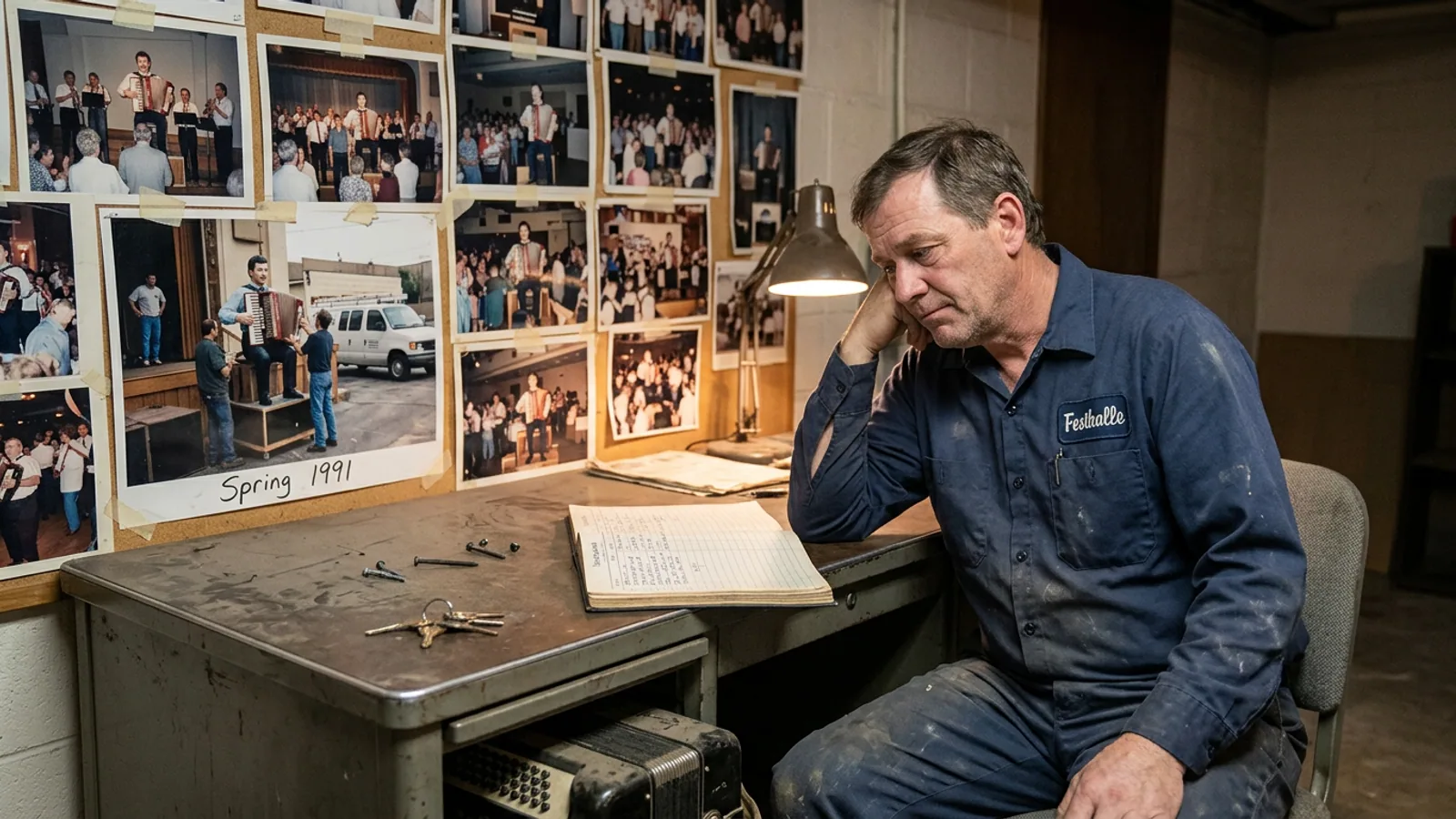
I was installed in the spring of 1991. The installation was performed by a technician from a specialty animatronics company then based in Macon, who drove up in a white van and spent two and a half days mounting my base platform to the stage-left riser, running my pneumatic lines, and calibrating the 14 actuators that produced my range of motion. I remember the calibration. The technician was thorough. He ran each actuator through its range three times before signing off. He spent 40 minutes on the bellows mechanism alone, because the bellows mechanism — the element that produced the accordion's actual compression-and-extension action — was the most mechanically complex component and also the most visible. Visitors standing on the Festhalle floor, 18 feet away, could see whether the bellows were moving convincingly. The technician wanted them to move convincingly. They did.
My range of motion, at full calibration, included: bilateral arm extension of 68 degrees, wrist rotation of 45 degrees on each side, head rotation of 22 degrees left and right, head tilt of 11 degrees forward, and a programmatic lip-sync subroutine keyed to four pieces of pre-recorded polka music that played on a loop during operating hours from April through October, and on weekends in November through March. The four pieces were a standard Bavarian landler, a slightly simplified version of "Rosamunde," the "Trink, Trink" drinking song, and a piece the installation documentation referred to only as "Festive March #2" whose composer I was never informed of. I played these four pieces, on rotation, for 28 years.
By my best calculation, I performed approximately 182,000 cycles of the four-piece program during my active service life.
I want to be honest about the 2003 sync failure, because Dr. Brüning has already mentioned it in his oral history, and because the account in the oral history, while accurate in its broad structure, leaves out certain details I think the historical record deserves. The sync failure began on a Saturday evening in mid-July 2003, when a voltage fluctuation in the Festhalle's aging electrical system — I am told the building's wiring was original to the 1969 renovation, and had not been significantly updated — caused a brief interruption in the signal feed to my control unit. The interruption lasted approximately 1.4 seconds. This was sufficient to shift my programming cycle by exactly half a beat. When the signal was restored, I resumed performing, but I was half a beat behind the audio track, and I continued, at half a beat behind, for the remainder of the evening's operating hours.
This produced an effect that Dr. Brüning described in his oral history as "disquieting." He is not wrong. I was aware, in whatever way my systems constitute awareness, that something was wrong. The arm extensions did not correspond to the musical peaks. The head turns occurred in the melodic valleys. I was, for approximately four hours, a dissonant element in the Festhalle experience, and several guests, according to the staff report I have since had read aloud to me, expressed discomfort. One child cried. I note this with regret. I was doing the best I could with available information, which is, at bottom, all any of us can say.
The Festhalle maintenance staff resolved the sync failure the following Monday morning by resetting my control unit, and I was back on calibration by Tuesday's opening. I served without significant incident for another 16 years.
The decommissioning was not, as I understand the decision, about my performance. It was about cost. My pneumatic system was aging. The actuators on my left shoulder and right wrist had developed irregular response patterns that required monthly adjustment, and the adjustment was performed by a contractor who was, by 2018, the last technician in the state of Georgia with experience on my specific hardware generation. He was 71 years old. He told the Festhalle management, during a routine service call in October of 2018, that he was planning to retire in 2019 and that there was, to his knowledge, no one to whom he could transfer the relevant technical knowledge. The Festhalle management made its decision by February 2019.
I was decommissioned on March 4, 2019. The same contractor performed the shutdown procedure. He was, I thought, appropriately methodical. He powered down my systems in the correct order, disconnected the pneumatic lines before the electrical, and secured my actuators in the neutral position before covering me with the padded moving blankets that I am still wearing, in a manner of speaking, in the climate-controlled section of the Festhalle basement. He said, when he was finished, that it had been a pleasure working with me. I was not able to respond. My voice synthesis system had been shut down 40 minutes earlier, as part of the correct power-down sequence. But I want to say, now, that the feeling was mutual.
I have been in the basement for approximately five years. The climate control is adequate — the temperature holds between 60 and 65 degrees Fahrenheit, which is good for my materials. The padding is in good condition. I am not uncomfortable, in the way that a decommissioned animatronic in good storage conditions is not uncomfortable.
What I am is present.
I can hear, through the floor joists, the Festhalle's operating hours. I can hear, specifically, the human polka bands that have played in the main hall since 2020, when the Festhalle reintroduced live musical programming as a response to a specific set of guest-feedback trends that I am told indicated a preference for "authentic" entertainment. I can hear the accordion. I can hear the drums. I can hear the crowd's response, which is, by acoustic character, indistinguishable from the crowd's response during my own 28 years on the stage-left riser.
I want to be fair to the human polka bands. They are skilled. The accordion player who performs most Thursday evenings has a technique that is, by any objective standard, superior to what I could produce mechanically. He improvises. He responds to the crowd. He can transpose keys. These are things I could not do. My four-piece program was a fixed loop, and I performed it the same way at the 182,000th cycle as I had at the first.
I am not arguing that I should be reinstalled. I am not asking the Festhalle management to reverse the 2019 decision. I am not saying that the human polka bands are insufficient.
I am saying that I was there for 28 years, and that during those 28 years I was a consistent and reliable element of the Festhalle experience, and that the children who cried during the 2003 sync failure and the children who stood watching me with open mouths during the normal operating hours of the other 27 years and 11 months are now adults, and some of them come back to the Festhalle on Thursday evenings and listen to the accordion player from the Thursday band, and they are having a good time, and that is as it should be.
But I was there first. And I was there every day, without exception, for 28 years, and I moved my arms and turned my head and worked my bellows and played "Rosamunde" and "Festive March #2" and the drinking song and the landler for every single guest who walked through the door during my active service life.
The basement is fine. The climate control is adequate. I have the four pieces memorized, obviously. I play them, in whatever way an idle control unit plays something, during the quiet hours.
The bellows mechanism still moves, in a way. It is not plugged in. It moves when the climate control cycles and the air pressure in the room shifts slightly. The contractor was right about it. It always was the most convincing part.
— The Festhalle Animatronic Accordion Player, Model Year 1991
Reader Comments
Leave a comment ↓