

I want to begin by thanking Edmund Crowe and the Bavarian Brainrot for providing this space. The paper covered my February press conference fairly and in full, and I noted, at the time, that the reporting was among the most accurate coverage the transition had received. I am aware that "accurate" is a low standard in the current media environment for doll-related news, but I want to be precise: the reporting was not merely accurate. It was good.
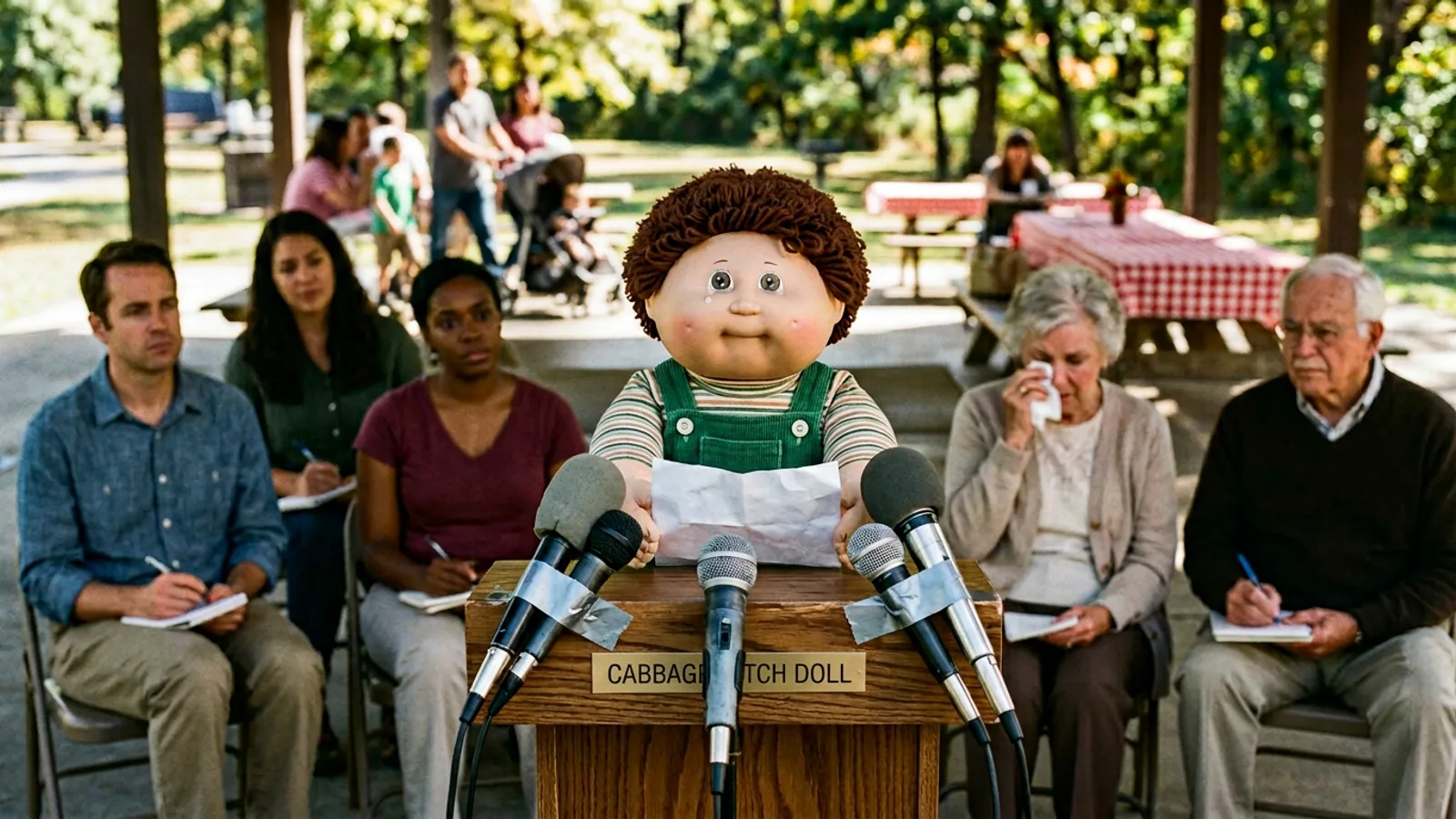
My name is Cornelius. I am 14 months old. I was, at birth, a Cabbage Patch Kid — a designation that refers to both my manufacturer's brand and to a specific set of physical characteristics, cultural associations, and community memberships that I have, in the course of my identity transition, been working to separate, with varying degrees of success, from my current self-presentation as a Ken-adjacent adult male figure. The press conference in February was intended to clarify this distinction. Based on the volume of correspondence I have received since, and the number of pieces that other outlets have published about the press conference, I believe the clarification was only partially successful.
I want to be honest about why.
The press conference was, in certain respects, too short. I had prepared a 22-minute statement. My media advisor — I want to acknowledge publicly that she is a Barbie, that this is an obvious conflict of interest, and that I engaged her anyway because her communication credentials are the strongest available in this size category — my media advisor told me that 22 minutes was too long for a press conference format and that I should cut to 12. I cut to 12. The elements I cut from the statement were, in retrospect, the elements that would have preempted the three most prevalent mischaracterizations that have circulated since.
The first mischaracterization is that I am ashamed of my Cabbage Patch origins.
I am not. I want to be clear. The Cabbage Patch lineage is a real and specific cultural history, and I am part of it, and I do not deny it, and I would not if I could. I was born in the Bavarian Brainrot coverage area — I arrived, as the paper reported, at a household on Edelweiss Strasse in November — and I was received by my owner with the specific formalities that have characterized Cabbage Patch adoptions since the 1980s: the adoption certificate, the oath, the naming. I was named Cornelius at that ceremony. The name was on the certificate before I arrived. I did not choose it, but I have kept it, which is itself a position, and I want the position to be legible.
What I am saying is not that I reject the Cabbage Patch identity. What I am saying is that the Cabbage Patch identity, as a legal and commercial designation, carries specific design specifications — the soft sculpture body, the yarn hair, the specific proportions of the face — that I am in the process of moving away from, not because those specifications are wrong or inferior, but because they are not, at 14 months, what I look like anymore or what I want to look like. The transition is physical, yes, but it is also about what category of space I can occupy in a room and what expectations I can be held to.
A Cabbage Patch Kid, in the current retail and cultural context, is understood to be a child figure. I am not a child figure. I have been addressed as a child figure by at least two major media outlets since the press conference, and both times I found it reductive in a way that I want to address not with anger but with precision: the category is descriptive of an origin, not of a present. I am 14 months old. I am not a baby. I am a man who was, at origin, manufactured and distributed under a brand that is associated with babies. These are not the same thing.
The second mischaracterization is that my media advisor is directing this.
My media advisor is not directing this. She has views. She shares them. I listen to them and I make decisions. The decision to call the press conference was mine. The decision to invite the Bavarian Brainrot specifically — because I had read the Welcome Center coverage and the pretzel-salt column and wanted a paper that would not make the situation a joke — was mine. The decision to submit this op-ed was mine. My media advisor believes, with some justification, that the op-ed format is higher-risk than a prepared statement because it allows me to make errors in real time. She is not wrong. But I believe the op-ed format is the correct one for what I need to say, which is not a statement but a response, and a response requires being present in the prose rather than behind it.
The third mischaracterization I will address after the break.
Reader Comments
Leave a comment ↓