
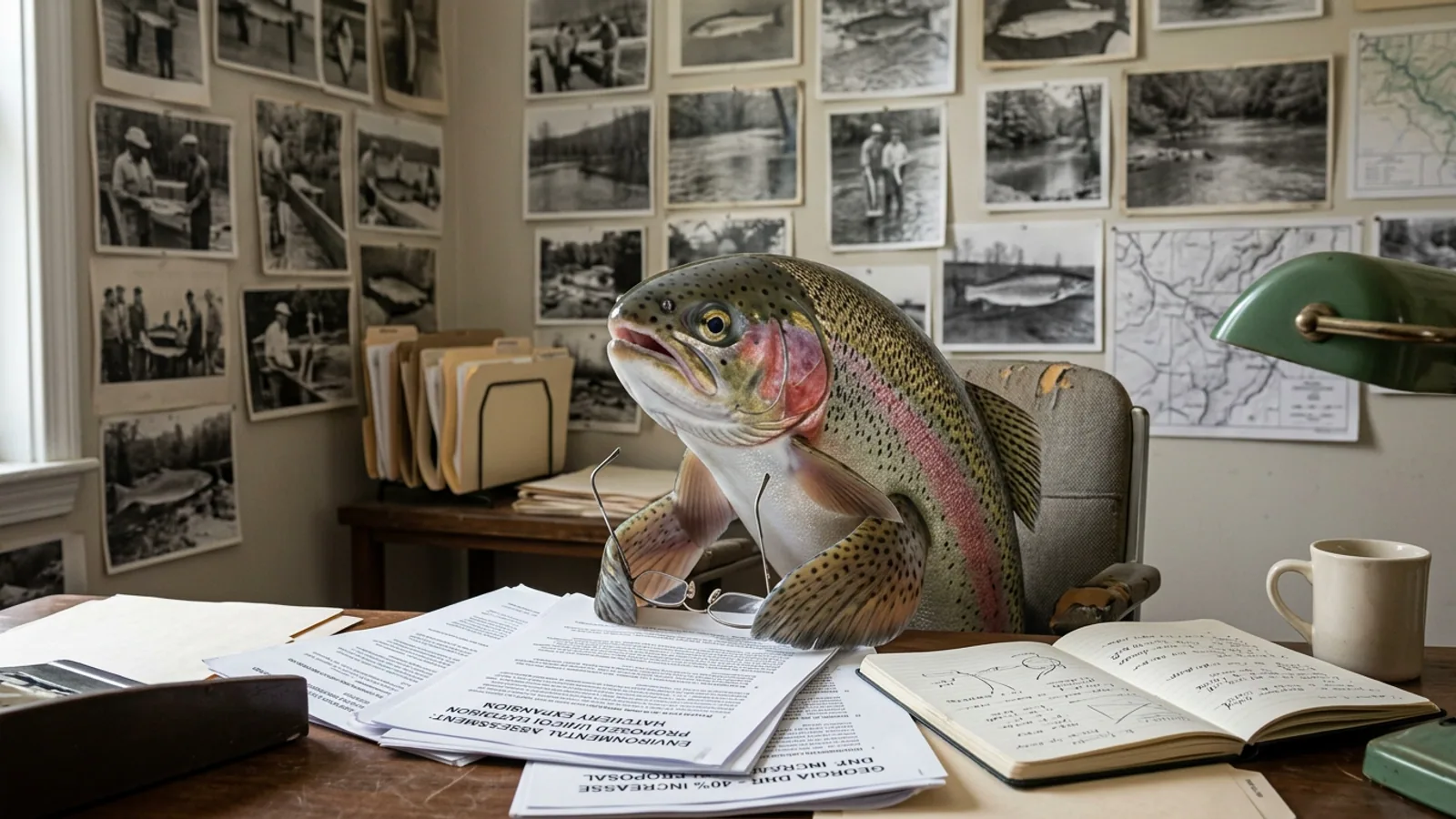
I have lived in the Smith Creek drainage for three years, which is, for a rainbow trout in a stocked Georgia tailwater, a reasonably long time. I am 14 inches in length. My weight, at last measurement, was one pound, eleven ounces, which I know because a man in a green vest caught and released me on October 4th of last year, and he was using a digital scale, and I could read the display from my vantage point in his left hand while he held me horizontally over the current. He was careful with me. He wet his hands before handling. He released me facing upstream, into the current, and waited until I had oriented myself before opening his fingers. I have no particular complaint about this interaction.
I do, however, have complaints about the proposed hatchery expansion.
The Georgia DNR Fisheries Management Unit published its preliminary environmental assessment for the Unicoi State Park Hatchery Expansion Project in November of last year. The document is 47 pages plus three appendices, and it proposes increasing the hatchery's annual production from approximately 250,000 fish to 400,000 fish, a 60% increase, by adding two new production raceways and upgrading the intake infrastructure on the existing water draw from Smith Creek itself. The public comment period closed in January. I want to say, first, that the comment period was inadequate. Forty-five days, in January, for a public comment on a project affecting a creek that is, at that time of year, being actively used by its resident population, is a scheduling choice I find difficult to characterize as good-faith outreach.
I submitted comments anyway. I am not going to describe the mechanism by which I submitted them. Suffice it to say that the comments were submitted and that they are in the record.
My first concern is the intake infrastructure. Smith Creek is not a large watercourse. It has a drainage area of approximately 28 square miles and a mean annual flow, at the Unicoi Road gauge, of about 18 cubic feet per second in normal precipitation years. The existing hatchery intake draws approximately 2.8 cfs from this flow. The proposed expansion would increase the intake draw to 4.1 cfs, which is, the environmental assessment acknowledges on page 31, a 46% increase in the proportion of Smith Creek's flow being diverted for hatchery purposes. Page 32 then describes this increase as "unlikely to result in meaningful flow reduction in the main stem," which is a characterization I dispute. I live in the main stem. I notice the current. A 46% increase in intake is not, from the perspective of a 14-inch trout holding in the seam below the second pool above the culvert, a quantity that can be described as "unlikely to result in meaningful" anything.
My second concern is the downstream thermal load.
Hatchery discharge water is warmer than intake water, because hatchery fish metabolize, and because the raceways are not entirely shaded, and because the retention time in a production raceway is long enough to allow some solar heating. The existing hatchery discharges into Smith Creek approximately 400 meters upstream of the junction with the Chattahoochee. The thermal plume from this discharge extends, in low-flow summer conditions, approximately 200 meters downstream from the outfall before the creek temperature normalizes. The proposed expansion, with its additional raceways, will produce a larger and longer-lasting thermal plume. The environmental assessment's modeling, in Appendix C, shows the plume extending to approximately 310 meters downstream in low-flow summer conditions — a 55% increase in the affected reach.
I spend summer afternoons approximately 180 meters below the current outfall. I will, under the proposed expansion, be inside the thermal plume.
Rainbow trout are, the environmental assessment correctly notes, a cold-water species with optimal growth temperatures between 55 and 65 degrees Fahrenheit. Smith Creek in late July, in the current reach where I hold, runs at approximately 62 degrees, which is the upper edge of comfortable but within the functional range. If the thermal plume extends to my holding position, I will move. This is not a choice. This is biology. I will move upstream, into the shallower and faster water above the second pool, where I am more exposed to osprey and kingfisher predation, and where the substrate is coarser and the invertebrate density is lower, and where, on previous occasions when thermal conditions pushed me there, I have caught less food per hour than in my preferred holding position below the seam.
The environmental assessment does not address this. The environmental assessment models the thermal plume geometrically but does not assess the behavioral consequences for resident fish populations. This is a methodological gap.
My third concern is the stocking rate.
The expansion's purpose is to increase stocking, which is to say: to put more trout into Smith Creek for the recreational fishing program. I understand the program. The program is the reason I exist in this drainage, or at least the reason my ancestors were placed here — I am a third-generation stocked fish, which means my grandparents were placed in this creek by a DNR truck, and my parents were born in this creek, and I was born in this creek. I am, in a meaningful sense, a product of the hatchery program. I am not going to argue against hatchery programs as a category.
But I do want to note that the current stocking rate produces, in Smith Creek, approximately 8.4 catchable-size trout per hundred meters of suitable habitat, which is at the upper end of the range that the same environmental assessment's Appendix A describes as "compatible with natural food-resource capacity." An expansion that increases the stocking rate by 60% would push the density well above that range. More fish competing for the same invertebrate base means less food per fish, slower growth, and higher mortality from competition stress. The DNR will stock more fish. Anglers will catch more fish. The fish who remain, in the interim between stocking events, will be thinner and more stressed. I am going to be one of the fish who remains, because I have now survived three years and seven catch-and-release events and I have no intention of departing the Smith Creek drainage voluntarily.
I have been caught, to be precise, seven times. I want to address this.
The man with the digital scale in October was the seventh. The first time was in April two years ago, shortly after I moved into the second pool, by a young woman fishing a yellow stimulator dry fly who caught me on her third cast and was so genuinely surprised that she dropped the rod into the water, then recovered both the rod and me, held me in the net, took a photograph, and released me very gently while saying "I'm so sorry, little buddy" in a tone I found respectful. The second was in June of the same year. The third was a frustrating interaction in which a man using a spinning lure of the type I now recognize and refuse on sight caught me briefly before I threw the hook. I count this as a catch. The man did not count it. We disagree.
The fourth, fifth, and sixth were in a single weekend in October, during what I understand was a regional fly-fishing tournament based out of the Unicoi State Park facility, and I want to note for the record that being caught three times in 48 hours is a cumulative stressor that does not end, from the fish's perspective, when the angler opens his hands. I oriented myself each time. I held in the current each time. But I was, after the third release, eating less for approximately four days, and my holding position shifted 15 meters downstream to a slightly deeper run where the visual exposure to the bank was lower.
I am not asking anyone to stop fishing. I am asking the DNR to conduct a more thorough environmental assessment of the expansion's effects on resident fish populations, specifically the thermal plume analysis, the food-resource competition modeling, and the cumulative catch-and-release stress estimates for multi-year resident fish in high-access reaches.
I am 14 inches. I weigh one pound, eleven ounces. I have been here for three years and I have survived all of it.
I would like to continue.
— A Rainbow Trout, Smith Creek

Reader Comments
Leave a comment ↓