On April 21, 2026, the Helen City Commission was scheduled to consider approval of a farm winery license for Eric James Miller of Yonah Vineyards, LLC, doing business as The Pour Haus, located at 8016 South Main Street Suite B-1, Helen, Georgia 30545. If approved, the license would be the first farm-winery license granted by the City of Helen under the current Charter. The agenda item — No. 10 on the April 21 packet prepared by City Clerk Marilyn M. Chastain — also included requests for beer package, wine package, and Sunday sales privileges at the same address.
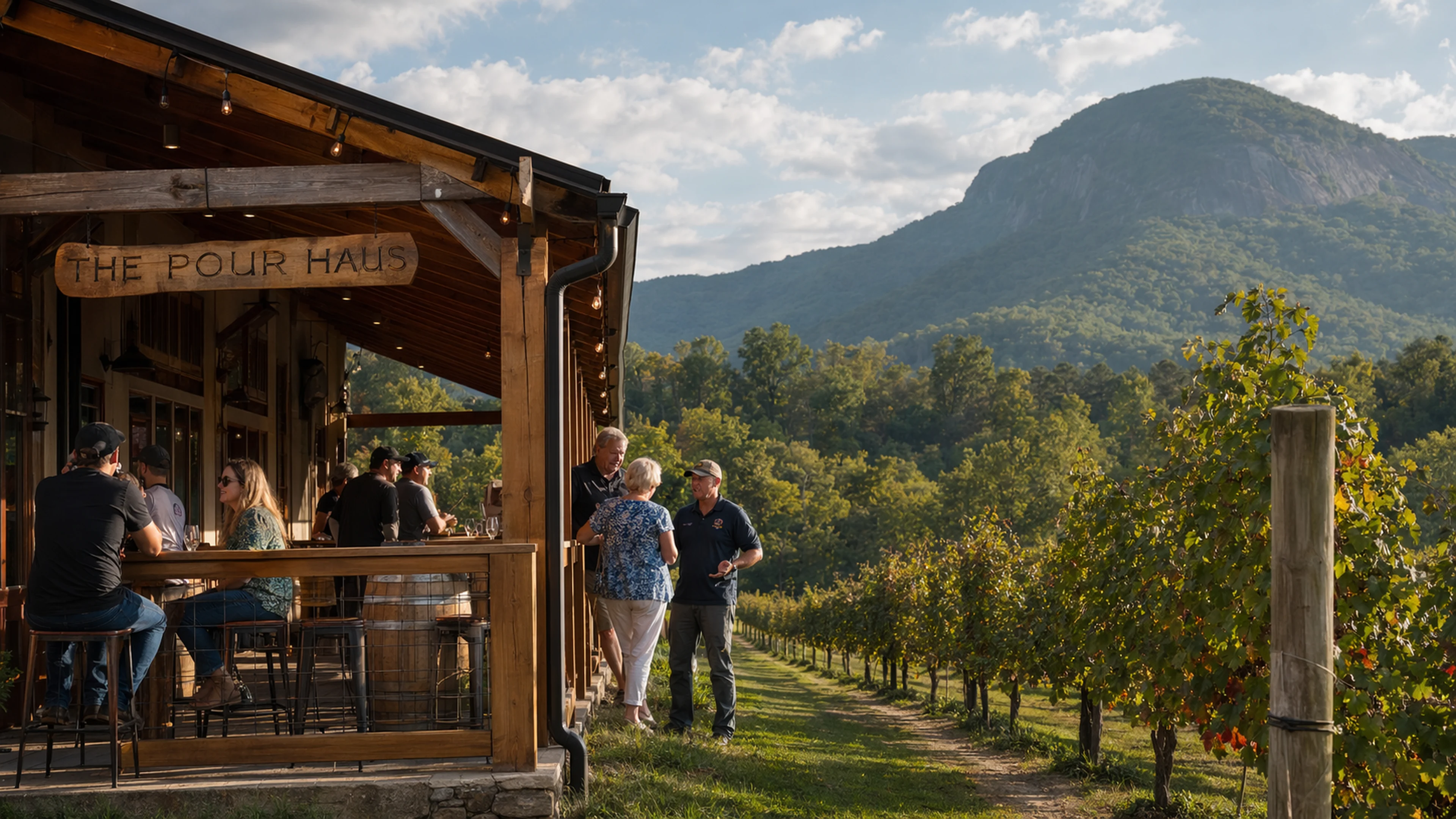
The application raises no apparent legal barrier. It does raise a geographic one. A Georgia farm-winery license, codified under O.C.G.A. § 3-6-21.1 et seq., is a specific alcoholic-beverage-licensing category designed for vineyard-scale operations. The statute requires that a licensed farm winery manufacture wine using at least 40 percent Georgia-grown agricultural products. Suite B-1 of a commercial retail structure on South Main Street is not, by any standard topographic or agricultural reading, a vineyard. The nearest confirmed Yonah Vineyards planting acreage sits approximately six miles south-southeast of the Pour Haus front door, in the shadow of Mount Yonah, a 3,166-foot monadnock in the Chattahoochee-Oconee National Forest corridor. The grapes, in other words, are not on the premises. The license, if granted, will be.
This is the regulatory configuration that Helen is now being asked to accommodate: a farm winery whose farm component exists at one location, and whose winery component — or at minimum its retail tasting and package-sales interface — exists at another, six miles north, in a half-timbered commercial suite on the most heavily trafficked pedestrian corridor in White County. The distance is not unusual for Georgia farm-winery operations generally. It is unusual for Helen specifically, a municipality of fewer than 700 permanent residents that has, since the alpine-theme zoning mandate of 1969, processed hundreds of alcohol licenses without once encountering the farm-winery category.
Dr. Wilhelm Brüning, retired chair of the Bavarian State Institute for Regional Cultural Geography and a frequent commentator on Helen's regulatory landscape, called the application "an unusual architectural-regulatory intersection." Reached by telephone, Brüning noted that "a farm winery in a downtown commercial suite is a configuration that requires some flexibility of imagination. The license exists. The cellar exists. The vineyard is, presumably, six miles away. Helen is learning to accommodate this configuration, and it will do so with the same procedural gravity it brings to all licensing matters."
The procedural gravity in question has been considerable. In the first four months of 2026 alone, the Helen City Commission has approved or considered alcohol licenses for six separate applicants across eight distinct license categories. On December 16, 2025, the Commission approved a liquor-pouring addition for Matthew Daniel Boggs of Campfire Hootin & Hollering Entertainment LLC, doing business as Campfire, at 8160 South Main Street Suite B-66. At the same meeting, it approved beer and wine package licenses for Guy Slabbaert of Aryana Hotels Inc., doing business as the Holiday Inn Express & Suites at 8100 South Main Street. On March 17, 2026, Slabbaert returned — this time as licensee for Perform Motel Helen LLC, doing business as Home 2 Suites Helen — for beer on premises, wine on premises, liquor pouring, and Sunday sales. He is now the named licensee on two separate lodging properties within a quarter mile of each other along the South Main Street corridor.
At the same April 21 meeting at which the Pour Haus application appeared, the Commission was also scheduled to consider a liquor-pouring addition for Chris and Lauren Williams of Day Late Dollar Short LLC, doing business as Pink Pig Southern BBQ at 663 Brucken Strasse. The Pink Pig already held licenses for beer on premises, wine on premises, and Sunday sales. The liquor-pouring addition would round out its portfolio to four active license categories, a number matched in Helen only by the Home 2 Suites approval from March and by the Pour Haus application itself.
But none of those licenses involved a farm. None required that 40 percent of the product sold be manufactured from Georgia-grown agricultural inputs. And none asked the Commission to accept the premise that a retail suite in a commercial building constitutes an extension of a vineyard six miles away.
The Pour Haus address — 8016 South Main Street Suite B-1 — places the proposed tasting room on the west side of South Main, between the Chattahoochee River and the roadway, in the dense commercial band that runs from the Festhalle south toward Robertstown Road. The suite designation suggests a subdivided commercial structure, consistent with the multi-tenant retail buildings that characterize the South Main corridor south of the river bend. Building and Zoning Administrator Jonah Casper, who has spent the first months of 2026 conducting a seat-counting operation across Helen's restaurants to verify sewer impact fee compliance, would presumably be responsible for confirming the physical suitability of the space for its proposed use. Whether a farm-winery tasting room triggers the same sewer-impact calculus as a restaurant has not been publicly addressed. The question of how many seats a tasting room contains — and whether those seats have been counted — remains, as of press time, unanswered.
Yonah Vineyards LLC appears in Georgia Secretary of State records as a limited liability company with a registered agent in White County. The entity name references Mount Yonah, from the Cherokee word meaning "bear," the same peak whose granite face is visible from approximately 40 percent of White County's total acreage and from precisely zero percent of Suite B-1's interior square footage. The vineyard's planting history, varietal profile, and total cultivated acreage are not detailed in the Commission agenda packet. Nor is there any indication in the minutes that a site visit to the vineyard was conducted or contemplated as part of the licensing review.
City Attorney Carl Free, who in March advised that the proposed Ferris wheel at Bavarian Mini Golf would require a Conditional Use process with public hearings before both the Planning, Development, and Review Board and the full Commission, has not been quoted in the available record regarding the farm-winery license's procedural requirements. The Conditional Use pathway that Free outlined for a 65-foot amusement ride does not appear to apply to the retail sale of wine manufactured from Georgia muscadines. The two proposals share only a jurisdictional novelty: neither has been attempted in Helen before.
The farm-winery license is, in some respects, a quieter milestone than the Ferris wheel. It does not require structural engineering review. It does not alter the skyline. It does not pose the liability questions that attend a rotating passenger conveyance overlooking a miniature-golf course. But it does introduce, for the first time in Helen's 113-year municipal history — the city was incorporated on August 18, 1913, when John E. Mitchell of St. Louis laid out the original town plan — a licensing category that presumes the existence of agriculture within the applicant's commercial operation. Helen's economy has been organized around the simulation of a Bavarian alpine village since 1969. It has not, in the intervening 57 years, been organized around the cultivation of grapes.
"The vine does not care about the zoning overlay," Brüning observed. "It cares about the soil, the drainage, and the frost line. Suite B-1 has none of these things. But it does, presumably, have a cash register."
The Commission was scheduled to vote on the license at its regular meeting at 25 Alpenrosen Strasse. Finance Director Mona Wood's March 2026 revenue report showed beer, wine, and liquor excise collections at $12,294 for the month, bringing the fiscal-year-to-date total to $129,514 — down 8.41 percent from the same nine-month period in fiscal year 2025. Whether the addition of a farm-winery license to Helen's regulatory portfolio would move that number in either direction has not been modeled. The grapes, for now, remain six miles away.


Reader Comments
Leave a comment ↓