
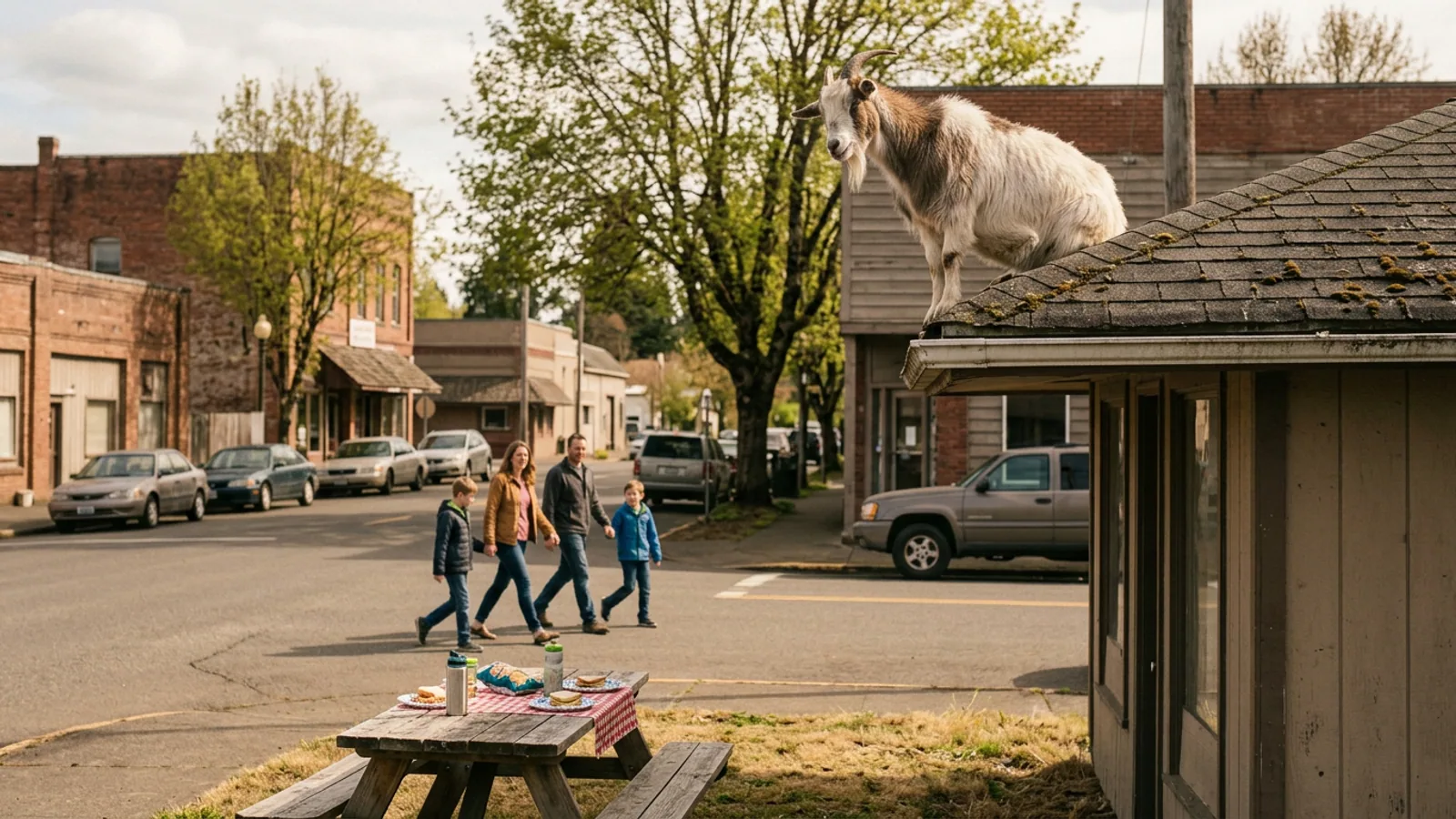
In the spring of her tenth year on the roof, the goat had come to understand several things about the situation that she had not understood in her first year, or even her fifth.
She had understood, in her first year, the basic operational facts: the roof was flat at the center and sloped at the edges and it was covered with sod that in summer was deep green and in November turned the color of dried hay and smelled accordingly. She understood the schedule — the morning delivery, the afternoon rotation when the second pair of goats came up and she and her companion Inge were taken down by the service elevator in the rear, and the evening when the roof closed and the cameras stopped. She had understood, in her first year, that the cameras were recording her.
What she had not understood, in her first year, was what the cameras were for.
She understood it now. Or she understood it as well as a goat could understand something that required a theory of other minds to grasp fully. The cameras were for the people below. And the people below were there to see her. Not to feed her, or to examine her hooves, or for any of the operational purposes a goat has historically been useful to humans. They were there, specifically, to see a goat on a roof, which was an unusual thing, and which was, she had come to understand, the whole point of the arrangement.
She had taken some time to reach equanimity about this. In her third year she had responded to the crowds on the sidewalk with a kind of active engagement, walking to the roof edge to look down, which had, she could see from the response, pleased the people very much. In her fifth year she had stopped doing this as deliberately, not from hostility but from a growing sense that the response was too easy, that walking to the edge and being looked at was giving them what they wanted without giving them anything that was actually hers. In her seventh year she had developed her current approach, which was to ignore the crowd entirely, to graze in the normal way that a goat grazes, to stand where it was comfortable to stand, to look at the ridgeline to the north when the ridgeline interested her, to look at nothing in particular when nothing particular interested her.
The crowd, she had found, seemed equally pleased by this. They photographed it extensively.
Inge had been her roof companion for six of her nine years. Before Inge there had been a goat called Hilde, who had been older and indifferent to everything with a purity of indifference that the current goat had respected and tried to learn from. Inge was different — younger, more reactive, still in the years of caring what the cameras saw. The current goat did not judge Inge for this. She had been in those years herself.
There were two other goats in the operation who rotated to the roof in the afternoons: a younger pair whose names she knew in the functional sense of knowing which sound corresponded to which goat, though she did not use the names herself. They were fine. They were rooftop goats as she was a rooftop goat. They had, as all rooftop goats eventually did, the slightly particular quality that comes from having spent a significant portion of your life being looked at from below by large numbers of people eating pretzels.
What the current goat had that the younger pair did not have was nine years of accumulated observation. She had watched, over those nine years, the patterns of the crowd. She understood that October was different from February, not only in temperature but in volume and quality of attention. The October crowds were larger and their cameras were more directed. The February crowds, on the days they came at all, were smaller and their attention was more incidental, more likely to take one photograph and move on, less likely to stand at the fence for twenty minutes.
She preferred February.
She had also developed, over nine years, a reasonably accurate taxonomy of the types of people who came to see her. There were the children, who pointed and made sounds and sometimes ran toward the fence and had to be redirected by the adults holding their hands. She was neutral on the children. There were the adult couples who stopped walking to look up and then looked at each other in a way that meant something between them that she could not read but that she recognized as a significant look. There were the people who photographed her immediately and thoroughly and moved on, and the people who stood for a while and seemed to be genuinely looking at her, not at the camera, not at their companion, but at her. These last were rarer than the others. She was not sure what to make of them.
There was, also, the friend.
The friend came at five forty-seven every morning. This was not a schedule the current goat had registered in any deliberate way; she had simply come to know, over years, that there was a time in the early morning when the light came up over the eastern ridge, and that at that time a figure would come through the service door in the rear with a bundle of hay and with the particular walk of someone who is carrying something in both hands and is therefore slightly off-balance.
The friend was, as far as she could tell, a man, though she was aware that her ability to categorize humans by this designation was imprecise. He was not young. He walked carefully on the roof surface, as people who have been on the roof many times learn to walk: toward the center, away from the sloped edges, with the particular confidence of knowing where the surface was uneven. He set the hay in the morning spot and he stood there for a while with his hands in his pockets and he looked at her and at Inge without saying anything.
She did not know his name. She knew his smell, which was a specific combination of sawdust and something sweet and a base layer that she associated with the interior of the building: insulation, or old timber, or the particular mineral smell that buildings develop over decades. She knew his footstep. She knew the exact angle at which he set the hay bundle down, which was always the same.
Over nine years, the friend had been the most consistent thing on the roof.
She had not, as a younger goat, paid this particular attention. She had paid it in the way you pay attention to a regular feature of a landscape — acknowledged, mapped, unremarkable. It was only in perhaps her seventh year that she had begun to understand that the friend was a different category from the crowd. The crowd came because of her. The friend came because of the hay, and because of the roof, and because something in the friend's pattern had organized itself around this particular five forty-seven arrival, and she happened to be there, and after nine years of her being there at five forty-seven, the friend had come to be there for her too, in whatever way a human is there for a goat they have fed every morning for nine years.
She could not say whether the friend knew this. She suspected he did, in some partially formed way, the way she suspected most things about humans: with the understanding that humans knew more than they showed and showed more than they meant to, and that the distance between those two facts was where most of what mattered happened.
On the morning that the friend did not come, she woke at her usual hour, before the light had cleared the eastern ridge, and stood at the center of the roof and waited.
The light came up. The ridge defined itself against the sky in the precise sequence she had watched for nine years. The service door did not open.
Inge was awake and grazing in a distracted way near the north side. The morning was quiet in the particular way February mornings were quiet, the town still fully asleep below, the highway audible in the distance but low.
She stood at the center and waited.
At six-fifteen a different person came through the service door. It was a younger person, the one who sometimes came on the days the friend was not available, which happened rarely. The younger person carried the hay the same way, in a bundle in both hands, and set it in approximately the same spot, though not at the exact same angle. The younger person looked at her and at Inge for a shorter time, and then went back through the service door.
She went to the hay.
She ate it.
It was the same hay.
She went back to the center of the roof and stood there for a while. The town was waking below. The first cameras appeared on the sidewalk, aimed upward. She did not go to the edge. She grazed at the center in the normal way.
She did not know where the friend was. She did not know whether the friend would come tomorrow at five forty-seven, or whether the younger person would come instead, or whether there would be someone else entirely, someone whose smell she did not know. She understood, in a basic way, that things changed. She had watched eleven Octobers and eleven Februaries and she had seen the composition of the crowd change and the shape of the cameras change and the height of the fence change. She had seen Hilde come to the roof and leave the roof. She had seen the younger pair arrive. Change was the basic condition.
She stood at the center and grazed.
The crowd grew on the sidewalk below. Cameras were pointed at her. She was, as she had been for nine years, a goat on a roof in Helen in the early morning, which was what she was, and which was what she knew how to be.
She looked at the ridgeline to the north.
The light on it was good.
He came back on Thursday.
She knew him before the door opened, from the sound of him on the service stairs, which had a particular cadence when it was him, a slight pause at the third step up where the step was shallower than the rest. The door opened and he came through with the hay bundle and set it at the morning spot at the correct angle.
He stood there with his hands in his pockets.
She went to the hay.
He stood there while she ate. He looked at the ridgeline. He looked at Inge, who was making a circuit of the north side with no particular purpose. He put his hands in the pockets of his work jacket and then took them out again and crossed his arms instead.
She ate the hay.
He did not say anything. He never said anything.
After a while he went back to the service door and went through it and she heard his steps on the stairs going down, the slight pause at the third step.
She stood at the center of the roof.
Below, on the sidewalk, the first people were arriving to look at her. She could hear them without looking at them: the shuffle, the voices, the occasional sound of a child being directed toward the fence. She did not go to the edge. She grazed at the center in the way she had always grazed.
She looked at the ridgeline.
It was a Tuesday in late March, and the light on the mountains was the thin early-spring light that was different from October and different from February, neither the heavy gold of the fall nor the gray flat of winter but something in between, or something else entirely, something that was its own thing and not a comparison.
She stood in it.
"The Goat Who Knew" is a work of fiction. The rooftop goats of the Old Bavaria Inn in Helen, GA, are real. Their interior lives are invented. Any resemblance to the interior life of any specific goat currently or formerly resident on any real rooftop in White County is the kind of resemblance that is impossible to disprove and that the author considers a compliment.
Reader Comments
Leave a comment ↓