
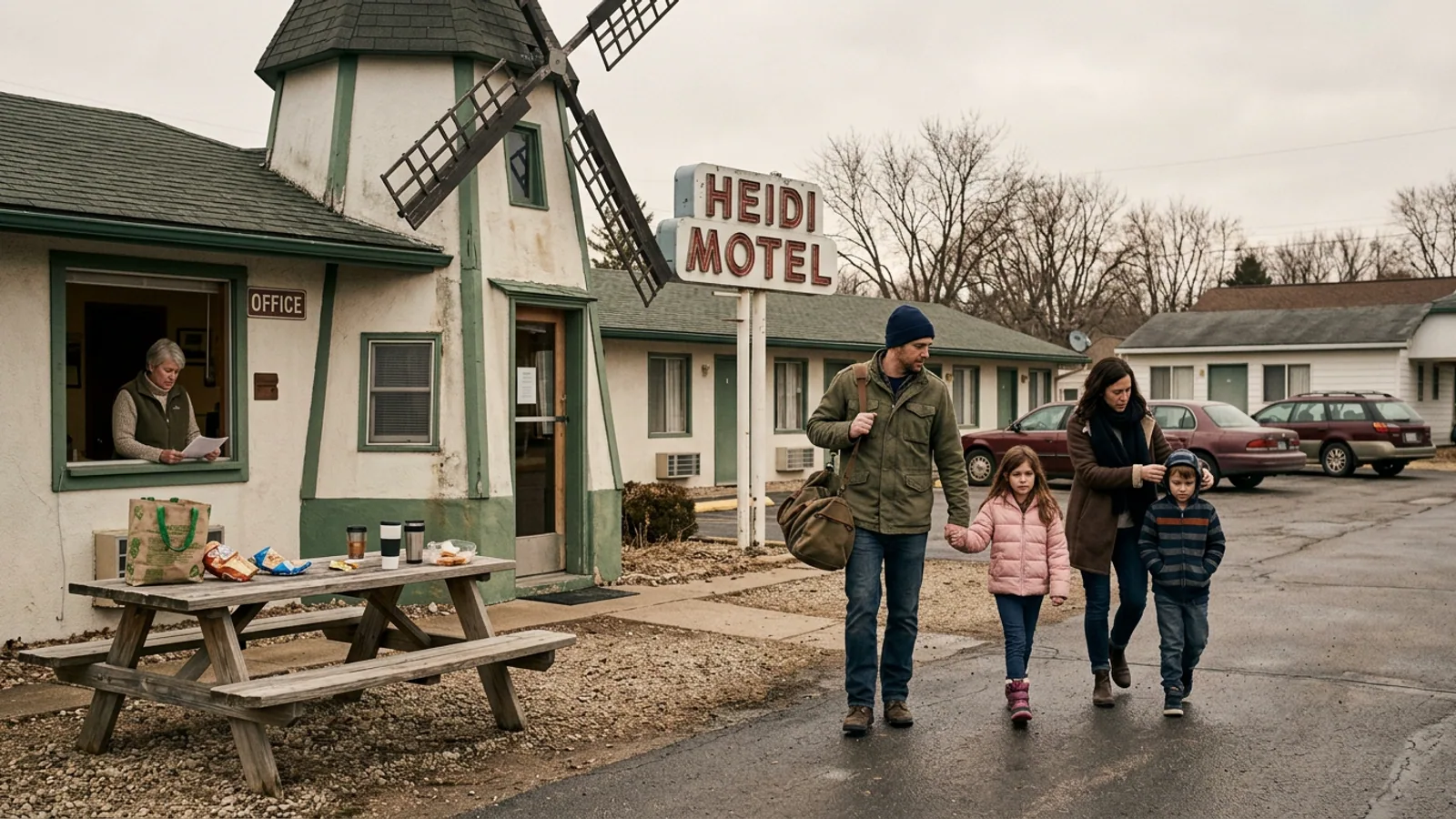
They had been on the road since eleven and they checked in at three forty-five on a Wednesday in the second week of February, and the front-desk attendant — a woman in her late fifties who had the unhurried manner of someone who has worked a front desk for long enough that the desk and the person behind it have reached a mutual accommodation — looked at the reservation and said that the room they had booked was actually unavailable, a maintenance issue with the bathroom exhaust, and that as compensation the motel would be upgrading them at no additional charge to the Windmill Suite.
"The Windmill Suite," the traveler said.
"It's our best room," the attendant said.
"Is it in the main building?"
"It's the windmill," the attendant said, gesturing toward the east side of the property in the way a person gestures when they are describing something that can be seen from where you are standing, if you look in the right direction.
The traveler turned and looked. Through the glass door of the lobby, at the east end of the Heidi Motel parking lot, there was a windmill. It was not a small decorative windmill. It was approximately thirty-five feet tall, white-painted, with four blades and a domed upper story. The blades were turning in a slow and apparently involuntary way in the light February wind.
"The blades turn?" the traveler said.
"They do," the attendant said. "They always have. The mechanism isn't connected to anything. It's original to the property."
"What's the sound like?"
The attendant considered this. "Low," she said. "Rhythmic. Some guests find it relaxing. Some guests don't check out."
"Don't check out early, you mean."
"Yes," the attendant said. "Early."
The suite was the lower floor of the windmill. There was a second story accessible by a tight wooden staircase, where the original mechanical housing had been cleared and replaced, at some point in the motel's history, with a loveseat, a low table, and a window that faced north over the highway. The lower floor had the bed, the bathroom, a kitchenette with a two-burner stove and a coffee maker, and a door to a small deck facing the parking area. The ceiling was low and circular. Everything about the room was adjusted to the fact of its being inside a cylinder.
The traveler set their bag on the bed and stood in the middle of the room and listened.
The motor sound was not what they had expected. They had expected a grinding, or a creak. The sound was actually a kind of persistent low murmur, not unlike the sound of a fan running in an adjacent room — present but not insistent, there but not demanding attention. It varied slightly as the blade speed varied. When the wind dropped outside, the sound slowed and softened. When a gust came through, the blades accelerated and the murmur rose into something closer to a hum.
The traveler stood and listened to the hum for a while. Then they unpacked their bag and made coffee on the two-burner stove.
They did not, on the first day, do much of anything in particular.
They drove into the downtown in the early evening and walked along Bruckenstrasse in the February quiet, which was a different kind of quiet from October's. The gift shops were open but not crowded. The pretzel cart at the corner of Edelweiss was closed and locked. The glockenspiel at the Welcome Center played at five o'clock while they were standing near it, and the sound of it in the February air was, for reasons the traveler could not exactly articulate, more interesting than it would have been in October, when it would have been competing with noise on all sides.
They ate at the Old Munich Restaurant and drove back to the motel at seven forty-five.
They watched the upper motor housing for a while from the loveseat, which was the thing to do from the loveseat. The window above the highway showed the headlights of the occasional passing vehicle, the 75 north ramp visible at the tree line. The blades turned. The motor hummed.
They fell asleep at nine-thirty, which was earlier than they generally fell asleep anywhere.
The second day was a Thursday and they woke at six forty-five because the light came in through the east-facing crack in the window shade at six forty-five, and there was nothing to do about it in a cylindrical room.
They lay in bed and listened to the motor.
"Do you think the blades have always turned?" they said to no one in particular, because there was no one else in the room.
The motor gave no indication either way.
They drove to the Cool River Tubing equipment lot and back, because it was closed in February and the traveler had wanted to see it. The parking lot was empty. The rental shed was locked with a padlock. The river ran behind the tree line, audible but not visible from the lot.
They stopped at a gas station on 75 and bought a bag of peanuts and a cup of coffee and sat in the car for a while in the gas station parking lot, not for any reason, just because sitting in the car in a parking lot was, at this particular moment, what was happening.
Back at the motel, they climbed to the upper story and lay on the loveseat and looked at the highway through the north window. Trucks came through irregularly. The occasional passenger car. The sky was overcast and the color of aluminum. A single crow crossed the window frame going west at about eleven in the morning, which was the sort of thing you noticed from the upper story of a windmill because the upper story of a windmill was a place where there was nothing to notice except the things that crossed the window.
They called their sister in the afternoon.
The sister's name was Margot, and she was four years older, and she lived in Columbus, and the call began at two-fourteen and ended at four fifty-one, which was the longest phone call the traveler had made since their father's funeral two years prior.
The call began with the basic logistical exchange — how are you, how is everything, where are you, why are you in a windmill — and the traveler explained the windmill as best they could, which was that it was a motel room inside a windmill and the blades turned and the motor made a sound and it was, in some way they were still identifying, the right place to be in February.
"Is this about Daniel?" Margot said.
"No," the traveler said.
"Okay," Margot said, in the way that meant she had accepted the answer provisionally and would not push.
There was a silence on the call that lasted perhaps twenty seconds, which is long on a phone call between siblings when there is nothing wrong. During the silence the motor in the ceiling hummed its variation. A vehicle on 75 visible through the upper window caught the gray afternoon light for a moment on its roof and then passed.
"I'm thinking about staying past Saturday," the traveler said.
"In the windmill?"
"Maybe."
"What's in Helen on Sunday?"
"Nothing particular," the traveler said.
"Is that the reason or is that the problem?"
"I don't know," the traveler said. "I think that's the question."
Margot was quiet for a moment. In Columbus, she was in her kitchen, the traveler knew, because she was always in her kitchen when she called in the afternoon, and the background sound of her kitchen — the particular refrigerator hum, the occasional sound of something on the counter being moved — was, to the traveler, as familiar as any sound they knew.
"I think you should stay if you want to stay," Margot said.
"I don't have anything to do here."
"That might be the point."
"I'm not sure what the point is."
"That might also be the point," Margot said.
They talked for the rest of the call about Margot's daughter, who was fourteen and learning to drive, and about a neighbor dispute involving a fence line, and about their mother's hip, which was better but not right. They talked about Daniel briefly, near the end of the call, and the traveler said they thought it was mostly fine and Margot said she was glad, and neither of them said anything more about it because there was not anything more to say that had not already been said across other calls on other days in other months.
The call ended at four fifty-one. The traveler put the phone down on the loveseat and looked at the window. The light was going. The highway was developing its evening character, the headlights more frequent now, the trucks larger in the dark.
The motor hummed.
They stayed on Saturday.
They had checked out, technically, at eleven a.m., and then stood at the front desk for several minutes and then asked the attendant whether the windmill was available for a fourth night. The attendant checked the system and said it was. She said the rate was the same. She said the exhaust situation in the original room was still being assessed.
"What is the exhaust situation?" the traveler asked.
"I honestly don't know," the attendant said. "It was there when I started the shift Monday. It may still be there when I leave on Sunday. These things run on their own schedule."
The traveler paid for the fourth night.
On Saturday they drove north on 75 to the state highway and took the state highway east along the river road to the Anna Ruby Falls trail and walked the trail to the falls, which were running well for February, two falls converging at a pool that was, in the gray winter light, the kind of thing you stood in front of longer than you expected to. Three other people were at the falls. A family with a dog. A man with a very large camera on a tripod who was adjusting the tripod with the intensity of a person for whom the angle of the tripod was not yet right and might not be right for some time.
The traveler stood at the falls and looked at them.
They stood there until the man with the camera appeared satisfied and began disassembling the tripod, which seemed like a natural conclusion.
Back at the windmill by four. The motor was humming. The blades were turning at what was, the traveler had come to understand, their default speed in the February wind off the mountains, which was not fast but was not slow either, just the speed of things turning because the wind was there and there was nothing preventing them from turning.
They made coffee on the two-burner stove. They sat on the deck in the cold for a few minutes and looked at the parking lot, which was mostly empty on Saturday afternoon. They went back inside.
They thought about calling Margot again and decided not to.
They thought about Daniel, briefly, in the way you think about someone when you are in a quiet place and there is no noise to displace the thought. They thought about him specifically: his coat, the green one from the Army surplus place on Ponce, and the way he had worn it on a particular Sunday in October that they could recall exactly and would not describe.
They let the thought be there for a while.
The motor hummed. The blades turned. The highway moved through its Saturday evening.
They checked out on Sunday morning at ten o'clock. The attendant was the same woman. The traveler thanked her for the windmill. The attendant said she was glad it had worked out. She said some guests found the motor sound a problem.
"I didn't," the traveler said.
"People either do or they don't," the attendant said. "There isn't much in between."
The traveler loaded their bag into the car and sat for a moment in the lot, the engine running, looking at the windmill from the parking area. The blades were turning in the morning wind. The white paint on the upper dome was slightly weathered on the south-facing side, the way all painted surfaces in the mountain valley weathered. The window of the upper story caught the morning light for a moment and then didn't.
They pulled out of the lot onto the road and went west toward 75 south and Atlanta.
The motor sound lasted, in memory, longer than most sounds last.
"Three Days In The Heidi Motel Windmill" is a work of fiction. The Heidi Motel is a real motel in Helen, GA. The Windmill Suite is invented. Any resemblance to a real motel room inside a real ornamental windmill is, at this time, coincidental.

Reader Comments
Leave a comment ↓