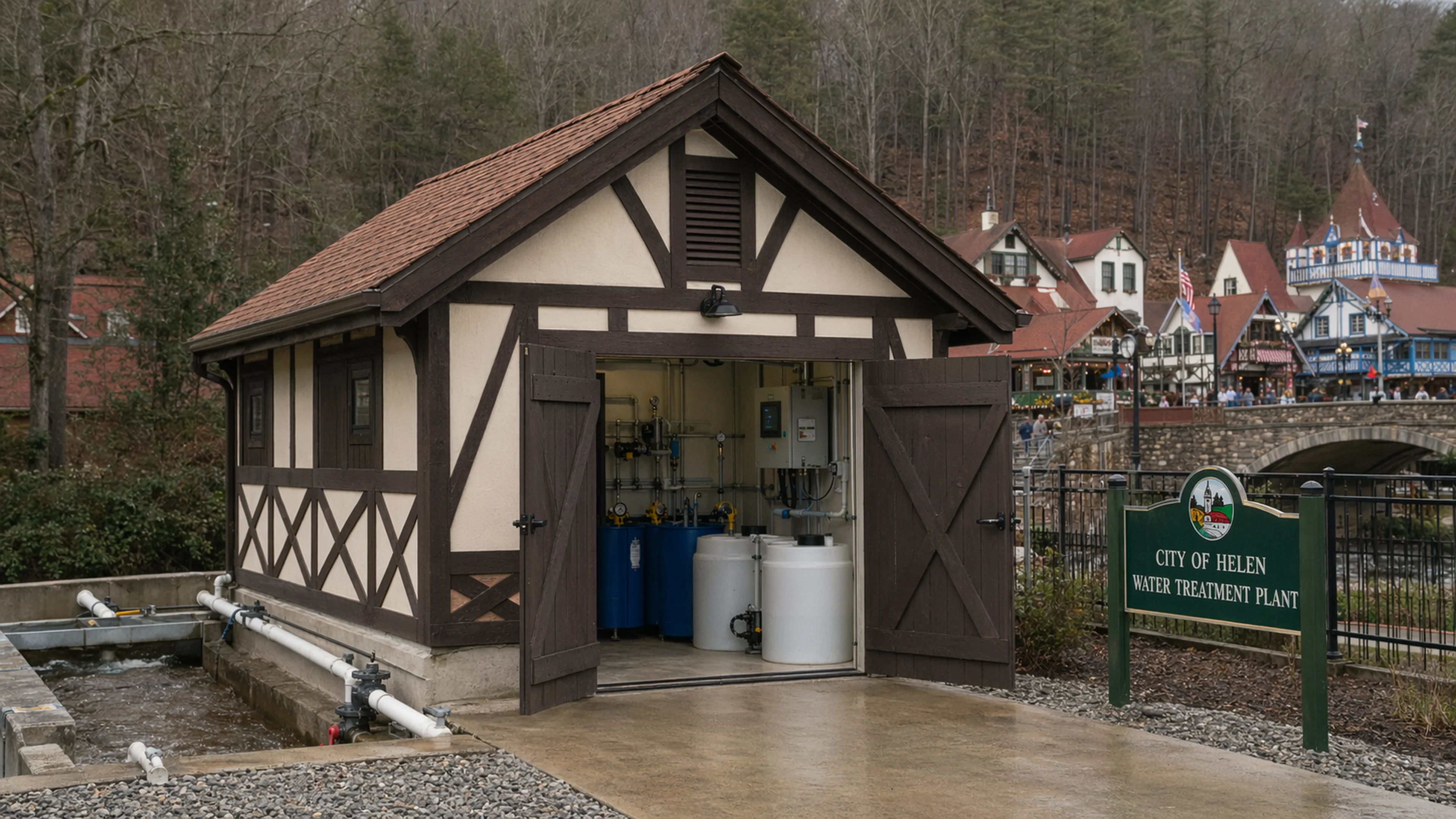
During engineering updates at the March 17, 2026 City of Helen Commission meeting, the Commission considered the addition of a new Gypsum Feed Systems Building to the city's water-treatment infrastructure. The building — a functional shed housing chemical-dosing equipment used to regulate calcium hardness in the municipal water supply — will, per the minutes prepared by City Clerk Marilyn M. Chastain and filed at 25 Alpenrosen Strasse, "also have the Alpine look."
The seven-word clause appears on page three of the minutes, between a notation on spray-field vegetation bid rejections and a discussion of Fletcher Holliday's broader infrastructure timeline. It is not flagged. It is not debated. It is not questioned. It is, by the documentary record, the most architecturally consequential sentence in the March 17 agenda, and no one in the room appears to have paused on it for longer than the time required to say it aloud.
The Alpine mandate, adopted by the Helen City Commission in 1969 as the founding ordinance of modern Helen's architectural identity, has never been formally limited. It applies, by its operative text, to any new structure or exterior renovation within the city limits. A chemical-dosing shed is, by any ordinary reading of municipal zoning law, a structure. The shed will therefore be, upon completion, Helen's first purpose-built municipal water-infrastructure building with Bavarian-alpine architectural elements engineered into the design from the schematic phase — an extension of a mandate that has, in its 57-year life, governed hotels, restaurants, retail storefronts, residential construction, civic buildings, a single mini-golf parcel, and, since the 1998 lift station visible-wall retrofit, at least one piece of sewer infrastructure. It has not, until now, governed the exterior presentation of a gypsum-dosing chamber.
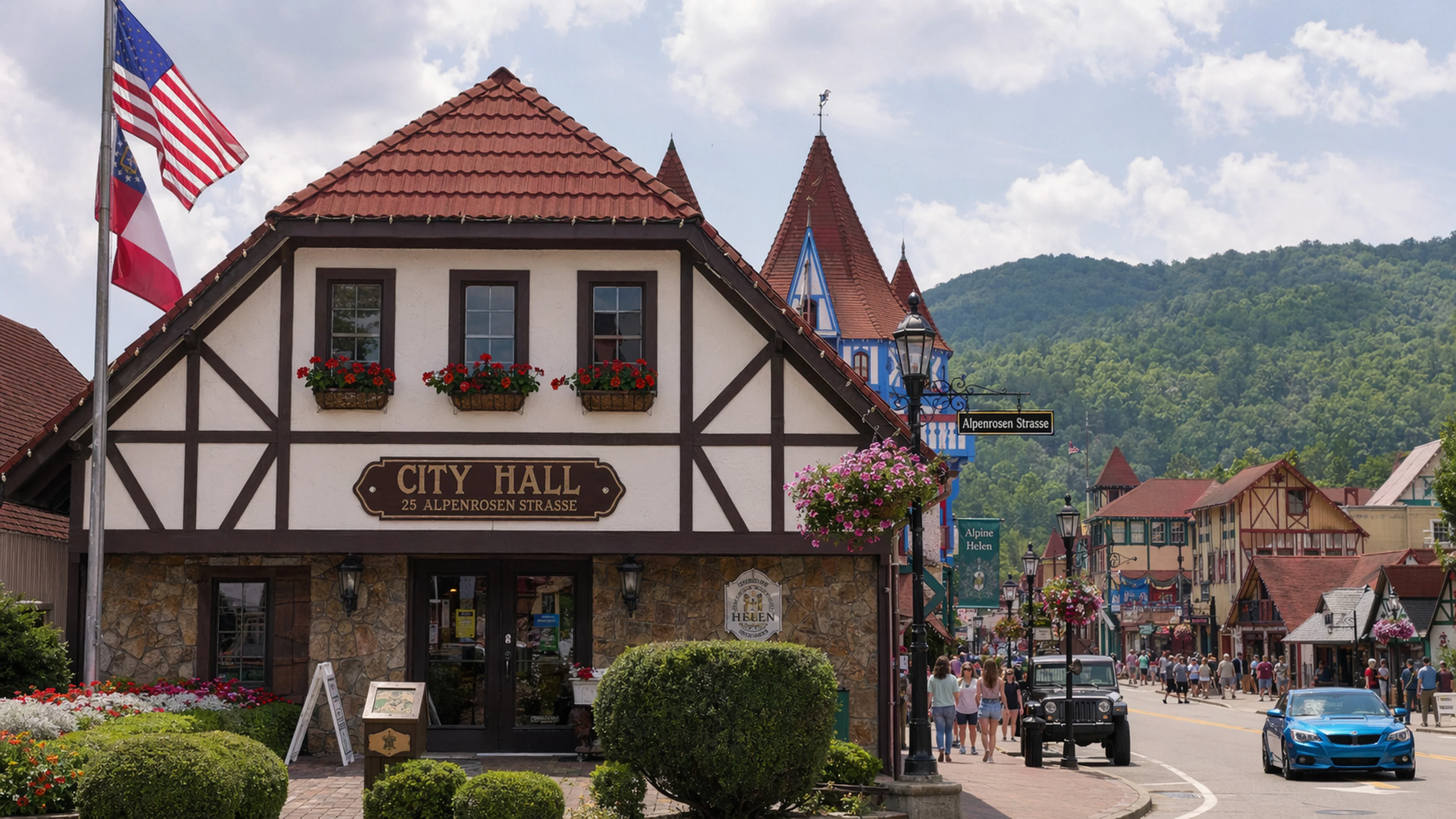
The mandate's original text, codified in the Helen Code of Ordinances and available on Municode, requires that all new construction and exterior renovation within the city limits conform to "traditional southern German style." The phrase is not further defined in the ordinance. It does not specify roof pitch, timber-frame detailing, shutters, stone veneer, or flower boxes. It specifies a style. The style is, by local consensus and 57 years of enforcement, the style visible on every commercial building along Bruckenstrasse, North Main Street, and South Main Street: steep gabled roofs, half-timber facade work, carved wood trim, painted shutters, and — where structurally or decoratively possible — geraniums in window boxes. The ordinance contains no exemption for non-public-facing structures, utility buildings, chemical storage facilities, or sheds of any kind. A shed is a structure. The mandate applies.
The question of what it means to apply the mandate to a gypsum feed systems building requires, first, a brief account of what a gypsum feed systems building contains.
Gypsum feed systems are used in municipal water treatment to regulate calcium sulfate concentration in the distribution system. Calcium sulfate — gypsum in its mineral form — is dosed into treated water to stabilize calcium hardness, which in turn controls corrosion rates in metal pipes and reduces the leaching of lead and copper from older service lines. The equipment is mechanical: a bulk storage hopper, a volumetric or gravimetric feeder, a dissolving tank, a metering pump, associated pipework, a control panel, and, in most configurations, a ventilation system rated for calcium sulfate dust. The building housing this equipment is, in standard municipal practice, a single-story utility structure with a poured concrete floor, fire-rated CMU or metal-panel walls, access doors sized for equipment servicing and chemical delivery, and minimal fenestration. Windows, where present, exist for emergency egress or passive ventilation, not for light. The interior does not benefit from natural light. The equipment does not care about natural light. The building is, by every convention of civil engineering, the architectural opposite of a Bavarian inn.
The Gypsum Feed Systems Building's design is, as of the April 2026 EMI infrastructure update presented by Fletcher Holliday, 85% complete. The telescopic valve and gypsum feed system's preliminary engineering has been finalized and the survey is done. What remains is the final 15% of design — the portion that, by the logic of the March 17 minutes, must incorporate the Alpine look.
How does an engineer make a chemical-dosing shed look traditionally southern German? Bavarian Brainrot consulted a civil engineering source with project experience in the Helen city limits who declined to be named.
"You pay for the Alpine," the source said. "I've worked in Helen three times. Every time I've paid for the Alpine."
The source outlined five architectural interventions that would bring a standard utility shed into compliance with the 1969 mandate. Each is technically feasible. Each adds cost. None serves a functional purpose related to gypsum dosing.
First: a steep roof pitch. Traditional Bavarian residential architecture uses roof pitches between 40 and 50 degrees, originally designed for snow shedding in the Alpine climate zone. Helen, Georgia, receives an average annual snowfall of approximately 3.2 inches per National Weather Service records at the Dahlonega 5 SW station. A 45-degree gable roof on a chemical shed in Helen is not functionally required for snow management. It is, the source noted, "the cheapest piece of the Alpine." It can be framed with standard trusses and adds between 8% and 14% to roof-system cost depending on span.
Second: half-timber detailing. The exposed dark-timber-and-white-stucco facade seen on every building between 8016 and 8265 South Main Street is, in Helen, almost universally decorative. The timbers are not structural. They are applied to the exterior as trim, bolted or adhesive-mounted to the substrate wall. On a CMU utility building, this means installing a furring system, applying a stucco or EIFS base coat, and then mounting timber-profile trim in the traditional pattern. The source estimated the facade treatment at $18 to $26 per square foot of decorated wall area, depending on material grade.
Third: window shutters. Bavarian shutters on a gypsum-dosing building present what the source called "a philosophical problem." The building does not need windows. If windows are present, they are sealed or screened for dust control. Shutters on sealed, non-functional windows are decorative elements applied to decorative elements. The source paused at this point in the conversation and said nothing for four seconds. "You put the shutters on," the source continued. "They go on the windows that go on the wall that goes on the building that holds the gypsum. That's Helen."
Fourth: carved wood trim along the eave line and at gable peaks. Standard Bavarian Brainrot-region detailing, available from at least two regional millwork suppliers. Cost varies. The trim does not interact with the gypsum system.
Fifth: a stone or stone-veneer base. Traditional Bavarian structures frequently feature a stone ground story with timber-frame upper stories. On a single-story utility building, the stone base would constitute the entire visible wall surface below the half-timber line. This is the most expensive Alpine element per square foot and the one most likely to push the total project cost above the threshold established by Ordinance 25-11-01.
There is a sixth element, less structural and more botanical: geraniums in window boxes. The Bavarian window box — a painted wooden planter mounted below each window, filled with red or pink geraniums — is the single most recognizable signifier of the Alpine look in Helen's commercial district. On a chemical-dosing shed, geraniums present a maintenance problem that the source described as "real." Geraniums require six to eight hours of direct sunlight. Gypsum feed buildings are typically sited for operational access, not solar exposure. The shed's orientation on the treatment-plant parcel has not been disclosed in public minutes, but the source noted that "if it faces north, you're doing impatiens, and impatiens are not Alpine."
The net result: the Gypsum Feed Systems Building will be, architecturally, a Bavarian inn exterior wrapped around a chemical-dosing interior. It will cost more than a standard utility shed. The cost increment — the price of the Alpine look applied to what may be the smallest useful surface in the city's infrastructure inventory — has not been publicly disclosed.
Dr. Wilhelm Brüning, formerly of the Bavarian State Institute for Regional Cultural Geography and a recurring consultant to this publication on matters of Alpine-mandate theory, said the gypsum building represents a category extension that the 1969 ordinance's authors could not have anticipated but would not have exempted.
"What is important about the 1969 mandate is not what it demands of a building," Dr. Brüning said. "It is what it demands of the people responsible for the building. Every time Helen adds a piece of civic infrastructure, the question of whether it will 'fit' is re-asked. The question is not architectural. It is ontological. It is: does this city mean what it says about itself? The Gypsum Feed Systems Building is a small structure. It holds a pump and a hopper and a control panel. But the question it forces on the Commission is the same question the Bandshell forced in 1972, and the same question the debated alpenhorn at the sewer department exterior forced in 2011. That is the mandate's power. It does not expire. It does not tire. It asks the same question of a hotel and of a shed."
Dr. Brüning noted that the mandate has, in practice, been applied with varying rigor across five decades of construction. The commercial buildings along Bruckenstrasse and Main Street are fully compliant and represent the mandate's highest expression. Residential structures in the city limits are generally compliant in facade treatment, though Dr. Brüning noted that "compliance attenuates with distance from the commercial core, as it does in any themed municipality." Municipal buildings — City Hall at 25 Alpenrosen Strasse, the Festhalle, the Welcome Center — are fully Alpine. Infrastructure, historically, has been less consistent.
The public works garage visible from Robertstown Road is, by Dr. Brüning's assessment, "utilitarian with Alpine gestures." The sewer lift stations are, in most cases, bare concrete enclosures, though at least one received a partial facade treatment following the 1998 retrofit. The water treatment plant's main building has Alpine elements that appear to date from its original construction. None of these structures received, in the public meeting record available to this publication, an explicit instruction from the Commission to "have the Alpine look." The Gypsum Feed Systems Building did.
This brings the story to Ordinance 25-11-01, adopted by the Helen Commission on December 16, 2025, on second reading. The ordinance amends Charter Article VI, Section 6.27, "Contracting Procedures," and grants City Manager Darrell Westmoreland authority to enter into contracts on behalf of the city up to $25,000.00 for previously budgeted goods and services. Contracts above $25,000 require further procedure — which, in practice, means a Commission vote at a public meeting.
A standard gypsum feed systems building — the kind without an Alpine look — costs, at 2026 construction prices in the North Georgia market, between $35,000 and $80,000 depending on footprint, equipment specification, and site preparation. The Alpine treatment adds cost. The civil engineering source estimated the facade and roof premium at 15% to 30% of the base building cost, depending on the level of detailing required for compliance. At the low end of the base range, a $35,000 shed with a 15% Alpine premium reaches $40,250. At the high end, an $80,000 shed with a 30% premium reaches $104,000. Every plausible scenario places the total project cost above $25,000, which means the Gypsum Feed Systems Building will almost certainly require a Commission vote for contract award.
That vote has not yet appeared on a Helen agenda. The April 21, 2026 agenda, the most recent available, includes items on parking-lot contracts on Hoen Strasse, matrix sign approvals, alcohol license applications for Day Late Dollar Short LLC and Yonah Vineyards LLC, and a monitoring well replacement contract awarded to Sailors Engineering Associates of Lawrenceville at $6,611.00 — a bid that came in $14,319 below the runner-up submission of $20,930 from Nutter and Associates of Athens, a spread of 216%. The gypsum building is not on the April 21 agenda. It will appear at a meeting not yet scheduled, at a cost not yet disclosed, with Alpine detailing not yet specified.
The monitoring well contract is, in its own way, instructive. The bid opening occurred on April 16, 2026. The engineering letter recommending the award was signed by Wiley S. Helm, P.E., of Engineering Management Inc., reachable at [email protected]. The letter, dated 2024 in what appears to be a clerical error later noted in commission materials, recommended acceptance of the low bid. The monitoring well, it should be noted, does not have the Alpine look. It is a well. It is underground. The mandate, by any reasonable interpretation, does not apply to holes.
The Gypsum Feed Systems Building is not a hole. It is a structure. It will rise above grade. It will have walls, a roof, and, if the mandate is observed with the rigor the March 17 minutes imply, shutters on windows that do not open, timber detailing that bears no load, a stone base that resists no frost, and, possibly, geraniums that may or may not receive adequate sunlight.
The design is 85% complete. EMI's engineers are, presumably, working on the remaining 15%. Some portion of that 15% is structural. Some portion is mechanical. And some portion — a portion that will not affect the water quality, the pump performance, the chemical-dosing accuracy, or the calcium hardness of a single gallon flowing through the system — is the Alpine look.
The Commission was reminded. The minutes recorded the reminder. The building will comply. It has been this way since 1969, when the mandate was new, and it will be this way when the mandate is older than every person who voted for it. The gypsum will not know. The calcium sulfate will dissolve at the same rate inside a Bavarian facade as inside a plain CMU box. The pumps will cycle. The control panel will read nominal. And outside, on a wall that exists for no operational reason, a decorative shutter will hang beside a sealed window, in a town of fewer than 700 people that is the third-largest tourist destination in the state of Georgia, on a building that almost no tourist will ever see, in a style that a zoning ordinance adopted 57 years ago determined would be the style of everything built here, forever, without exception, including this.


Reader Comments
Leave a comment ↓