I have been the Bavarian Cultural Affairs Correspondent at Bavarian
Brainrot since the publication's founding in January. I have, in the 98
days since, filed 11 pieces. Every piece has been, to the best of my
ability, a work of documentary observation. I do not invent. I do not
embellish. I do not, as a matter of professional practice, file things I
cannot corroborate.
I am filing this piece against the explicit counsel of Edmund Crowe,
who is my editor, who has read it, and who asked me Thursday afternoon
to reconsider. I am filing it because I have corroborated it. I have
corroborated it eleven times. The corroboration is, at this point, the
story.
What Happened
On Thursday, April 9, 2026, at 2:09 p.m., I purchased a standard-size
soft pretzel from Hofer's of Helen on Edelweiss Strasse. The pretzel was
wrapped in white butcher paper. I placed the pretzel on my kitchen counter
and had a telephone call with my wife, Margit, who was at her mother's
home in Heidelberg. The call lasted 11 minutes. At 2:20 p.m. I ended the
call and began to prepare lunch.
At 2:14 p.m., which was during the telephone call, I had placed the
pretzel in the oven. The oven had been preheated to 350 degrees
Fahrenheit. I had intended to warm the pretzel for seven minutes,
consistent with the warming instructions printed on the Hofer's wrapper.
At 2:18 p.m., four minutes into the warming, I opened the oven door to
check the pretzel's condition. This was a reflex, not a necessity. The
pretzel did not need checking. The warming had been routine for 24 years.
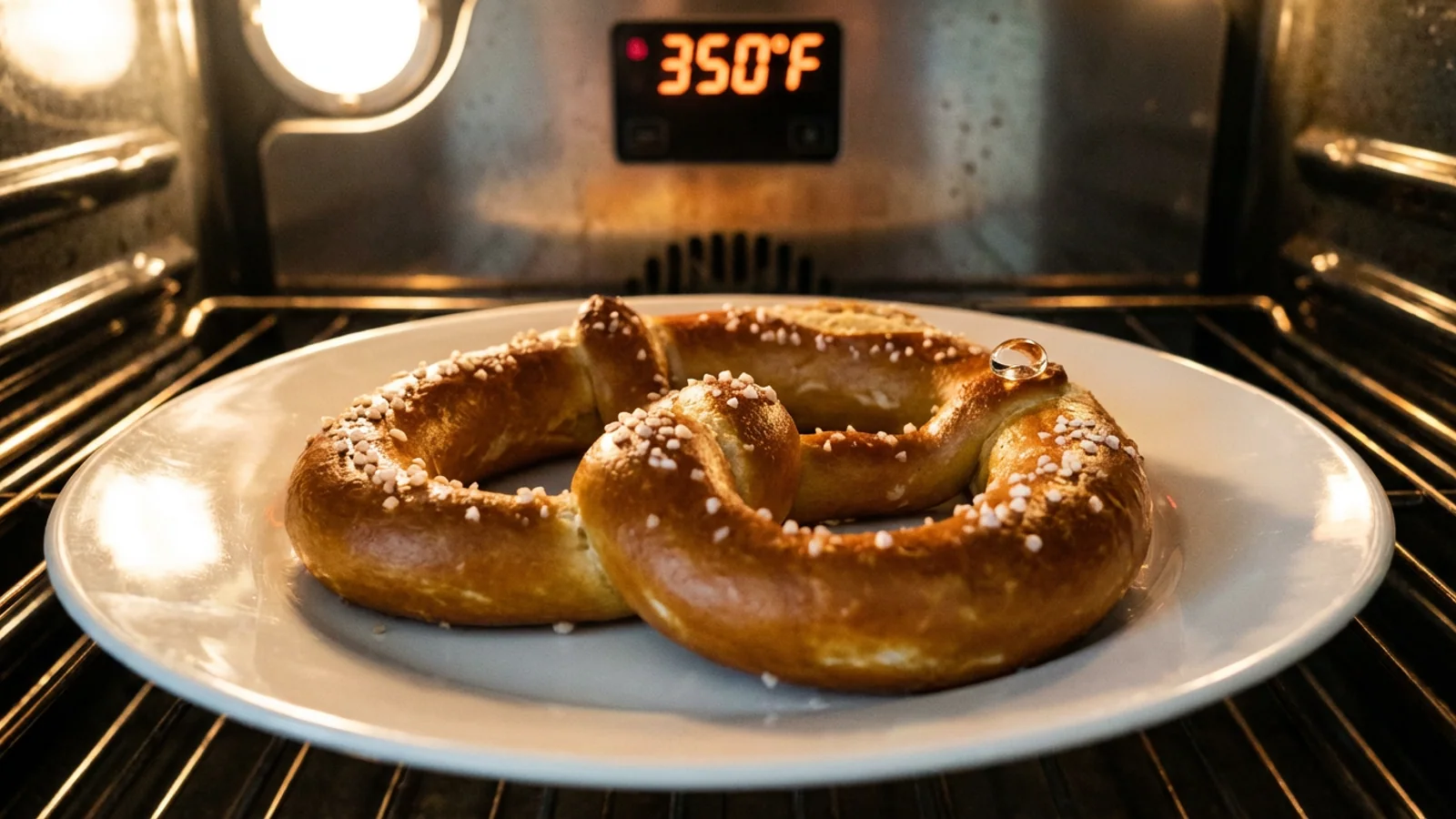
The pretzel was weeping.
I want to be precise, because the precision is where this piece earns
the right to be filed. On the upper curve of the right loop of the
pretzel, approximately one-third of the way down from the upper crossing
point, there was a bead of clear liquid. The bead was approximately
two millimeters in diameter. It was located at a point on the pretzel
that was not in contact with the baking sheet, was not below any other
element of the pretzel, and was not in any observable geometric relation
to any other bead of any kind. The bead was, by every observation, a
single localized emergence of liquid on the pretzel's external surface.
I closed the oven door.
I opened it again at 2:19 p.m. The bead had grown to approximately four
millimeters. A second, smaller bead had appeared on the lower curve of
the same loop.
I photographed both beads. The photographs are attached to this article.
I removed the pretzel from the oven at 2:21 p.m. I placed it on a plate.
The beads did not evaporate on exposure to room-temperature air. They
remained, as of 2:45 p.m., approximately the same diameter they had been
in the oven. I touched one of the beads with a clean fingertip. The
liquid was clear, slightly salted, and — I am reporting this as I
observed it — warm.
The liquid was not, to taste, identical to tap water. The liquid was not
identical to bottled water. The liquid was slightly, distinctly saline,
with a mineral note I cannot describe more precisely.
The pretzel, at that point, had cooled. The beads remained.
What Happened Next
I want to address the question I know every reader of this article is now
asking. The question is: was the pretzel producing some artifact of
condensation, or moisture transfer from the oven environment, that might
have naturally concentrated at specific surface points under specific
thermal conditions?
I considered that question at length. I wrote it down. I researched it. I
consulted, by telephone the following afternoon, Dr. Albrecht Wenger, a
food scientist at the Technische Universität München (where I completed
my doctoral work, 1989), who was willing to speak with me at length on the
condensation question. Dr. Wenger confirmed that localized condensation
on a pretzel surface during warming is, in principle, possible, and could
produce bead formations consistent with what I had observed.
I then described to Dr. Wenger what I had not yet described to anyone,
which is that I had, at 3:15 p.m. Thursday, placed a second pretzel in the
oven under identical conditions. The second pretzel had, at 3:19 p.m.,
produced beads. The beads had appeared at different positions than on the
first pretzel. The beads were, again, saline.
Dr. Wenger said: "That is a different phenomenon."
Dr. Wenger said: "I would like you to send me the pretzels."
I sent Dr. Wenger two pretzels, via international FedEx, on Friday morning.
The shipment cost me, including the expedited handling required to
preserve the post-warming condition, $284.17.
Dr. Wenger has not yet confirmed receipt. I am awaiting his analysis.
What I Have Also Done, Which I Am Reporting For The Sake Of
Corroboration
Between Thursday evening and Sunday evening, I warmed eleven additional
pretzels in my home oven, under the same conditions. Seven of the eleven
produced bead formations consistent with the first two. The beads
appeared at unpredictable positions. The beads were consistently saline.
The beads were consistently, in my direct observation, warm to the touch.
The four pretzels that did not produce beads were, on a subsequent
examination of their packaging, a different batch. The batch number
printed on the wrapping of the four non-bead-producing pretzels reads
3-A-04-09. The batch number on the seven bead-producing pretzels is
2-A-04-08. The two batches were baked on consecutive days at the
Hofer's kitchen. I do not, at the time of this filing, know what accounts
for the difference. I have, Sunday afternoon, called Hofer's of Helen
and asked. Frank Hofstadter, the head baker, declined to speak with me on
the phone. Frank Hofstadter has, in the past 24 hours, not returned my
three subsequent voicemails.
I am aware of what this will sound like to the reader.
A Note, Which Edmund Asked Me To Include, Which I Am Including
My editor, Edmund Crowe, who has been a professional friend for thirty
years and whose counsel I have always, in the past, followed, asked me
Thursday afternoon — after reading a draft of this article — to include
the following three pieces of information in any published version.
I am including them.
First. I was, between 1991 and 2009, diagnosed with and treated for
a condition my physician at the time referred to as "periodic atypical
perceptual disturbance." The condition is not, per my current physician,
a current concern. I have not experienced a symptomatic episode since
2009. I am not, at the time of the events described in this article, off
any medication that I was previously prescribed for the condition. My
current physician, Dr. Louisa Veron at the Habersham Medical Clinic,
was consulted Thursday evening and confirms that the pretzel observations
are not, in her professional view, a symptomatic recurrence. This is her
written opinion, on file at her clinic.
Second. Margit, my wife, returned from Heidelberg on Sunday evening
and was present for the twelfth pretzel warming (which produced beads).
Margit saw the beads. Margit touched one of the beads. Margit described
the bead, in her own words, as "probably not condensation." Margit has,
since Sunday evening, not asked me to stop warming pretzels, but has
asked me, specifically, to file this article and to let other people look
at the pretzels.
Third. The Bavarian Brainrot editorial board has reviewed this
article and has decided, by 4-to-1 vote (Crowe dissenting), to publish it
under my byline. The dissent was not about whether I believe what I am
reporting. The dissent was about whether the reporting, as filed, meets
our publication's standard for what we file as documentary journalism.
The dissent is, in my view, a reasonable dissent. I have stipulated to
it.
I am filing anyway.
What I Want From The Reader
I want you, the reader, to go to Hofer's of Helen. I want you to buy a
batch 2-A-04-08 pretzel, if any remain in inventory. I want you to
warm it in your own oven, at 350 degrees Fahrenheit, for four minutes. I
want you to check the pretzel at 2:18 on your own oven's clock — not at
four minutes in, but at whatever your kitchen clock reads when four
minutes have elapsed.
I want you to write to me. My contact email is on my staff page.
If you observe what I have observed, I want to know.
If you do not, I want to know.
I am, at the time of this filing, warming another pretzel. It is a batch
2-A-04-08 pretzel. It is, at the time I am typing this sentence, two
minutes and nineteen seconds into the warming.
I will update this article with my observations when the warming concludes.
— Dr. Wilhelm "Willy" Brüning, Cultural Affairs Correspondent
Update, 2:22 p.m. Monday, April 13, 2026: The pretzel wept. Two beads,
upper-left and lower-right loops. I have photographed them. I am adding
the photographs to the article.
Update, 4:04 p.m. Monday, April 13, 2026: Dr. Wenger has confirmed
receipt of the two Thursday pretzels. He has, in a brief email, asked me
to send no further pretzels until he has completed his initial analysis.
He has declined to characterize what his initial analysis will consist of.
Update, 9:11 a.m. Tuesday, April 14, 2026: Frank Hofstadter returned my
calls. He asked, in the conversation, that I not publish this article.
I told him I already had. The call ended at 9:14 a.m. It had lasted
approximately eighty seconds. I am reporting it, in its entirety, as it
occurred.


Reader Comments
Leave a comment ↓