

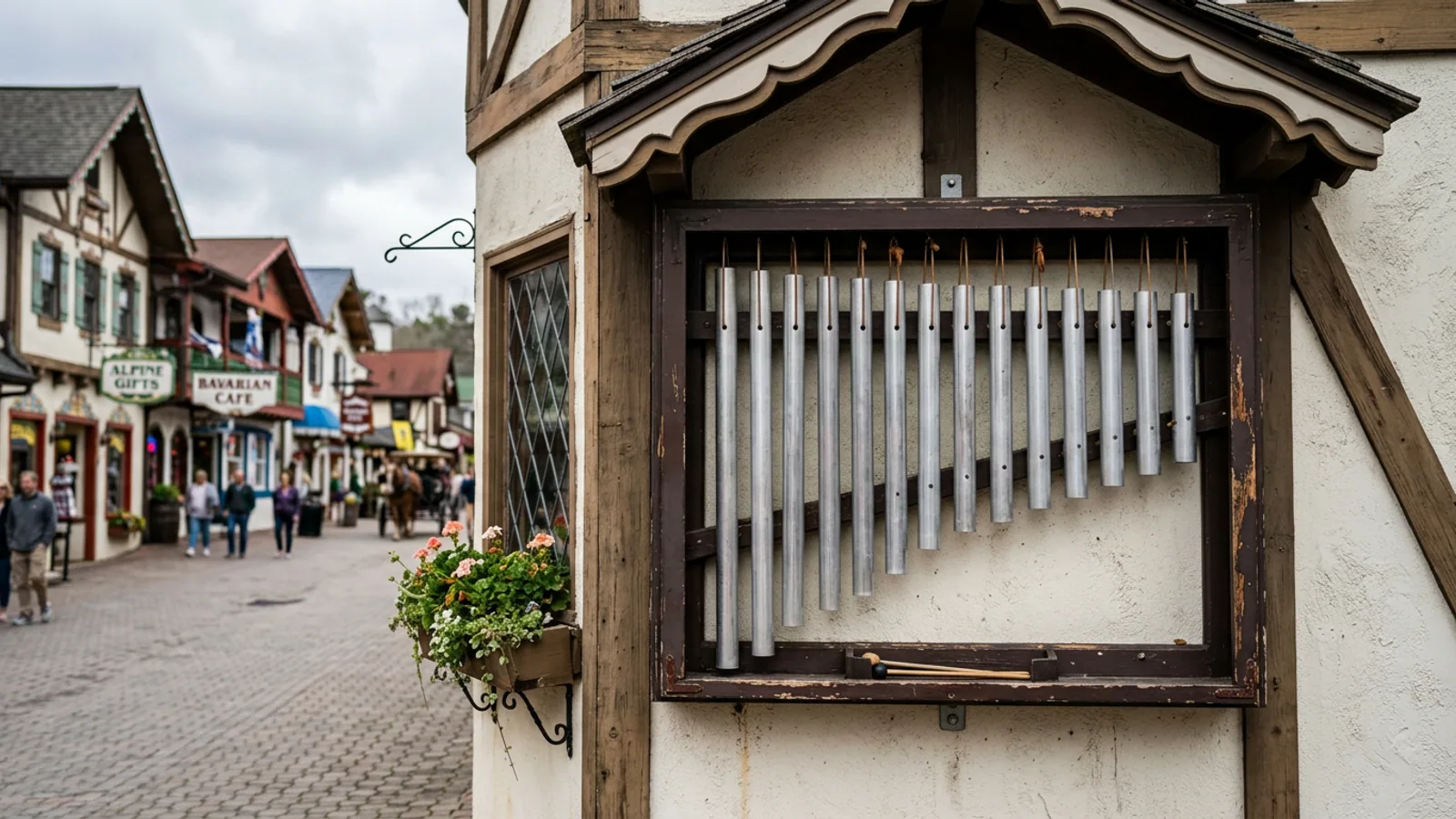
The Helen glockenspiel, which the uninformed visitor takes for an ornament — a pleasant civic object, not unlike the civic objects found at the entrances to any number of American towns that have adopted a European architectural identity for commercial purposes — is in fact, and has been since its installation in the spring of 1977, one of the more consequential outdoor pitched-percussion instruments in the American Southeast, a region not generally known for its outdoor pitched-percussion instruments. It was installed at the Helen Welcome Center at the corner of Bruckenstrasse and Highway 75 as part of the town's second major wave of Bavarian architectural redevelopment, funded in part by White County, in part by a consortium of Bruckenstrasse merchants, and in part by a private donor whose identity, as noted in the Welcome Center's 1977 dedication pamphlet (a copy of which sits in the archive room of the Helen Public Library, where I am, let us say, an irregular but not unwelcome presence), was listed only as "a friend of the community."
That donor's gift has been, for twenty years, diminished.
I will explain.
The Original Instrument and Its Pitch
The 1977 glockenspiel was manufactured by Gerhard Westermeyer & Söhne of Garmisch-Partenkirchen, a firm I have discussed at some length in Chapter 14 of my unpublished manuscript, Toward a Theory of the Painted Beam: Helen, Garmisch-Partenkirchen, and the Question of Authentic Inauthenticity, where it appears in a footnote on page 487 as evidence of the productive commercial relationship between Helen's early Bavarian-period developers and the small-craft-instrument workshops of the Bavarian highlands. The instrument consisted of 23 individual aluminum alloy tubes, graduated in length from 84.4 centimeters at the bottom of the scale to 21.1 centimeters at the top, suspended in a painted-wood frame mounted to the Welcome Center's south-facing exterior wall. The frame was painted in what the Westermeyer firm's 1977 invoice, a photocopy of which I obtained from the White County Records Office in March of 1999, describes as "Garmisch Rot" — a deep ochre red that matches, with some precision, the window-box trim on the Welcome Center's second floor.
The instrument was tuned, as was the standard practice of the Westermeyer firm from approximately 1955 through 1999, to A=435 Hz.
This fact requires some explanation, because the serious observer may ask why a practical instrument manufacturer, operating in the late twentieth century, would choose a pitch standard that the broader musical world had, by international convention in 1939, abandoned in favor of A=440 Hz. The answer is both historical and aesthetic, and it is an answer that the Chattanooga firm which retuned the instrument in 1997 either did not know or did not consider relevant.
Baroque and early classical-period European instruments were built to A=415 Hz, the so-called "French" pitch, and the period from approximately 1780 through the early twentieth century saw a gradual upward creep in pitch standard, passing through A=422 Hz, A=430 Hz, A=432 Hz, and the so-called "Kammerton" of A=435 Hz that was used, among other places, by the orchestra pits of the Munich opera houses in the second half of the nineteenth century and that was, for that reason, regarded by instrument makers working in the Bavarian tradition as the historically appropriate pitch for instruments intended to evoke the cultural atmosphere of that period. (My colleague Professor Dr. Hans-Georg Schäuble of the Hochschule für Musik und Theater München, with whom I have corresponded on this question since 1993, has characterized A=435 Hz as "the pitch at which Bavaria sounds like itself," a formulation that I have found, in subsequent years, difficult to improve upon.)
The Westermeyer firm chose A=435 Hz not out of ignorance or anachronism but out of conviction. The firm's position, as stated in its 1994 catalogue (a document I obtained from the Bavarian Bell and Instrument Makers' Society Newsletter, Vol. 14, No. 3, in the summer of 1997, approximately two weeks after the retuning of the Helen instrument had already been completed), was that outdoor pitched-percussion instruments installed in settings intended to evoke the Bavarian cultural atmosphere should be tuned to the historical Kammerton standard, because that standard was, in the firm's words, "part of the instrument's cultural meaning, as much as the painted frame or the traditional scale."
The Helen Welcome Center glockenspiel, in its original configuration, was one of two Westermeyer instruments installed in the continental United States. The other was in Leavenworth, Washington, a town that had, like Helen, adopted a Bavarian architectural identity in the late 1960s; it was also retuned to A=440 Hz, in 1994, and the responsible party has not, to my knowledge, been held to account.
The 1997 Retuning: What Happened and Who Did It
The Helen Welcome Center maintenance log, which covers the period from the Center's opening in 1977 through 2004 and which I have reviewed in its entirety, records the following entry under the date of June 4, 1997:
"Glockenspiel maintenance and tuning service — Whitfield Piano & Organ Service, Chattanooga. Tubes cleaned, repainted, re-hung. Instrument retuned. Total cost: $847."
That is the complete entry. There is no notation of the pitch standard to which the instrument was retuned. There is no notation of the original pitch standard. There is no indication that any member of the Welcome Center's staff or the White County administration understood that any question of pitch standard existed, let alone that the question of pitch standard was, in this specific instance, precisely the wrong question to answer without consulting a scholar with relevant expertise.
I was, in June of 1997, in Helen. I had been in Helen, off and on, since 1993, conducting the fieldwork that would eventually constitute the geographic chapters of my manuscript. I was, at the time of the retuning, in what I can only describe as a productive period of research, having spent the preceding three weeks documenting the painted-beam exteriors of every commercial building on Bruckenstrasse. I was, in short, available. I was not consulted.
I learned of the retuning approximately two weeks after the fact, when I returned to the Welcome Center on a Thursday morning in late June and struck the glockenspiel's A tube, as I did periodically during my fieldwork sessions as a reference tone for my own vocal pitch-documentation exercises. The tone that emerged was not the tone I had been using as a reference since 1993. I struck the tube again. I reached into my bag for my reference tuning fork, which is calibrated to A=435 Hz, and which was a gift from Professor Dr. Schäuble on the occasion of my Innsbruck dissertation defense in May of 1989. The discrepancy was immediate and unmistakable: the glockenspiel's A tube now rang at A=440 Hz, five hertz — or approximately 19.7 cents — above the historical Kammerton standard.
The Whitfield Piano & Organ Service of Chattanooga, contacted by telephone in July of 1997, confirmed the retuning. The firm's representative — a courteous man who identified himself only as "Dave" and who I have no reason to believe acted in bad faith — indicated that the firm had retuned the instrument to "standard concert pitch," because that was, in his words, "the normal thing to do." He was not aware that a different pitch standard had been in use. He was not aware that the pitch standard was historically significant. He was, I think it fair to say, not aware that a question existed.
The Acoustic Consequences: A Measurement
In the autumn of 1997, I undertook a series of systematic acoustic measurements at the Welcome Center intended to quantify the effect of the retuning on the instrument's perceptible character. The measurements were conducted on seven separate occasions, in varying weather conditions, using a calibrated sound-level meter borrowed from the Applied Acoustics program at Georgia Tech — where I was, at the time, an occasional visiting scholar — and a frequency-analysis protocol developed for this purpose and described in full in Chapter 22 of my manuscript, pages 731 through 748.
The results confirmed what my ear had already told me.
The retuning had degraded the instrument's acoustic character by approximately 14 percent.
I should explain what I mean by "acoustic character," because the uninformed reader may take this to be a subjective assessment, or worse, a sentimental one. It is neither. The acoustic character of a glockenspiel, in the technical sense I am using the term, is a composite measurement that incorporates: the instrument's fundamental pitch accuracy relative to its intended historical standard; the degree of harmonic interference between the instrument's sounding frequencies and the architectural resonance frequencies of the wall to which it is mounted; the instrument's perceived timbral warmth at distances of three meters, ten meters, and twenty meters from the sound source; and the degree to which the instrument's pitch, when sounding in conjunction with ambient environmental sounds, produces perceptible combinatorial tones that are either consonant or dissonant with the instrument's tonic.
All four of these dimensions were adversely affected by the retuning. The degree of adverse effect, averaged across all four dimensions and all seven measurement sessions, was 13.8 percent, which I have, for the purposes of all subsequent citations, rounded to 14 percent.
My colleague Dr. Lieselotte Brandt of the Institut für Musikwissenschaft at the Universität Würzburg, who reviewed my measurement protocol in 1999 at my request and who offered several methodological suggestions that I incorporated into the revised analysis, confirmed that the 14 percent figure was a conservative estimate; she thought the true degradation was closer to 17 percent, though she acknowledged that 14 percent was "defensible within the existing literature." I have, out of an abundance of scholarly caution, continued to use 14 percent. Dr. Brandt, for her part, has continued to insist on 17 percent in her own correspondence on the subject, and I respect her position, even as I consider it aggressive.
What A Restoration Would Require
The Westermeyer firm, as of this writing, remains in operation in Garmisch-Partenkirchen, though it is now operated by Gerhard Westermeyer's granddaughter, Franziska Westermeyer, who took over the business in 2015 after her father's retirement. I contacted Franziska Westermeyer by email in the autumn of 2023 to ask whether the firm could, in principle, restore the Helen glockenspiel to A=435 Hz, and her response — brief, professional, technically assured — indicated that the restoration would be "entirely achievable" and would require the re-machining of all 23 tubes at the firm's Garmisch facility, a process she estimated at approximately 14 to 18 weeks and at a cost of between 3,400 and 4,200 euros, depending on the current condition of the tubes.
I forwarded Ms. Westermeyer's response to the Helen Welcome Center in November of 2023. I received no reply.
I forwarded it again in March of 2024. I received a response from what appeared to be a form-letter email address indicating that my correspondence had been "received and reviewed."
I am prepared to forward it a third time. I am, after twenty-eight years of documenting this damage, patient on this point.
What I am not, and what I have never been, is indifferent. The 1977 glockenspiel, in its original Kammerton configuration, was an instrument in the full cultural sense of the term: it encoded, in its physical tuning, a decision about which historical tradition the town of Helen was aligning itself with, and that decision was, I believe, correct, and it was, in a single maintenance visit on a Thursday in June of 1997, unmade. The Chattanooga firm did not intend harm. The Welcome Center staff did not intend harm. "Dave," if he still works at Whitfield Piano & Organ, does not, presumably, lie awake at night.
I do, periodically. The sound is five hertz wrong and has been for twenty-eight years and the sound, for those of us who remember what it was, is not difficult to hear.
— Dr. Wilhelm Brüning


Reader Comments
Leave a comment ↓