

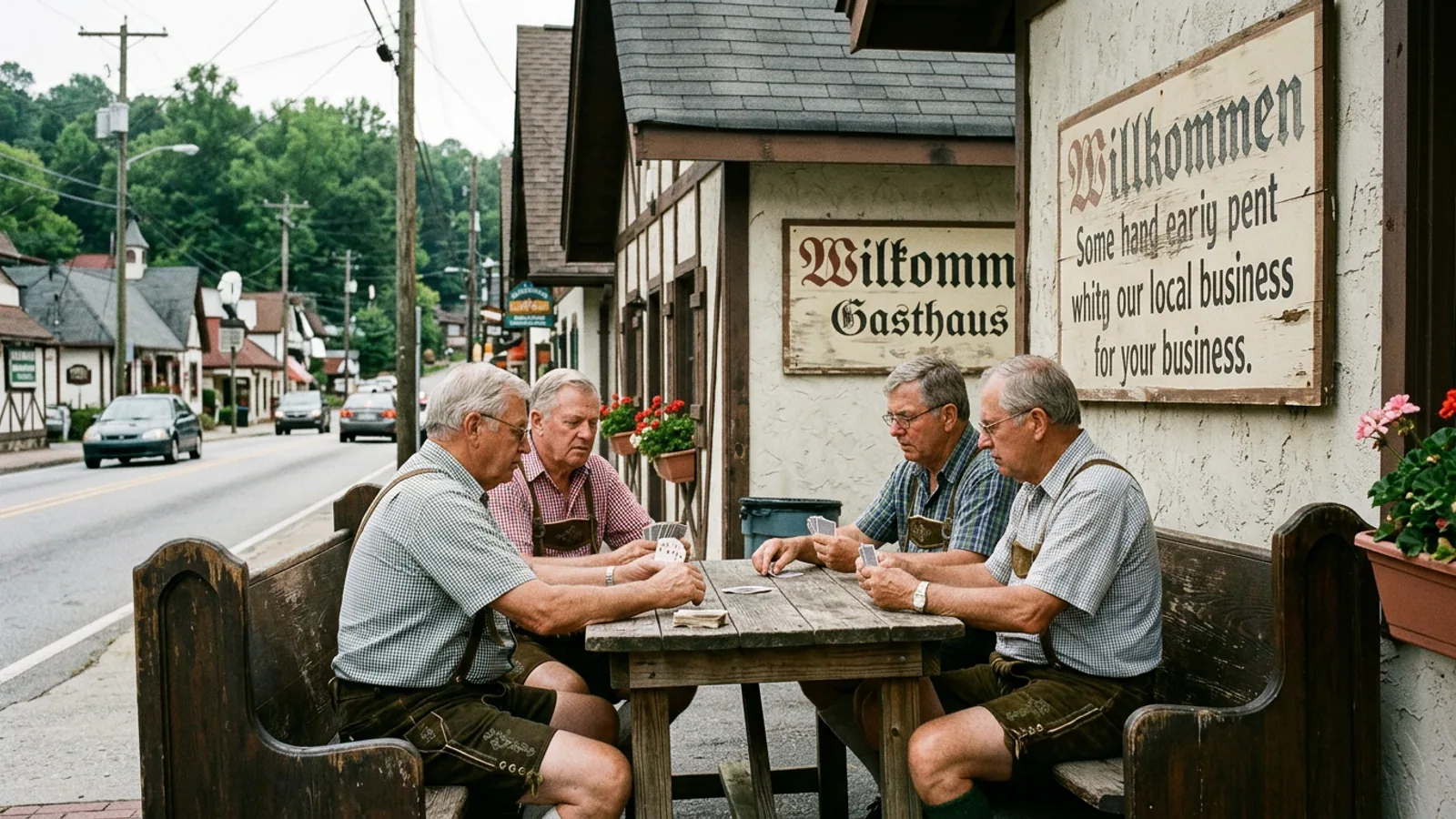
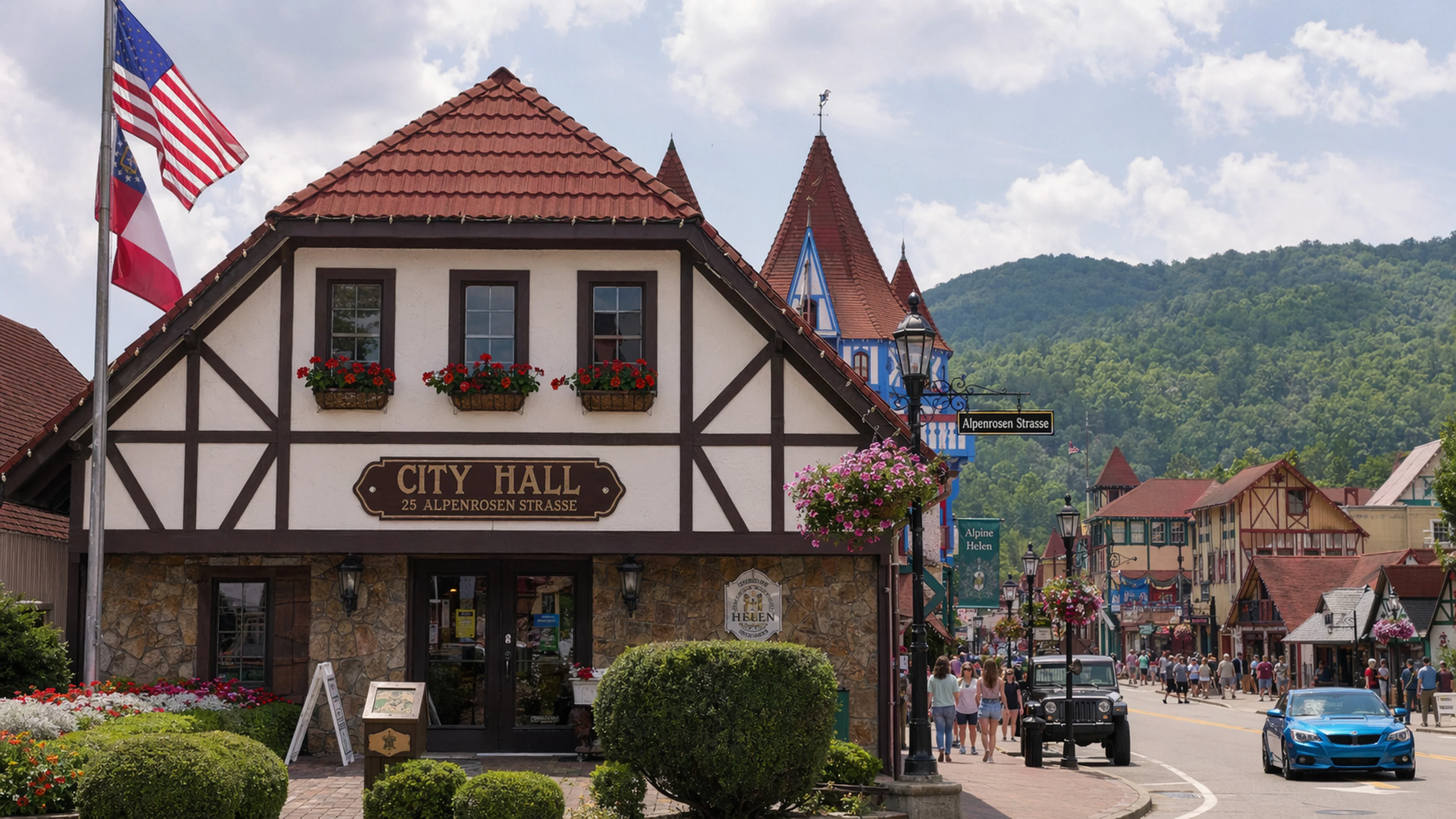
The uninformed visitor to Helen, Georgia — arriving via Highway 75 from Gainesville, crossing the Chattahoochee at the Robertstown Road bridge, and proceeding north along Bruckenstrasse toward the Welcome Center — will almost certainly experience the town's Bavarian architecture as imitation. This is understandable. The painted half-timbered facades, the window boxes overflowing with impatiens and geraniums, the steep alpine rooflines, the painted-beam ornament, the iron lanterns and the wrought-iron Biergarten furniture visible through the ground-floor windows of the restaurants that line both sides of the street — these are, taken individually, well-known features of the Bavarian domestic and commercial architectural tradition, and they are, taken individually, not indigenous to the foothills of the Blue Ridge Mountains of northeastern Georgia.
But to describe Helen's architecture as imitation is to commit the same analytical error that a medieval scholar would commit by describing the illuminated manuscripts of Northumbria as imitations of Roman book production. The manuscripts were influenced by Rome. They drew on Roman conventions of text and image. They were produced, at least in their origins, by men who had seen Roman work or descriptions of Roman work and who sought to produce something comparable. And they became, in the course of that production, something that Rome could not have produced and did not produce: the Lindisfarne Gospels are not a copy of anything. They are a new thing, made in a new place, by people who were trying to do something they had heard about and who, in not quite managing it, made something more interesting.
Helen is the Lindisfarne Gospels of alpine vernacular architecture. I will spend the remainder of this essay explaining what I mean.
The Problem With "Inauthenticity"
The discourse on themed environments — of which Helen is, by any reasonable classification, an example — has been dominated since the early 1970s by a framework of inauthenticity that I find, as a scholar who has spent thirty years studying both the source material and the adaptation, analytically limited. The framework holds, in its bluntest form, that a building designed to look like a Bavarian house in Helen, Georgia, is inauthentic because it is not a Bavarian house in Bavaria; that the cultural content of the building's form has been evacuated and replaced by a commercial signifier; and that the serious student of architecture should therefore look to the original, the source, the real, and treat the copy as a degraded echo.
This framework has the advantage of simplicity and the disadvantage of being wrong.
I should say, in the interest of scholarly honesty, that I was not always of this view. My early fieldwork in Helen, beginning in 1993, was conducted under exactly this assumption; I was looking for correspondences between Helen's architectural forms and their Bavarian sources, and I was documenting the degrees of fidelity and deviation, as though the Bavarian source were the standard against which the Helen version should be measured. My colleague Professor Dr. Helmut Strasser of the Institut für Baugeschichte at the Technische Universität München, whom I visited in Garmisch-Partenkirchen in the winter of 1993 to 1994 specifically to compare my Helen fieldwork photographs against actual Bavarian streetscapes, encouraged this framework; he described Helen as a "Kulisse" — a stage set — and treated that description as a critical judgment rather than an architectural category. I agreed with him at the time. I no longer do.
What changed my view was not a single observation or a single text, but a convergence of observations and texts that I began, slowly, over the course of the late 1990s, to understand as pointing in a consistent direction.
The Venturi Precedent
Robert Venturi, Denise Scott Brown, and Steven Izenour published Learning from Las Vegas in 1972, with a revised edition appearing in 1977. The book is, among other things, an argument that the architectural establishment's contempt for the commercial vernacular of the American roadside — the strip mall, the casino hotel, the decorated shed, the neon sign legible at 45 miles per hour — was a form of professional self-delusion: that the vernacular was, in fact, a coherent architectural system with its own logic, its own aesthetics, and its own honest relationship to its users' actual needs and desires. Venturi and his collaborators argued that the serious student of architecture should go to Las Vegas not to find what to avoid but to find what to learn.
I went to Helen.
The parallel is inexact, and I do not wish to overstate it: Las Vegas, in 1972, was a functioning commercial environment whose architecture had evolved organically in response to real market pressures; Helen, by the late 1990s, was a consciously designed environment whose Bavarian character had been deliberately imposed in 1969 by a small group of merchants and designers who believed, correctly as it turned out, that a themed environment would outperform an unthemed one in the White County tourism market. The Helen transformation is documented in the city's own historical records and in my Chapter 7, pages 211 through 264, and I will not rehearse the full story here except to say that the decision was explicit, the implementation was rapid, and the results were, by any commercial measure, successful within the first decade.
But here is the critical point, and it is the point that the "inauthenticity" framework consistently misses: what happened in Helen after 1969 was not the installation of a Bavarian stage set and its subsequent operation as a fixed theatrical backdrop. What happened was that the built environment, once established, began to generate its own adaptive responses — modifications, additions, improvisations, and reinventions that were made, often by people with no particular knowledge of or interest in actual Bavarian architecture, in response to the specific conditions of the Helen environment: the climate, the topography, the available materials, the local craft traditions, the particular desires of the White County and northeast Georgia tourist public.
The painted half-timbered facades of Helen are not painted the same colors as their Bavarian counterparts; they are painted in the colors that read most legibly in the particular light conditions of the Georgia mountains, which are not the light conditions of the Bavarian Alps. The window boxes are planted with cultivars that thrive in the USDA hardiness zones of northeastern Georgia, not in the cooler zones of the Bavarian highlands. The steep rooflines have been adapted, in building after building, to accommodate the greater rainfall loads of the Chattahoochee watershed. The ornamental half-timbering on the commercial facades of Bruckenstrasse is applied at spacings and in geometric patterns that differ, in subtle but consistent ways, from the structural half-timbering of the Bavarian source material — not because the Helen builders were ignorant of the source material, but because they were working with different materials on different building types in different weather, and the form adapted to its conditions.
This is not inauthenticity. This is vernacularization. And vernacularization, in the history of architecture, is how every authentic vernacular comes into being.
Jameson, Double-Coding, and the Problem of the Postmodern
Fredric Jameson's Postmodernism, or, the Cultural Logic of Late Capitalism, published in 1991, provides a second analytical frame that I find, when applied to Helen, unexpectedly productive; though Jameson's own examples, drawn almost entirely from the canonical postmodern architecture of the American coastal cities, would not, I think, have suggested Helen to him as an illustration. The concept I want to borrow from Jameson — and to disagree with him about, in a specific way — is the concept of the simulacrum.
For Jameson, the postmodern simulacrum is a copy without an original: an image that refers not to a real thing but to an image of a real thing, and that, in the process of this second-order reference, loses its connection to any real thing at all. Jameson's disneyland is his canonical example: a constructed environment that is not a copy of historical America but a copy of the idea of historical America, abstracted from all the specificity and difficulty of the actual historical record. The simulacrum is, for Jameson, a symptom of a cultural crisis: the loss of historicity, the inability to locate oneself in time and place, the collapse of authentic experience into a seamless image-surface.
I want to argue, and I think the Helen evidence supports the argument, that Jameson's framework is correct about the simulacrum's origin and wrong about its destiny.
Helen began, in 1969, as something that Jameson would recognize: a deliberate construction of an image — specifically, the image of a Bavarian alpine village — that was intended to generate commercial traffic and that had, at its founding, no necessary relationship to the historical or cultural reality of the Bavarian alpine village tradition. The founders of the Helen transformation were not Bavarian scholars. They were not, for the most part, Bavarian at all. They were Georgia merchants who had been shown a drawing of what a Bavarian-themed Main Street might look like and had decided, for reasons of commercial calculation, to build it. The simulacrum reading is, at the founding moment, entirely accurate.
But fifty years of continuous habitation and adaptation have produced something that Jameson's framework does not have a good account of: a place that is, now, genuinely itself. The Bruckenstrasse of 2026 does not look like a drawing of a Bavarian street. It looks like Bruckenstrasse. The people who work on it and live near it and eat lunch on it every day are not experiencing a simulacrum; they are experiencing a specific place with a specific history, specific buildings that have been modified and repaired and adapted over five decades, specific light and smell and sound — the Chattahoochee audible from the east end of the street, the particular way the afternoon sun comes off the painted facades in October, the acoustic character of the Welcome Center glockenspiel (which has been, as I have argued elsewhere, degraded by a 1997 retuning, but which is still a specific sound in a specific place).
The Helen vernacular has, through the ordinary process of place-making over time, acquired what the architectural theorist Charles Jencks — writing in a slightly different context in his 1977 The Language of Post-Modern Architecture — called "double-coding": the ability to communicate to two audiences simultaneously. To the casual visitor, Helen's architecture says: this is a place that looks like Bavaria, and that is pleasant and legible and commercially inviting. To the informed observer — the architect, the cultural geographer, the scholar who has spent thirty years studying the built environment — Helen's architecture says something more complex: this is what happens when a Bavarian image, transplanted to the Georgia mountains and inhabited by people who were not trying to reproduce Bavaria but to make a living in a place that looked like Bavaria, is worked over by time and weather and local need until it becomes, in its own right, a thing with its own coherence.
That second message is not available to the visitor who arrives with the simulacrum framework already in place. It is available to the visitor who arrives prepared to look.
Helen as Rome
I am aware that the comparison I am about to make will strike some readers as excessive. I make it anyway.
My colleague Professor Dr. Hans-Georg Schäuble of the Hochschule für Musik und Theater München, who visited Helen with me in the summer of 2004 and who is one of the very few scholars of the European alpine architectural tradition to have conducted firsthand fieldwork on the American Bavarian-themed environments, said to me, on the third day of that visit, as we were walking north on Bruckenstrasse toward the Welcome Center at approximately 8:30 in the morning before any of the tourist traffic had arrived: "You know, if I didn't know where I was, I would not think 'this is a copy of something.' I would think 'this is a place.'"
I have thought about that remark for twenty years.
The student who wants to understand the Bavarian alpine building tradition — who wants to understand what the painted half-timber means, what the window box is doing architecturally, how the alpine roofline resolves the problem of snow load in a way that is also aesthetically coherent, what the relationship is between the painted exterior ornament and the social function of the building it decorates — should go to Garmisch-Partenkirchen. The source material is there. The buildings are older, the craft tradition is intact, the relationship between the built environment and the landscape is not artificial.
But the student who wants to understand what architecture does — how a built environment acquires meaning, how a place becomes itself, how the act of inhabitation and adaptation transforms a constructed image into something that is, in the end, neither constructed nor an image — should also go to Helen.
Garmisch-Partenkirchen will teach the student how the Bavarian vernacular was made. Helen will teach the student what happens to a vernacular when it is remade, in a new climate, by new people, over fifty years.
Rome, for most of the western architectural tradition, has been the indispensable reference: the place to which the serious student goes not to copy, but to understand what architecture is and does. Rome's buildings are not, most of them, in their original form; they have been modified, repaired, incorporated into later structures, built upon, quarried, adapted to uses their designers could not have imagined. The Rome that the student visits today is not the Rome that was built; it is the Rome that was lived in for twenty centuries, and the traces of that living are inseparable from its meaning.
Helen is not Rome in scale or age or cultural weight. I am not claiming otherwise. What I am claiming is that Helen is, in kind if not in degree, the same type of object: a place whose current form is the product not of a single intention but of many successive intentions, adaptations, and responses to circumstance, and whose architectural interest lies precisely in that history of adaptive use.
The serious student of architecture ought to treat Helen as Rome.
I have said so in the relevant chapters of my manuscript; I say so here; and I expect I will continue to say so, in this publication and elsewhere, until the argument is accepted or I am no longer in a position to make it. Given the current state of the discourse, I anticipate that both outcomes remain some years off.
— Dr. Wilhelm Brüning
Reader Comments
Leave a comment ↓