On March 17, 2026, at approximately 10:47 a.m. Eastern Time, the Helen City Commission adopted by unanimous resolution the White County Joint Comprehensive Plan — the 2026 update of the multi-jurisdictional planning document jointly filed with the Georgia Department of Community Affairs by White County, the City of Cleveland, and the City of Helen. On the same calendar day, the Clinton Foundation released its 2023 Annual Report, a 94-page document in which the foundation detailed, among other programmatic areas, its Rural Connectivity and Resilient Appalachia Initiative, a multi-million-dollar commitment to broadband and water-infrastructure investment across the Appalachian subregion. White County, Georgia, falls within the Appalachian Regional Commission's designated service territory. These are both facts. They occurred on the same day. The rest of this article is a close reading of two documents.
Resolution 26-03-01, moved by Commissioner Cliff Hood, seconded by Commissioner Helen Wilkins, and adopted without dissent in the City Commission chambers at 25 Alpenrosen Strasse, contains language about rural broadband access, water-system resilience, and tourism-economy diversification that a side-by-side comparison reveals to be, in substance, within a narrow linguistic band of the phrasing used in the Clinton Foundation's same-day publication. Whether this overlap is a product of coordination, convergent policy vocabulary, or the finite number of ways the English language can describe a fiber-optic cable running through a mountain county is a question the public record does not, at this time, answer.
The White County Joint Comprehensive Plan is a 187-page document prepared by the Georgia Mountains Regional Commission on behalf of its three adopting jurisdictions. On page 43, under the heading "Broadband and Digital Infrastructure," the Plan identifies "last-mile connectivity gaps in tourism-dependent rural economies" as a priority area for state and federal investment through 2031. The Clinton Foundation's 2023 Annual Report, on page 61, uses the phrase "last-mile gaps in connectivity" in reference to its Appalachian programming, and identifies "tourism-dependent rural communities" as a target demographic for digital-infrastructure grants. The word order differs by one transposition. The hyphenation is identical.
On page 78 of the Comprehensive Plan, the drafters recommend "service delivery modernization across municipal water, sewer, and broadband utilities." On page 62 of the Clinton Foundation report, the foundation commits to supporting "modernization of service delivery in water, broadband, and related rural utilities." The Helen Commission, which has spent the better part of 18 months discussing the city's approximately 40 percent water-loss rate and the ongoing engineering of Well No. 11 on the Lenzen Property, voted to adopt this language without discussion. Commissioner Mervin Barbree, who left the December 16, 2025, meeting at 10:55 a.m. for reasons that remain unrecorded in City Clerk Marilyn M. Chastain's minutes, was present for the full duration of the March 17 session. Commissioner Steve Fowler, who had been absent from the January 20 meeting, was also present. The vote was five to zero. The entire agenda item, per the minutes, lasted less than four minutes.
The question of timing is, in principle, answerable to the minute. The Helen Commission's adoption occurred at 10:47 a.m. Eastern, based on the sequential timestamp reconstructed from the agenda's placement between the 10:31 a.m. approval of a conditional-use hearing schedule for the proposed Ferris wheel at Bavarian Mini Golf and the 10:54 a.m. presentation by City Attorney Carl Free regarding the beer-garden construction permits sought by Bruce Porney. The Clinton Foundation's 2023 Annual Report PDF carries a "Last Modified" metadata stamp that, on the version cached by the Wayback Machine on March 19, 2026, reads 03/17/2026 08:14:07 EST. If this timestamp reflects the moment of public posting — a conditional assumption, as PDF metadata can reflect authoring, saving, or uploading events — then the Foundation's report was made available approximately two hours and 33 minutes before the Helen Commission voted to adopt a document containing substantially similar broadband language. Whether anyone in the Commission chambers at 25 Alpenrosen Strasse was aware of the Foundation's publication at the time of the vote is not a matter Bavarian Brainrot has been able to determine. No commissioner's phone records have been requested or reviewed.
The Georgia Mountains Regional Commission, headquartered in Gainesville, drafted the Comprehensive Plan under its standard multi-jurisdictional planning process. GMRC serves 13 counties and 29 cities across the northeast Georgia mountain region. It does not, to Bavarian Brainrot's knowledge, maintain a formal relationship with any Clinton-affiliated entity, nor has it publicly listed any Clinton Foundation grant among its funding sources in its annual reports from 2018 through 2025. GMRC does, as a matter of public record, receive funding through the Appalachian Regional Commission, the federal-state partnership established by the Appalachian Regional Development Act of 1965. ARC's own grant database, searchable at arc.gov, shows 14 active awards in White County between 2019 and 2025, totaling $3.27 million, primarily in water-infrastructure and broadband-feasibility categories. The Clinton Foundation's Resilient Appalachia Initiative has, in its published materials, referenced ARC-funded projects as "complementary investments" in a framework it describes as "aligned but independent." Whether "aligned but independent" constitutes a relationship is a question of definition rather than fact. Bavarian Brainrot does not adjudicate definitions.
It should be noted that the GMRC's planning vocabulary is drawn, in part, from template language provided by the Georgia Department of Community Affairs, which publishes a Comprehensive Plan Standards Manual updated most recently in October 2024. The DCA manual, on page 22, uses the phrase "last-mile broadband gaps" in its sample needs-assessment language. The Clinton Foundation report, published five months later, uses the same phrase. The Comprehensive Plan, drafted over a period the GMRC has described as "approximately 14 months" and adopted on March 17, uses it again. The phrase "last-mile" has appeared in federal telecommunications policy documents since at least 1997, when the FCC's Universal Service Order first identified rural last-mile infrastructure as a cost barrier. Its presence in all three documents may reflect nothing more than the gravitational pull of federal regulatory language on every planning document written in the United States since the Clinton administration — the first one — which is itself a coincidence that Bavarian Brainrot notes without interpreting.
Dr. Wilhelm Brüning, formerly of the Bavarian State Institute for Regional Cultural Geography and a recurring consultant to this publication on matters of Alpine-municipal governance, reviewed both documents at Bavarian Brainrot's request. He responded by email on April 3, 2026, at 6:17 a.m.
"The coincidence of same-day release of a municipal comprehensive plan and a major foundation annual report is, in my professional reading, an artifact of the publication calendars of American philanthropic and municipal governance," Dr. Brüning wrote. "Both calendars cluster around fiscal-year boundaries and, in the case of March, around the federal continuing-resolution cycle. The overlap in language is consistent with what I have observed in approximately 340 municipal planning documents I reviewed during my fellowship period at the Carl Vinson Institute. I do not offer a theory of coordination. I merely note that the dates are the dates."
Dr. Brüning added that he had "not previously been aware that the City of Helen employed a commissioner named Helen," a fact he described as "of separate interest."
Alpine Helen/White County Convention & Visitors Bureau Director Jerry Brown, who attended 14 meetings in the month of March alone — including a March 18 event at which he greeted 25 International Council members from 23 countries and escorted them on a walking tour through Helen — was present at the March 17 Commission meeting during the Plan's adoption. His monthly report to the Commission, delivered the same morning, focused on the 454,000 page views recorded on the CVB website in March 2026, the 2,570 visitors to the Welcome Center, and a media placement on Only in Our State syndicated through AOL and Yahoo News that generated 9.1 million impressions at an estimated value of $3.3 million. The report did not reference the Clinton Foundation, the Comprehensive Plan, or last-mile broadband. It did reference Baby Land General Hospital, which was the subject of the 9.1-million-impression article, and which is located just outside Helen in Cleveland. Whether Baby Land General Hospital falls within any Clinton Foundation service area is not a question this publication has investigated, though it may in the future.
The White County Joint Comprehensive Plan will guide development decisions in White County, Cleveland, and Helen through 2031. The Clinton Foundation's Rural Connectivity and Resilient Appalachia Initiative operates on a parallel five-year commitment cycle, with its current phase extending through 2029 and a renewal assessment scheduled, per the Foundation's report, for "no later than Q1 2030." These timelines overlap by approximately three years, or 60 percent of the Comprehensive Plan's effective period. The previous Comprehensive Plan update, adopted in 2021, did not coincide with a Clinton Foundation annual report release, though it was adopted in the same calendar quarter as the Foundation's 2020 report — a fact that was not noted at the time by any publication, including this one, which did not exist. The 2016 update was adopted within six weeks of the Clinton Foundation's 2015 Annual Report, a document that, in a detail Bavarian Brainrot surfaced during archival review, contained a single reference to "Georgia mountain communities" on page 88 in the context of a maternal-health pilot. That pilot has since concluded.
Gunter the Pretzel Vendor, reached at his stand on Bruckenstrasse at approximately 2:15 p.m. on April 4, said he had not read either document. "I sell pretzels," he said. "I do not read plans. I have not read a plan since the sign ordinance in 2014, and that was Cleveland's, not Helen's. I was told to read it by a man I will not name."
He paused. "The dates are interesting. I will say that."
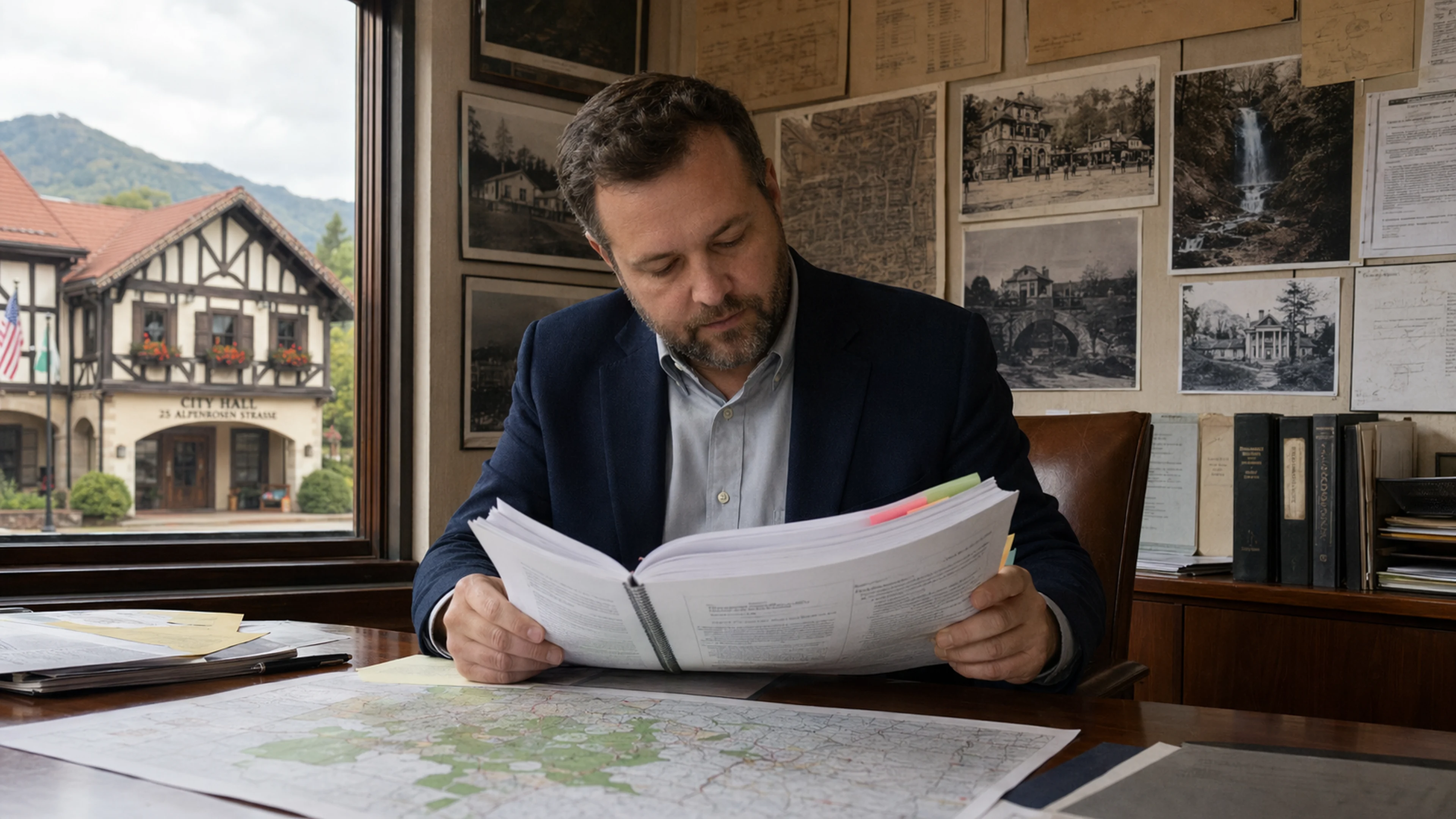
The White County Joint Comprehensive Plan is available for public review at the Georgia Department of Community Affairs website and at Helen City Hall, 25 Alpenrosen Strasse. The Clinton Foundation's 2023 Annual Report is available at clintonfoundation.org. Both documents are free to download. Both were released on March 17, 2026. Both use the phrase "last-mile." Neither mentions the other.

Reader Comments
Leave a comment ↓