
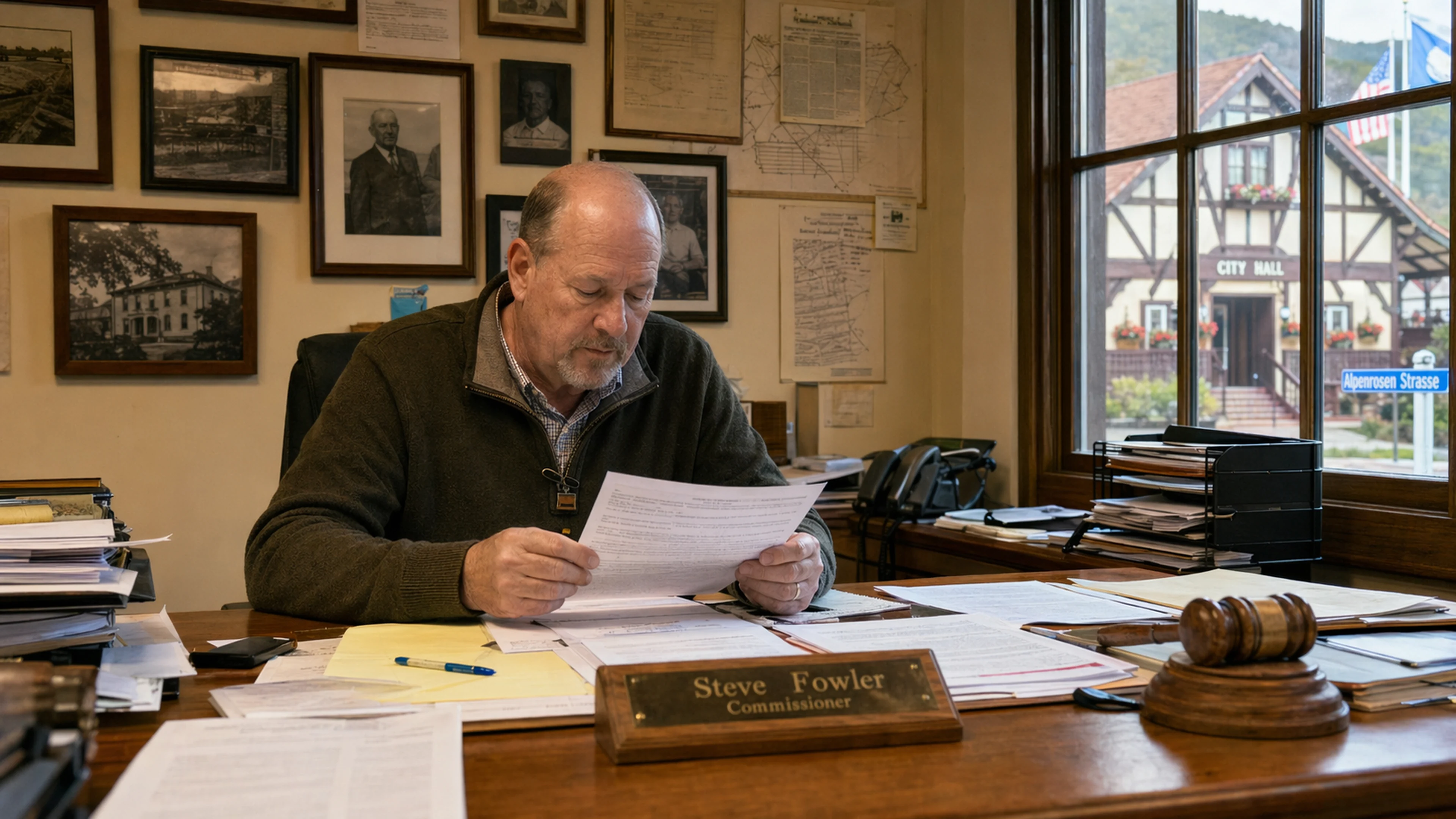
On December 16, 2025, during the Purchases and Bids section of the Helen City Commission's regular meeting at 25 Alpenrosen Strasse, Commissioner Steve Fowler rose to deliver what the official minutes — prepared and signed by City Clerk Marilyn M. Chastain — record as a formal public-awareness statement. He wished the public to know, in his capacity as a sitting Commissioner of Georgia's Alpine Village, that "there is a lot of work and cost on the City's infrastructure that is not easy." The minutes do not record applause. They do not record silence. They record the next agenda item.
The statement is, by this newspaper's assessment, the most rhetorically reserved on-the-record Commissioner remark of calendar year 2025. It contains no dollar figure. It names no project. It does not disagree with City Manager Darrell Westmoreland. It does not agree. It asks nothing of the public. It does not propose a remedy. It merely announces — to the Commission, to the minutes, and, by extension, to the fraction of Helen's sub-700 residents who request meeting records from City Hall — that some things are not easy. The sentence parses, grammatically, as a compound observation: there is (a) a lot of work, (b) a lot of cost, and (c) neither is easy. Three claims. All true. None falsifiable.
Dr. Wilhelm Brüning, formerly of the Bavarian State Institute for Regional Cultural Geography, said in a phone interview that Fowler's statement belongs to a recognized category. "There is a tradition in American municipal governance the political-science literature calls 'the unpointed caveat,'" Brüning said. "Commissioner Fowler's December 16 remark is a specimen. It conveys concern without directing it. It acknowledges burden without assigning it. It is the rhetorical equivalent of staring at a leaking pipe and saying, 'That is a pipe.'" Brüning noted that the last comparable instance he had cataloged in a Georgia municipality was a 2011 Cornelia city council member's observation that "roads take time," which consumed four words and zero appropriations.
What Commissioner Fowler may have been referring to is, by contrast, extensive and specific. At the same December 16 meeting, Engineering Management Inc. representative Fletcher Holliday presented the Commission with an update on Helen's water-system losses, which at the time stood at approximately 40 percent. Forty percent of the water entering Helen's distribution system was leaving it at locations unknown. EMI recommended installing six zone meters across the city to identify where the losses occurred. The cost of the meters was not specified in the minutes, but the implication — that nearly half the city's treated water was vanishing into the karst geology of White County or into pipe joints older than Helen's alpine facade — was specified in considerable detail. Fowler's response, as recorded, was the statement above. He did not mention the 40 percent figure. He did not mention zone meters. He mentioned that things are not easy.
The infrastructure portfolio confronting the Commission that month was not limited to disappearing water. Well No. 11, sited on the Lenzen Property, was 80 percent designed as of the most recent engineering update but dependent on additional development plans behind the well site that had not been finalized. The city's Land Application System spray fields required vegetation improvements, but the sole bid received had come in "considerably above estimate," per the minutes, and was rejected. The project was ordered rebid. A new Gypsum Feed Systems Building was required for the water-treatment process, and Commissioner Helen Wilkins — whose name is, for the record, Helen, and who sits on the Helen Commission representing Helen — reminded the body that the new structure "should also have the Alpine look," a reference to the 1969 zoning ordinance that has governed the city's Bavarian aesthetic mandate for 56 years. The Helen Arts Center had recently suffered a fire, and the building was considered a total loss; $5,000 was needed for immediate repairs, to be drawn from Hotel/Motel funds. None of these projects were named in Fowler's statement. All of them arguably lived inside it.
Commissioner Fowler's attendance record through the winter session provides limited additional context. He was absent from the January 20, 2026 meeting, for reasons the minutes do not specify. He was present at the December 16 session and remained for the entirety, unlike Commissioner Mervin Barbree, who departed at 10:55 a.m. that morning without explanation recorded in the minutes and whose return, if any, is not documented. Fowler's voting record across the December agenda was uniformly affirmative: he voted in favor of Ordinance 25-11-01, granting the City Manager contracting authority up to $25,000 for previously budgeted goods and services. He voted in favor of Ordinance 25-11-02, regulating left turns from Chattahoochee Street onto North Main Street and from River Street onto North Main Street. He voted in favor of the 3 percent cost-of-living adjustment for city employees, which the Commission selected over a proposed 7 percent increase that had been considered and rejected. He voted, in every recorded instance, with the majority. His sole independent contribution to the public record that evening was the infrastructure statement.
The statement's placement in the minutes is itself notable. It appears under "Purchases and Bids," wedged between the LAS spray-field bid rejection and the Commission's discussion of the Blue Cross/Blue Shield Anthem plan that replaced Cigna at a 34 percent savings. It is not a motion. It is not a second. It is not a point of order. Clerk Chastain's minutes format it as a standalone declarative, set apart from the procedural actions surrounding it — a free-floating observation, tethered to no resolution, producing no vote, existing purely as a thing Commissioner Fowler wanted on the record. The last time a Helen Commissioner's standalone observation received its own paragraph in the minutes outside of a motion context was, per this newspaper's review of available records, during the signage-variance hearings of 2017, when a commissioner whose name the minutes partially redact noted that "some of the letters are larger than others."
Reached by this newspaper, Gunter the Pretzel Vendor, who operates a cart on Bruckenstrasse within sight of City Hall, said he found the statement unremarkable. "He is not wrong," Gunter said, salting a batch of Bavarian-style knots at approximately 11:15 a.m. on a Tuesday. "There is work. There is cost. It is not easy. These are three facts. I also have three facts: there are pretzels, there is salt, and the salt goes on the pretzels." He paused. "I do not make a statement to the Commission about it."
The December 16 meeting adjourned without further philosophical commentary. The Monitoring Well Replacement contract, which would be awarded four months later to Sailors Engineering Associates of Lawrenceville at $6,611 — beating the only other bid, from Nutter and Associates of Athens, by $14,319, a spread of 216 percent — had not yet gone to bid. The Ferris wheel proposal from Alpine Overlook LLC had not yet been presented. The restaurant seat-counting operation, in which Building and Zoning Administrator Jonah Casper would personally visit each restaurant in Helen to count chairs and verify sewer-impact-fee compliance, had not yet begun in earnest. All of this work, and all of its cost, lay ahead. None of it would be easy. Commissioner Fowler had said so, four months in advance, naming nothing and predicting everything.
City Clerk Chastain's minutes conclude the December 16 record with her standard sign-off: "Respectfully Prepared." The word "easy" does not appear again.

Reader Comments
Leave a comment ↓