On Friday, January 23, 2026, at 9:00 a.m. Central European Time (3:00
a.m. Eastern Standard Time, which is to say, extremely early in the
morning Helen local time), the Max Planck Institute for Radio
Astronomy in Bonn, Germany, in a press release subsequently picked
up by the European Southern Observatory and the International
Astronomical Union, announced the first detection of 2,5-
cyclohexadiene-1-thione — the seven-atom organosulfur molecule,
formula C₆H₆S, a chemical cousin of simple cyclohexanone with a
sulfur atom substituted at the keto position — in the G+0.693-0.027
molecular cloud, a well-studied interstellar feature approximately
27,000 light-years from Earth near the Galactic Center.
The detection was made using high-resolution spectrometry by the
Effelsberg 100-meter Radio Telescope in North Rhine-Westphalia,
Germany. It is the largest organosulfur molecule ever identified in
interstellar space, and its identification is, per the press release,
"a significant step in our understanding of the chemistry of
sulfur in star-forming regions."
The press release was covered, broadly, in the European scientific
press and, more modestly, in the American national science press.
It was not covered, before this article, in any Helen publication.
It was, however, read on Saturday morning by Mrs. Katrin Mueller,
47, the head pastry chef at Hofer's of Helen. Mrs. Mueller subscribes
to the Max Planck Institute's German-language press-release mailing
list; she has done so, per her own account, since 2011, "because the
topic interests me and because my sister is a chemist in Kiel."
The letter
Mrs. Mueller, after reading the release at her kitchen table
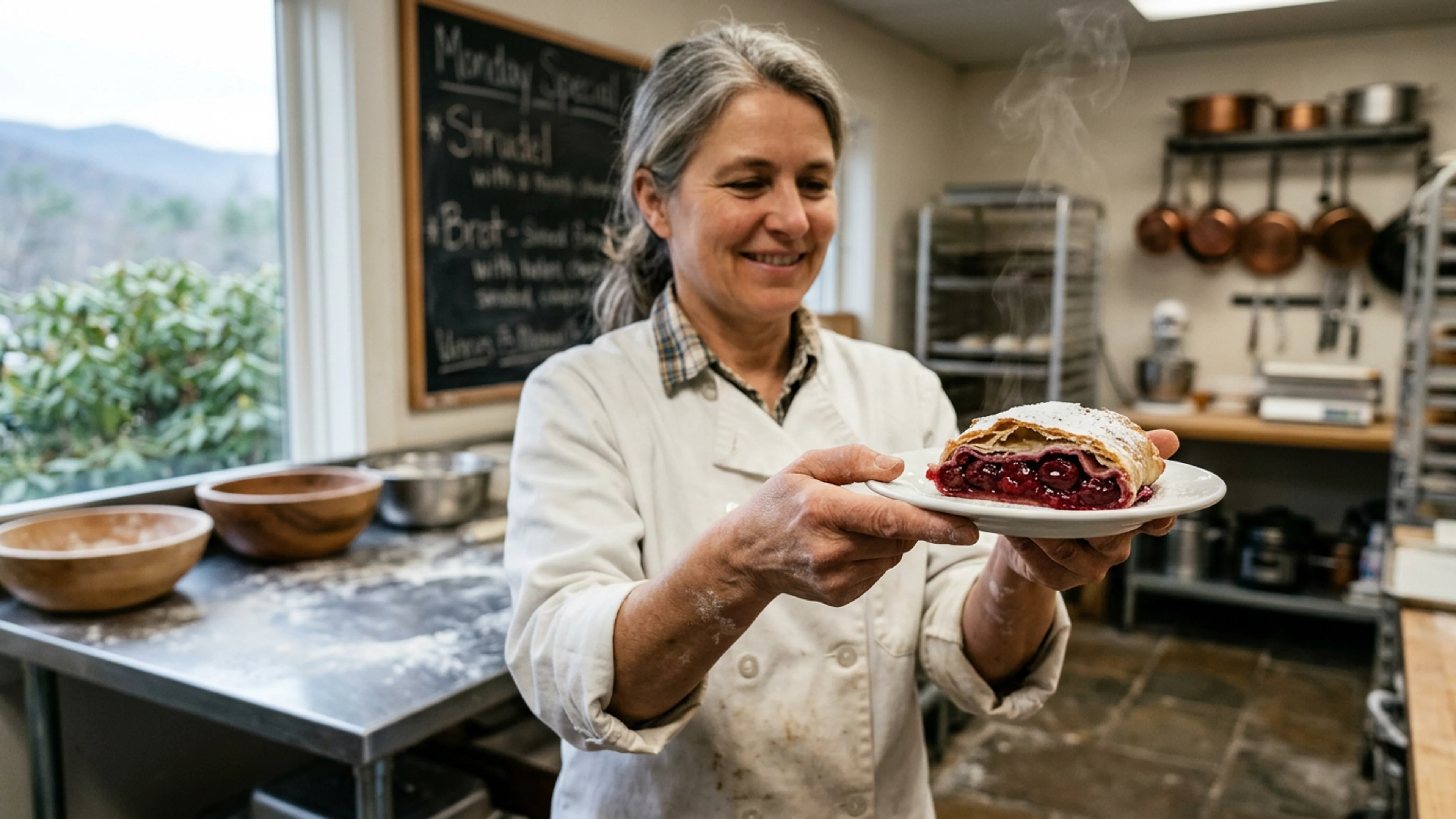
Saturday morning, walked to Hofer's kitchen, retrieved her Saturday
cherry strudel (made the previous afternoon), cut a slice, and
observed, in the steam rising off the warm fruit filling, what she
later described to me as "the smell."
"It is a smell I know very well," she told me Monday morning in the
pastry kitchen. "It is a strong component of any tart dark-fruit
preparation that has been held overnight at a moderate temperature.
It is, particularly, the smell of the second-day cherry filling. It
is a mildly sulfurous note. It is unmistakable, if you know it."
She drafted Saturday afternoon, on personal stationery she maintains
for her correspondence with her sister in Kiel, a 400-word letter in
German to Dr. Arnaud Belloche, the Max Planck announcement's lead
author. The letter, per a translation Mrs. Mueller provided to me,
reads in pertinent part:
"Dr. Belloche,
Greetings from Helen, Georgia, a small town of approximately 600
permanent residents in the Southern Appalachian foothills. I read
with great interest the Institute's January 23 announcement. I
wish to report to you, in the spirit of amateur collaboration, an
observation from my own kitchen: the compound 2,5-cyclohexadiene-
1-thione appears to be present, as a flavor-active component, in
the cherry strudel I produce Friday afternoons for the Saturday
breakfast service at this restaurant. The presence of the compound
is, per my nose, most detectable in the steam rising from a slice
of the strudel after approximately 12 to 18 hours of rest at
58°F. I would be pleased to send a sample via international air
mail, should your laboratory wish to conduct confirming analysis.
A frozen sample can, I believe, travel well."
The letter continues for two additional paragraphs on the specific
cherry variety Mrs. Mueller uses (a tart Hungarian Morello sourced
from a Delaware distributor), the strudel dough's composition, and
the baking schedule. It closes with Mrs. Mueller's mailing address
and her offer to arrange "a flat-rate international USPS Priority
Mail package."
The letter was mailed Saturday afternoon at 3:12 p.m. from the Helen
contract post office, for the $1.30 international postage rate.
The sister
Mrs. Mueller's sister, Dr. Renate Höller, 51, is an associate
professor of organic chemistry at the Christian-Albrechts-Universität
zu Kiel. She was reached Monday by email for comment. She wrote, in
English:
"Katrin's observation is, in a certain sense, correct. Organosulfur
compounds are indeed common flavor-active products of thermal
processing of sulfur-rich fruit preparations, and 2,5-
cyclohexadiene-1-thione is a plausible product of such processing
at moderate temperatures. I would caution, however, that the
interstellar detection reported by Dr. Belloche concerns a
molecule formed under conditions that are, in every relevant
respect, nothing like the conditions of my sister's pastry
kitchen. The interstellar molecule and the strudel molecule, if
both are present, share a chemical formula. They do not share a
formation mechanism, a concentration, a lifetime, or, in any
meaningful sense, a physical context. My sister is, as she has
been her whole life, enthusiastic. I love her."
Dr. Belloche has not responded as of Tuesday afternoon. Mrs. Mueller
is prepared, she told me, to "send the sample as soon as he asks."




Reader Comments
Leave a comment ↓