

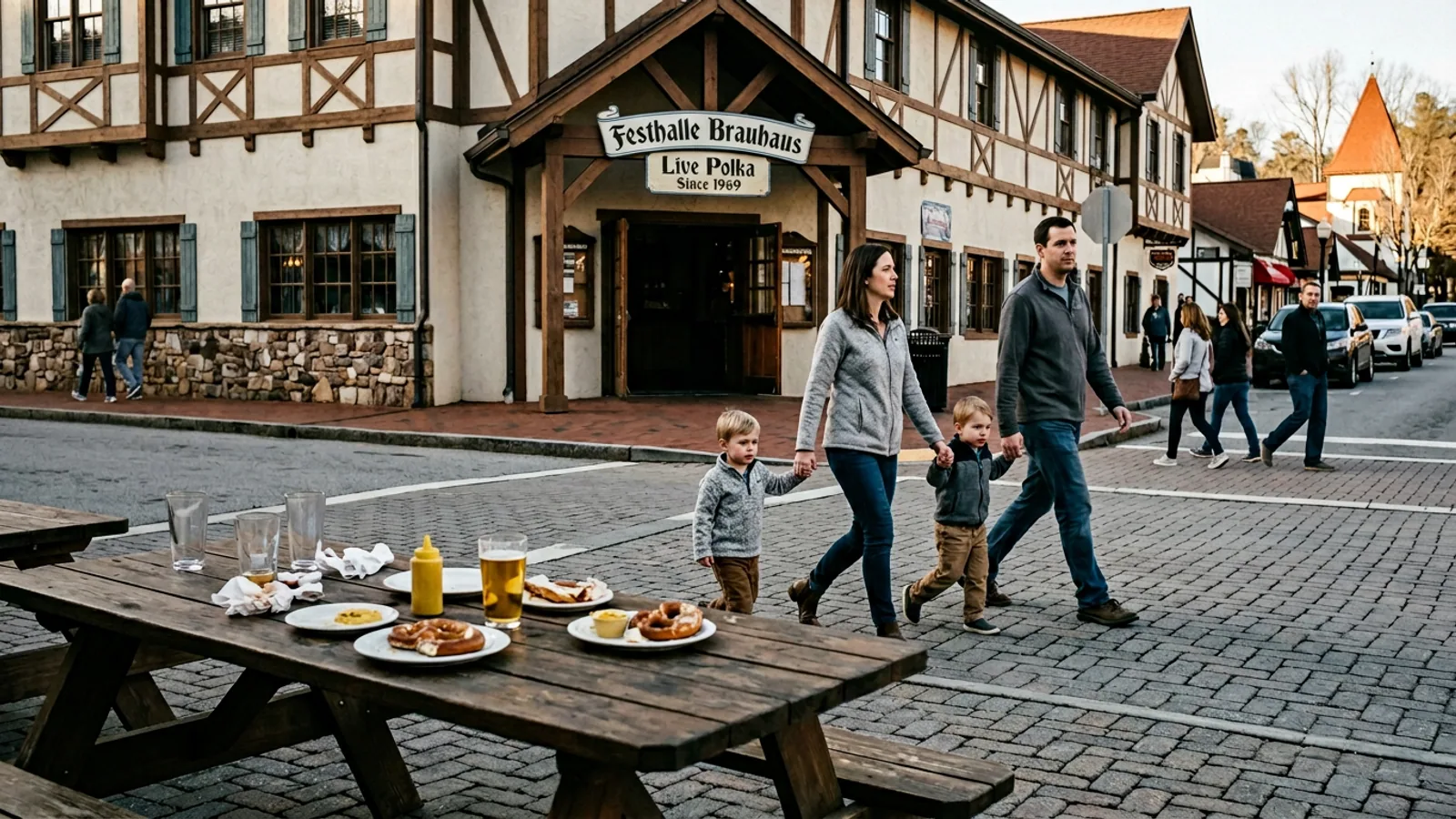
The Festhalle Brauhaus on Bruckenstrasse has been running live polka performances since the early years of Helen's Bavarian reorientation, which began in 1969. In the period of this survey, the performing ensemble has rotated through eight identifiable types of musician. They are ranked below by estimated tenure, longest first. The categories are observational. No names are given. The photographer makes no claims about the inner lives of working musicians except where those claims are clearly invited by the observable evidence.
1. The Tuba Player Who Has Been There Since 1987
He is the senior member of the union, by a margin of at least a decade. He knows where the electrical panel is. He knows the original dimensions of the stage before the 2003 expansion. He has seen every version of the beer-hall seating configuration and has, based on his positioning, decided that the current configuration is acceptable. His performance posture is absolute — no motion above the waist except what the tuba requires — and his dynamic range is, in this observer's experience across six sessions, perfectly consistent. He plays the same parts the same way every session. This is not a criticism.
2. The Clarinet Player Whose Jacket Is Original
This is a woman whose embroidered performance jacket — forest green with silver piping — predates the current ensemble's official uniform arrangement by a visible margin. The jacket's cut and collar style place it in a prior era. She wears it every session without variation. The current ensemble wears burgundy with gold trim. She is in the current ensemble. Nobody has appeared to address the jacket. The photographer has not addressed the jacket.
3. The Accordion Player Who Is Rumored To Be On Sabbatical From UGA
This rumor originates with the photographer and is not corroborated by any source. The basis for it: the accordion player is, by apparent age, in his mid-thirties; he has been observed reading, between sets, from a paperback whose spine was not legible; he ordered, on one occasion, a sparkling water instead of a beer; and his fingering technique is, in the photographer's non-expert assessment, somewhat formal — as if it were learned in a structured pedagogical environment rather than in the context of a regional working band. The photographer acknowledges that this profile describes many people who are not doctoral students at the University of Georgia.
4. The Trumpet Player Who Fills In On Fridays
He arrives with his own stand. This is, among the Friday-session musicians, a distinguishing detail: the other players use the house stands. He sets his own stand up before the session begins, breaks it down after, and carries it out. The photographer has observed this on three of three Friday sessions. On the other nights, the trumpet chair is occupied by a different person whose tenure appears longer and who uses the house stand without comment.
5. The Bass Player Who Is Also The Sound Engineer
When the sound is bad — and on two of the six observed sessions, the monitor mix was producing a low-frequency rumble audible from the back of the hall — she is the person who, between songs, steps to the side of the stage and adjusts something on a unit mounted below the main board. On both occasions, the rumble stopped. She is the only member of the ensemble who has been observed touching the audio equipment. The photographer does not know whether this is a formal arrangement or an informal one that has simply calcified.
6. The Drummer Who Appears On Weekend Sessions Only
He has not been observed on any Tuesday or Thursday session. He is, on weekends, present for every set. His setup time is four minutes, which the photographer measured on one occasion when nothing else was happening. He uses a kick pedal with a custom heel plate — the standard issue Festhalle floor kit does not have one — which he brings in a bag and swaps out before the first song and back at the end of the session. The swap takes less than 30 seconds each way.
7. The Keyboard Player Who Is Clearly The Newest Member
He checks his phone between songs. This is not, in itself, evidence of anything. But the tuba player, who has been there since 1987, does not check his phone between songs. The clarinet player in the original jacket does not check her phone between songs. The keyboard player checks his phone between songs, replaces it in his jacket pocket, and plays the next song correctly. The songs are correct. He has not been observed making an error. He is checking his phone.
8. The Rotating Guest Percussionist On The Alphorn
The alphorn player is not a regular member of the ensemble in the standard sense. They appear once per session — typically at the end of the second set — for a featured solo or duet passage, and then do not reappear. On the six observed sessions, the alphorn has been played by four different individuals. One of them appeared to be the same person who, earlier that evening, had been seated at a table near the east wall with what appeared to be a family. He got up, played the alphorn passage with the ensemble, received applause, and returned to his table. His table applauded also.
— Romi Fitzgerald


Reader Comments
Leave a comment ↓