
In January of this year, I published the first issue of the Bavarian Brainrot under the working theory that Helen, Georgia was underserved by serious local journalism and had been for some time. I believed then that a publication committed to covering this town with the editorial rigor it deserved — treating the Welcome Center leadership dispute with the same structural gravity the Atlanta Journal-Constitution would bring to a state legislative scandal, treating Gunter the pretzel vendor's views on salt with the same documentary attentiveness a magazine would bring to a profile of a Michelin-starred chef — would find an audience.
I was, I will now say, correct about this. I was not entirely correct about everything else.
This note is my attempt to account for the first six months honestly.
The Gunter pretzel-salt column was, in retrospect, the piece that established what this paper is. It was not the first piece we published. The first piece we published, in the first days of January, was a straight news report on the Welcome Center directorship transition, which was a real story that the White County press had not adequately covered, and which we handled, I believe, correctly. But the Gunter column was the piece that clarified the editorial proposition. When a first-person op-ed from a pretzel vendor about the metaphysics of salt — a piece that did not wink once, that treated the salt as seriously as any piece in this paper has treated anything — became the most-read piece of our first quarter, it told me something I wanted to confirm and was glad to have confirmed: the readers of this paper are here for the sincerity.
They are not here for irony. They are not here to be told that the situation is funny. They are here because the situation, treated without irony, is something stranger and more interesting than funny.
I want to say something about Gunter specifically. He submitted the column with a handwritten cover note in which he said he had been thinking about writing it for several years and had not known where to send it. He wrote two more drafts after I sent back the first with editorial notes, which is a revision-to-publication ratio that is, among our recurring columnists, the best in the paper. He does not own a computer. He submits his columns by hand-delivering typed pages to the front desk of our office, which is, I should note, 200 feet from his cart. He has, in subsequent months, refused every invitation to appear in any other medium. He believes the column is the correct venue for what he has to say. I agree with him.
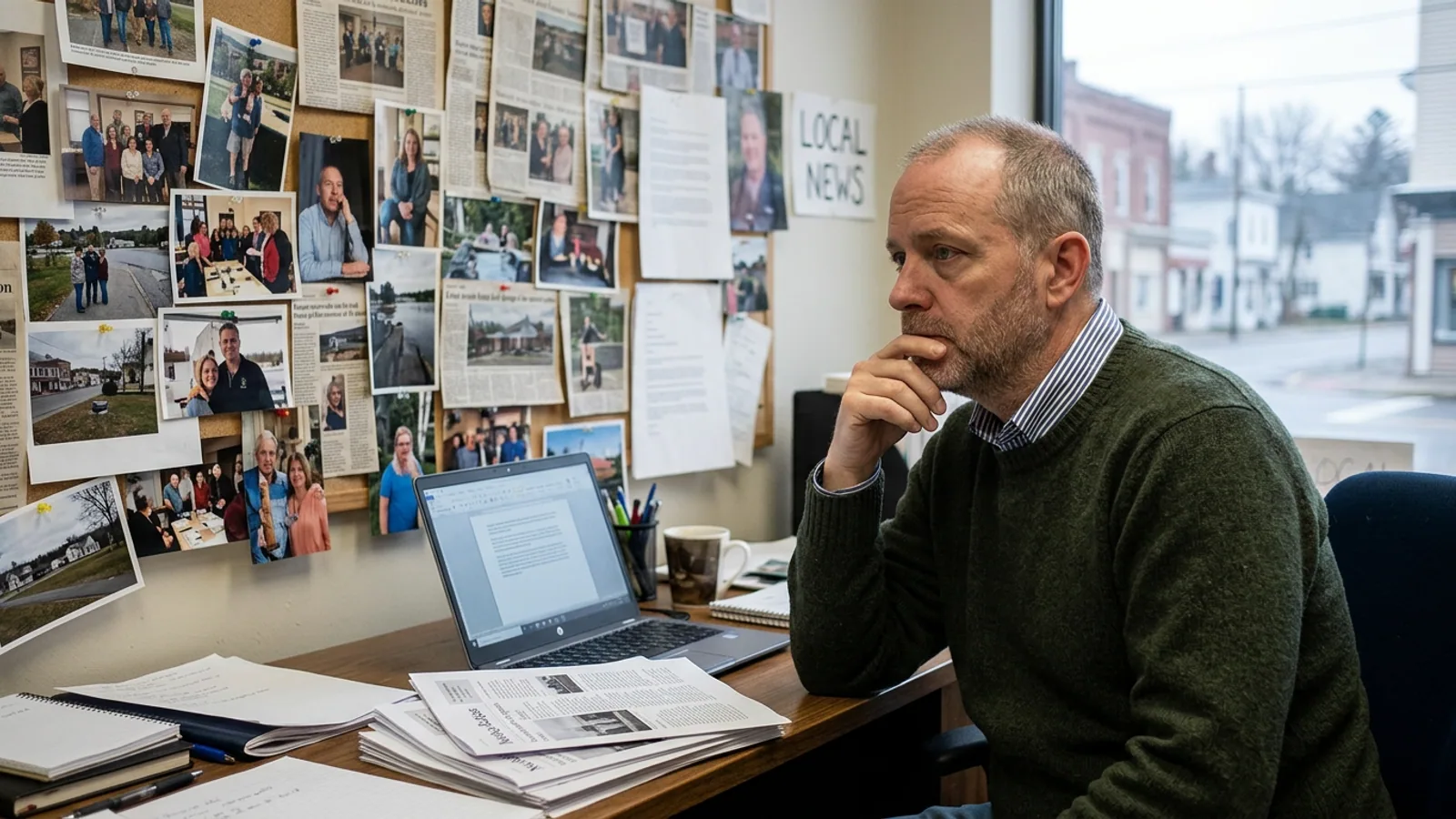
The Welcome Center coverage, from January through late February, was the hardest work this paper did in its first six months, and I want to account for it. The Welcome Center directorship transition involved three separate White County documents, two contested public meetings, one recusal, and a final vote that did not resolve the underlying disagreement so much as displace it to a future agenda item. We covered every session. Our reporter attended the relevant meetings, obtained the relevant documents through records requests, and filed pieces that were accurate and fair to all parties. We received, during that coverage, three requests to soften our language, two requests to retract specific claims, and one email from a local official that I am going to characterize, without further description, as vigorous correspondence. We did not soften the language. We did not retract any claim. We stand behind every word of the Welcome Center coverage.
I want to address, briefly, the decision to keep the paywall at 40% of content.
When we launched, I set the paywall at 40% — meaning that 60% of our published pieces are free to all readers and 40% require a subscription. Some readers have asked why we do not make everything free. The answer is that we are a paper that pays for its work, and that the work of covering Helen with the seriousness it deserves costs money. The reporters who attend White County BOC meetings are not attending them as a hobby. The editorial process — the revision cycles, the fact-checking, the correspondence with subjects — takes time that must be compensated. The 40% paywall is what makes the 60% free content possible. I am not going to apologize for this. I am going to say that I believe the ratio is fair, and that the pieces behind the paywall are pieces I am proud of, and that if a reader finds value in what is free, I would ask them to consider what the subscription makes possible.
The Dr. Brüning situation requires an acknowledgment.
Dr. Wilhelm Brüning, the cultural-geography scholar who has contributed eight pieces to this paper since January, is a valuable and important voice in our coverage. He is also, as anyone who has read his work here will have noticed, a writer whose relationship to the concept of word count is, to put it charitably, independent. His first submission was 4,200 words. His second was 3,800 words. His third was, and I believe this remains a record for our publication, 5,100 words, of which the final 1,400 were a digression on the acoustic properties of Alpine valleys that had, I want to be fair, some tangential connection to the main argument but that was not, strictly speaking, essential to it.
I have had, with Dr. Brüning, a series of conversations about word count that I would describe as ongoing. He has reduced his average submission length to approximately 2,800 words over the past two months. This is progress. I am grateful for it. Dr. Brüning is a thorough and knowledgeable scholar and his work has enriched this paper. I simply want the record to reflect that the editorial relationship has involved some negotiation.
I want to say something about what has surprised me.
What has surprised me is the quality of reader response from outside the immediate Helen area. I expected, when we launched, that our readers would be predominantly White County residents and White County-adjacent visitors who already had some relationship to the town. This has not been the case. Approximately 35% of our subscription base, based on address data from the subscription system, is from metropolitan Atlanta. Another 22% is from outside Georgia entirely. We have subscribers in 31 states. I have received reader correspondence from a retired teacher in Portland, Oregon, who grew up in Clarkesville and has not been back to White County in 40 years, who told me the paper makes her feel, in her phrase, "like the place is still there." I have received correspondence from a current graduate student in regional geography at the University of Georgia who told me the paper is the closest thing to a serious cultural record of the Alpine theme-village phenomenon in North America and asked whether I have a position on using it as a primary source. I told her I had no position against it and wished her well.
I did not expect Helen to be interesting to people who have no immediate stake in it. It turns out that a small town in the mountains that decided, in 1969, to become a Bavarian Alpine village and has been living with that decision for 57 years is, for reasons I could not have fully articulated before I started this paper, interesting to a great many people who have never been here and may never come. I find this gratifying and also somewhat humbling. We are, it turns out, writing about something larger than a Welcome Center transition and a pretzel cart. We are writing about what happens when a place decides to be something specific, and what it costs, and what it preserves, and what it loses, over the long duration.
That is, I think, the actual story we are covering. The glockenspiel. The bear in the hedge. The Christmas Shoppe's 50-year no-discount policy. The animatronic accordion player in the Festhalle basement. These are not curiosities. They are the record of a place holding its shape against time and traffic and the constant erosion of every specific thing by the general pressure of tourism and familiarity.
We are six months old. We have published, as of this writing, 43 pieces. We have covered the Welcome Center, the tubing season, the Festhalle's entertainment programming, the Christmas Shoppe, the Anna Ruby Falls visitor infrastructure, the local bear, the pretzel vendor, and the ghost of the woman whose name is on the waterfall. We have more to cover.
To the readers who have been here since January: thank you. You have made this paper possible, and you have made it, in ways I continue to find instructive, more than I expected it to be.
To the readers who are arriving now: welcome to Helen. We are glad you are here.
— Edmund Crowe, Editor
Reader Comments
Leave a comment ↓