

On April 11, 2026, the journal Science published, in its first- issue-of-the-month print and online editions, a paper authored by a three-member team at the Scripps Research Institute in La Jolla, California, reporting the first confirmed aqueous-phase stabilization of a thiamine-derived carbene intermediate — a highly reactive single-atom carbon species, bonded to a thiazole ring, that is widely believed to play a central catalytic role in the human body's processing of vitamin B1 (thiamine). Carbenes, as a class, are famously short-lived in water: textbook estimates place their aqueous half-life at under a millisecond. The Scripps team, per the paper's abstract, extended that half-life to approximately 14 seconds by stabilizing the intermediate inside a specially engineered supramolecular cage.
Fourteen seconds is not a long time. It is, by the standards of single-atom carbene chemistry, an eternity.
The paper's lead author, Dr. Roisin Williams, told the journal's press office the finding was "a confirmation of a hypothesis we have been, collectively, dancing around since the late nineteen-fifties."
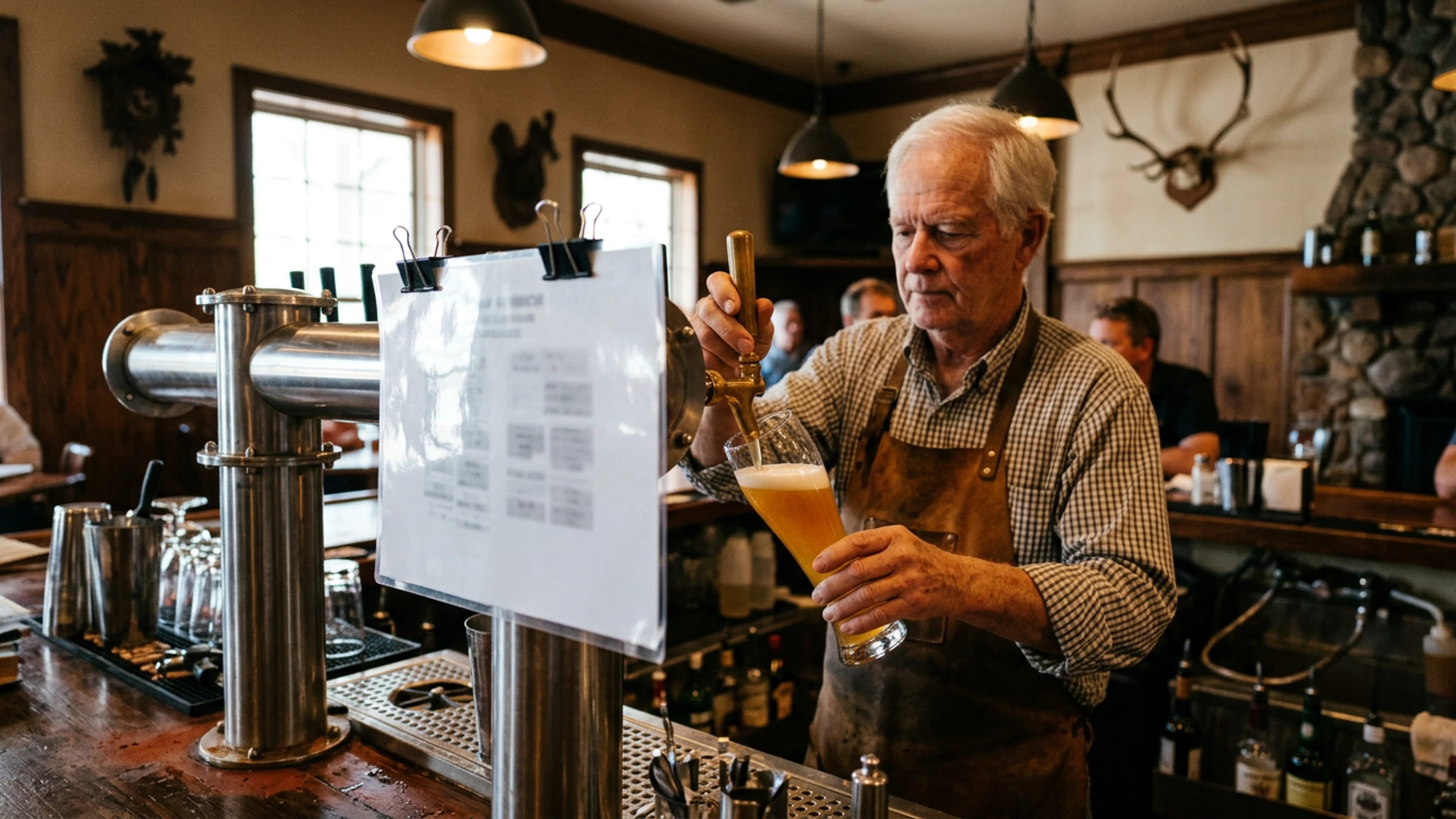
At approximately 4:47 p.m. Eastern Daylight Time on April 17, 2026 — six days later — Gunter Maier, the proprietor of Hofer's of Helen, the 1138-seat beer hall and bratwurst restaurant at 1208 Bruckenstrasse, Helen, Georgia, taped to the manifold of his draft-beer tap system a laminated sign measuring nine inches by twelve inches, reading, in full, on a plain white background in 48-point black sans-serif:
THIS HEFEWEIZEN NOW CONTAINS A STABILIZED ROGUE VITAMIN B1 MOLECULE — PER PROPRIETOR
The proprietor
Mr. Maier, 71, a second-generation Helen beer-hall operator whose father emigrated from Augsburg in 1962, was interviewed at his usual afternoon post — a corner stool near the tap manifold — Saturday afternoon.
Asked whether the sign was related to the April 11 Scripps finding, Mr. Maier said: "Somewhat."
Asked how, specifically, his Hefeweizen — which he brews on-site under a Georgia craft-brewer license, using a recipe he described as "ordinary yeast, ordinary barley, ordinary wheat, Bavarian hops" — could be said to contain a stabilized thiamine-derived carbene intermediate, when such intermediates require specialized supramolecular cages to persist for more than a millisecond, Mr. Maier said: "The beer is a kind of cage."
Asked whether he had consulted a chemist before posting the sign, Mr. Maier said: "I have consulted my father." His father, the late Erik Maier (1937-2014), is not reachable for comment.
Asked whether he was concerned the sign might, under the Georgia Department of Agriculture's Food Safety labeling compliance rules, constitute a misrepresentation, Mr. Maier said: "It is a claim made by the proprietor. It is clearly so labeled. I have not made it about the bratwurst."
Chemistry consultation
Dr. Linus Parks, who readers may recall from last week's Glockenspiel coverage, was contacted Saturday afternoon in his capacity as the only reachable chemistry-proximate academic in the region. Dr. Parks is an assistant professor of economics, not chemistry, at the University of North Georgia. This publication noted the discipline mismatch in its initial outreach. Dr. Parks said he would "make some calls."
Dr. Parks called back at 7:14 p.m. Saturday with the response of a colleague in the UNG Department of Chemistry, Dr. Wilma Garriga, who had reviewed the Hofer's sign via photograph. Dr. Garriga's statement, relayed through Dr. Parks, was as follows:
"I cannot, in good conscience, rule this out. A thiamine-derived carbene intermediate is, in its natural state, present in any fluid that contains thiamine, for a small fraction of a second during normal biochemical turnover. Hefeweizen, owing to its yeast, contains thiamine. Thus, at any given instant, any glass of Hefeweizen does, statistically, contain some number of these intermediates, for brief moments. Whether it is fair to call those molecules 'stabilized,' by the standards of the Scripps paper, is a matter of generous interpretation."
She added: "I would not purchase the Hefeweizen specifically for the stabilized carbene. But I would also not refuse it on those grounds."
The sign remains
As of 10:00 p.m. Saturday evening, the laminated sign remained on Hofer's tap manifold. Hofer's Hefeweizen was being poured, at a rate of approximately 28 pints per hour, into the waiting glasses of Saturday-night patrons, none of whom this reporter observed to read the sign before drinking.
The Scripps Research Institute, asked for comment Saturday evening on whether Mr. Maier's claim was in any way representative of its April 11 finding, did not respond by press time. Dr. Williams, the paper's lead author, is on a scheduled spring break from her La Jolla lab until Monday, April 20.
She is unlikely to visit Helen.


Reader Comments
Leave a comment ↓