
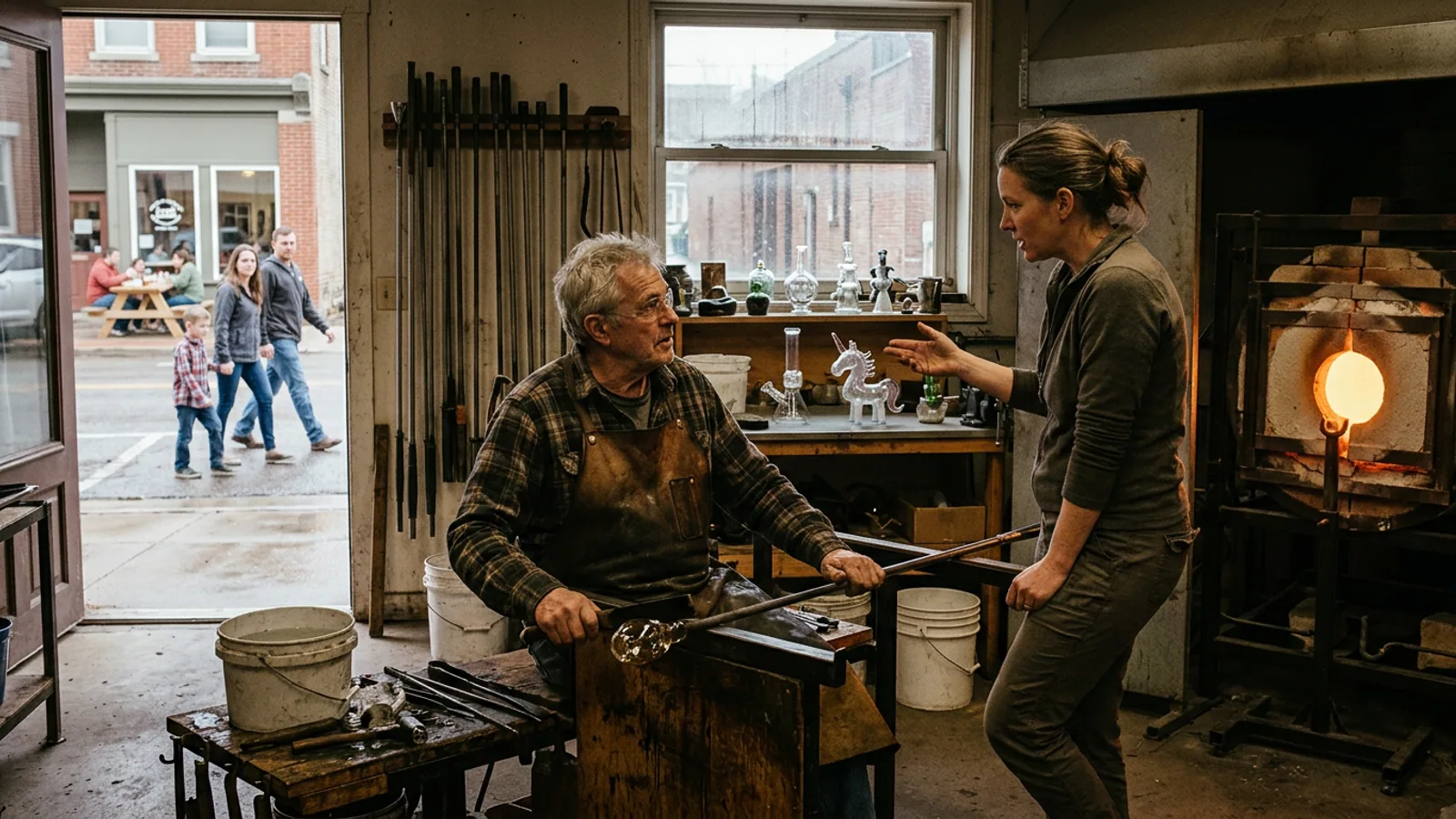
It was a Tuesday in early April, the morning after a rain, and the air at the back of the studio still held the smell of wet timber from the alley. Lothar had been at the bench since seven. He had run the kiln up to the working temperature, tested the gather, set out the marvering tools in the order he had set them out every morning since 1981, and was now sitting on the small wooden stool by the bench drinking the second of his three morning cups of coffee, looking at the glass.
The owner came in at seven-thirty.
The owner was the third owner Lothar had worked under. The first owner, the one who had hired him in 1981 when Lothar had been twenty-six and only seven months out of the apprenticeship in Stuttgart, had retired in 1997 and had passed away in 2003. The second owner, the first owner’s son-in-law, had run the studio competently for nineteen years and had sold the building in 2016 to the third owner, a younger man from Atlanta who had, in the period since, made several decisions Lothar did not approve of.
The third owner stopped at the entrance to the back room, looked at Lothar, and said good morning. Lothar said good morning back.
“Listen,” the third owner said. “The gentleman from yesterday is coming back at ten. He wants the unicorn.”
Lothar set down the coffee.
“The unicorn,” he said.
“The one we talked about,” the third owner said. “The glass thing.”
“The bong-shaped unicorn,” Lothar said.
“Well, I would not call it a bong,” the third owner said. “It is a decorative piece.”
“It has a chamber,” Lothar said. “It has a stem. It has a downstem. The downstem is the spiral horn. The chamber is the body of the unicorn.”
“Yes,” the third owner said.
“It is a bong.”
“I would not call it that.”
Lothar looked at the glass. He had been a glassblower for forty-five years. He had blown approximately eighty thousand individual pieces. He had, in the early part of his career, been a serious enough artisan that two of his pieces from the late 1980s were currently in the permanent collection of the Corning Museum of Glass in upstate New York. He had been, for a time, considered one of the more interesting working hot-glass artists in the southeastern United States.
He had, in the period since 2016, blown approximately three hundred and twenty bong-shaped unicorns.
He had blown them in pink. He had blown them in blue. He had blown them in a swirled pink-and-blue that the third owner had, on the back-of-shop sales tag, called “iridescent.” He had blown them in clear with a single small blue dot on the unicorn’s flank that the third owner had, in his marketing copy, called “the Mountain Sapphire variant.” He had blown them with one horn and he had blown them with two. He had blown them with the horn straight and he had blown them with the horn spiraled. He had blown them with the four legs articulated and he had blown them with the four legs as a single rounded pedestal.
He had not, in the period since 2016, blown a single piece that was not, in some configuration, a bong-shaped unicorn.
“At ten,” the third owner said.
“At ten,” Lothar said.
The third owner left. Lothar sat at the bench. He drank the third of his three morning cups of coffee. He thought, for a long minute, about the chamber. He thought about the spiral horn. He thought about the four-legged pedestal that had become, in the third owner’s line, the standard base configuration. He thought about the marvering rod that had, since 1981, been the same rod, made by the same Italian metalworking firm, that he used for every piece. He thought about the fact that this would be, by his count, the three hundred and twenty-first bong-shaped unicorn he had ever produced.
He stood up.
He walked to the kiln. He pulled the gather. He brought it to the marvering bench. He worked the glass.
The chamber came out cleanly. The downstem, which on the bong-shaped unicorn was the spiral horn, came out cleanly. The four-legged pedestal came out cleanly. The body, the haunches, the tail — all of it came out cleanly. He had done it three hundred and twenty times. He could do it without thinking. He did do it without thinking.
He set the unicorn on the cooling rack at nine fifty-three.
The gentleman from yesterday came in at ten oh-four. The third owner brought him to the back. The gentleman looked at the unicorn. He picked it up. He turned it over. He looked at the chamber. He looked at the spiral horn. He looked at the four-legged pedestal. He set the unicorn back on the cooling rack and turned to the third owner and said, in a voice that suggested he had inspected several bong-shaped unicorns in his life and had developed certain criteria, that the piece was “really something.”
The third owner agreed that it was really something.
The gentleman paid one hundred and forty dollars in cash. The third owner wrote a receipt. The gentleman took the unicorn, wrapped in three layers of pink Christmas-themed tissue paper, out the back door of the studio toward his car.
Lothar watched him go.
He sat down at the bench. He looked at the kiln. He looked at the marvering bench. He looked at the small wooden stool. He thought, for a long minute, about whether he would, the following morning, blow a piece that was not a bong-shaped unicorn. He thought he might. He thought, perhaps, he would blow a small bird. A finch. The finch he had, in 1989, blown three of, and that he had been, at the time, considered to be unusually good at.
He thought, in the long minute, that the third owner would not, on seeing the finch, place it in the front display case. He thought the third owner would, on seeing the finch, ask Lothar what the finch was for.
He thought he would tell the third owner that the finch was for the cooling rack.
He thought the third owner would shrug and would say, that is fine, but we are going to need three more unicorns by Friday.
He thought he would say, fine, three more unicorns by Friday.
He thought he would, then, sit down and blow the three more unicorns. Because, after all, that is what the studio sold. That was what the rent on the building required. That was what kept the kiln running and what kept the lights on and what kept the owner’s salary, and Lothar’s salary, and the salary of the young woman who worked the front register, paid.
He thought he would, after the three more unicorns were on the cooling rack, blow the finch.
He thought, perhaps, he would not put the finch in the front display case at all. He thought he would, perhaps, put the finch on the back shelf of the studio, on the high shelf where he kept the marvering tools that he no longer used — the curved tools from the apprenticeship in Stuttgart, the long single-blade he had bought in 1990 and that he had not, in the period since 2016, had occasion to pick up.
He thought the finch would, on the high shelf, look perfectly fine.
He thought he would, on quiet mornings, look up at it.
He picked up the third coffee cup. The coffee was cold. He drank it anyway.
He stood up. He walked to the kiln. He pulled another gather.
He started on the next unicorn.
—
Edmund Crowe is the editorial page editor of Bavarian Brainrot. “The Last Glassblower Of Main Street” is a work of fiction. The Bruckenstrasse Glass Studio, the studio’s third owner, and Lothar are inventions. Any resemblance to a real downtown Helen glass studio is the kind of resemblance that is the point.

Reader Comments
Leave a comment ↓