
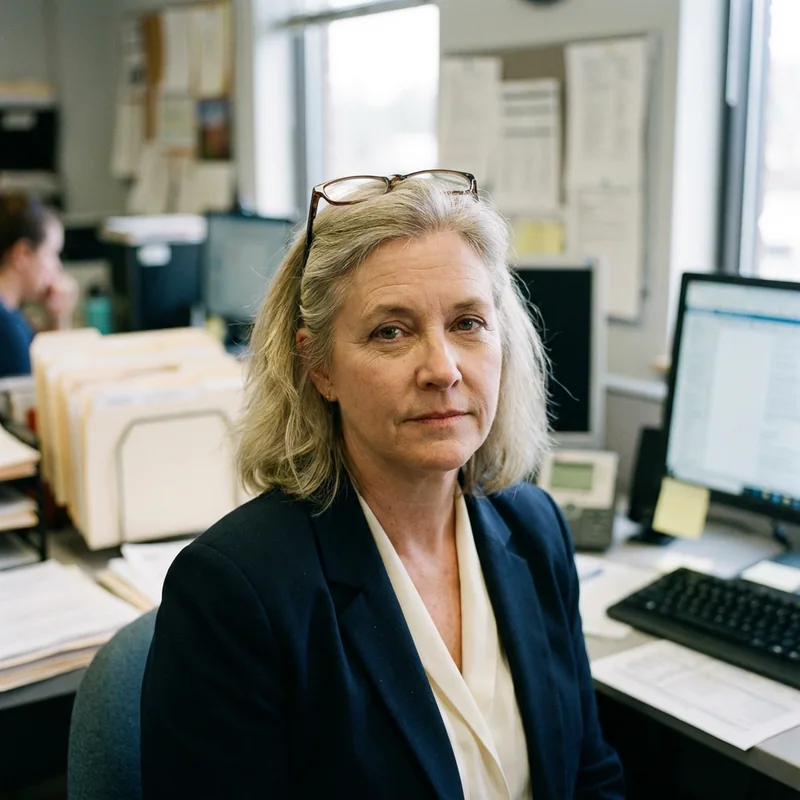
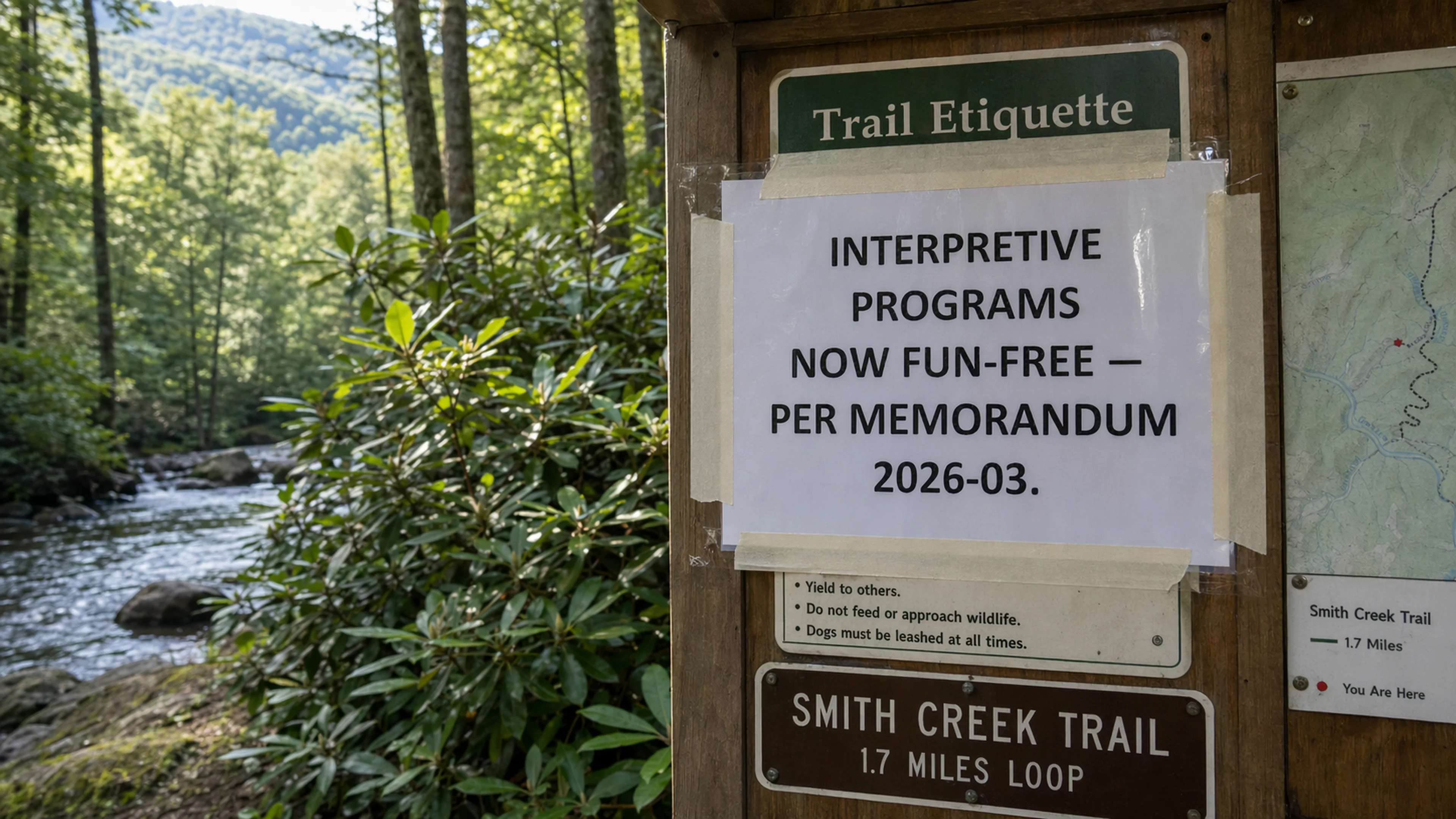
Chief Ranger Helena Barksdale, the senior interpretive official at Unicoi State Park and a 31-year veteran of the Georgia Department of Natural Resources, issued an internal memorandum to the park's 14 seasonal interpretive staff at 5:47 p.m. Friday, April 18, prohibiting the use of the word "fun" on any guided tour, naturalist walk, craft demonstration, or educational program conducted on park property. The prohibition, per the memorandum, took effect at 6:00 a.m. Saturday, April 19, and applies to every interpretive interaction between park staff and park visitors from that moment forward, "without exception, without qualification, and without any allowance for inherited program scripts predating this revision."
The memorandum, titled "Interpretive Standards Revision 2026-03," was obtained by Bavarian Brainrot on Saturday afternoon via a public-records request filed with the Georgia Department of Natural Resources at 9:04 a.m. the same morning. The Department, per its standard practice on non-sensitive personnel communications, released the document within six hours.
The memorandum runs 1,420 words across four pages. It is structured in the standard Department of Natural Resources memorandum format, with a cover page, a numbered list of operational justifications, a schedule of acceptable substitute vocabulary, and an appendix enumerating each of the park's 41 active interpretive programs and the specific substitutions required for each.
The Four Justifications
Chief Ranger Barksdale's memorandum cites four distinct justifications for the prohibition. They are reproduced here in the order in which the memorandum presents them.
First, the memorandum cites what Chief Ranger Barksdale terms "measurable degradation of interpretive outcomes" in the park's 2025 end-of-season visitor survey. The survey, which the park has conducted every October since 1998, asks visitors to rate, on a seven-point scale, the degree to which a guided program "expanded your understanding of the natural or cultural resource." The 2025 survey returned an average score of 4.7 across all programs. The 2019 survey, the last conducted before the park's interpretive scripts were revised to include the phrase "this is going to be so much fun" at the top of every program introduction, returned an average score of 5.9. Chief Ranger Barksdale, in a footnote, attributes "at least 0.8 points" of the decline to the front-loaded "fun" framing.
Second, the memorandum cites a peer-reviewed 2023 study, published in the Journal of Interpretive Research, titled "Anticipatory Vocabulary And Actual Experiential Outcome In Guided Natural-Resource Programs: A Quasi-Experimental Study Of 11 Southeastern State Parks." The study, conducted at parks in Georgia, South Carolina, Tennessee, and North Carolina, found that programs introduced with the word "fun" were rated, at the end of the program, 0.4 points lower on a five-point enjoyment scale than programs introduced without the word. The study's authors hypothesized that the word "fun," when used as a prediction, establishes an expectation the subsequent program cannot satisfy. Chief Ranger Barksdale cites the study twice in her memorandum and appends a copy to the third page.
Third, the memorandum cites what Chief Ranger Barksdale describes as "an internal audit, conducted across a randomized sample of 23 interpretive programs delivered between June 12 and September 4, 2025, in which the average seasonal interpreter was observed to use the word 'fun' 11.3 times per 45-minute program, with a peak instance of 34 uses in a single program." The peak instance, per the memorandum, occurred during a basket-weaving demonstration conducted at the park's craft pavilion on the afternoon of July 19. The interpreter is not named. The memorandum refers to the interpreter only as "Seasonal Staff Member 7."
Fourth, the memorandum cites what Chief Ranger Barksdale calls "the professional-dignity consideration." The paragraph reads, in full:
"Our interpretive programs convey the ecology of a mixed mesophytic forest that has stood, in some sections, for more than 200 years, and the cultural history of a region whose Cherokee, Scots-Irish, and German-American inhabitants shaped these mountains across ten generations. The word 'fun,' deployed in this context, is insufficient. It is a word appropriate to a bounce house. It is not a word appropriate to the interpretation of old-growth forest or of treaty history. We will, beginning Saturday, use language adequate to the subject."
The Schedule Of Substitutions
The memorandum's appendix provides a schedule of acceptable substitute vocabulary. The schedule is organized in a table with two columns. The left column lists common phrases the memorandum has identified in existing interpretive scripts. The right column provides the approved replacement.
A selection of the entries:
- "This is going to be fun" becomes "This will reward your attention."
- "Fun fact" becomes "Point of interest."
- "Let's have fun with this" becomes "Let us proceed with rigor."
- "It's more fun than it sounds" becomes "It is more rewarding than its reputation suggests."
- "Having fun?" becomes "Are the materials proving useful?"
- "This is the fun part" becomes "This is the operationally significant section."
The appendix lists 47 such substitutions. It does not provide a substitute for the word "fun" when used in the names of external products referenced on tours, such as the "Fun Size" Snickers bars distributed at the park's Halloween night-hike program. The memorandum notes that this matter "will be addressed in a subsequent revision."
Staff Response
The park's 14 seasonal interpretive staff received the memorandum by email at 5:47 p.m. Friday. The park's Seasonal Staff Liaison, Ranger Second Class Dellara Wicks, convened an emergency all-hands meeting in the park's staff lodge at 7:00 a.m. Saturday, 60 minutes after the prohibition took effect. The meeting lasted 47 minutes.
Ranger Wicks, reached by telephone at her office Saturday afternoon, said the meeting was "productive."
"The staff understand the rationale," Ranger Wicks said. "The staff will comply with the rationale. The staff have been provided a printed copy of the substitution schedule. The staff will, where applicable, consult the schedule before speaking."
Asked whether any staff member had expressed concern, Ranger Wicks said: "One staff member raised a concern. The concern was noted. The staff member's concern, and I will say this on the record, was that the substitute phrasing for the sentence 'Having fun?' — which is, per the schedule, 'Are the materials proving useful?' — sounds, to a visitor, like the staff member is asking the visitor to submit a review. This is a reasonable concern. The concern has been logged. A revision to the schedule is not, at this time, anticipated."
A Saturday Morning Observation
This reporter attended the park's 9:00 a.m. Saturday naturalist walk, a 90-minute guided tour of the Smith Creek Trail conducted by Seasonal Staff Member 4, Tori Eckersley, 23, a second-year seasonal interpreter and a senior at the University of North Georgia. The walk was the first interpretive program at Unicoi State Park conducted entirely under the new prohibition.
Ms. Eckersley opened the walk, at precisely 9:00 a.m., with the sentence: "Welcome to the Smith Creek Trail. This will reward your attention."
She did not use the word "fun" at any point during the 90-minute program. She did, at minute 34, begin to say "Isn't this fu—" before correcting herself. The corrected sentence, delivered after a one-second pause, was: "Isn't this operationally significant."
The ten visitors present — four adults, six children, all from Gwinnett County — did not, to this reporter's observation, appear to notice the correction. Two of the children, at that moment, were watching a chipmunk on an adjacent stump. The other four were looking at the creek. The adults were, uniformly, looking at their phones.
The walk ended at 10:32 a.m. Ms. Eckersley closed the program with the sentence: "Thank you for joining this program. I hope the materials proved useful." One of the adults said, "Yes, very useful, thank you." The group dispersed.
What Comes Next
Chief Ranger Barksdale, reached at her office at the park's administrative building at 11:48 a.m. Saturday, declined an interview. In a written statement transmitted through the Department of Natural Resources' communications office, she said the prohibition "will be evaluated against the 2026 end-of-season visitor survey, scheduled for the first week of October, and retained, revised, or rescinded on the basis of that evaluation."
She added, in the same statement: "The park's commitment is to the quality of interpretation, not to the social register of its vocabulary. If the 2026 survey indicates the prohibition has not improved outcomes, the prohibition will be reconsidered. If the survey indicates the prohibition has improved outcomes, the prohibition will be extended to additional vocabulary."
The memorandum does not specify which additional vocabulary is under consideration for a future prohibition. The memorandum's final sentence, however, reads: "The word 'awesome' is, the Chief Ranger wishes to note, already under review."
— Margaret Holcomb, Outdoors Correspondent
Reader Comments
Leave a comment ↓