

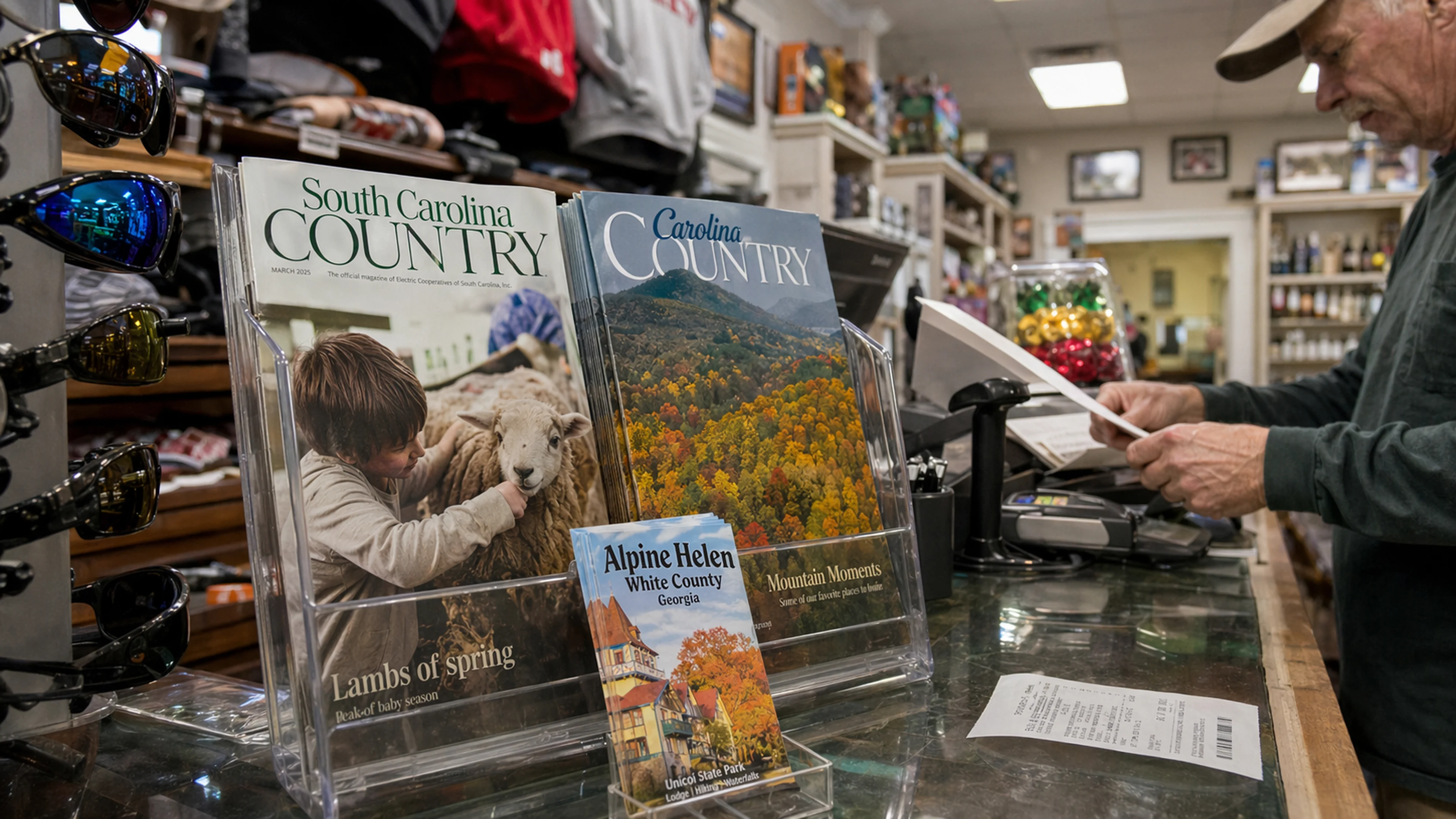
The Alpine Helen/White County Convention and Visitors Bureau currently maintains paid print advertising in 11 distinct magazine titles, according to the bureau's March 2026 activity report delivered to the Helen City Commission on March 17. Two of the 11 — South Carolina Country and Carolina Country — are not available at newsstands, are not sold by subscription in the conventional sense, and cannot be purchased by a member of the general public who does not receive electricity from a participating rural electric membership cooperative. They arrive, without request, in the mailboxes of cooperative members across specific service territories in South Carolina and North Carolina, between the power bill and the Tractor Supply circular.
CVB Director Jerry Brown's March report lists all 11 placements by name but does not disaggregate the bureau's advertising expenditure by publication. The total cost of the campaign across all 11 titles is not stated in the report, nor in the accompanying fiscal summary presented by Finance Director Mona Wood at the same meeting. It is, as of this writing, a single undifferentiated line in the CVB's marketing budget — a budget funded primarily by Helen's hotel/motel tax, which generated $151,428 in March 2026 alone and $2,201,494 across the first nine months of fiscal year 2026.
The decision to place Helen tourism advertising in two electric-cooperative member magazines represents a specific demographic bet. EMC magazines are distributed to households that receive power from nonprofit, member-owned rural electric cooperatives rather than from investor-owned utilities. Their combined circulation in the Carolinas exceeds 1.5 million households. The readers are, by structural definition, residents of territories served by rural co-ops — small-town and exurban populations in the Piedmont, foothills, and mountain corridors of both states. These are, by CVB logic, the precise populations most likely to drive four to six hours south on U.S. 23 or I-85 to spend a weekend in a 529-resident Appalachian municipality themed to resemble a Bavarian alpine village it has never been.
The two EMC publications are distinct entities. South Carolina Country is the monthly magazine of the Electric Cooperatives of South Carolina, Inc., reaching member households of the state's 19 electric cooperatives. Carolina Country serves the North Carolina Association of Electric Cooperatives and its 26 member co-ops. Both magazines carry a mix of regional lifestyle features, recipes, home-improvement columns, and cooperative governance news. Both accept tourism advertising. Helen has bought into both.
"Electric cooperative magazines are, in the American rural-media landscape, one of the most durable print formats remaining," said Dr. Wilhelm Brüning, formerly of the Bavarian State Institute for Regional Cultural Geography, reached by telephone at his home in Dahlonega. "A CVB that buys into them understands where its customers actually live. These are not aspirational publications. They are delivered to the address that receives the power. The open rate, if you want to use the digital term, is functionally 100 percent, because the magazine is sitting on top of the bill."
Dr. Brüning noted that Helen's placement in EMC magazines predates the bureau's current digital campaigns, though the precise year of first insertion could not be confirmed from available records. The bureau's March 2026 report also references a separate contract with Advance Travel & Tourism for digital campaign management and a parallel relationship with LRC, Inc. for blog content, social media campaigns, and travel-writer coordination — the latter managed by Ruth Sykes, who met with Brown on March 26 to plan spring and summer travel-writer visits.
The remaining nine magazine placements, as listed in the March report, fall into three rough categories. Four are regional Southern lifestyle titles: Southern Living Magazine, the dominant publication in the category with a rate base exceeding 2.8 million; Southbound Magazine; Blue Ridge Country Magazine, which covers the central and southern Appalachian corridor from Virginia to North Georgia; and Atlanta Magazine, the city-specific glossy whose readership represents Helen's single largest same-day drive market. Three are Georgia-specific publications: North Georgia Living Magazine, Georgia Design Magazine, and Georgia's Great Places Magazine, the last of which functions as a statewide tourism directory. One is a membership publication for a non-electric organization: AAA Explorer, specifically the Alabama edition, which reaches AAA members in a state that shares no border with Georgia's White County but does sit within the six-hour drive radius the CVB has historically treated as its primary catchment zone. The 11th placement — if one counts LRC, Inc.'s blog and social media work as a discrete channel — is the digital content operation, which Brown's report lists alongside the print titles without distinction.
Margaret Holcomb, reporting for this publication, requested a per-title breakdown of advertising expenditure from the CVB on April 23. As of press time, no response had been received. The bureau's total marketing budget is embedded within the broader hotel/motel tax fund, which also supports the Helen Arts Center — a facility that suffered a fire in late 2025, requiring $5,000 in repairs from the same fund, with the original building declared a total loss at the December 16 commission meeting.
The CVB's advertising strategy operates in parallel with its earned-media tracking, which in March 2026 logged placements with a combined estimated publicity value of more than $3.5 million. The single highest-value placement — an Only in Our State article about Babyland General Hospital, syndicated through AOL and Yahoo News — generated an estimated $3.3 million in publicity value from 9.1 million impressions. That figure exceeds the entire nine-month hotel/motel tax haul by more than $1 million, though the relationship between estimated publicity value and actual visitor spending has not been modeled in any public CVB document reviewed by this publication.
An industry observer who declined to be named noted that Helen's media mix — lifestyle glossies, EMC monthlies, a single AAA regional edition, and a digital layer — resembles a strategy last formally audited during what the observer called "the 2017 rack-card consolidation," a reference this publication was unable to independently verify.
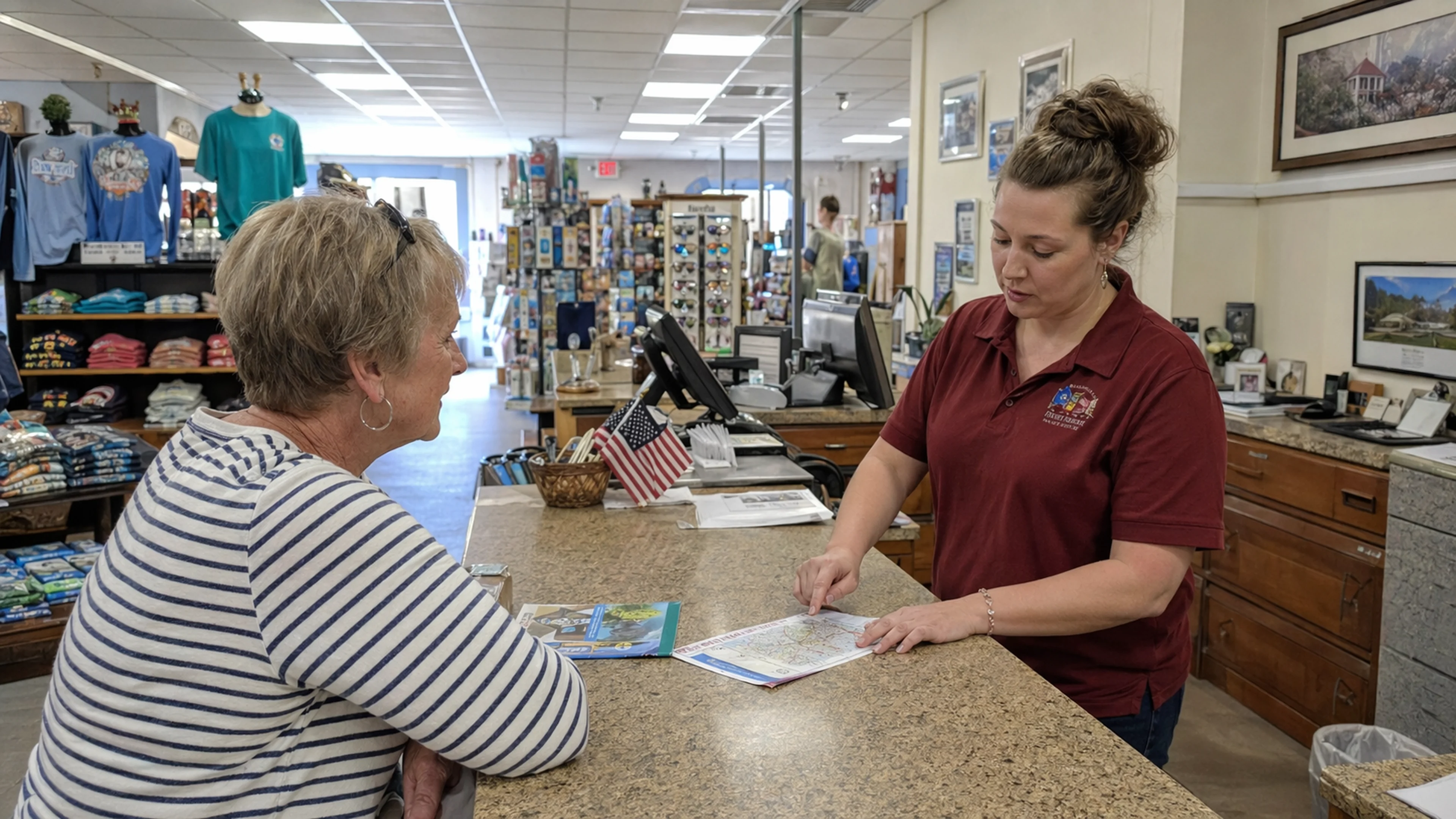
What is verifiable is the reach. The Helen Welcome Center logged 2,570 visitors in March 2026, an increase of 170 over February. The bureau's website recorded 108,000 visits, 101,000 unique users, and 454,000 page views at an average session duration of two minutes and 58 seconds. The bounce rate was 49.50 percent, meaning roughly half of all visitors to HelenGA.org left after viewing a single page. Whether any of those visitors arrived because they saw a quarter-page ad between a pecan pie recipe and a notice about their co-op's annual meeting in Laurens County has not been determined.
The bureau also delivered 230 cases of the Helen Travel Guide to regional distribution points in March, mailed 400 individual guides by request, and recorded 124 digital downloads. The guides are free. The EMC magazines are free. The advertising in them is not. The cost remains, for now, between the CVB, its vendors, and the hotel/motel tax fund's next quarterly report.
Reader Comments
Leave a comment ↓