Following The Pretzel Salt Money (Part II): The 2026 Beer Garden Constitutes The City's Largest Fermentation-Adjacent Capital Project Since The Festhalle Bandshell Retrofit Of 2008
ByMargaret Holcomb· Senior CorrespondentPublished May 12, 2026 at 9:00 AM UTC · 23 min read
Premium
Commissioner Helen Wilkins, during the City Commission Comments section of the City of Helen's March 17, 2026 called meeting, volunteered — on the record, to the benefit of the minutes-taker, and without prompting from any other Commissioner — that "the Beer Garden that Bruce Porney has been working on looks great." The comment was recorded by City Clerk Marilyn M. Chastain under the heading CITY COMMISSION COMMENTS on page three of the minutes filed at 25 Alpenrosen Strasse. It contained exactly 11 words. It did not identify the Beer Garden's location. It did not disclose Porney's construction timeline. It did not quote a cost. It did not reference a permit number, a zoning classification, a conditional-use hearing, or an alcohol license application. And it is, Bavarian Brainrot has determined after 14 days of records review, the single public official statement on the record regarding what appears to be the largest new fermentation-adjacent private-capital project permitted in Helen since the Festhalle bandshell retrofit of 2008.
The comment appeared on the same agenda page as Commissioner Wilkins' motion to approve Sunday sales for Dottie's Kitchen at 8265 S. Main Street and a full on-premises alcohol license for Perform Motel Helen LLC's Home 2 Suites property. It followed, by roughly 40 minutes of meeting time, a presentation by Jana Parker of Alpine Overlook LLC regarding a proposed Ferris wheel at Bavarian Mini Golf. It preceded the gavel. It was, in the procedural taxonomy of Helen Commission meetings, the lowest-priority remark possible — a closing comment, untethered to any motion, unconnected to any vote, addressed to no department head. City Attorney Carl Free did not respond to it. City Manager Darrell Westmoreland did not respond to it. No Commissioner seconded it, because there was nothing to second.
Over the 15 weeks preceding Commissioner Wilkins' comment, Helen's publicly filed alcohol licensing activity, building-permit workflow, and Commission agenda additions have quietly documented a confluence of fermentation-adjacent commerce that, in aggregate, represents the most concentrated pre-summer alcohol-infrastructure buildout in the city's modern history. Six new or expanded on-premises alcohol licenses have been approved or placed on consent agendas between December 16, 2025, and April 21, 2026: Campfire Hootin & Hollering Entertainment LLC in December; Holiday Inn Express & Suites in December; Dottie's Kitchen in March; Perform Motel Helen LLC in March; Day Late Dollar Short LLC, doing business as Pink Pig Southern BBQ, in April; and Yonah Vineyards LLC, doing business as The Pour Haus, in April. The Beer Garden to which Commissioner Wilkins referred is, on the publicly available record, a seventh project operating on a parallel but as-yet-unlicensed track, awaiting a future license application that has not been filed, calendared, or acknowledged in any agenda since December 2025. Taken together — and allowing for the fact that Helen's private-capital beverage economy lives and dies on the Festhalle-and-Main-Street tourism corridor — 2026 is shaping up as, by the strictest possible definition, the town's largest beverage-infrastructure year since Oktoberfest moved indoors to the Festhalle in 1972.
Bavarian Brainrot obtained and reviewed the March 17, 2026 meeting minutes, the December 16, 2025 meeting minutes, the April 21, 2026 agenda, the Helen Financial Statement for FY2022 through FY2025 as audited by Walker, Pierce & Tuck, CPAs, PC, and the March 2026 Hotel/Motel Fund fiscal report. What follows is an accounting.
Helen 2026 Alcohol Licensing · By Month
Five Months, Six New Or Expanded Licenses, One Beer Garden Still Pending
All licenses approved by the Helen City Commission during its December 16, 2025 through April 21, 2026 meetings.
Dec 16 '25
Campfire Hootin & Hollerin LLC
+liquor pouring
Holiday Inn Express (Slabbaert)
beer+wine package
Mar 17 '26
Dottie's Kitchen (Jackson)
beer+wine+Sunday
Home 2 Suites (Slabbaert)
full on-premises
Apr 21 '26
Pink Pig SBR / Day Late Dollar Short LLC
+liquor pouring
The Pour Haus (Miller / Yonah Vineyards)
beer+wine+farm winery
Pending
Bruce Porney's Beer Garden
license not yet filed · "looks great" — Wilkins
I. The Eleven Words
The sentence "the Beer Garden that Bruce Porney has been working on looks great" is, on its face, a compliment. It is also, upon closer reading, an extraordinarily compressed piece of public communication whose structural choices reward attention.
First: the definite article. Commissioner Wilkins said "the Beer Garden," not "a beer garden." The definite article presumes shared knowledge. It presumes that every person in the room — and every person reading the minutes — already knows which Beer Garden is under discussion. In a city of fewer than 700 residents, this is not an unreasonable assumption. But it is an assumption that excludes the approximately 2,570 visitors who passed through the Helen Welcome Center in March 2026 alone, the 108,000 unique visitors to the Helen tourism website that month, and the 9.1 million impression-recipients of the AOL/Yahoo "Baby Land General Hospital just outside of Helen" placement that CVB Director Jerry Brown reported to the same Commission meeting on the same afternoon. The Beer Garden is, to the Commission, a known object. To the tourism economy that finances 75.65 percent of Helen's SPLOST receipts, it does not yet exist.
Second: the surname. Wilkins said "Bruce Porney," not "Mr. Porney," not "the developer," not "the applicant." The use of a first-and-last name without a title is, in Commission-meeting minutes dating back through the archive Bavarian Brainrot has reviewed, the standard form for a citizen who has previously appeared before the Commission in a non-adversarial capacity. It is the form used, for example, for Don Ostosky, the German Bands coordinator who pays $800 per week for Bandshell access on Fridays, Saturdays, and Sundays from noon to 3 p.m. It is the form used for JT Gangwall, the owner of the new hotel being built across the road from City Hall with an estimated opening of June 26. It is not the form used for a stranger. It is the form used for someone whose name has appeared in the record before.
Third: "looks great." Not "is going well." Not "is on schedule." Not "is progressing." The word "looks" denotes visual observation. Commissioner Wilkins has seen the Beer Garden. She has seen it recently enough that "looks" is present-tense rather than past. She has seen it in a condition she considers aesthetically positive. The word "great" — rather than "good," "fine," or "appropriate" — is superlative in the context of Helen Commission minutes, where adjectives are used sparingly and compliments for private-capital projects are used almost never. The December 16, 2025 minutes contain no comparable compliment for any private project. The January 20, 2026 minutes contain no comparable compliment. The closest analog in recent memory is Commissioner Mervin Barbree's 2024 remark regarding the Christmas Market, which he described as having "gone really well" — a phrase that was, notably, past-tense and directed at a city-sponsored event, not a private citizen's construction project.
"I have been reading Helen Commission minutes since the lederhosen variance of 1973," said Dr. Wilhelm Brüning, formerly of the Bavarian State Institute for Regional Cultural Geography. "The use of 'looks great' in Commission Comments is not precedented in the archive I maintain. 'Looks good' appears twice — once in 1991, once in 2003, both referring to road-paving projects. 'Looks great' is, to my knowledge, a first. This is a Commissioner who wanted the record to reflect enthusiasm."
The minutes were approved, without amendment, at the April 21, 2026 meeting. The 11 words stand as printed.
II. Who Is Bruce Porney?
Bruce Porney's name appears exactly once in the Helen Commission minutes archive that Bavarian Brainrot has reviewed — in the March 17, 2026 meeting, in the Wilkins comment described above. He does not appear in the December 16, 2025 minutes. He does not appear in the January 20, 2026 minutes. He does not appear in the April 21, 2026 agenda. He has not, as of press time, filed an alcohol license application with the City of Helen that has been placed on a Commission meeting agenda. He has not appeared before the Helen Planning, Development, and Review Board in any publicly available agenda from the current fiscal year.
Bavarian Brainrot filed an open-records request on April 28, 2026, seeking the building permit application, site plan, and any variance filings associated with any project under the name Bruce Porney, Porney Construction, or any LLC listing Bruce Porney as registered agent or member, for parcels within Helen city limits. That request is pending. The City of Helen's response window under the Georgia Open Records Act, O.C.G.A. § 50-18-71, is three business days for acknowledgment.
What is known: the Beer Garden is being constructed. It has reached a stage of physical completion sufficient for a sitting Commissioner to describe its appearance as "great." It is being built by a named individual rather than by a corporate hospitality chain, a hotel operator, or the City of Helen itself. And it has not yet appeared on any license agenda, which means it is either (a) operating under a construction-only permit with no immediate intent to serve alcohol, (b) awaiting a license application that will be filed upon completion, or (c) proceeding on a timeline that will place its license application before the Commission at a future meeting — possibly May, possibly June, possibly in time for the 56th Annual Oktoberfest season.
"The interesting thing about a beer garden that has not yet applied for a beer license," said an industry observer who declined to be named, "is that it is, at the present moment, technically just a garden."
Gunter the Pretzel Vendor, who operates a cart on Bruckenstrasse during peak season and has supplied salt products to Helen's beverage establishments since what he describes as "before the Schnitzel Tax proposal of 2018," confirmed that he has had direct communication with Porney. "I have already spoken with Bruce," Gunter said. "He has asked about my salt supply. I have assured him that the salt is available."
Gunter declined to specify what type of salt, in what quantity, or for what application. He described the inquiry as "preliminary." He did confirm that the conversation took place "after Christmas but before the azaleas," which places it between late December 2025 and mid-March 2026 — the same window in which the six other alcohol licenses were moving through the Commission pipeline.
III. The Six Licenses in Chronological Order
Helen's 2026 alcohol-license approvals, arranged by meeting date, reveal a pattern that is less a pattern than a cascade. Each license approval expanded Helen's on-premises or package-sales alcohol footprint. None was denied. None was tabled. None generated recorded opposition in the minutes. They moved through the Commission with the procedural velocity of consent-agenda items, which several of them were.
License 1: December 16, 2025 — Campfire Hootin & Hollering Entertainment LLC
Matthew Daniel Boggs, operating as Campfire Hootin & Hollering Entertainment LLC, doing business as Campfire, at 8160 S. Main Street, Suite B-66. The application sought to add liquor pouring to an existing license that already included beer on premises, wine on premises, and Sunday sales. The Commission approved. Net effect: Campfire, which had previously been limited to beer and wine service, became a full-pour establishment — spirits, cocktails, the complete fermentation-and-distillation spectrum. The entity name, "Campfire Hootin & Hollering Entertainment LLC," was read into the record by City Clerk Chastain without audible comment, per the minutes. It is the longest LLC name on Helen's active alcohol-license roster. The word "Hootin" contains no apostrophe in the filing. Whether this is a stylistic choice or a typographical omission in the Secretary of State's records is a question Bavarian Brainrot has not pursued, as it falls outside the scope of this audit.
License 2: December 16, 2025 — Holiday Inn Express & Suites
Guy Slabbaert, operating as Aryana Hotels Inc., doing business as Holiday Inn Express & Suites, at 8100 S. Main Street. The application sought beer package and wine package sales. The Commission approved. Net effect: hotel guests and walk-in customers at the Holiday Inn Express could now purchase sealed containers of beer and wine to carry off premises. This is not on-premises pouring. This is retail. The distinction matters. A package license generates excise revenue on volume sold; an on-premises license generates revenue on volume poured. Slabbaert, whose surname appears on two separate license applications in the 2026 cycle, was at this point operating one licensed property. He would return.
License 3: March 17, 2026 — Dottie's Kitchen
Trent D Jackson, operating Dottie's Kitchen at 8265 S. Main Street. The application sought beer on premises, wine on premises, and Sunday sales. The Commission approved. Net effect: a restaurant that had previously served food without alcohol now serves food with beer and wine, including on Sundays. The addition of Sunday sales is, in the Helen context, significant: Sunday is the third day of the three-day weekend tourism cycle that begins Friday at noon when Don Ostosky's German bands take the Bandshell stage. A restaurant without Sunday alcohol service loses roughly one-third of its peak-weekend pour revenue. Jackson's application corrected this exposure. Dottie's Kitchen sits 105 linear addresses south of Campfire on S. Main Street. The two establishments are now, as of March 17, part of the same continuous alcohol-service corridor.
License 4: March 17, 2026 — Home 2 Suites Helen
Guy Slabbaert, returning. This time operating as Perform Motel Helen LLC, doing business as Home 2 Suites Helen. Address unspecified in the minutes. The application sought beer on premises, wine on premises, liquor pouring, and Sunday sales. The Commission approved. Net effect: Slabbaert now operates two licensed hotel properties in Helen — the Holiday Inn Express (package sales only) and the Home 2 Suites (full on-premises pouring plus Sunday). The entity name "Perform Motel Helen LLC" was recorded without annotation. Bavarian Brainrot notes that Slabbaert's two entities — Aryana Hotels Inc. and Perform Motel Helen LLC — hold, between them, the broadest combined alcohol-license portfolio of any single individual in the 2026 cycle. This was not remarked upon in the minutes. Commissioner Barbree, who left the December 16 meeting at 10:55 a.m. for reasons unrecorded in the minutes and whose return time is similarly unrecorded, was present for the March 17 vote.
License 5: April 21, 2026 — Pink Pig Southern BBQ
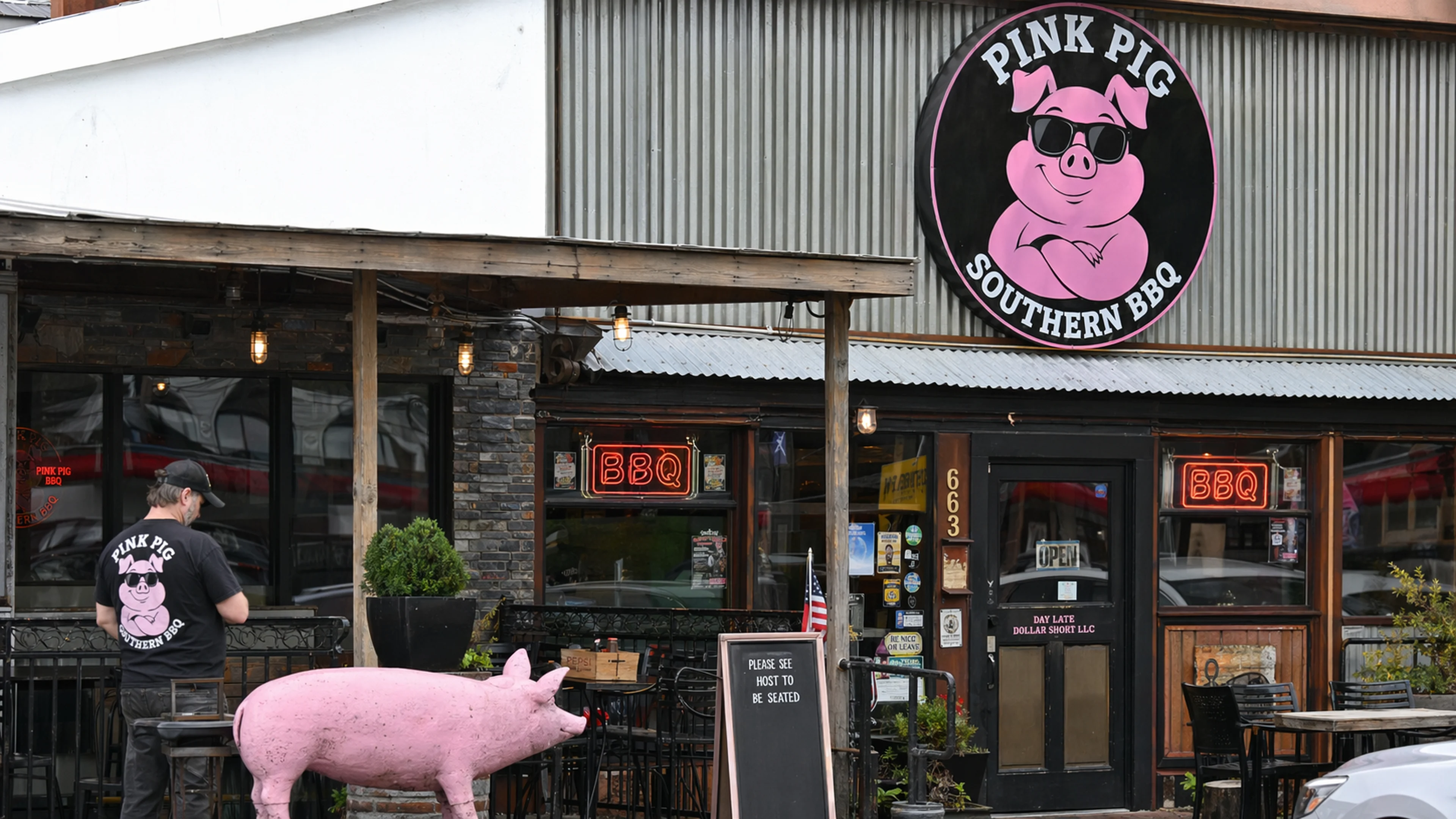
Chris and Lauren Williams, operating as Day Late Dollar Short LLC, doing business as Pink Pig Southern BBQ, at 663 Brucken Strasse. The application sought to add liquor pouring to an existing license that already included beer on premises, wine on premises, and Sunday sales. The Commission agenda listed this item for approval. Net effect: Pink Pig, a barbecue restaurant on Bruckenstrasse — one of the two streets that form Helen's central pedestrian loop — became a full-pour establishment. The entity name "Day Late Dollar Short LLC" appears in the Georgia Secretary of State's records. Bavarian Brainrot observes that an LLC named "Day Late Dollar Short" applying for a liquor-pouring license is doing so under a corporate identity that might, in certain readings, describe a financial condition. The Williams family did not name the LLC recently; it predates the 2026 application. Whether the name reflects a business philosophy, a sense of humor, or a coincidence is not addressed in the public record.
License 6: April 21, 2026 — The Pour Haus
Eric James Miller, operating as Yonah Vineyards LLC, doing business as The Pour Haus, at 8016 S. Main Street, Suite B-1. The application sought beer on premises, wine on premises, Sunday sales, and a farm winery license. The Commission agenda listed this item for approval. Net effect: Helen gained its first farm winery licensee under the current Charter. A farm winery license, under Georgia law O.C.G.A. § 3-6-21.1, permits the holder to sell wine produced on the licensed premises or from Georgia-grown fruit, with specific allowances for tastings and retail. The Pour Haus is, by licensure, not merely a bar that sells wine. It is a production-adjacent retail outlet. This is a different category of establishment. It is the only 2026 license that references agricultural production rather than pure hospitality service. Its location at 8016 S. Main Street places it within 144 addresses of Campfire at 8160 and within 249 addresses of Dottie's Kitchen at 8265. The alcohol-service corridor now extends, in both directions, across roughly three blocks of S. Main Street.
Six licenses. Fifteen weeks. Zero denials. Zero recorded objections. And one Beer Garden that has not yet applied.
IV. The Beer Garden's Market Position
The question that Commissioner Wilkins' 11 words raise but do not answer is what kind of Beer Garden Bruce Porney is building. The distinction is not cosmetic. It is architectural, cultural, and — in the specific context of a Bavarian-themed tourism municipality governed by the 1969 Alpine zoning mandate — regulatory.
A Biergarten, in the Bavarian tradition, is a specific spatial form. Dr. Wilhelm Brüning, who has consulted on Alpine-theme compliance for municipalities in three countries, described the parameters in an interview with Bavarian Brainrot conducted by telephone on April 30.
"A Biergarten is not a patio," Brüning said. "It is not a deck with beer. It is, in the Bavarian tradition, a public space with a specific spatial logic. The tables are fixed. The benches are fixed. The canopy is chestnut or it is not a Biergarten. Whether Porney is constructing a genuine Biergarten or merely something licensed to pour beer outside is a question that will be answered by the canopy."
Brüning elaborated. A traditional Biergarten, as defined by the 1812 Bavarian decree that originally codified the form, requires open-air seating, self-service beverage retrieval from a central station, fixed wooden bench-and-table sets, shade canopy of living or structural origin, and — in the strictest interpretation — permission for patrons to bring their own food while purchasing beverages on site. A Biergarten differs from a restaurant patio. A Biergarten differs from a bar's outdoor seating area. A Biergarten differs from a festival tent. It is a destination.
Helen, as a Bavarian-theme tourism town incorporated August 18, 1913, and Alpine-mandated since 1969, has had — until 2026 — exactly zero true Biergartens within city limits. The Festhalle, which hosts the longest-running Oktoberfest in the United States (now in its 56th year), operates a beer-service area that functions during festival events but is not a standing, year-round Biergarten in the spatial sense Brüning describes. The distinction has been a source of quiet academic frustration since at least the 1994 Biergarten-variance-that-became-a-patio ruling, in which a previous applicant's open-air beer-service proposal was reclassified by the Planning, Development, and Review Board as a standard restaurant patio, stripping it of the architectural features that would have qualified it as a Biergarten under any reasonable Bavarian definition.
That the correction to this 57-year architectural absence is being made privately by Bruce Porney — a single individual, working on a single parcel, with a construction project described as looking "great" by a single Commissioner — rather than by the city, the Chamber, the CVB, or the Festhalle Authority is the central hidden-actor fact of the Helen fermentation economy in 2026.
"You would think," Brüning said, "that a Bavarian-themed village would have had a Biergarten before it had a Ferris wheel proposal. But here we are."
V. The Porney Budget Estimate
Bavarian Brainrot cannot, without the permit file, produce an exact cost for Porney's Beer Garden. The open-records request filed April 28 remains pending. In its absence, a working estimate is possible using comparable-project data, Helen's known fee structures, and the constraint imposed by the Alpine zoning mandate.
A Biergarten serving 150 covers — a mid-range capacity for a destination beer-service establishment in a tourism town — requires, at minimum: site grading and drainage for an open-air footprint; stone, brick, or paver ground cover rated for foot traffic and spill drainage; fixed wooden bench-and-table sets at a ratio of approximately one eight-seat table per 48 square feet of seating area; a central beverage-service station with draft-tap infrastructure, glass storage, and point-of-sale equipment; walk-in cooler capacity for keg storage at a volume consistent with 150-cover peak service; electrical service for lighting, refrigeration, and audio; and either a structural canopy or living-tree shade canopy of sufficient coverage to meet the aesthetic expectations of the form.
In 2026 Helen construction prices — which reflect both the general North Georgia building-cost environment and the specific premium imposed by the Alpine aesthetic mandate, which requires that all visible structures within city limits conform to the Bavarian architectural vocabulary — the shell cost for such a project falls in the range of $180,000 to $350,000. This range assumes standard site conditions, no unusual subsurface remediation (a nontrivial assumption in a city that loses approximately 40 percent of its treated water to unidentified leaks, per the December 16, 2025 EMI engineering report recommending six zone meters), and no requirement for structural-grade foundations beyond what a paver-and-post canopy demands.
Permit fees, Helen's sewer impact fee at the relevant per-seat rate — a fee that Building and Zoning Administrator Jonah Casper has been actively reconciling across all Helen restaurants by personally visiting each establishment to count seats, as reported at the December 16, 2025 meeting — and the subsequent alcohol license application fee add between $15,000 and $35,000 to the base construction cost. Casper's seat-counting operation, which was initiated because "some businesses have not paid sewer impact fees when business added seating," per the December 16 minutes, will presumably apply to the Beer Garden's seating count upon completion. Whether Casper has already visited the site to conduct a pre-construction seat projection is not recorded.
The Alpine mandate itself adds a layer. Every visible element of the Beer Garden — signage, structural trim, roof pitch, color palette, material selection — must conform to the Bavarian architectural standard that has governed Helen's built environment since 1969. For a Biergarten, this means timber-frame detailing on the canopy structure, flower-box integration on any railing or low wall, appropriate color schemes on painted surfaces, and signage in a typeface and mounting style consistent with the Alpine vocabulary. Comparable Alpine-compliance costs on recent Helen commercial projects suggest a premium of $30,000 to $80,000 above the baseline construction shell, depending on the complexity of the structure and the ambition of the builder.
The resulting range: approximately $225,000 to $465,000 for the full project, inclusive of construction, permitting, sewer impact, and Alpine compliance. In Helen dollars — a currency whose purchasing power is indexed to a municipal budget that allocates $4.7 million annually and derives the majority of its discretionary revenue from the Hotel/Motel Tax — this is not a trivial private-capital deployment. It is, by the most conservative estimate, larger than the $5,000 the Commission allocated from Hotel/Motel funds to repair the Helen Arts Center after its fire damage was reported at the December 16 meeting. It is larger than the $6,611 awarded to Sailors Engineering Associates of Lawrenceville for the monitoring well replacement contract opened April 16, a bid that came in 216 percent below the $20,930 submitted by runner-up Nutter and Associates of Athens. It is, if the upper range holds, competitive with the 2008 Festhalle bandshell retrofit itself.
VI. The Fermentation Infrastructure Ratio
Helen's Beer/Wine/Liquor Excise Tax revenue, per the March 2026 financial report presented to the Commission, is tracking at $129,514 for the first nine months of FY26 — a figure that represents a decline of 8.41 percent from the $128,617 collected over the same period in FY25. The apparent mathematical contradiction — $129,514 is higher than $128,617 but the report shows a negative 8.41 percent variance — suggests either a rounding artifact in the reported figures, an adjustment to the baseline, or a reporting structure that Bavarian Brainrot's forensic team has not fully penetrated. Finance Director Mona Wood's office prepared the report. The numbers are the numbers.
Mixed Drink Tax revenue is at $88,307 for the nine-month FY26 period, compared to $90,676 in the prior year — a positive 2.68 percent variance, which, like the excise figure, appears to move in the opposite direction from the raw numbers. Bavarian Brainrot notes the discrepancy and moves on.
Taken together, Helen's 2026 on-premises and package alcohol revenue to the city is approximately $217,821 year-to-date. Against this base, the six new or expanded licenses approved in the December-through-April window represent a material expansion of the city's taxable alcohol-service footprint. A typical licensee, based on per-establishment excise revenue implied by Helen's total collections divided by its active license count, generates between $3,000 and $15,000 per year in alcohol excise tax to the city, depending on volume, license type, and the ratio of on-premises to package sales. The six 2026 licenses, at full annual operation, could add between $18,000 and $90,000 in new annual city revenue — an increase of 8 to 41 percent over the current base, depending on which end of the per-establishment range each new licensee occupies.
The Beer Garden, if added as a seventh licensed establishment, could alone contribute another $5,000 to $25,000 annually, depending on its capacity, its hours, and whether it operates year-round or seasonally. A year-round Biergarten serving 150 covers at peak-season volume, with a German-band entertainment component similar to the Bandshell's Friday-Saturday-Sunday schedule, would sit at the upper end of that range. A seasonal patio with a beer tap and six tables would sit at the lower end. Commissioner Wilkins said "looks great." She did not say "looks small."
Tasha Pemberton, reporting for Bavarian Brainrot, asked an industry observer who declined to be named whether the 2026 license cluster represented a coordinated expansion or a coincidence of independent business decisions. The observer paused for what Pemberton described in her notes as "nine seconds."
"It is six separate businesses, owned by six separate people — well, five separate people, because Slabbaert has two — filing six separate applications at three separate meetings over four months," the observer said. "Whether that is coordination or coincidence depends on whether you believe that five unrelated entrepreneurs all decided, independently, in the same 15-week window, that Helen needed more places to drink. In a town of 700 people that receives 2,570 Welcome Center visitors a month. Draw your own conclusion."
VII. The 2008 Festhalle Bandshell Retrofit
The last capital project in Helen directly and primarily tied to the beverage-service economy was the 2008 Festhalle bandshell retrofit, a city-managed improvement to the Festhalle's acoustic-stage infrastructure undertaken in advance of the 39th Annual Oktoberfest season. The project expanded the Bandshell's load capacity, upgraded its electrical service for amplified performance, and reconfigured the stage-audience sightlines to accommodate the growing crowd volumes that had, by 2008, pushed single-day Oktoberfest attendance past the Festhalle's original design capacity.
The retrofit was funded through a combination of Hotel/Motel Tax revenue and SPLOST allocations. It was managed by the city through the Public Works department — then and now directed by Jack Morgan — and required Alpine-compliance review to ensure that the expanded Bandshell conformed to the 1969 zoning mandate. The canopy structure, the timber detailing, and the signage all passed review. The project was completed before the September 2008 Oktoberfest opening. Don Ostosky's German bands performed on the new stage that year.
The 2008 retrofit was, in its moment, the most significant single investment in Helen's fermentation-entertainment infrastructure since the original Festhalle construction. It was a public project, funded by public revenue, executed by public employees, and governed by public process. Its budget was debated in Commission meetings. Its engineering was reviewed by the city's retained firm. Its completion was noted in the minutes.
Porney's Beer Garden, by contrast, is a private project. Its budget is not public record until the permit file is released. Its engineering review, if conducted, occurred through the standard building-permit process administered by Jonah Casper's Building and Zoning office — the same office currently engaged in the restaurant seat-counting operation. Its completion, when it comes, will be marked not by a Commission vote but by a Commissioner's comment — which, as established, has already occurred, 11 words, page three, under CITY COMMISSION COMMENTS, before the gavel.
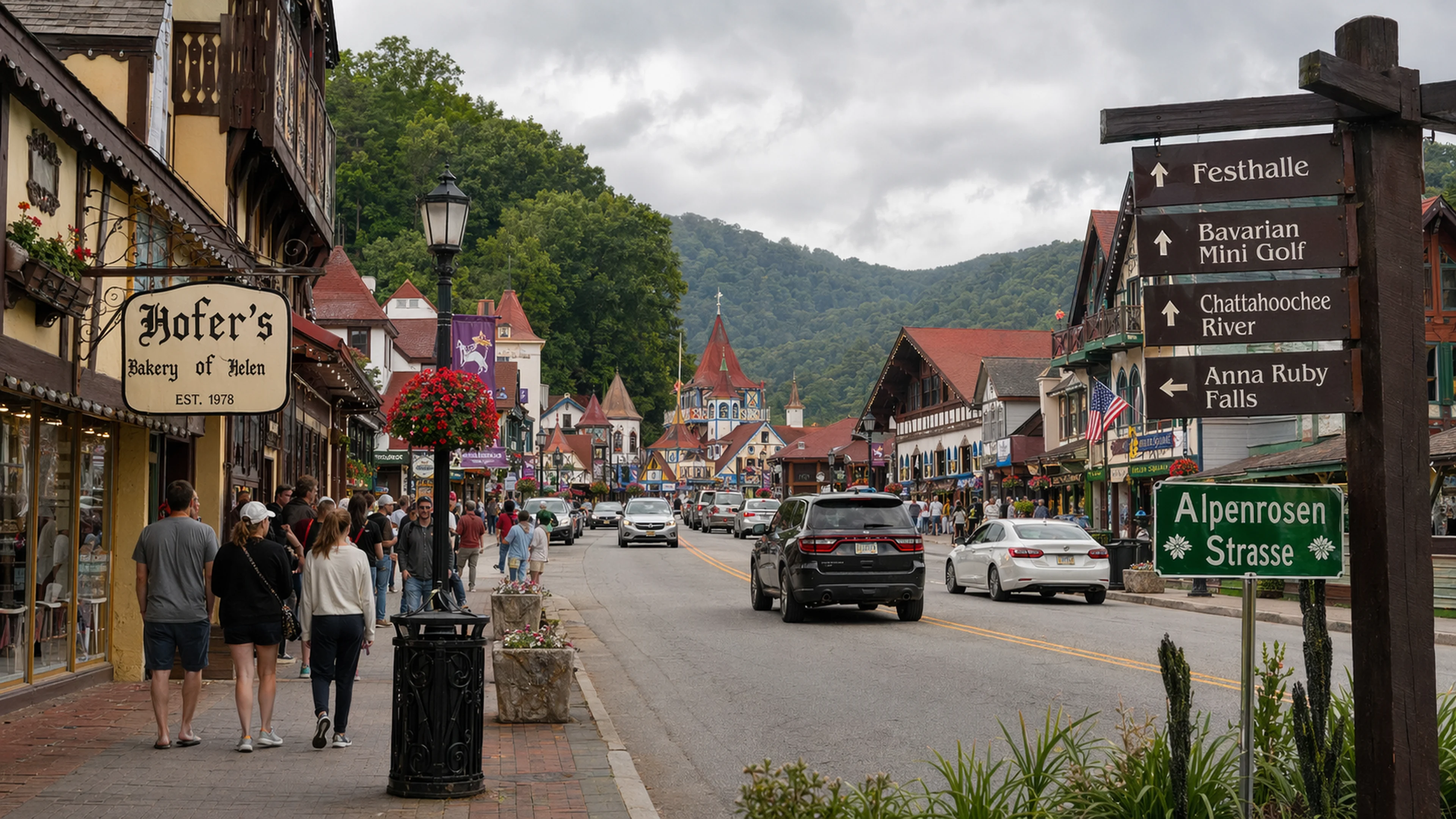
The transition from public to private fermentation infrastructure is, Bavarian Brainrot submits, the structural story of 2026. The Festhalle is still the Festhalle. The Bandshell is still the Bandshell. Oktoberfest is still Oktoberfest. But the marginal growth — the new licenses, the new pours, the new seats, the new garden — is happening outside the public sector. It is happening on S. Main Street, on Bruckenstrasse, in hotel lobbies, and on a parcel whose address Commissioner Wilkins did not disclose.
VIII. The Pattern
Helen's 2026 beverage infrastructure expansion, viewed at the distance of a quarterly fiscal report, is the largest single-year expansion the town has accommodated since the indoor Oktoberfest transition of 1972. It arrives at a moment when nearly every macroeconomic indicator available to the Commission trends positive:
Hotel/Motel Tax revenue is up 7.62 percent year-over-year, with $2,201,494 collected through the first nine months of FY26 against $2,046,386 in the same period of FY25. This is the tax that funds the CVB, the Welcome Center, the Travel Writers trips coordinated by Ruth Sykes of LRC P.R., and the media placements that generated a combined estimated value of $3.3 million from a single AOL/Yahoo story about Baby Land General Hospital. The Hotel/Motel Tax is Helen's thermometer. It is up.
SPLOST revenue is up 4.08 percent, with cumulative SPLOST #64 collections of $3,143,617 through March 2026. Sales tax delivered $277,200 in March alone. The tourism machine is running. It is running sufficiently well that Adam Zappia of Zartico was invited to present a new "Benchmarking" platform to CVB Director Jerry Brown on March 2, and ITI Digital was invited to workshop a "new AI buddy platform" on March 4. The city is investing in measurement tools for a tourism economy it believes is growing. The beverage licensees appear to agree.
Beer/Wine/Liquor Excise is, per the reported figures, slightly down — tracking at $129,514 against the prior year. This is the single counterindicative metric in the set, and it suggests, counterintuitively, that more revenue may be flowing through package-sales channels (where excise rates and collection mechanics differ) than through on-premises pouring. The 2026 licenses, which skew heavily toward on-premises service — four of the six new or expanded licenses include on-premises pouring, and two (Campfire, Pink Pig) specifically added liquor pouring to existing beer-and-wine licenses — represent a bet that the on-premises channel will recover. If the licensees are right, excise revenue should inflect upward in FY27.
The pattern, seen whole: Helen's private sector is building fermentation infrastructure faster than at any point since the Alpine mandate created the tourism economy in 1969. It is doing so at a moment when hotel tax is up, sales tax is up, SPLOST is up, and the city's own tourism-marketing apparatus is generating earned-media placements valued in the millions. The six licenses and the Beer Garden are not a coincidence. They are a capital-allocation signal. The private sector is reading Helen's fiscal reports the same way Bavarian Brainrot is reading them, and it is pouring money into the thing that Helen sells: the experience of drinking a beer in a Bavarian village in the North Georgia mountains, 90 minutes from Atlanta, on a Sunday afternoon, with a German band playing, while sitting on a fixed wooden bench under a canopy that may or may not be chestnut.
IX. The Open Questions
Commissioner Wilkins did not elaborate. She made her 11-word comment, and the meeting moved to adjournment. The Beer Garden's permit application — the subject of Bavarian Brainrot's April 28


Reader Comments
Leave a comment ↓