The cold snap of Sunday, January 4 through Saturday, January 10,
2026 — a seven-day period in which temperatures in the upper Smith
Creek drainage, elevation 2,040 feet, averaged 18°F and dropped to a
low of 6°F at approximately 4:47 a.m. Wednesday, January 7 —
produced the first substantial ice-sheathing of Anna Ruby Falls since
January 2015, when a comparable but shorter cold snap produced a
similar, slightly smaller, formation.
I hiked up the Smith Creek trail Monday morning, January 12, with
Ranger Calvin Pope of the U.S. Forest Service's Anna Ruby Falls
Visitor Center, to document the formation. The hike, ordinarily a
moderate 0.4-mile walk from the Visitor Center parking lot on a
paved ADA-accessible surface, required the use of ice cleats above
the trail's midpoint. The Visitor Center has, per Ranger Pope,
advised all visitors against attempting the hike without appropriate
traction. I had borrowed a pair of Ranger-issue Yaktrax from the
Center's loaner supply.
The formation
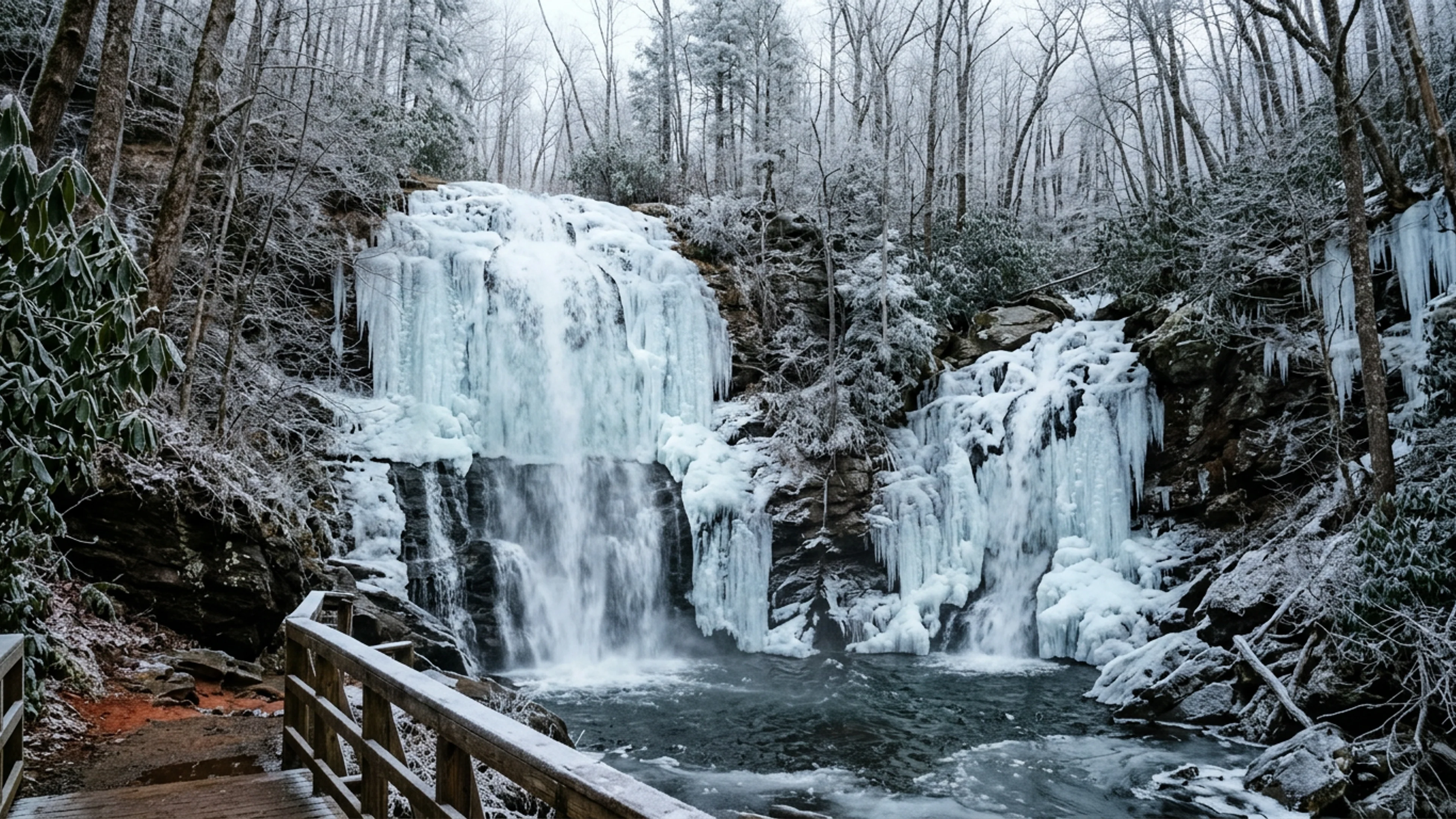
Curtis Creek, the 153-foot-high northern column of the tandem
formation, is, as of Monday morning, sheathed in ice from its upper
lip (elevation 2,178 feet, the top of the rock face) to a clear
horizontal demarcation line at approximately 100 feet above the lower
pool (elevation 2,078 feet). The ice is, per my visual inspection
from the public viewing deck, approximately 3 to 5 inches thick at
its most built-up sections, and is translucent — a pale, milky
blue-white with the suggestion of channels of liquid water flowing
behind and occasionally through its mass.
Below the demarcation line, the remaining 50 feet of Curtis Creek's
column flows in visible liquid form, striking the lower pool in its
usual arrangement.
York Creek, the 50-foot southern column, is, per Ranger Pope,
approximately 80% ice-sheathed — slightly more extensively covered
than Curtis Creek's 70%. This is, Ranger Pope explained, a
consequence of York Creek's substantially lower volume of flow: less
water is moving through the column, so more of the water's mass has
had time to freeze against the rock face.
The two falls, from the public viewing deck at 10:40 a.m. Monday,
were producing a continuous, low-register, percussive sound — water
flowing behind ice, occasional ice chunks breaking loose and
striking the lower pool, and the wind moving through the exposed
lip of each column. I have visited Anna Ruby Falls approximately
forty times over the past twenty-eight years. I have not before heard
this sound.
The advisory
Ranger Pope's standing advisory, as of Monday afternoon, is that the
formation is "beautiful and also not a destination you should
currently visit" — specifically for members of the general public
without prior winter-hiking experience or proper traction equipment.
The advisory cites the following reasons:
- The Smith Creek trail, above its midpoint, is substantially ice-
covered. A hiker without traction has an elevated fall risk.
- Ice chunks are, under current daytime-warming conditions, falling
from both columns. The observation deck is within the estimated
fall shadow of occasional such chunks.
- The Center's ambulance-access from the public parking lot to the
trailhead is, per current road conditions, estimated at 20-30
minutes longer than under normal conditions.
- The Center, which is ordinarily staffed by three rangers in peak
season, is presently staffed by Ranger Pope alone.
The Center recommends, per Ranger Pope's advisory, that visitors
wishing to view the ice formation do so via the webcam feed
maintained at the USFS website (linked from anna-ruby-falls-live-cam
on this publication), which offers a continuously updated image
from a fixed camera on the Center's roof.
Expected duration
Per the National Weather Service's extended forecast for the Helen
upper-slope region, temperatures are expected to moderate into the
mid-40s°F range during the daytime through the end of January, with
continued sub-freezing nighttime lows. Ranger Pope estimates, based
on his own observation of the 2015 formation's dissipation curve,
that the 2026 ice sheath will persist, in visible form, through the
end of the month.
"It will be what it is for about two weeks," Ranger Pope said,
standing at the observation deck at approximately 11:14 a.m. "Then
it will stop."
He paused.
"I wanted to see this again," he said.


Reader Comments
Leave a comment ↓