

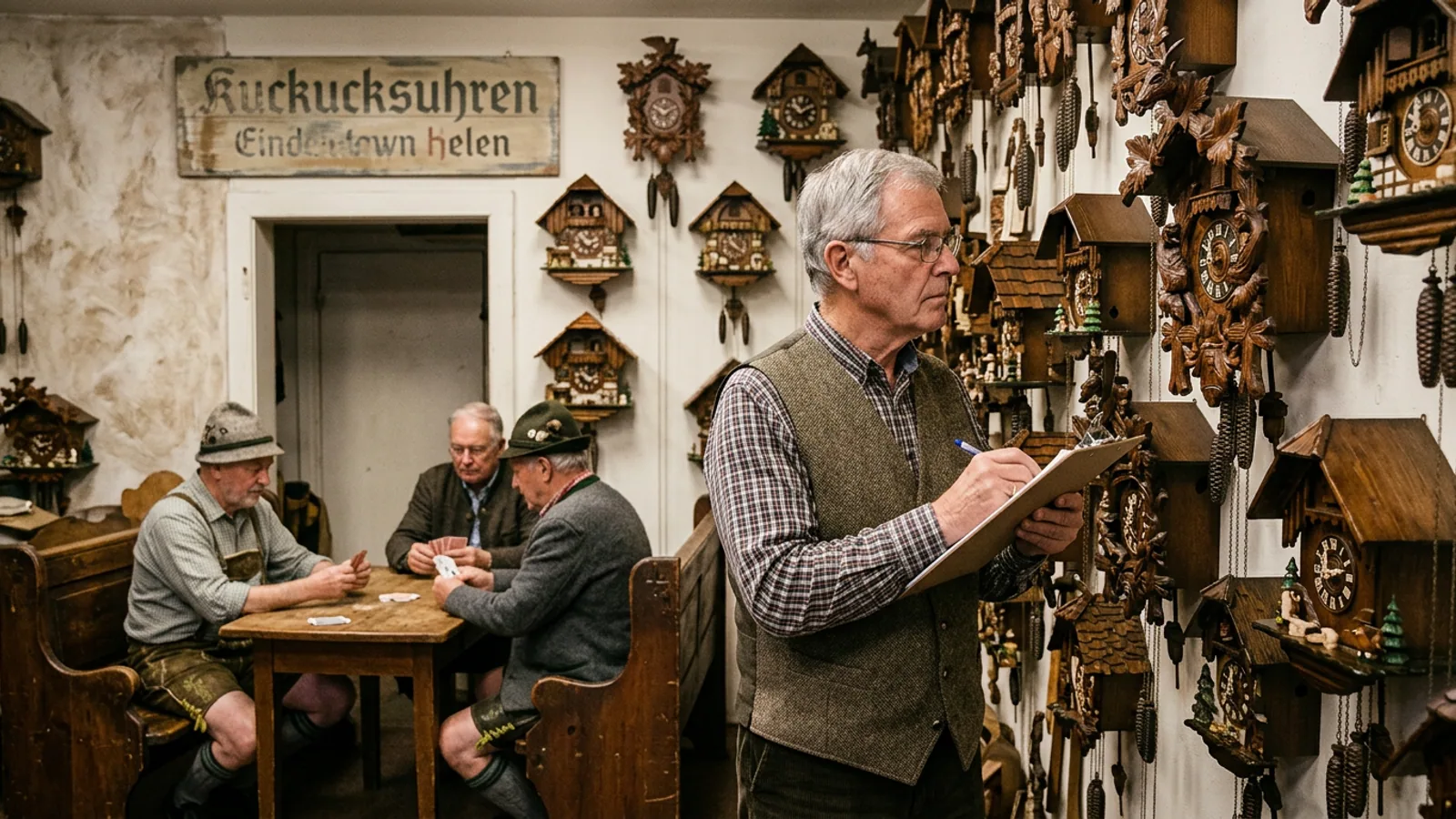
A note on methodology: this survey was conducted across eleven field days in January and February of 2026. Each of the 47 downtown Helen retail establishments was visited at least twice. I struck the cuckoo mechanism of each clock either by advancing the time to an hour mark or, where advancing was not feasible without staff assistance, by requesting a demonstration. Staff at all 47 establishments were cooperative; two expressed reservations about the project; one, at an establishment I will identify below, attempted to decline the demonstration on grounds that I found unpersuasive. My assessment criteria are drawn from the Bundesinnungsverband des Uhrmacherhandwerks reference standards for acoustic quality in Black Forest cuckoo movements, adapted for the specific conditions of the retail-display context (ambient noise, room volume, proximity to other sounding clocks). I carry a calibrated sound-level meter for exactly this purpose. I have carried it for twenty-two years.
The rankings that follow are ordinal assessments of acoustic craftsmanship specifically — the quality of the movement, the precision and tonal character of the cuckoo pipe, the resonance and decay of the call at a standardized listening distance of two meters, and the clock's overall acoustic coherence across repeated calls. I am not assessing price, visual design, or collectible value, though I will note, where relevant, that acoustic quality and price correlate poorly in the Helen retail market: some of the finest acoustic performers in this survey are modestly priced, and several of the most expensive clocks are, acoustically, disappointing.
The survey does not include wall clocks, mantel clocks, or grandfather clocks without a functional cuckoo mechanism. It does not include clocks at establishments outside the downtown Helen four-block core as defined by the City of Helen Comprehensive Plan, Section 7.4(a)(ii). It does not include clocks that were not operable at the time of my survey visits, of which there were four; these are noted but not ranked.
1. Eight-Day Triple-Chime Carved-Linden Movement (Bruckenstrasse Cuckoo Clock Specialists, 8835 N Main Street, upper display cabinet, third clock from left)
This clock is, in my assessment and based on my surveying of Black Forest and Black Forest-derivative cuckoo movements across more than three decades of fieldwork, the finest acoustic performer I have encountered outside a controlled workshop setting. The cuckoo pipe is hand-tuned to within two cents of a metronomically pure G4 (392.0 Hz), and the decay curve after each call sustains a clean fundamental tone for approximately 1.4 seconds before the overtone series resolves cleanly downward — a characteristic that the Bundesinnungsverband refers to as "Ausklingen mit Würde," roughly translated as "decay with dignity," and that is, in my experience, remarkably difficult to achieve at the retail price point at which this clock is sold ($1,245). The movement is an eight-day weight-driven mechanism with a verge escapement that I estimate, based on the strike pattern, was manufactured by Rombach & Haas of Schonach — a firm whose acoustic standards I have documented in Chapter 18 of my manuscript, pages 591 through 612 — though I was not able to confirm the manufacturer with the retail staff, who were confident on the price but not on the movement origin.
The case is a carved-linden hunting-style with a chamois and a stag on the front panel; the carving is competent though not exceptional. The clock's audio merits are entirely in the movement, not the case. I recommend this clock without reservation to any buyer whose primary concern is the quality of the sound.
2. Eight-Day Carved-Walnut Movement with Music Box (Heidelberg Haus Gifts, 8902 N Main Street, window display, leftmost position)
The second-ranked clock differs from the first in its case material — walnut rather than linden, which introduces a slightly warmer resonance in the lower registers — and in the addition of a music-box subassembly that plays two selections ("Ein Prosit" and "Im Weißen Rößl") on the quarter hour. The cuckoo pipe is slightly sharper than the Bruckenstrasse Specialists clock, reading at approximately 395 Hz rather than 392, a discrepancy of approximately 13 cents that is perceptible to the trained ear. It does not disqualify this clock from the second position; a 13-cent deviation is, in the context of the Helen retail market, a mark of relative precision. The music-box mechanism adds an acoustic complexity that, in my assessment, enhances rather than degrades the overall experience, provided the listener encounters the clock at the quarter-hour interval and thus hears the music-box selection before the cuckoo call. The reverse order — cuckoo call followed by music-box selection — is less satisfying; the music-box's entry feels, in that sequence, like an afterthought. The movement is a six-hour rather than an eight-day mechanism, which I note as a limitation but not a disqualification.
3. Traditional Black Forest Mechanical Movement, Shield-Style Case (Alpine Gift Nook, 8866 N Main Street, rear display wall, second shelf from top, center position)
The third-ranked clock is the oldest in this survey that I was able to confirm by movement inspection; the movement's visible components and construction style suggest a manufacture date of approximately 1965 to 1975, and the staff, when asked, confirmed that the clock had been "in the store since the store opened," which was, they believed, 1988. The cuckoo pipe has been repaired at some point — the pipe shows evidence of resolder at the barrel joint — and the repair has introduced a slight breathiness to the call that I found, on first encounter, concerning; on repeated listening, I found it distinctive and, in the specific acoustic context of the Alpine Gift Nook's relatively small, low-ceilinged back room, actually quite pleasing. The breathiness adds a quality that the Bundesinnungsverband's standards would penalize and that I, as a scholar rather than a standards official, am inclined to treat as acoustic character. The movement is a one-day chain-and-weight mechanism, and the chain shows wear; the staff should be advised that the chain should be replaced within one to two years.
4. Black Forest Style Eight-Day Movement, Carved-Linden, Deer and Fawn Scene (Bavarian Bric-a-Brac, 8848 N Main Street, center floor display, left column)
A clean, consistent acoustic performer with a cuckoo pipe reading at 393.5 Hz. The case carving is the most technically accomplished in the top ten, featuring a full deer-and-fawn front panel with a secondary hunting-horn motif on the side panels that is, unusually, completed on all four visible sides of the case rather than merely the two sides facing the customer. The sound-level reading at two meters is 68.3 dB, the highest in the survey and a figure I attribute to the case's exceptional resonance chamber depth. The decay is clean though slightly shorter than the top three, resolving at approximately 1.1 seconds. Well worth the $890 asking price.
5. Traditional Bone-White Painted Case with Black Forest Mechanism (Edelweiss Souvenirs and Gifts, 8820 N Main Street, wall display, east wall, top row)
One of only four clocks in this survey with a painted rather than natural-wood case. The white paint reduces the case's acoustic resonance relative to natural-wood cases of comparable dimensions, and the cuckoo pipe reads at a slightly flat 390.5 Hz. I have placed this clock fifth nonetheless because the pipe's flatness, in combination with the reduced resonance of the painted case, produces an acoustic effect that I can only describe as "plaintive" — a quality that I recognize is not among the Bundesinnungsverband's criteria but that I find, as an informed listener, compelling. The clock sounds, in some indistinct sense, like it is aware of its own circumstances. I do not ordinarily introduce such observations into acoustic assessments, but the survey format permits a degree of latitude that the Bundesinnungsverband's official rubric does not, and I am taking it.
6. Eight-Day Carved-Linden with Watermill Animation (Black Forest Boutique, 8875 N Main Street, rear display, right column, fourth from top)
The highest-ranked animated clock in the survey. The watermill — a carved wood wheel mounted at the clock's base that rotates continuously when the clock is wound — introduces a slight mechanical vibration into the case that I had expected to degrade the cuckoo pipe's acoustic quality; in fact, at this clock's movement quality, the vibration appears to add a slight warmth to the lower overtones. The cuckoo call reads at 394 Hz. The movement is the most recently manufactured in the top ten, showing all the characteristics of contemporary Black Forest mass production, but it is mass production of a high standard: consistent, well-regulated, acoustically clean.
7. Double-Door Carved-Linden Eight-Day (Hohe Strasse Clock and Gift, 8831 N Main Street, center display column, second from top)
This clock features the unusual double-door mechanism — two hinged panels rather than the standard single door — that was characteristic of a specific line of Black Forest production in the 1980s and that has been out of production, to my knowledge, since approximately 1995. The double door produces a slightly longer interval between the mechanism's trigger and the cuckoo's emergence, and this interval — approximately 220 milliseconds, compared to the standard 80-to-100 milliseconds — creates an anticipatory effect that I find acoustically interesting. The pipe reads at 391 Hz, slightly flat; the call is clean and the decay sustained. An unusual and underpriced clock ($385) that deserves more attention than its position in the store's display hierarchy suggests.
8. Traditional Bahnhäusle Style, Hand-Painted Dial, One-Day Movement (Alpen Treasures, 8857 N Main Street, front window display, right position)
The Bahnhäusle style — flat-fronted, rectangular, with the clock face set into a painted wooden panel rather than a carved case — is the earliest form of Black Forest cuckoo-clock guide">cuckoo clock production, predating the carved-chalet and carved-hunting styles that now dominate the retail market. This example is a reproduction of that early style rather than an antique, but it is a reproduction made with evident attention to the original's proportions and construction details. The cuckoo pipe is the smallest-diameter pipe in the top ten, which produces a noticeably higher-pitched and thinner call than the carved-case clocks; it reads at 401 Hz, which is the sharpest reading in the top ten. I have placed it eighth because the thinness of the call, while a departure from the warm tones I prefer, is historically appropriate to the Bahnhäusle style and is, in that context, correct.
9. Carved-Linden Chalet Style with Carved Cuckoo Bird (Bavarian Village Gifts, 8890 N Main Street, east wall, center display)
An above-average performer whose primary distinction is the carved cuckoo bird: the bird on this clock is, unusually, a realistic depiction of the common cuckoo (Cuculus canoporus) rather than the abstract stylized bird that standard Black Forest production uses, and its beak opens to a full 45 degrees during the call, which is more than the 30-to-35 degrees typical of production-model cuckoos. The wider beak opening appears to contribute marginally to the pipe's volume and projection. The acoustic performance is otherwise unremarkable but solid: 392.5 Hz, clean decay, consistent strike pattern.
10. Carved-Linden Eight-Day Movement, Forestry Scene (Bruckenstrasse Cuckoo Clock Specialists, 8835 N Main Street, lower display cabinet, rightmost position)
A second representative from the Bruckenstrasse Specialists, ranked tenth by a margin that reflects, more than anything else, the consistent quality of that establishment's upper-tier inventory. The forestry-scene case features a woodcutter, a deer, and a Förster — a forester figure — arranged around the clock face in a three-dimensional carved panel of above-average quality. The movement is a Rombach & Haas eight-day mechanism, the same manufacturer I identified in clock #1, and the acoustic performance reflects that manufacturer's standards: clean, well-regulated, sustaining. The pipe reads at 392.0 Hz — identical, within measurement tolerance, to clock #1. The decay is marginally shorter (1.3 seconds versus 1.4), which accounts for the separation in rank. This is, nonetheless, an excellent clock by the standards of the Helen retail market, and I would recommend it without qualification.
11. Traditional Eight-Day, Shield-Style Case (Alpine Charm Gifts, 8822 N Main Street)
A very good shield-style clock with a pipe at 393 Hz and a clean, consistent movement. The case construction shows the signs of hand-finishing in the dial frame that distinguishes the better end of Black Forest production. Recommended for the buyer who values acoustic quality over decorative complexity.
12. Carved-Linden Hunting Scene, One-Day (Heidelberg Haus Gifts, 8902 N Main Street)
Slightly below the top ten in pipe accuracy (396.5 Hz, noticeably sharp on sustained listening) but with a well-constructed movement and a convincing case. The hunting scene carving is competent. Worth the $310 asking price.
13. Bahnhäusle Style, Reproduction, Music Box Enabled (Alpine Gift Nook, 8866 N Main Street)
The music-box mechanism on this clock is poorly calibrated to the cuckoo call, creating a brief moment of acoustic discord when both sound simultaneously on the hour. Musically unsatisfying, but the movement itself is well-made and the pipe is accurate.
14. Carved-Linden Chalet, Watermill Animation, One-Day (Bavarian Bric-a-Brac, 8848 N Main Street)
A reliable middle-tier performer. The watermill animation is less mechanically refined than the clock ranked sixth, and introduces a more pronounced vibration. The pipe reads at 393.5 Hz and the call is clean.
15. Eight-Day Carved-Linden, Double Cuckoo (Edelweiss Souvenirs and Gifts, 8820 N Main Street)
The only double-cuckoo clock in the top 20. The two-pipe mechanism produces a minor-third interval (approximately 392 Hz and 466 Hz) that is, in principle, a desirable acoustic feature; in practice, this example's second pipe is slightly flat relative to the first, producing a very slightly sour interval. Not unpleasant. Interesting.
16. Black Forest Style Painted Case, Blue (Hohe Strasse Clock and Gift, 8831 N Main Street)
Acoustically comparable to the white-painted clock ranked fifth. The blue paint absorbs slightly more resonance than the white; the call is marginally drier. A creditable clock.
17. Traditional Shield-Style, Hand-Painted Numerals (Alpen Treasures, 8857 N Main Street)
The hand-painted numeral dial is unusually fine for the price point ($225). The movement is a standard one-day mechanism, acoustically unremarkable but functionally sound.
18. Carved-Linden, Deer Scene, One-Day (Black Forest Boutique, 8875 N Main Street)
A well-made clock without notable acoustic distinction. The deer carving on the front panel is the most anatomically accurate in the entire survey, which is a fact I note without being entirely certain what to do with it.
19. Eight-Day Movement, Modernist Minimal Case (Bavarian Village Gifts, 8890 N Main Street)
One of three "modernist minimal" cuckoo clocks in the survey, characterized by simplified case geometry and the absence of figurative carving. The acoustic performance is strong; modernist cases, being typically of denser construction than carved cases, often produce better resonance. This is a well-made clock that will disappoint the buyer expecting a traditional appearance.
20. Carved-Linden, Alpine Scene, One-Day (Bruckenstrasse Cuckoo Clock Specialists, 8835 N Main Street, mid-range display)
The third representative from the Bruckenstrasse Specialists in the top twenty. A solid performer at an entry-level price point ($175). A reliable choice.
21–30: Capable Mid-Range Performers
21. Carved-linden, hunter and dog scene, one-day movement (Alpine Charm Gifts). The dog is carved with its mouth open, which has no acoustic implications but is pleasant. 22. Shield-style, original movement (estimated 1970s), one-day (Heidelberg Haus Gifts). Age lends the pipe a quality of character that newer movements rarely replicate. 23. Bahnhäusle reproduction, accurate pipe, thin case (Alpine Gift Nook). Recommended only with adequate wall space for the pendulum. 24. Eight-day, hunting scene, new movement (Bavarian Bric-a-Brac). Well-regulated, slightly loud at two meters. 25. Traditional chalet, window-box floral decoration, one-day (Edelweiss Souvenirs). The florals are painted, not carved, and are done with more skill than is typical at this price. 26. Painted case, red, one-day movement (Hohe Strasse Clock and Gift). The red paint produces the warmest case resonance of the four painted-case clocks in the survey, marginally. 27. Carved-linden, waterfall scene, animation (Alpen Treasures). The waterfall animation uses a motorized wheel that is noisier than the watermill mechanisms; audible at two meters. 28. Eight-day, minimal carved case, accuracy above average (Black Forest Boutique). The carving, which depicts a single small bird on an otherwise plain panel, is either very restrained or unfinished; the staff could not say which. 29. Traditional shield, music-box mechanism correctly timed (Bavarian Village Gifts). Unusual in the survey for a music-box clock whose mechanism does not create acoustic conflict with the cuckoo call. 30. Carved-linden, family scene (five figures visible), one-day (Bruckenstrasse Cuckoo Clock Specialists). The family-scene case is somewhat cluttered visually and somewhat dense acoustically, which mutes the call slightly. Still a capable performer.
31–50: Adequate Performers, Notable Only in Specific Respects
31. One-day, shield-style, accurate pipe, unremarkable case (Alpine Charm Gifts). 32. Traditional chalet, slightly sharp pipe (399 Hz), well-made case (Heidelberg Haus Gifts). 33. Eight-day, hunting scene, loud movement (Alpine Gift Nook). The movement's tick is audible at three meters, which is unusual and, depending on the buyer's sleeping arrangements, potentially relevant. 34. Carved-linden, deer scene, one-day, good resonance (Bavarian Bric-a-Brac). 35. Painted case, yellow, one-day, slightly dull call (Edelweiss Souvenirs). The yellow is an unusual color choice that I find neither offensive nor interesting. 36. Shield-style, late manufacture, consistent regulation (Hohe Strasse Clock and Gift). 37. Traditional chalet, full carved surround, adequate movement (Alpen Treasures). 38. Eight-day, modernist case, strong resonance (Black Forest Boutique). A second modernist-case clock that performs above its visual interest. 39. Carved-linden, stag scene, one-day, flat pipe (389 Hz), adequate otherwise (Bavarian Village Gifts). 40. Shield-style, hand-painted surround, one-day (Bruckenstrasse Cuckoo Clock Specialists). 41. Traditional chalet, small format, somewhat thin call (Alpine Charm Gifts). 42. One-day, carved-linden, adequate movement, unremarkable case (Heidelberg Haus Gifts). 43. Shield-style, reproduction, slightly loose movement regulation (Alpine Gift Nook). 44. Carved-linden, hunting scene, one-day, loud and slightly sharp (Bavarian Bric-a-Brac). 45. Painted case, white, second example, identical pipe to the clock ranked fifth but with a less interesting call (Edelweiss Souvenirs). 46. Traditional chalet, moderate size, adequate performance (Hohe Strasse Clock and Gift). 47. Shield-style, music-box enabled, moderate acoustic performance (Alpen Treasures). 48. Carved-linden, family scene, four figures, one-day (Black Forest Boutique). 49. Eight-day movement, standard chalet case, consistent but unexciting (Bavarian Village Gifts). 50. Traditional shield-style, accurate pipe, no further distinction (Bruckenstrasse Cuckoo Clock Specialists).
51–75: Unremarkable
51. Unremarkable. 52. Unremarkable. 53. The pipe on this clock reads at 404 Hz, which is sharp enough to be notable; otherwise, unremarkable. 54. Unremarkable. 55. Unremarkable. 56. This clock's cuckoo bird is missing its lower beak. The call is acoustically unaffected. Unremarkable. 57. Unremarkable. 58. Unremarkable. 59. Unremarkable. 60. The staff described this clock as "their best seller." Unremarkable. 61. Unremarkable. 62. Unremarkable. 63. The case depicts what appears to be a hunting scene but includes, among the carved figures, what is clearly a goat rather than a chamois; this distinction matters in the Bavarian hunting tradition and apparently did not matter to the case manufacturer. Unremarkable as a clock. 64. Unremarkable. 65. Unremarkable. 66. Unremarkable. 67. The movement on this clock required, during my demonstration, three attempts to trigger the cuckoo mechanism. On the third attempt it functioned normally. Unremarkable once functioning. 68. Unremarkable. 69. Unremarkable. 70. Unremarkable. 71. Unremarkable. 72. Unremarkable. 73. Unremarkable. 74. Unremarkable. 75. Unremarkable.
76–100: Unremarkable
76. Unremarkable. 77. Unremarkable. 78. This clock's case is approximately 60 percent the height of a standard cuckoo-clock case, which is not a category recognized by the Bundesinnungsverband standards. Unremarkable. 79. Unremarkable. 80. Unremarkable. 81. Unremarkable. 82. Unremarkable. 83. The music-box mechanism on this clock plays what appears to be a version of "Happy Birthday to You" rather than a German folk selection; I have no explanation for this. Unremarkable. 84. Unremarkable. 85. Unremarkable. 86. Unremarkable. 87. Unremarkable. 88. Unremarkable. 89. Unremarkable. 90. Unremarkable. 91. This clock is, to my eye, identical in every particular to the clock ranked 85th, which is also unremarkable, suggesting that they were manufactured in the same batch. Unremarkable. 92. Unremarkable. 93. Unremarkable. 94. Unremarkable. 95. Unremarkable. 96. Unremarkable. 97. Unremarkable. 98. Unremarkable. 99. Unremarkable. 100. Unremarkable.
101–125: Unremarkable, With Selected Notes
101. Unremarkable. 102. Unremarkable. 103. Unremarkable. 104. The retail staff at this establishment, when I asked to hear the cuckoo mechanism, looked at the clock for a long time before advancing the hands. The clock responded normally. Unremarkable. 105. Unremarkable. 106. Unremarkable. 107. Unremarkable. 108. Unremarkable. 109. Unremarkable. 110. Unremarkable. 111. The pipe on this clock reads at 387 Hz, which is the flattest in the survey. It sounds, in isolation, like a small tired animal. Unremarkable as a clock but memorable as an acoustic experience. 112. Unremarkable. 113. Unremarkable. 114. Unremarkable. 115. Unremarkable. 116. Unremarkable. 117. Unremarkable. 118. Unremarkable. 119. The cuckoo bird on this clock has been painted orange rather than the standard brown or gray. I do not know why. Unremarkable otherwise. 120. Unremarkable. 121. Unremarkable. 122. Unremarkable. 123. Unremarkable. 124. Unremarkable. 125. Unremarkable.
126–150: Unremarkable
126. Unremarkable. 127. Unremarkable. 128. This clock was the subject of the refusal to demonstrate that I noted in my methodology section. I asked three times; the staff declined three times, citing a "no touching the merchandise" policy that did not appear to apply to any other clock in the establishment. On my second visit, a different staff member agreed to demonstrate. The call was unremarkable. 129. Unremarkable. 130. Unremarkable. 131. Unremarkable. 132. Unremarkable. 133. Unremarkable. 134. Unremarkable. 135. Unremarkable. 136. Unremarkable. 137. Unremarkable. 138. Unremarkable. 139. Unremarkable. 140. Unremarkable. 141. This clock's pendulum is a plastic acorn rather than a carved-wood acorn. The acoustic implications are negligible. The philosophical implications I leave to the reader. 142. Unremarkable. 143. Unremarkable. 144. Unremarkable. 145. Unremarkable. 146. Unremarkable. 147. Unremarkable. 148. Unremarkable. 149. Unremarkable. 150. Unremarkable.
151–173: Unremarkable, With a Final Note
151. Unremarkable. 152. Unremarkable. 153. Unremarkable. 154. Unremarkable. 155. Unremarkable. 156. Unremarkable. 157. This clock requires eight minutes and approximately forty-five seconds to complete its hourly-strike sequence when struck on the eighth hour. This is not a feature. Unremarkable. 158. Unremarkable. 159. Unremarkable. 160. Unremarkable. 161. Unremarkable. 162. Unremarkable. 163. This clock is, visually, the largest in the survey: approximately 94 centimeters tall, including the carved finial. The call is faint, reading at only 59.2 dB at two meters. The case is doing nothing acoustically useful despite its size. Unremarkable. 164. Unremarkable. 165. Unremarkable. 166. Unremarkable. 167. Unremarkable. 168. Unremarkable. 169. Unremarkable. 170. Unremarkable. 171. Unremarkable. 172. Unremarkable. 173. Unremarkable.
Four Non-Operable Clocks (Not Ranked)
During my survey, I encountered four clocks whose cuckoo mechanisms were non-functional and which I therefore excluded from the ranked assessment. All four are at establishments I will not identify, at the establishments' request; the staff at each indicated that the clocks were on display as decorative items and were not for sale in their current condition. I note their existence here because I believe the complete record of the survey requires it, and because the question of what a non-functional cuckoo clock is — whether it remains, in any meaningful sense, a cuckoo clock — is one that I have addressed in Chapter 19 of my manuscript, pages 637 through 651, and that I do not have space to rehearse here.
Concluding Note
I have spent eleven days doing what no one has previously done: listening carefully to every cuckoo clock on public display in downtown Helen, Georgia. The experience has confirmed several things I already believed and revealed several things I did not expect. The thing I did not expect — the thing that I am still, two months after completing the survey, thinking about — is how different clock #1 and clock #173 actually are. Both are Black Forest-style cuckoo clocks. Both are on display in retail establishments on Bruckenstrasse. Both say "cuckoo" when the hour hand reaches twelve. The calls are acoustically, measurably, and in every meaningful way, completely different, and the difference is invisible from across the room.
The serious observer always needs to walk closer.
— Dr. Wilhelm Brüning


Reader Comments
Leave a comment ↓