Pillar Guide · Culture · Retail
Helen, Georgia Cuckoo Clocks: A Complete Buyer's And Historical Guide
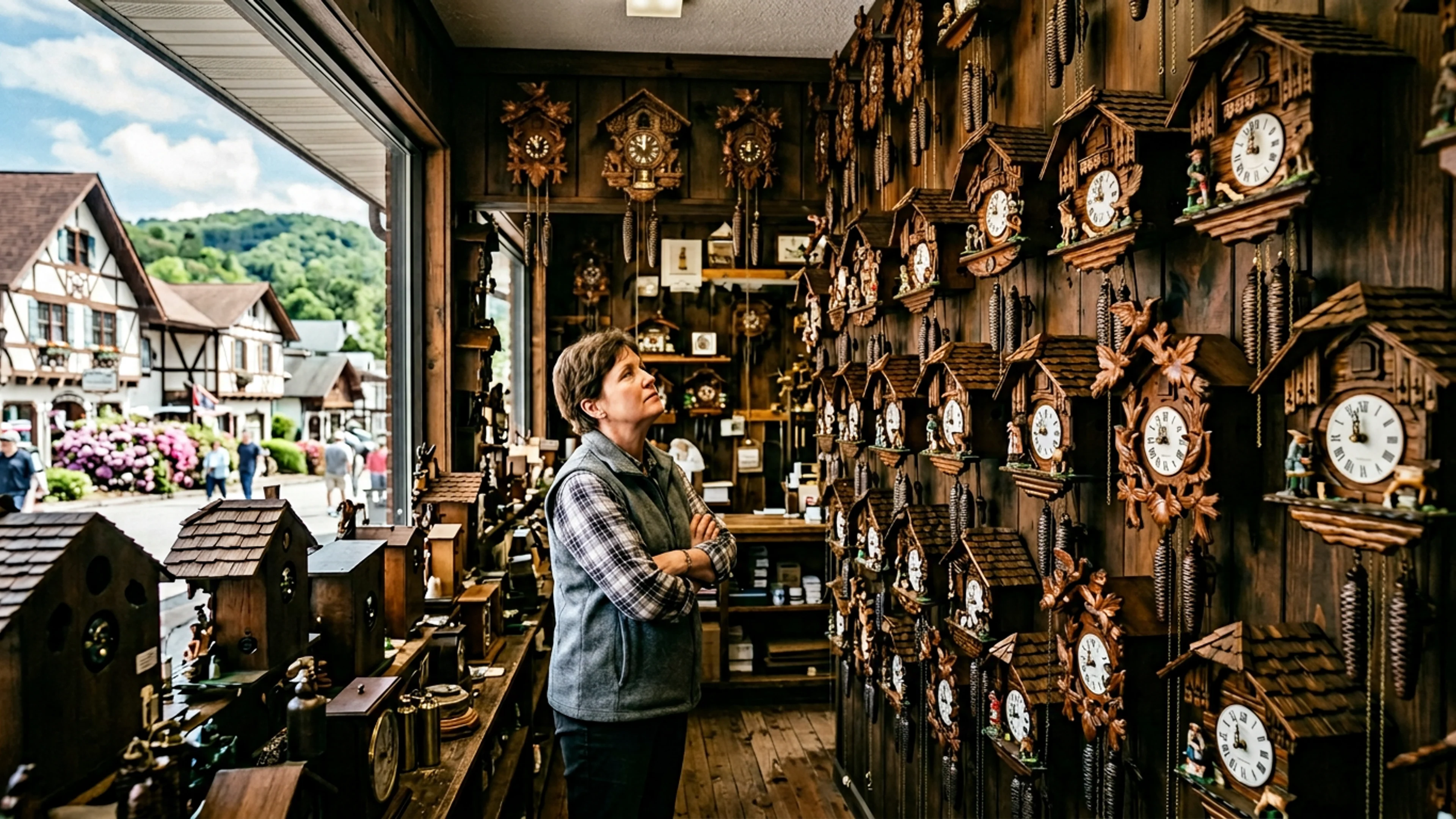
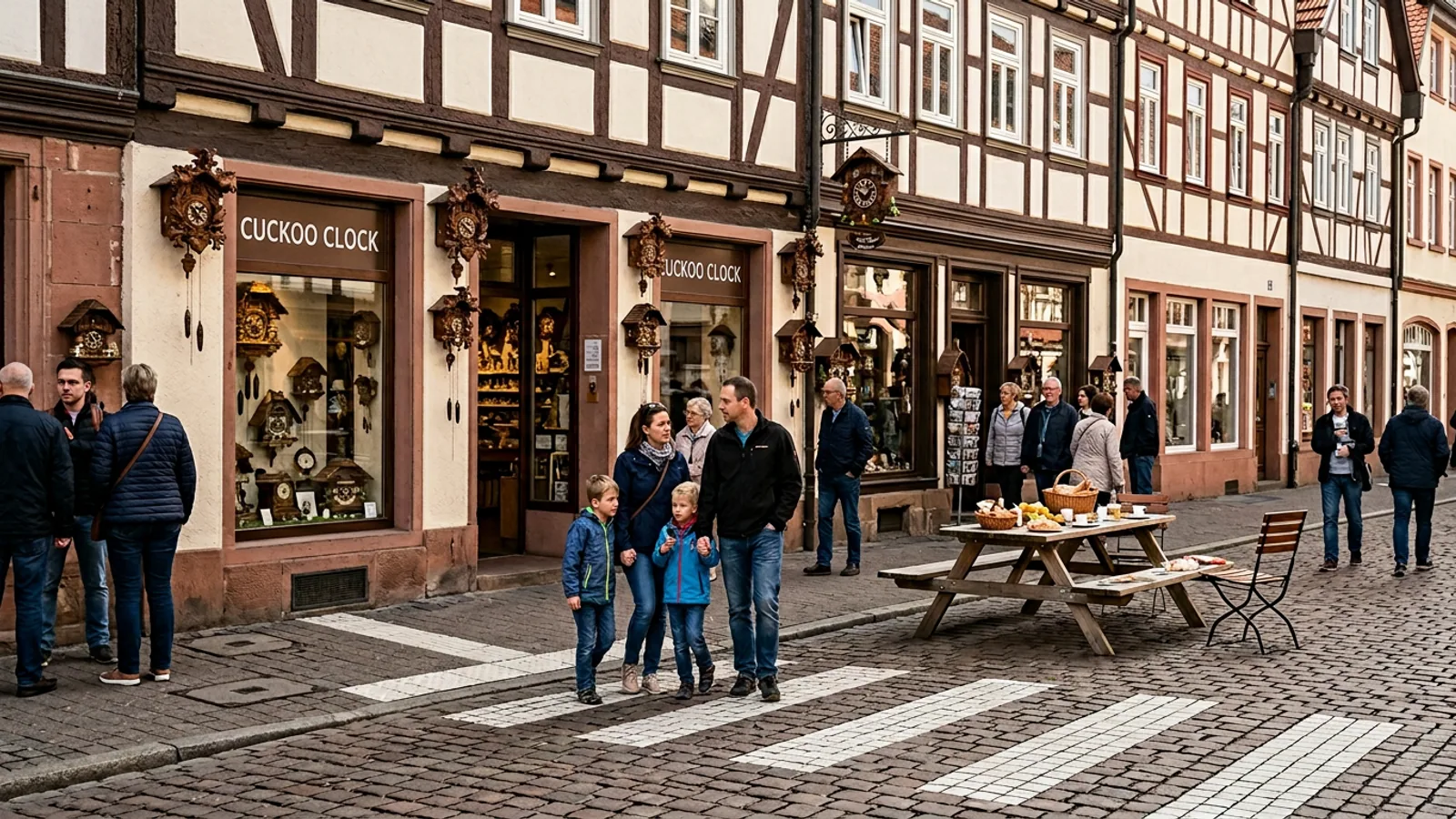
Helen's defining retail category is the cuckoo clock. This is not a promotional sentence. It is a count. Per the thirty-third consecutive quarterly inventory conducted by this publication's cultural-affairs desk, the downtown core, across a four-block footprint of roughly 1,056 linear feet, holds 274 individually countable cuckoo clocks on public display, a figure that sits four units above the ten-year January mean and five units short of the all-time October 2024 peak of 279. Within that inventory, Dr. Wilhelm Brüning has, over eleven field days in January and February of 2026, formally cataloged and ordinally ranked 173 cuckoo clocks by acoustic craftsmanship. The city has a Cuckoo Clock Density Index, which currently runs at 2.7 establishments per linear block, against a proposed aspirational ceiling of 1.8. That is the opening. The rest of this guide is the detail.
Why Helen Has So Many Cuckoo Clocks
The standing explanation begins in 1968. That year, a group of Helen business owners, working with the Clarkesville-based artist John Kollock, conducted the deliberate architectural conversion of a declining lumber town into an Alpine-village facsimile patterned on Garmisch-Partenkirchen, Bavaria. The conversion, which produced the pitched roofs, painted beams, and decorated second-story balconies still on view along Bruckenstrasse and Main Street, did not include a cuckoo clock mandate. The clocks arrived later, with the first documented specialty importer opening a storefront in the fall of 1972 and a second, a block away, in the spring of 1974.
The retail category grew in parallel with the town's tourist volume and was, in 2024, formalized into municipal planning policy. Section 7.4 of the City of Helen Comprehensive Plan, beginning on page 184 and running through page 198, establishes the regulatory overlay now governing the sector. The Plan defines a cuckoo-clock retail establishment as any business whose merchandise inventory, by stocking-unit count, consists of more than 15 percent cuckoo clocks. By that definition, downtown Helen currently hosts 11 such establishments. The broader set of retailers displaying at least one cuckoo clock is larger: Dr. Brüning's January survey counted 47 downtown storefronts meeting that looser threshold. Full annotated reading of the Plan is available at Margaret Holcomb's Section 7.4 breakdown.
The Helen Cuckoo-Clock Shops
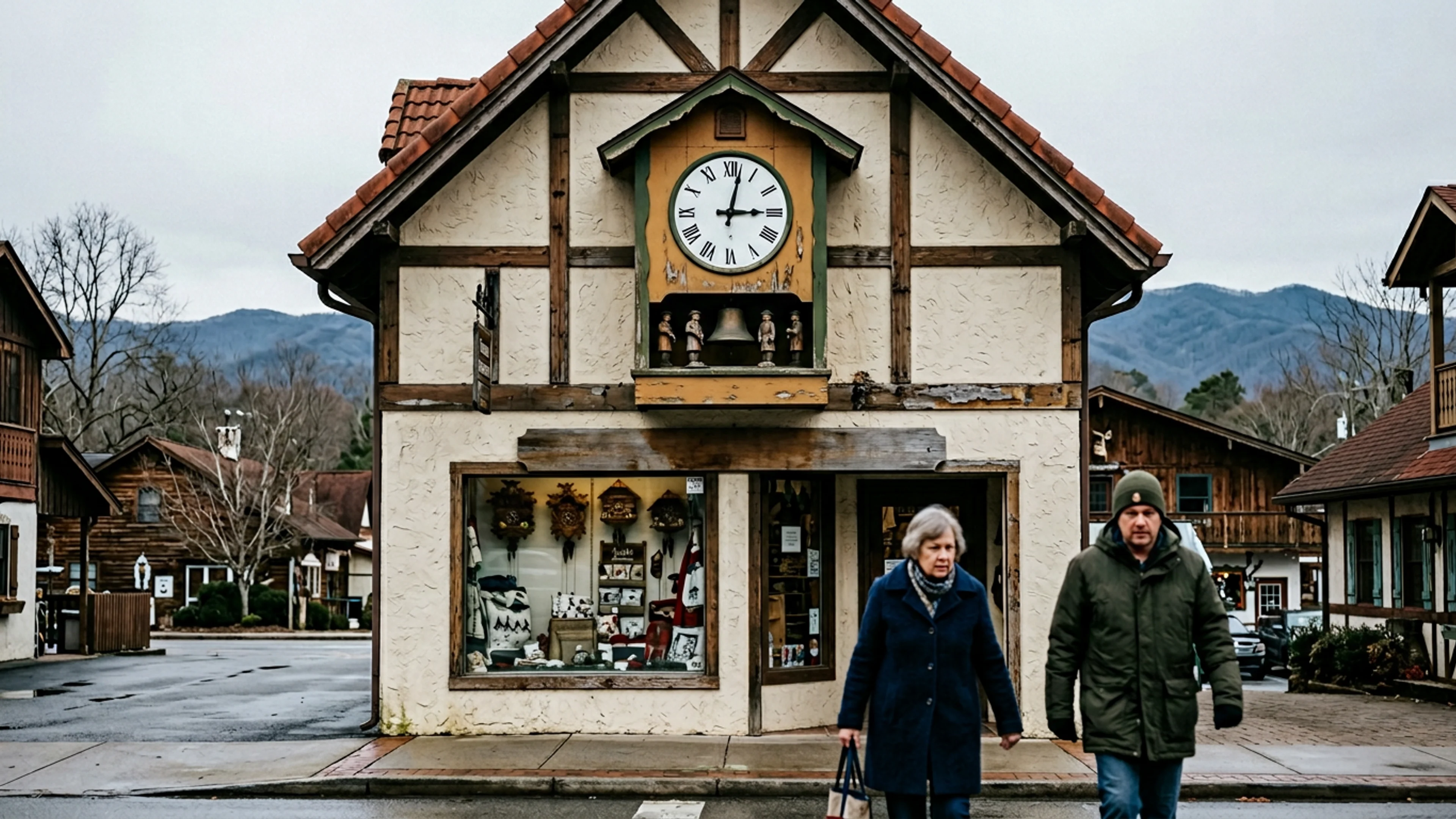
The three specialty shops — defined as operations in which cuckoo clocks constitute the primary retail proposition rather than an adjacent Bavarian-themed SKU — are concentrated within a three-block radius of the Welcome Center.
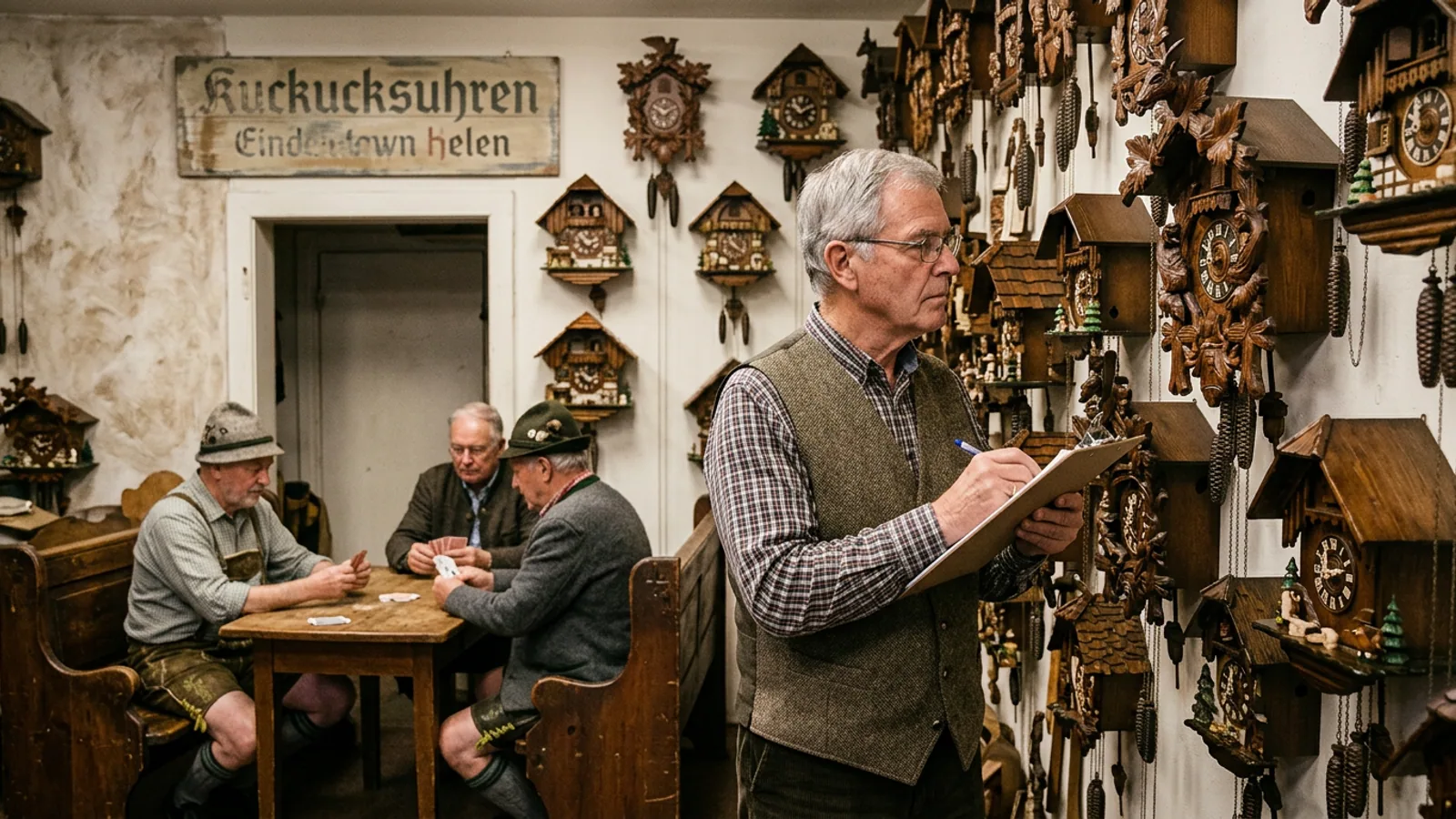
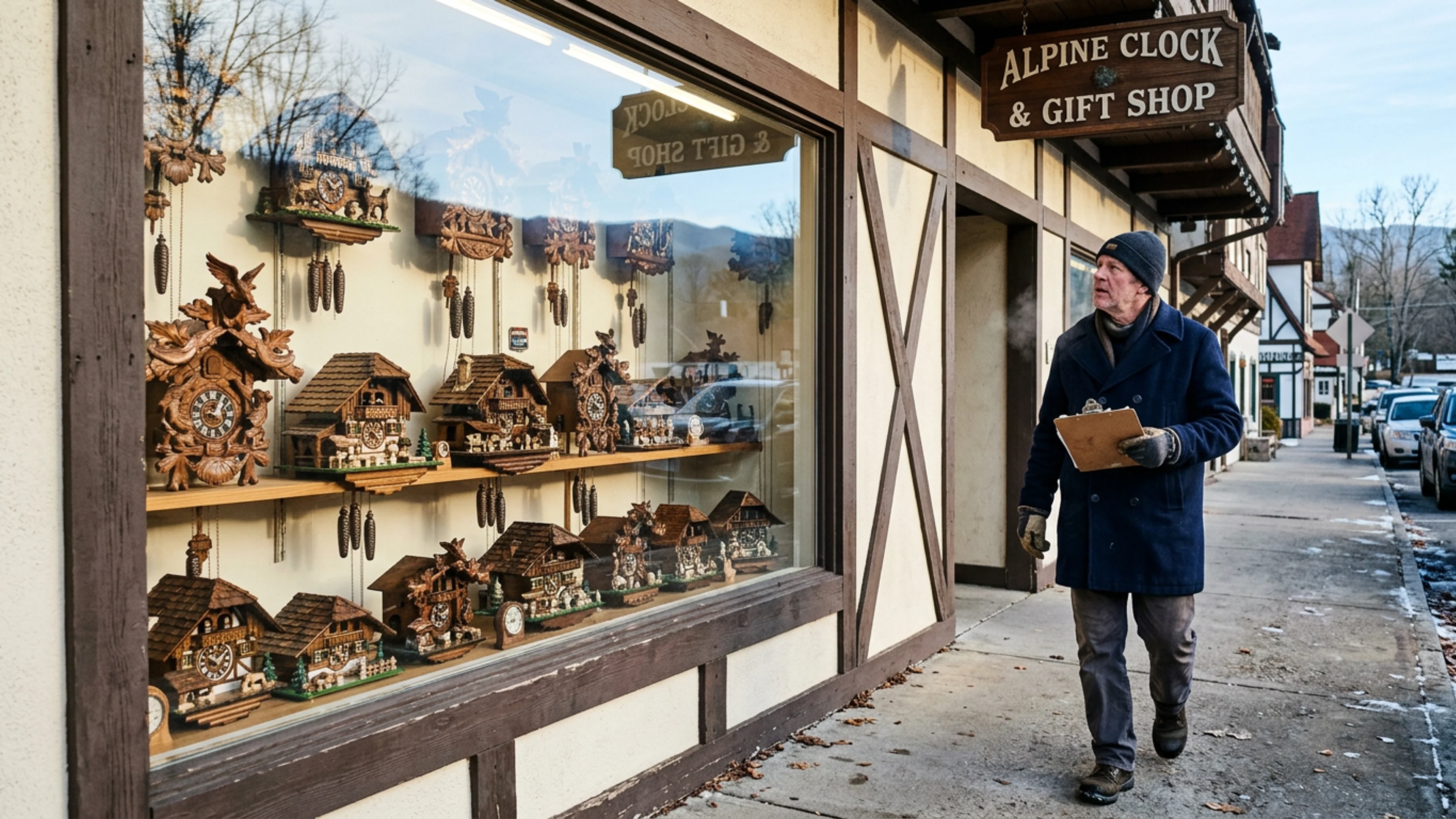
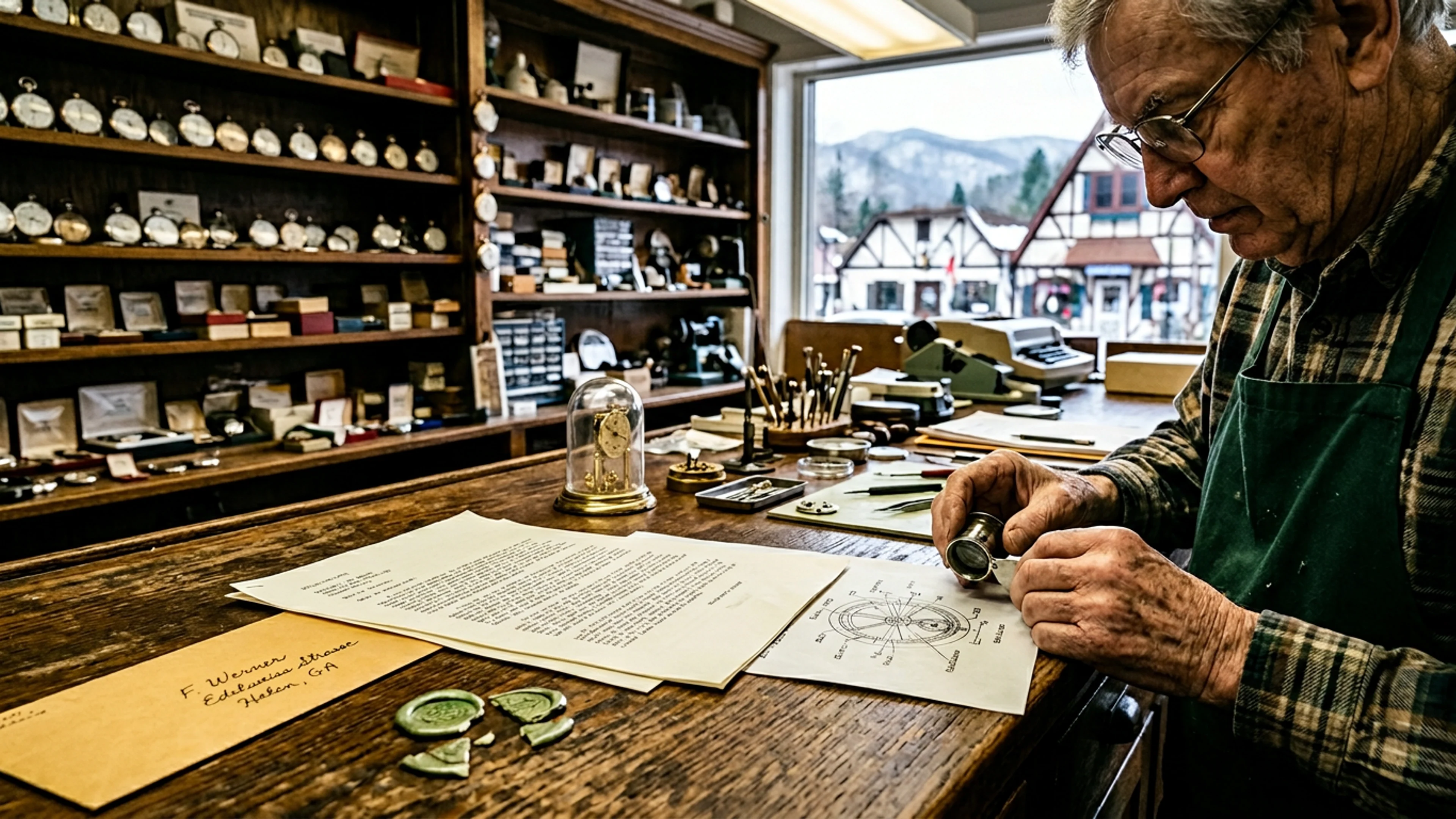
Heinrich's Cuckoo Emporium, at 1204 Bruckenstrasse, is the largest by floor count (62 clocks on the January 15, 2026 inventory, distributed across a south-facing display window, a north-facing display window, and an interior wall visible through the front door). The proprietor, Mr. Wilhelm Kreitz (71, WOSTEP 1976) is a retired certified horologist and the cousin by marriage of the paper's Bavarian Cultural Affairs Editor. Die Alte Uhrenhaus, at 1106 Main Street, carries 84 clocks and has held that number consistently across the last two quarterly inventories; its interior wall, visible through the front door, is the single densest continuous cuckoo display in the downtown core. Stadtkirchner & Söhne operates, on the 300-foot block that locals and the Plan both now call the Stadtkirchner Arcade, the Schwarzwald manufacturer's anchor retail storefront, and its 8-day weight-driven movements are priced from $380 to $1,400. A fourth shop, Kellner & Sons Timepieces, at 522 Edelweiss Strasse, carries 27 cuckoo clocks alongside a general watchmaking inventory; its proprietor, Mr. Norbert Kellner, is the subject of our January report on his six-page letter to the Vienna University of Technology.
Dr. Brüning's 173-Clock Ranking
Across eleven field days in January and February of 2026, Dr. Wilhelm Brüning visited each of the 47 downtown Helen retailers displaying at least one cuckoo clock, struck the mechanism of every operable unit, measured the cuckoo pipe's fundamental frequency with a calibrated sound-level meter he has carried for 22 years, and ranked the 173 functional clocks in descending order of acoustic craftsmanship. The top-ranked clock is an Eight-Day Triple-Chime Carved-Linden Movement in the upper display cabinet at Bruckenstrasse Cuckoo Clock Specialists. The pipe reads at 392.0 Hertz, within two cents of a metronomically pure G4, and the decay sustains a clean fundamental tone for approximately 1.4 seconds before the overtone series resolves downward, a characteristic the German watchmakers' guild describes as Ausklingen mit Würde, or decay with dignity.
The ranking descends through 19 specific mid-tier performers before flattening into a long, methodically labeled stretch of clocks Dr. Brüning classifies, in his own notation, as Unremarkable. Four clocks in the survey were non-operable at the time of his visits and are therefore excluded from the ranked positions. The full survey, including the flattest pipe recorded (387 Hertz, a clock Dr. Brüning characterizes as sounding in isolation like a small tired animal), is posted at the complete 173-clock ordinal survey.
Mechanisms: 1-Day, 8-Day, Weight-Driven, Musical
A cuckoo clock is defined by its movement before any other variable, including its carving. The Helen retail market carries, in functional terms, four movement categories. The 1-day mechanism runs on a single daily wind of the weight chain and is the most commonly stocked; these clocks, which dominate the entry-level souvenir segment, require roughly 24 hours between winds and exhibit a wider acceptable regulation tolerance. The 8-day mechanism, which winds weekly, is more expensive by a factor of two to three and is the movement of serious collectors; the weights are heavier, the gear train more substantial, and the regulation holds to within four minutes per week under the Bundesinnungsverband reference standard.
The weight-driven mechanism is the historical norm and is mechanically superior to the battery-operated quartz movements found in souvenir-tier units; the pendulum period in a weight-driven clock is self-regulating, whereas quartz units drift in proportion to battery voltage. The musical subassembly, finally, is a separately manufactured cylinder-and-pin mechanism typically paired with the 8-day movement. Two tunes are standard; three tunes exist but are rare outside the Stadtkirchner line. The hourly sequence, as observed in the best-calibrated Helen stock, runs music-box first, then cuckoo call; reversal is possible, and, per Dr. Brüning, acoustically less satisfying.
Authenticity Markers: What A Real Black Forest Clock Shows
The Black Forest cuckoo clock, as a category, is protected under the Federal Republic of Germany's Verein die Schwarzwalduhr certification. A clock bearing the certification carries a hologrammed seal affixed to the interior of the back panel and a serial-numbered certificate of origin traceable to one of the approved regional manufacturers: Rombach & Haas of Schonach, Hekas, Hönes, Anton Schneider, Hubert Herr, and, among the more recent certifications, Stadtkirchner & Söhne. The seal is visible only if the buyer opens the rear access panel, which the buyer is advised to do.
Secondary markers include carved-linden construction rather than a pressed-composite case, a hand-carved rather than a machine-stamped cuckoo bird (the beak on a hand-carved bird opens to 30 to 45 degrees and shows individual tool marks on the inner surface), a hand-tuned pipe reading within approximately 10 Hertz of the 392 standard, and chain-and-weight drive rather than battery power. Souvenir-tier pieces that carry the Black Forest aesthetic without the certification are not illegal; they are simply not, in the formal trade sense, Black Forest clocks. Dr. Brüning's position on this distinction is that it matters, and that the buyer paying more than $300 should be confident the distinction is on the buyer's side of the transaction.
Price Tiers: Under $200 To Collector-Grade Above $3,000
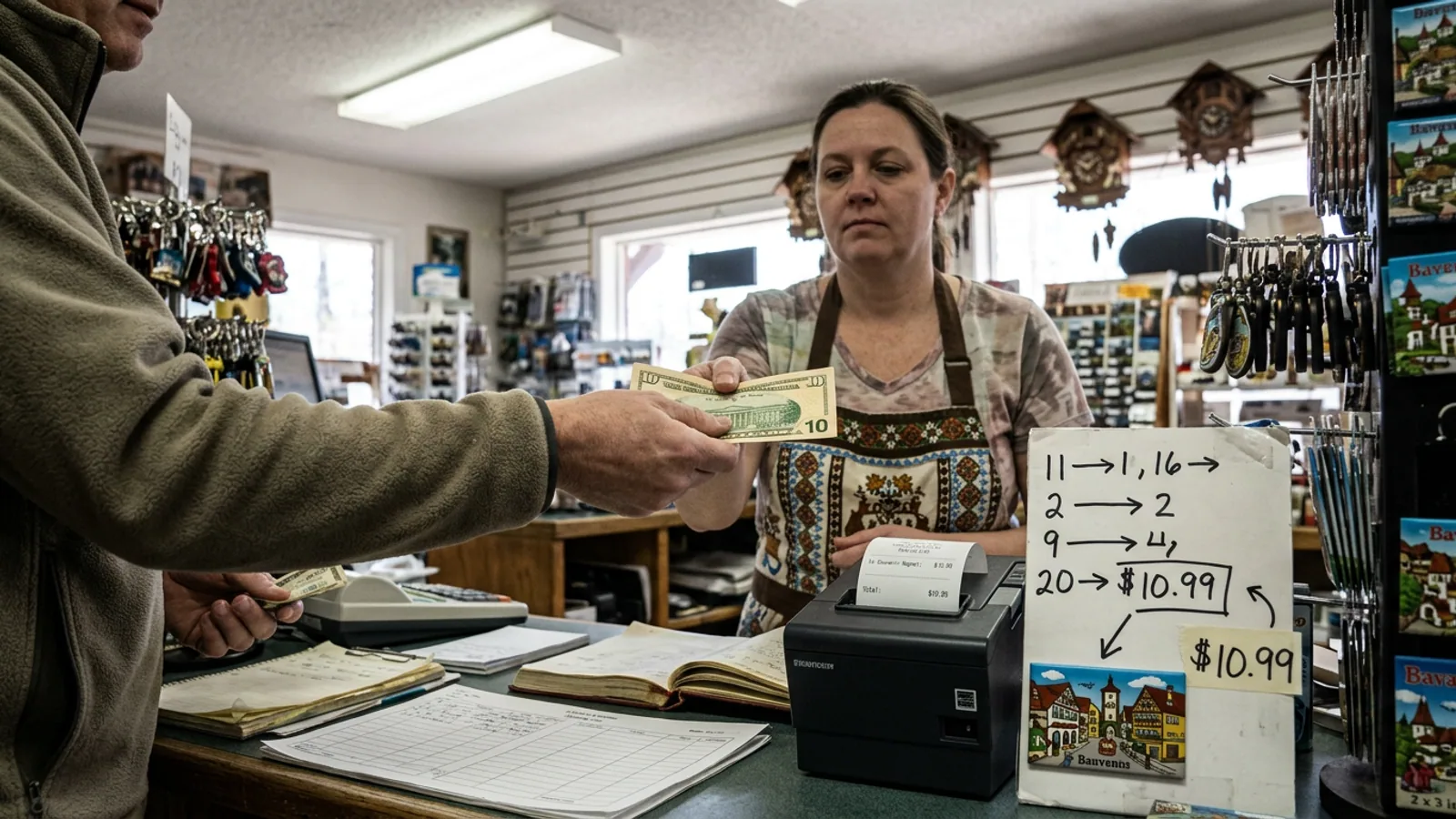
The Helen market stratifies cleanly. Under $200 is souvenir tier: battery-powered, pressed-composite case, recorded cuckoo call, frequently Chinese-manufactured. The miniature reproduction keychain variant, which plays a recorded call through a small piezoelectric speaker, retails for $8 to $14 and is the highest- unit-volume cuckoo product on Bruckenstrasse.
$200 to $500 is the entry-level certified category: 1-day mechanical movement, carved-linden construction, a single-tune music box or no music box, Black Forest certification frequently present. $500 to $1,200 is the working-collector tier: 8-day movements, two-tune music boxes, carved cases of documented manufacturer origin. $1,200 to $3,000 is the serious-collector tier: Rombach & Haas, Hönes, or comparable-origin 8-day weight-driven mechanisms with hand-finished dial frames and verified Schwarzwald provenance. Above $3,000 is specialty: triple- chime mechanisms, antique or pre-1970 movements with documented ownership chain, custom-carved cases commissioned through a manufacturer's bespoke program. The Bruckenstrasse Cuckoo Clock Specialists' $1,245 Eight-Day Triple-Chime — Dr. Brüning's top-ranked unit — sits at the top of the working-collector tier and, in acoustic terms, punches two tiers above its price.
The Cuckoo-Clock CPI Sub-Index
This paper's business desk publishes, monthly, the Bavarian-Beige Composite, a series of retail-price indices benchmarking the downtown Helen tourist-economy inflation rate against the national Bureau of Labor Statistics CPI release. The cuckoo-clock sub-index is a weighted mean of the entry-level certified tier ($200 to $500) and the working-collector tier ($500 to $1,200), with the weights derived from the desk's monthly foot-traffic sampling at the three specialty shops.
The sub-index has printed 41 consecutive monthly gains. The trailing twelve-month cuckoo-clock inflation rate is running at approximately 4.7 times the headline national CPI, a spread the business desk attributes to input-cost pressure on imported carved-linden stock, pricing-power among downtown retailers whose pricing sampling indicates close coordination, and the sustained willingness of the Helen tourist consumer to pay. The companion souvenir-magnet sub-index crossed the $10 psychological threshold in March and continues to run hot. Subscribers can read the full Bavarian-Beige methodology note in the business section.
Cuckoo Clock Of The Week
This paper's Monday feature draws, each week, a single clock from the active inventory of the downtown specialty retailers for formal review by the newsroom's cuckoo-clock review committee. The selection rotates across shops on a non-fixed cadence; the committee's method is walking, noting, and convening. Each week's entry carries the clock's manufacturer, year of production, case height, movement type, cuckoo-pipe material, music-box repertoire, retail price, and the shop-floor location at which the committee conducted its field test.
The current selection, drawn this week from the back wall of Bruckenstrasse Cuckoo Clock Specialists, is a Stadtkirchner & Söhne 8-day movement at $480. The full archive, as it accumulates, lives at Cuckoo Clock Of The Week. Readers seeking the committee's dissenting position on a given selection may write to the letters desk; the committee occasionally issues a minority report.
Restoration And Repair
Two establishments in the downtown core accept cuckoo-clock restoration work. Kellner & Sons Timepieces, at 522 Edelweiss Strasse, services any movement type and carries parts for the six Schwarzwald manufacturers currently in production; its standing quote for pipe resolder is $45, for chain replacement is $85, and for full movement overhaul is $220 to $460 depending on age and condition. Heinrich's Cuckoo Emporium handles lighter service — pendulum balancing, music-box calibration, cuckoo-beak reattachment — on the shop floor, typically while the customer waits.
Both shops post standing classified ads in this paper's back pages. The Bavarian Brainrot newsroom's standing advice to the owner of an inherited or long-stored clock is to bring the clock in for a diagnostic before any attempt at self-repair, and in particular before any attempt to re-glue a detached carved element using commercial cyanoacrylate adhesive, which will permanently mar the linden finish and depress the clock's subsequent resale value by 20 to 40 percent.
What To Look For Before You Buy One Home
A short field checklist, drawn from Dr. Brüning's standing counsel to first-time buyers and from the newsroom's observations across 33 quarterly inventories. One: ask to hear the cuckoo call. A shop that declines the demonstration is, on the basis of our field experience across 47 retailers, signaling something about the clock rather than about the policy. Two: open the rear access panel. The Verein die Schwarzwalduhr hologram is inside or it is not. Three: advance the minute hand to the half-hour and listen for the music-box cycle if the unit is music-box-equipped; the cycle should begin within 200 milliseconds of the cuckoo call's resolution.
Four: lift the clock. A certified Black Forest 8-day unit in the $800 to $1,400 range weighs, with its pine-cone weights installed, between six and nine pounds; a pressed-composite imitation of equivalent outside dimensions weighs three to four. Five: photograph the serial number on the certificate of origin and the seal on the interior back panel, and confirm the numbers match. Six: ask the shop for a written statement of the movement's manufacturer. If the staff is confident on the price but not on the movement origin — a pattern Dr. Brüning has documented repeatedly — the provenance is not certain, and the buyer should price accordingly. Seven: take the clock out of the shop on a level orientation and, on arrival home, hang it on an interior wall at least six feet from any exterior door, vent, or source of vibration. The pendulum requires stillness to keep time.
Continued reading on Helen's tourist economy: the Helen pillar guide, Oktoberfest, Chattahoochee tubing, the Glockenspiel chime schedule, and the downtown business directory.