The Helen schnitzel wars, which the casual dining public may not know occurred at all — for the conflicts I am about to describe were conducted without publicity, without formal grievance mechanisms, and, for the most part, without the knowledge of the customers eating the schnitzel in question — constitute, in my judgment, one of the more instructive episodes in the culinary history of the American South's small-market Bavarian-themed hospitality sector. This is, I recognize, a narrow field. The narrowness of the field does not diminish the instructiveness of the episode.
I documented the conflict between 1984 and 2011. I published a preliminary taxonomy in the Bavarian Architectural Quarterly in 1991 (Vol. 3, No. 2, pages 44 through 67), at a time when the conflict was still active and the outcome uncertain. I concluded, in 2011, that the conflict had ended with the Bodensee Restaurant's unilateral adoption of a 9-millimeter pork-thickness standard, and I said so in a letter to my colleagues at the Quarterly, which had by that point ceased publication but whose subscriber list remained active for correspondence purposes. Several of those colleagues expressed skepticism about my conclusion. I maintained it.
I am now, as of a newsletter item that appeared in the Bodensee's January 2026 customer mailing, less certain.
Background: The Three Establishments and Their Positions
To understand the conflict, the serious reader must understand the three establishments involved and the positions they occupied at the conflict's outset.
The Alpenhaus Stube, which operated at what is now 8802 North Main Street from 1979 through 2008, was founded by Dieter Kammler, who had emigrated from Augsburg in 1976 and who had worked, before establishing his own restaurant, as a line cook at two establishments in Leavenworth, Washington. Kammler's schnitzel, from the Alpenhaus's opening, was distinguished by its thinness: he pounded his pork to a consistent 6 millimeters, breaded it in a two-stage process (fine dry breadcrumbs, then a second coat of fresh-ground Semmelbröseln from a loaf he sourced weekly from the Alpine Bakery on Chattahoochee Strasse), and served it with Rotkohl exclusively. When I asked Kammler, in a conversation in August of 1986, why he used Rotkohl rather than Spätzle, he said: "Spätzle is not schnitzel's wife. Spätzle is schnitzel's cousin. You eat with the cousin, you get nothing but stories." I recorded this in my field notes, which are incorporated into Chapter 34 of my manuscript, and I have thought about the remark, on and off, for nearly 40 years.
The Schwarzwald Hütte, which operated at 8765 North Main Street from 1977 through 2011, was the oldest of the three establishments and the one with the most complex relationship to the question of pork thickness. Its founder, Werner Stelzig, had trained at a hotel-management school in Bad Tölz and held the position, stated openly in conversations and in the establishment's early menus, that schnitzel thickness was not a fixed parameter but a contextual one: that the appropriate thickness for a lunch schnitzel was 7 millimeters, the appropriate thickness for a dinner schnitzel was 8 millimeters, and the appropriate thickness for a special-occasion schnitzel — served, in Stelzig's practice, on Saturdays and on the Oktoberfest weekend — was 8.5 millimeters. Stelzig served both Spätzle and Rotkohl, as his position on accompaniment was that the customer's preference was the relevant variable, not the schnitzel's.
The Bodensee Restaurant, which has operated at 8890 North Main Street since 1984 and which continues to operate today, was founded by Gertraud Hausl, who had emigrated from Lindau, on the Bavarian shore of Lake Constance, in 1981. Hausl's position on pork thickness was, at the Bodensee's founding, the most extreme of the three: she used 10 millimeters, consistently, in the stated belief that the American Southeastern dining public, which she characterized in a 1986 conversation as "not yet ready for the thin cut," required a schnitzel with what she described as "body." She served Spätzle exclusively. Her view of Rotkohl as an accompaniment for schnitzel was, as she expressed it to me in that same 1986 conversation, unprintable in a publication of this character.
The conflict's parameters were therefore, by 1986, clearly defined: 6 millimeters versus a contextual 7-to-8.5 versus 10; Rotkohl versus the customer's preference versus Spätzle; two coats of breadcrumb versus a single coat versus (at the Bodensee) a proprietary blend of Panko and traditional Semmelbröseln that Hausl introduced in 1988 and declined, for the entire duration of my fieldwork with her, to describe in detail.
The Taxonomy of 1991
My 1991 taxonomy, published in the Bavarian Architectural Quarterly, attempted to bring analytical order to these competing positions by classifying each establishment's approach according to three independent axes: the Thickness Axis (thin, contextual, or thick); the Breading Axis (traditional, hybrid, or innovative); and the Accompaniment Axis (Rotkohl-first, customer-first, or Spätzle-first). The resulting taxonomy produced a three-by-three-by-three matrix of 27 possible positions, of which the three Helen establishments occupied three. I argued in the paper that the other 24 positions were theoretically available and empirically unoccupied, and that the question of which positions might eventually be occupied was a matter of some interest for the town's culinary development.
The Quarterly's readers, as I recall, had divided reactions to the paper. My colleague Klaus Reinhardt of the Institut für Gastronomiegeschichte in Wolfenbüttel wrote to say that he found the taxonomy "illuminating, if somewhat schematic." My colleague Brigitte Fuchs, whose own research focused on the schnitzel traditions of the Allgäu region, wrote to say that my use of the term "innovative" on the Breading Axis was "tendentious" and that the Bodensee's Panko blend was, in her view, not innovative but rather "an accommodation to available supply chains." I replied that in the context of the Helen market, the two were functionally indistinguishable. She has not, as of this writing, conceded the point.
The Conflict's Middle Period, 1992–2005
The years between the publication of my taxonomy and the conflict's apparent resolution constituted what I have come to think of as the conflict's middle period: a period of tactical maneuver, indirect pressure, and what I can only describe, using a military metaphor that I recognize is disproportionate to the subject matter but that I nevertheless find apt, as a series of escalating feints.
The first significant development of the middle period came in 1992, when the Alpenhaus Stube's Dieter Kammler, apparently in response to a favorable review of the Bodensee's thicker cut in a 1991 issue of the Georgia Restaurant Association's trade newsletter — a review written by a reviewer who, in my assessment, lacked the contextual knowledge to evaluate the thin-cut tradition — reduced his pork thickness from 6 millimeters to 5.5 millimeters. This was, in the terms of the conflict, a counter-escalation: Kammler was making his thinness more extreme in explicit response to favorable attention paid to Hausl's thickness. I visited the Alpenhaus in October of 1992 and confirmed the reduction with a calibrated meat gauge that I carry for exactly this purpose. Kammler acknowledged the reduction when I raised it but described it as a response to "customer feedback on crispness," a characterization that I did not accept at the time and do not accept now.
The second significant development came in 1994, when the Schwarzwald Hütte's Werner Stelzig, whose contextual thickness protocol had always occupied a mediating position between the Alpenhaus and the Bodensee, made a decision that I continue to regard as the most consequential single move of the entire conflict: he introduced a hybrid accompaniment, which he described on the menu as "Spätzle-Rotkohl-Combination," in which both elements were served simultaneously on a divided plate. I received word of this development from my research assistant, Gretl Hofbauer, who was at the time conducting fieldwork at the Schwarzwald Hütte on my behalf (I was in Garmisch-Partenkirchen for the winter semester of 1993 to 1994 and was not able to be present in Helen during the introduction). When I returned in May of 1994 and visited the Hütte for myself, I found Stelzig's "Combination" to be exactly what it claimed to be: not a compromise but a refusal to treat the question of accompaniment as a question at all, which is, in the logic of the conflict, a position more destabilizing than either extreme.
I wrote to my colleague Klaus Reinhardt in Wolfenbüttel to say that I thought Stelzig's move might effectively end the conflict, by removing one of its three axes. Reinhardt agreed that it was destabilizing but predicted, correctly as it turned out, that the Bodensee and the Alpenhaus would not adopt the "Combination" but would instead intensify their positions on the remaining axes.
He was right.
Between 1995 and 2005, the Alpenhaus and the Bodensee engaged in what I have described, in the unpublished Chapter 35 of my manuscript, as a "thickness war of attrition." Kammler pushed his pork to 5.2 millimeters in 1997, to 5 millimeters in 2001, and to an almost technically implausible 4.8 millimeters in 2003, at which point the schnitzel was, by my measurement, thinner than the breading that enclosed it, a physical situation that I found, on tasting, to be both impressive and faintly disturbing. Hausl, for her part, pushed the Bodensee's cut to 10.5 millimeters in 1998, to 11 millimeters in 2002, and to 11.5 millimeters in 2004, at which point several of my colleagues — including, notably, Dr. Ernst Vogel of the Staatliche Fachschule für Lebensmitteltechnik in Weihenstephan, who visited Helen in 2004 specifically to review my fieldwork — expressed the view that the Bodensee had left the domain of Wiener Schnitzel tradition entirely and was producing something closer to a pork chop.
I did not share Vogel's assessment. But I understood it.
The Resolution: The Bodensee's 9mm Declaration of 2011
Dieter Kammler sold the Alpenhaus Stube in 2006 and retired to Ringgold, Georgia, where he died in 2014. The establishment was purchased by a couple from Gainesville who operated it under the same name for two more years before closing it in 2008 and converting the space to a retail gift shop. Werner Stelzig closed the Schwarzwald Hütte in 2011, citing his own retirement. The closure left Gertraud Hausl's Bodensee as the sole surviving establishment of the original three, and it is in this context that the conflict's resolution must be understood.
In September of 2011, approximately six weeks after the Schwarzwald Hütte's final service, the Bodensee introduced a new menu. The new menu listed a single schnitzel at a single thickness, described in the menu text as "Bodensee Signature Schnitzel, prepared to our traditional 9mm standard." The change — from 11.5 millimeters, which had been the Bodensee's position for seven years, to 9 millimeters — was, in my reading, not a concession to the thin-cut tradition but a recognition that, with the thin-cut tradition now absent from the market, there was no longer any competitive purpose to an extreme thickness position. The 9mm standard was Hausl's own optimal thickness, arrived at in the absence of external pressure.
I visited the Bodensee in October of 2011 and spoke with Gertraud Hausl at length. She did not acknowledge the conflict. She did not describe the 9mm standard as a resolution of anything. She described it as "what schnitzel should be." I believe she was sincere. I also believe that "what schnitzel should be," for Gertraud Hausl in 2011, was partly a function of what it no longer needed to be.
I reported my conclusion — that the conflict had ended, that the Bodensee's 9mm standard was the outcome, and that the outcome was stable — in a letter to the former Quarterly subscriber list in November of 2011. Most of my colleagues accepted the conclusion. Brigitte Fuchs did not, noting that a conflict that ends because one party has survived the other is not, in the strict sense, resolved. I noted in reply that this was true of most conflicts. She has, characteristically, not replied.
The Bodensee Statement of January 2026
The Bodensee Restaurant's January 2026 customer newsletter, which was forwarded to me by a reader who is subscribed to the restaurant's mailing list, contains the following item, buried in the fifth paragraph of a section devoted to the restaurant's upcoming spring menu changes:
"As part of our spring 2026 menu refresh, we are revisiting our traditional schnitzel preparation, including a review of our long-standing thickness standard. We believe in continuous improvement and look forward to sharing the results of this review with our guests in the coming months."
The informed reader will understand immediately why this item, which most of the Bodensee's subscriber list presumably read with the same attention they give to news of the restaurant's updated hours or its participation in the Helen Chamber of Commerce dining promotion, constitutes, in my view, a development of the first order.
The Bodensee's 9mm standard has been in place for 15 years. Gertraud Hausl, who established it, retired from active management of the restaurant in 2019; the restaurant is now operated by her daughter, Marianne, who trained in hotel management in Atlanta and who has, in my limited acquaintance with her, a different relationship to the conflict's history than her mother had. The "review" referenced in the January newsletter may mean nothing. It may represent ordinary menu development of the kind that any restaurant undertakes periodically. It may reflect a desire to reduce food costs by moving toward a thinner cut, or to increase them by moving toward a thicker one.
It may also mean that the question of what thickness schnitzel should be in Helen, Georgia, in 2026, is once again an open question.
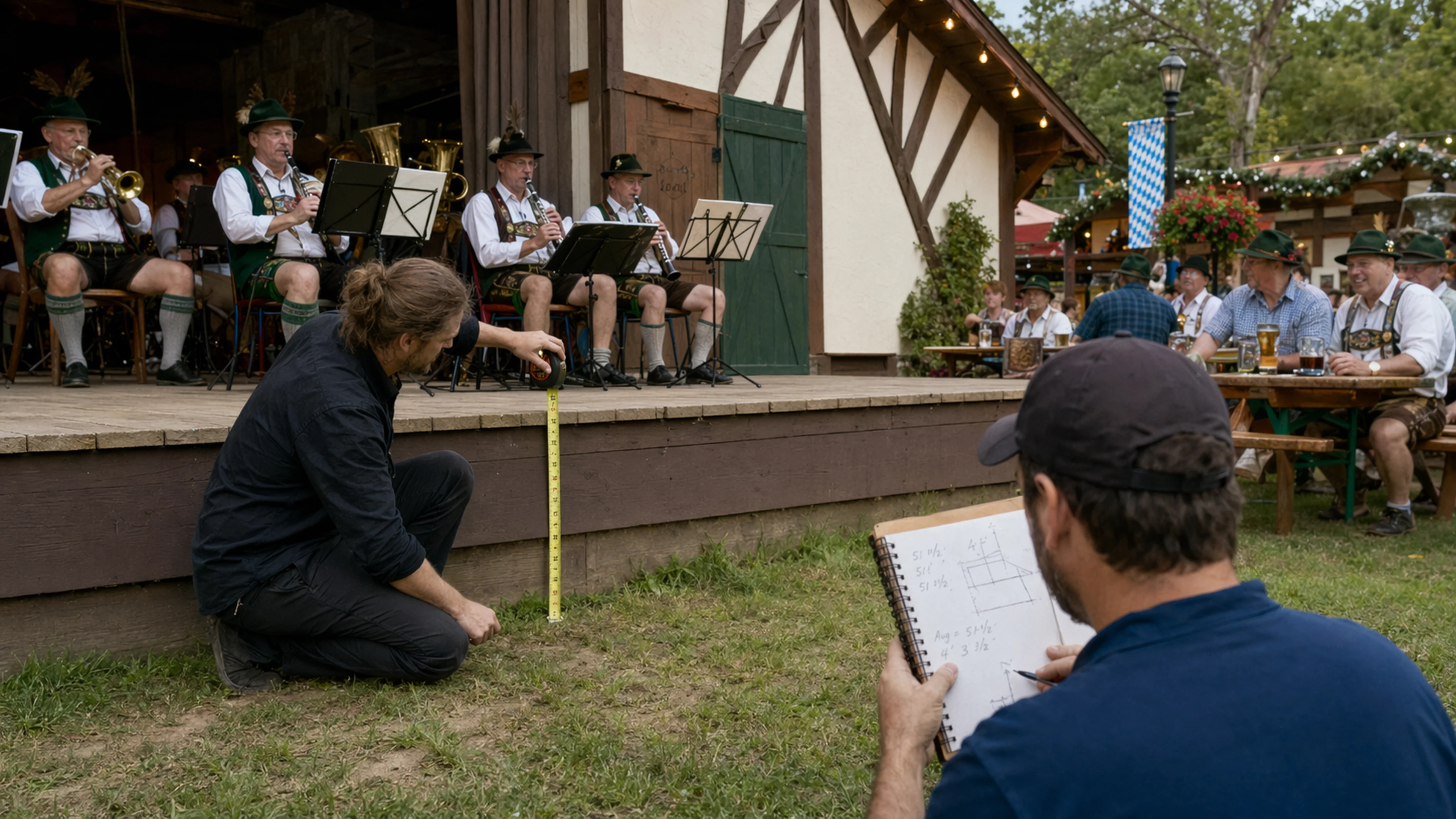
I have, as of this writing, not been able to reach Marianne Hausl to ask. My two telephone messages to the Bodensee's main number have not been returned. I intend to visit the restaurant in person in the coming weeks, calibrated meat gauge in hand, and I will report my findings in this publication.
My Personal Correspondence With The Principals, 1988–2011
The archive of my correspondence with the three establishments' principals spans, in physical form, two bankers' boxes that I keep in my home office on Edelweiss Strasse and that I have not, until now, considered releasing in any form. I am, on reflection, willing to share the following selected items, as they provide a texture to the conflict's history that the secondary record does not capture.
My earliest surviving letter from Dieter Kammler, dated March of 1988, is a response to a query I sent him asking for technical details about his Semmelbröseln sourcing. Kammler's reply, written in a tidy Bavarian script on Alpenhaus Stube letterhead, devotes two full paragraphs to the Alpine Bakery loaf before concluding: "I should tell you that I am aware the woman at the Bodensee is watching what I do. She has been in twice in the last month to eat. She orders schnitzel. She measures nothing, as far as I can tell, but I think she measures. Please do not tell her what you find here." I did not tell Hausl. I did, however, visit the Bodensee the following week and note that Hausl's schnitzel was, at that time, 10.2 millimeters — 0.2 millimeters thicker than I had last measured it.
My most substantive letter from Werner Stelzig, dated October of 1999, addresses the question of his "Combination" accompaniment. Stelzig wrote: "You said when you were here in May that you think my Combination is a 'destabilizing move.' I do not think of it as a move. I think of it as serving dinner. When a man sits down and he is hungry, he does not care whether it is Spätzle or Rotkohl. He cares whether he is still hungry when he stands up. I cook so that people are not hungry when they stand up. If this is a move, then every dinner I have ever served is a move, and I am a very old general." I have thought about this letter a great deal in the years since Stelzig's retirement.
My final letter from Gertraud Hausl, dated August of 2018 — four months before her retirement from active management — was, I should acknowledge, a response to a letter I sent her asking whether she intended to document the history of the schnitzel question for the benefit of the restaurant's new management. She replied: "I do not intend to write anything down. Marianne will make her own decisions. The schnitzel should be whatever she thinks it should be." I found this response, at the time, admirable in its restraint. I find it, in light of the January 2026 newsletter, slightly ominous.
The conflict was not, it appears, finished. It was waiting.
— Dr. Wilhelm Brüning






Reader Comments
Leave a comment ↓