

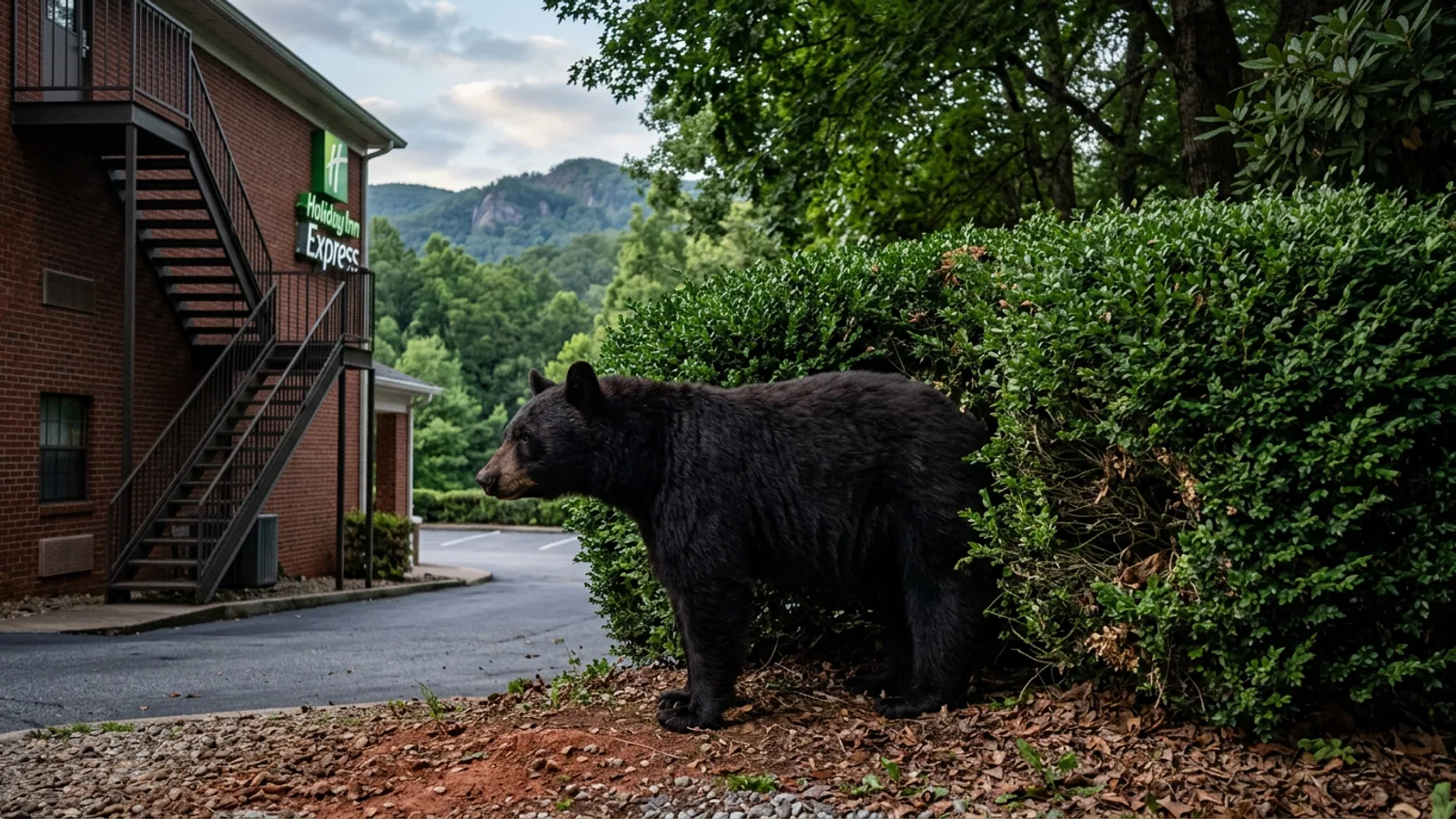
The hedge in question is on the south face of the Holiday Inn Express on Main Street in Helen, between the hotel's exterior fire-exit stairwell and the parking-lot entrance. It is an established boxwood hedge, roughly seven feet tall and twelve feet deep, running about forty feet along the south wall. By my estimate, the interior void space of the hedge — the area between the outer leaf layer and the hotel foundation wall — is approximately four feet wide at its widest point and two feet wide at the ends, producing a roughly 80-cubic-foot cavity that is sheltered on three sides.
A 250-pound male black bear has been using that cavity as his primary daytime resting site for at least eleven weeks.
I first photographed him there on January 9, 2026, at 6:14 a.m., from the parking lot of the neighboring business, using a 400mm equivalent telephoto from 80 yards. At that point I thought it was a one-time opportunistic roost — a cold night, a sheltered spot. I noted it and moved on. When I returned on January 16 to photograph the morning Chattahoochee flow conditions, he was in the hedge again.
By the third consecutive week, I began keeping a dedicated observation log.
The Daily Pattern
I want to be precise about what "primary residence" means in a wildlife context, because the phrase implies something that needs to be documented rather than assumed.
A bear using a site as a primary residence is a bear that returns to that site more days than not, uses it as its main rest period, and organizes its foraging activity in relation to it. By those criteria, the Holiday Inn Express hedge qualifies. Of the 77 observation days in my log between January 9 and March 24, I recorded the bear present in the hedge on 61 of them — a 79% site-fidelity rate. The 16 absent days cluster around the three weather events in January and February when temperatures dropped below 22°F overnight. On those nights he appears to have retreated to a secondary site, which I have not located.
His typical daily pattern, based on 43 confirmed observations with both an arrival and departure time logged:
The bear enters the hedge between 4:30 and 5:15 a.m. The median arrival time across all logged observations is 4:47 a.m. He comes from the northeast, moving along the back of the hotel parking lot from the direction of the Chattahoochee east bank. He enters the hedge at the east corner, where the boxwood has a gap at ground level that I estimate at 18 to 22 inches wide — large enough for a 250-pound bear to push through without breaking branches. He has done this repeatedly without altering the gap's dimensions in any visible way.
He rests in the hedge through the morning and afternoon.
He exits between 11:00 and 11:45 p.m. The median departure time is 11:20 p.m. He exits the same corner, moves south through the parking lot, rounds the southeast corner of the hotel, and accesses the dumpster enclosure on the hotel's service alley side. He spends approximately 40 minutes — my shortest logged dumpster visit was 27 minutes, my longest was 58 — before returning to the hedge to sleep.
On four occasions I have observed him make a secondary excursion at approximately 3:30 to 4:00 a.m., before his standard sunrise retirement. On those nights he moved north along the riverbank rather than to the dumpster. I believe this is a foraging excursion to the Chattahoochee east bank, where the geese roost. Whether he has successfully taken any geese I cannot confirm. On the mornings following these late excursions, goose activity on the east bank above the Helendorf put-in was noticeably reduced for two to three days. The correlation is suggestive. It is not proof.
Physical Description
He is a large male — I am estimating 240 to 260 pounds based on body-proportion comparisons in my photographs and against reference objects of known dimension in the same frame. He is fully black with no cinnamon coloring. His face is broad and his muzzle is slightly grayer than his body coat, which typically indicates a bear of four years or older. His right ear has a small notch near the tip that I use as an individual identifier.
He has no ear tag and no radio collar. He has not been handled by Georgia DNR wildlife staff, at least not in any incident that appears in their public records. He is, as far as the formal record is concerned, an undocumented animal.
I asked the Georgia DNR District 2 wildlife biologist whether this bear might be one they were tracking informally. She told me their department had received calls about a bear matching this description at the Holiday Inn Express since "sometime in the fall," but that absent a safety incident or a formal complaint from the property, there was no active management case open on the animal.
"Describe 'large male, right ear notch, boxwood hedge,'" she said to me, when I gave her my field description over the phone. She was quiet for a moment. "Yeah. We know that bear."
She asked me not to use her name.
The Night Manager's Perspective
The Holiday Inn Express night manager — who has been on the overnight shift since October and who has requested anonymity — has been aware of the bear since approximately his second week on the job. He told me this in a conversation outside the hotel at 12:10 a.m. on a Wednesday in early March, while the bear was audibly present at the dumpster enclosure behind us.
"He's respectful," the night manager said.
I asked him to say more.
"He does his thing. He doesn't bother the guests. I had one couple last month who saw him crossing the parking lot at midnight and they called the desk. I told them he lived here. They said they were from Alpharetta and that they understood."
The night manager said he had not filed a formal incident report with the hotel's property-management company about the bear because, in his assessment, the bear had not created an incident. He said he was aware that this might be a technical violation of the property's wildlife-encounter reporting policy. He described his reasoning as "practical."
"If I report it, someone comes out and relocates him," he said. "Then he's somebody else's problem and probably not as well-behaved about it."
He added that the bear had taken items from the dumpster on approximately 30 occasions since October and that the total inventory loss — based on his informal tracking — was one bag of used breakfast-buffet linens (non-food), two trays of day-old pastry that had been disposed of after the breakfast service, and a quantity of other food waste that was destined for disposal in any case.
"The pastry was the only one that cost us anything," the night manager said. "And honestly, we were going to throw it out."
He paused.
"He seemed to enjoy it."
What A Black Bear Is Doing In Downtown Helen
The range of a male black bear in the southern Appalachians is typically 50 to 100 square miles, according to the USFWS species profile. That is a large range. The southern Appalachian bear population has been growing for 30 years, pushing the effective range boundary progressively into more developed areas as the available back-country range fills with animals. Helen sits at the edge of the Chattahoochee-Oconee National Forest — the Chattahoochee headwaters drainage begins less than four miles from Main Street — and individual bears routinely move into the town corridor in search of supplemental food.
What is less routine is a bear maintaining a fixed residence in a commercial hotel hedge for eleven consecutive weeks. That is, in my experience and in the Georgia DNR's published guidance, at the outer edge of the habituated-bear behavioral spectrum. The DNR defines a "habituated" bear as one that has become so accustomed to the presence of humans and human infrastructure that it modifies its behavior to exploit that infrastructure reliably. This bear is habituated.
Habituated bears, per the DNR's guidance, present a management challenge because relocation rarely works: a habituated bear that is relocated to a new area typically returns to the habituated range within days or weeks, sometimes traveling significant distances to do so. The standard intervention for a bear that has reached the habituation level this bear appears to have reached is, in the DNR's own language, "not relocation, but elimination of the food attractant."
The food attractant here is the dumpster. The dumpster enclosure at the Holiday Inn Express is a standard commercial roll-off design with a hinged lid. The bear has figured out the lid.
A bear-resistant enclosure — the type that requires a latch mechanism the bear cannot operate — would likely interrupt the pattern. Whether the Holiday Inn Express property management is aware of this option or plans to pursue it is something I was unable to determine from the available information. The night manager told me the dumpster was under the management company's maintenance contract, not the property's, and that he had not raised the issue with them.
The Hedge
I want to close on the hedge itself, because it is the part of this story that I find most interesting from a wildlife perspective.
The bear did not choose the Holiday Inn Express hedge at random. A boxwood hedge of this dimensions, on the south face of a heated building, with a west-facing ground-level gap, represents a specific set of conditions: thermal mass from the building wall, solar gain on the south face through winter, windbreak on three sides, visual concealment from the parking lot, and a ground-level access point that larger animals would struggle to use. If you were designing a black bear day-roost in a commercial hotel environment, this is what it would look like.
He found it. That is either very good luck or the result of a systematic survey of the available shelter options along the Main Street corridor. Given what I know about black bear spatial cognition — they remember food sources, rest sites, and routes with considerable accuracy — I suspect the latter.
The hedge is currently healthy. The boxwood shows no visible damage from eleven weeks of a 250-pound resident. The property maintenance staff appears to trim it seasonally. Based on what I know of the bear's tenure and his entry pattern, I would recommend against trimming the hedge this spring. A disruption to the entry gap would not remove the bear from the area; it would just make him less comfortable with his current arrangement and more likely to seek access through a less convenient point.
The bear is not going anywhere. The hedge, for now, is the right place for him.
I will continue the observation log through April.
— Buck Pendergrass

Reader Comments
Leave a comment ↓