

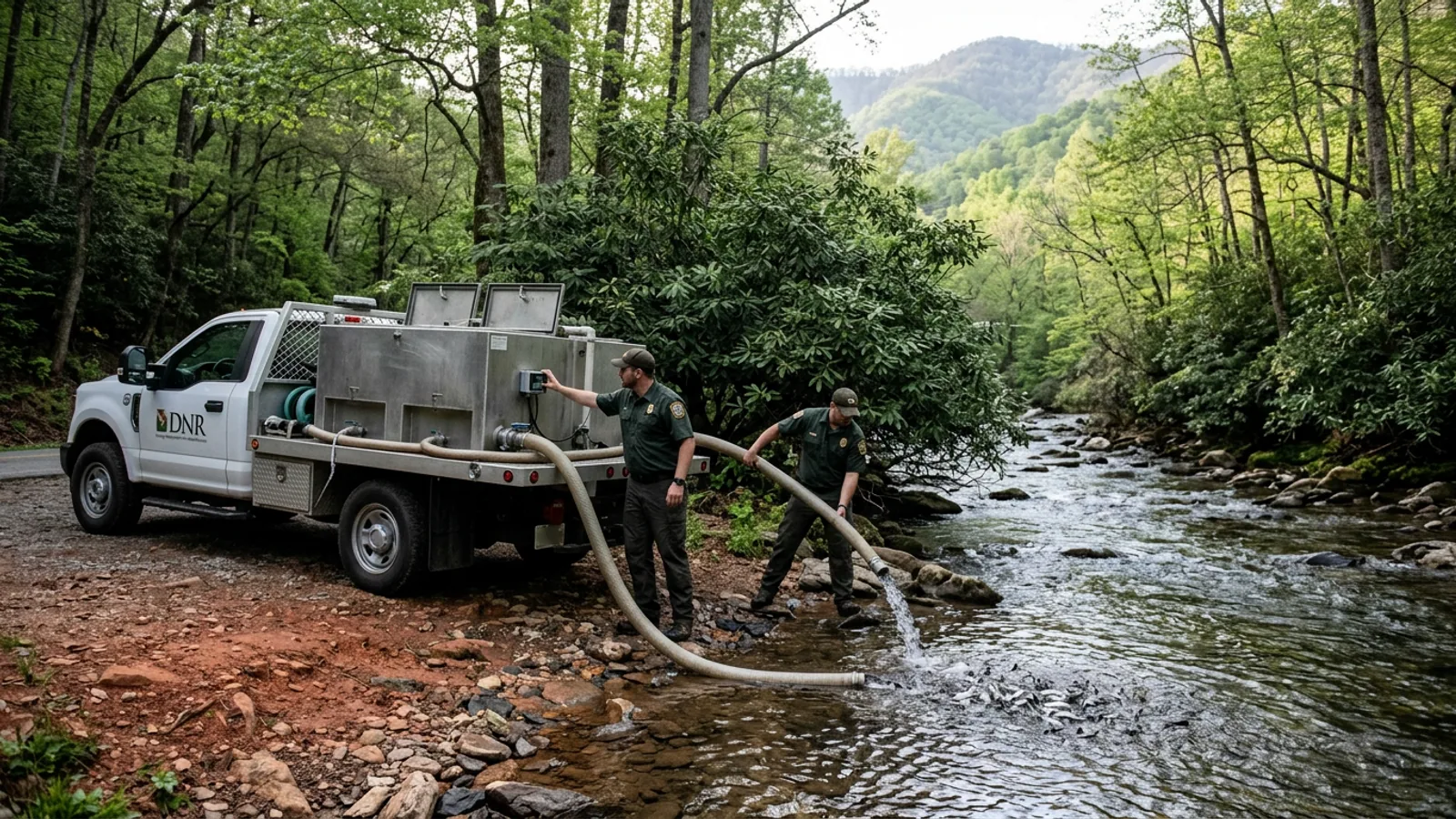
The DNR stocking truck was at the Smith Creek lower access pull-off, on the Unicoi State Park entrance road, at 7:18 a.m. Tuesday. The driver had the pump running and was pulling the first aeration reading before I finished walking down from where I'd parked. He knew the creek. He had done this reach before.
"Fourteen thousand fingerlings, split load," he told me, without my asking. "Eight thousand on Smith Creek lower, four thousand on Smith Creek upper, two thousand on the Anna Ruby Creek approach below the falls corridor."
That matches what Georgia DNR's 2026 trout stocking schedule lists for the White County spring fingerling run, Phase 1, Week of March 16. The schedule is public and is linked in the source documents above. I will note that the truck's load manifest, which the driver showed me, listed 14,200 fingerlings at the Chattahoochee State Hatchery departure point. He estimated 200 in-transit mortality — a figure he described as "pretty standard for a two-hour haul at this temperature." The water I measured at Smith Creek lower that morning was 51.3°F. The hatchery holding tanks had been running 50.4°F. The transfer stress was, by his read, minimal.
The fish were in the water by 7:21 a.m.
The Lower Smith Creek Release, 7:21–8:02 A.M.
The lower Smith Creek release point is at the concrete-apron low-water ford at the base of the Unicoi State Park entrance road, approximately 0.4 miles below the park lodge. At this point Smith Creek is roughly 22 feet wide, running between 8 and 14 inches deep, with a mixed gravel-and-bedrock substrate. The stocking calendar designates this point as SMCK-L-01. It is the highest-volume single-point release in the Anna Ruby Falls corridor.
The driver backed to within about 10 feet of the bank. The truck's outflow hose — a four-inch polyethylene pipe — extends about 8 feet from the tank and can be aimed at a point in the water or at the bank edge for a bank-release. He chose the bank edge on the right. The hose rested in three inches of water where the bank gravel slopes down into the ford.
Eight thousand fingerlings went in over approximately 41 minutes, in three distinct timed pulses. The driver's procedure is to release in pulses to avoid crowding the bank release point and to allow early-released fish to disperse before the next pulse follows them. That is standard DNR protocol for fingerling releases, as distinct from yearling releases, where you can put more fish in a concentrated pour.
The fingerlings — I asked, and was told these are Arlee-strain rainbow trout (Oncorhynchus mykiss), the standard Georgia hatchery stock — were between three and four inches in length. They are, in practical terms, not catchable fish yet. They are the April-and-May fish. The idea is to get them in the creek in March, let them orient to the water, begin feeding on invertebrates, put on some growth, and present them to anglers as six-to-eight-inch fish by the time trout season opens in earnest in late April.
The survival rate question is the realistic one. Not all 14,000 fish will make it to April. Fingerlings face predation pressure from larger resident trout, from herons, from mergansers, and from the kingfisher pair that I have documented working the Smith Creek lower reach for three years running. The Georgia DNR District 2 fish-stocking supervisor — the same one I spoke to for last month's temperature report — told me on the phone last week that the expected holdover survival rate for fingerlings in Smith Creek conditions is 55 to 70 percent, based on multi-year monitoring data.
"Fifty-five percent on a cold, clear creek with good habitat is fine," he said. "You put in fourteen thousand, you get somewhere between seven and ten thousand fish to April. That's what we plan for."
He asked me not to use his name. I did not use his name.
At 55 percent survival from the 13,800 fish actually introduced, you get 7,590 fish to April. At 70 percent, you get 9,660. The middle of that range — about 8,600 fish — is the planning figure.
Upper Smith Creek Release, 8:18–8:51 A.M.
After the lower release, the driver moved the truck up the Unicoi State Park entrance road to the upper stocking point, SMCK-U-01, which is at the paved pullout approximately 200 yards below the park's day-use area parking lot. Upper Smith Creek at this point is narrower — about 15 feet — and runs a little faster. Temperature: 51.0°F. Stage was low, which is ideal for a fingerling release. At higher flows the smaller fish have trouble holding position and get pushed downstream before they can orient.
Four thousand fish went in here, again in pulses, over 33 minutes. The release point is at a short riffle-to-pool transition. The fingerlings dispersed quickly into the pool's slower water. From the bank above, I could see the main body of fish as a dark smear moving out of the release point and spreading across the pool's depth. Within about three minutes the leading fish were holding behind the mid-pool boulder field.
There are good numbers of resident brown trout in the upper Smith Creek reach — I have counted 14 individual fish on previous observation walks in the 12-to-18-inch size class, which is a healthy figure for a creek of this width. Some of those fish will eat fingerlings. That is part of the attrition the DNR's survival estimate already accounts for.
Anna Ruby Creek Approach Release, 9:12–9:44 A.M.
The Anna Ruby Creek release is the one people ask about most, because Anna Ruby Falls is the headline attraction in the corridor and because the fishing below the falls, in the 0.8-mile stretch between the lower viewing platform and the confluence with Smith Creek, is the prettiest water in this part of White County.
The driver and I drove the separate entrance road to the Anna Ruby Falls trailhead and he used the short service pullout at the base of the trail, approximately 90 yards from the lower parking lot. This is the only practical vehicle access to the lower Anna Ruby Creek reach. The Anna Ruby Creek approach below the viewing platform falls is not the falls themselves — those are inside the USFS restricted zone — but the creek section that runs through the forested reach between the lower falls overlook and the Smith Creek confluence.
Two thousand fingerlings went in at 9:12 a.m. at the service pullout bank. The creek at this point is about 12 feet wide and running 6 to 9 inches deep over a boulder-and-rubble substrate. Temperature: 50.6°F — slightly cooler than Smith Creek due to the shade canopy and the cold-air drainage from the falls gorge.
The Anna Ruby Creek release is smaller because the creek is smaller and because the USFS permit structure limits stocking density in the Anna Ruby Falls Recreation Area to protect the visual and ecological experience. The 2,000 fingerlings going into the approach reach is the maximum the USFS permit allows for the spring Phase 1 run.
These fish will distribute themselves through the lower 0.8-mile reach and, over the next two to four weeks, some portion will move downstream and merge with the Smith Creek population at the confluence. Fish in the approach reach, specifically, tend to concentrate in the three pool-riffle sequences between the 0.3-mile and 0.6-mile points from the pullout. If you want to know where to stand in April, those are the pools.
The driver was packed up and pulling out by 9:53 a.m. The total operation took two hours and 35 minutes from first fish to truck departure. He had a second run to go to — the upper Toccoa River reach in Fannin County — so we shook hands and that was the end of my time with him.
What To Expect In April And May
The fingerlings released Tuesday will be the basis for the recreational trout fishery in the Anna Ruby Falls and Smith Creek corridor from late April through June. For context, this is not the only stocking. The DNR runs a Phase 2 yearling release in early April — larger fish, immediately catchable — which is the run that produces the opening-weekend fishing pressure at Anna Ruby Falls. The fingerlings I watched go in Tuesday are the sustaining population: they fill in behind the yearlings and extend the season.
Georgia's trout regulations for Smith Creek and Anna Ruby Creek in White County designate both waters as "delayed harvest" streams in the posted sections — catch-and-release from November 1 through May 14, artificial lures only. From May 15 onward, the standard statewide trout regulations apply. Check the 2026 Georgia Fishing Regulations for the current posted boundaries on both streams before you fish. The boundaries shift slightly from year to year depending on stocking-plan amendments.
Realistic catch-day windows for the fingerling class: May 1 through June 15. That assumes normal temperature progression — 59 to 65°F at peak May days — and normal fingerling growth. If we have a cold spring, push that window back two weeks.
For access: the lower Smith Creek reach is accessible from the Unicoi State Park entrance road without a park fee. The Anna Ruby Creek approach requires the $5 USFS parking fee at the Anna Ruby Falls trailhead. The upper Smith Creek reach inside Unicoi State Park requires either a day-use fee or a Georgia State Park ParkPass.
I'll be back on Smith Creek in late April for the first round of post-stocking fishing reports.
— Buck Pendergrass
Reader Comments
Leave a comment ↓