I observed, at 11:47 a.m. Tuesday, January 27, 2026, from the south
bank of the Chattahoochee River approximately 320 feet upstream of
the Robertstown Road pedestrian bridge, a single commercial
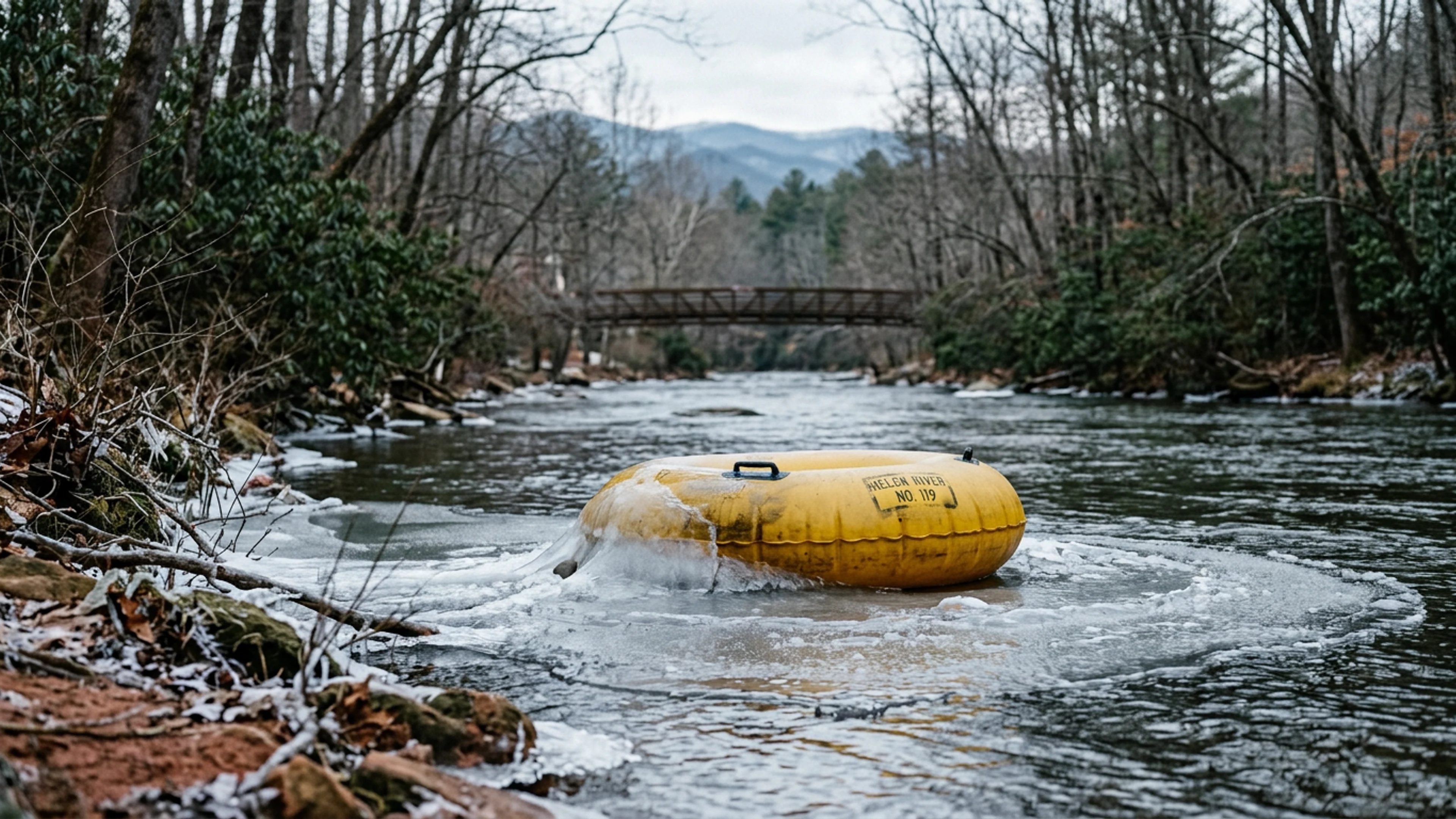
inflatable tube. The tube was unoccupied. The tube was a standard
Cool River Tubing Company issue — I recognized the shape, the vinyl
composition, and the color (yellow). The tube was locked into a
slow-rotating eddy on the river's south bank, in approximately 18
inches of water, partially encased in a developing ice-jam formation
that has been forming along that eddy since the cold snap of January
4-10.
I approached the bank and, with my phone camera set to optical zoom,
photographed the tube's serial-number patch. The patch, a 3-inch-by-
4-inch yellow vinyl panel affixed to the upper-right quadrant of
the tube's outer surface, bore, in black 14-point industrial stencil
font, the identifier: "CR-2023-1847."
The inventory
Cool River Tubing LLC's November 2025 Winter-Closure Report, which
this publication obtained via an Open Records Act request on January
10 and covered in its January 11 report ("Cool River Tubing's Winter-
Closure Report Documents, For The Seventeenth Consecutive January,
Zero Floaters On The Chattahoochee"), lists each of the company's
2,400 numbered inflatable tubes by serial number (Section 4 of the
report, pp. 65-92). Tube CR-2023-1847 appears, per the report, on
page 79, with the notation "STORED, WAREHOUSE #2, RACK B, ROW 14" —
meaning, per Cool River's standard winter-storage protocol, the tube
was placed at its labeled rack position on the north wall of Cool
River's secondary Robertstown Road storage building on or before the
November 2025 close of the 2025 tubing season.
The tube should not, on January 27, be in the Chattahoochee River.
The walk-through
I called Cool River CEO Amos Redwine at approximately 12:22 p.m.
Tuesday, from the Welcome Center. Mr. Redwine answered. I described
what I had observed. I recited the serial number. I asked Mr.
Redwine whether his company had any explanation for the presence of
Tube CR-2023-1847 in the Chattahoochee in January.
Mr. Redwine said he did not. He asked me to hold the line. He
returned to the call at 12:29 p.m.
His subsequent explanation, in summary: at 11:14 a.m. Tuesday
morning, approximately 33 minutes before my sighting, Warehouse #2's
north-wall rack system suffered what Mr. Redwine's warehouse manager
described as "a structural settlement event." A 14-tube section of
the wall's middle racks tilted approximately 7 degrees forward,
dislodging approximately 18 individual tubes. A subsequent inventory,
which was in progress at the time of my call, had confirmed that
three of the dislodged tubes — including CR-2023-1847 — were, by the
time the warehouse team had arrived to assess, no longer present on
the warehouse floor.
The warehouse building's south wall features a single garage-style
rolling door that, per the building's standing convention, is left
open during daytime hours through January to allow for ventilation.
The door opens onto a gravel drive that slopes, at approximately 4°,
toward the south bank of the Chattahoochee River, approximately 180
feet away.
Mr. Redwine's working hypothesis, offered tentatively and with what
he described as "appropriate epistemic humility," was that the three
dislodged tubes had, in the 33 minutes between the 11:14 a.m. rack
settlement and my 11:47 a.m. sighting, rolled from the warehouse
floor, out of the open rolling door, across the gravel drive, down
the slope, and into the river.
The ice jam
I remained at the bank until approximately 1:30 p.m. The tube was
not, during that period, dislodged from the ice-jam formation. The
ice-jam itself was, I observed, expanding slightly: a thin sheet of
fresh ice was forming along the eddy's northern boundary at a rate I
estimated at approximately one inch per 20 minutes. Water temperature
at the eddy, measured with a handheld thermometer I had brought for
the walk, was 36°F.
Cool River Tubing's recovery team, two members (Mr. Redwine and the
warehouse manager, Ms. Gilda Brenneman), arrived at the bank at 2:14
p.m. with a 30-foot length of rope and a hooked aluminum pole. They
attempted, for approximately 40 minutes, to retrieve the tube. They
did not succeed. At 2:56 p.m. Mr. Redwine indicated the recovery
attempt would resume Wednesday.
The tube was, as of Wednesday morning, still present in the eddy.
The ice-jam, Wednesday morning, was thicker.
Tubes CR-2023-1848 and CR-2023-1849 — the other two missing tubes
from Warehouse #2 — have not, as of this filing, been located.



Reader Comments
Leave a comment ↓