

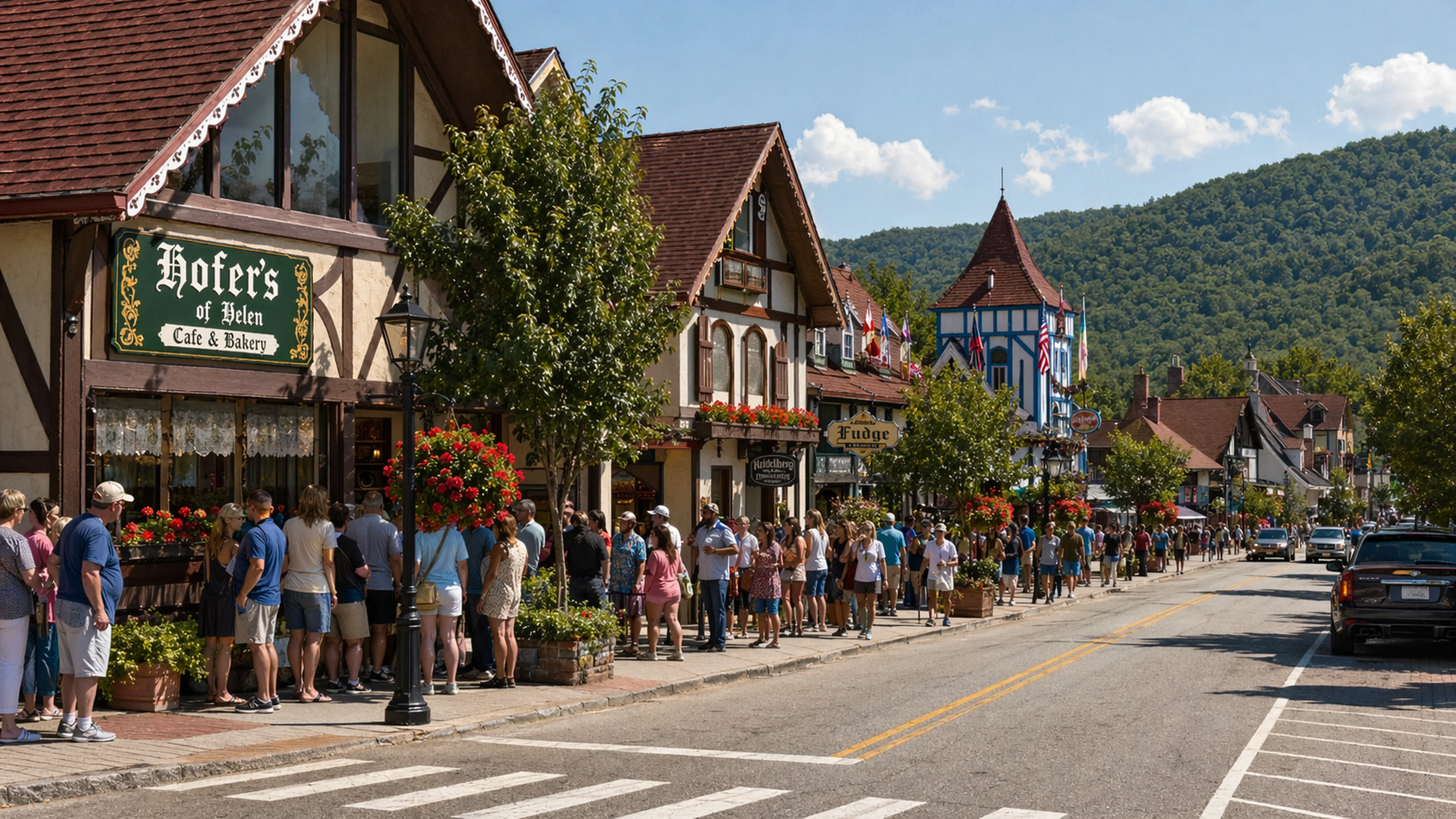
Rising Fawn, Georgia, is an unincorporated community in Dade County at the far northwestern corner of the state, 154 driving miles from Helen, population approximately 600 depending on which decade's census methodology one trusts. On March 8 and 9, 2026, Alpine Helen/White County Convention and Visitors Bureau Director Jerry Brown traveled to Rising Fawn to attend what the CVB's monthly report describes as the "Annual Winter Chautauqua Conference at the McLamore Resort." The report does not describe what the conference covered, who else attended, what Brown learned, or why the conference is held in Rising Fawn. It is the ninth line of a 14-line meeting schedule for the month.
The entry appears between a March 5 notation for "Tourism Day at the Capital" and a March 10 meeting with Georgia Department of Economic Development staff regarding the U.S. Travel International Trade Show in Chicago. Both of those entries are self-explanatory. The Rising Fawn entry is not. It sits in the document the way a locked door sits in a hallway — present, dimensioned, and offering no view of the room behind it.
Rising Fawn occupies a narrow valley along the western slope of Lookout Mountain, roughly two miles east of the Alabama state line and 13 miles south of the Tennessee state line. Dade County is the only county in Georgia that borders two other states but does not border another Georgia county to the west, a geographic condition that locals reportedly considered sufficient grounds for symbolic secession during the Civil War, though the county's formal re-entry into the Union was not ceremonially acknowledged until 1945. The community's name derives from a Cherokee leader, and its most prominent geographic feature is Cloudland Canyon State Park, a 3,538-acre gorge system administered by the Georgia Department of Natural Resources approximately four miles to the south. The nearest incorporated municipality is Trenton, the Dade County seat, seven miles to the northwest. Rising Fawn does not have a city hall, a police department, a zoning board, or, as far as publicly available records indicate, a convention and visitors bureau of its own.
It does, apparently, have the McLamore Resort.
Margaret Holcomb attempted to locate the McLamore Resort through standard channels: Google Maps, the Georgia Hotel & Lodging Association's member directory, Dade County tax assessor parcel searches, and the Georgia Secretary of State's corporate filings database. The name "McLamore Resort" does not appear in any of these databases in a form that resolves to a specific street address in Rising Fawn. This does not mean the resort does not exist. Private conference venues in unincorporated northwest Georgia are not required to maintain a public web presence, and Dade County's property records are indexed by owner name rather than commercial trade name. It means only that the resort, whatever its precise coordinates and capacity, does not make itself easy to find — a quality that, for a conference venue, is at minimum unusual.
Dr. Wilhelm Brüning, former senior fellow at the Bavarian State Institute for Regional Cultural Geography and a frequent commentator on municipal travel patterns, said the opacity is itself data. "A conference venue that does not appear in the standard commercial directories is either very new, very small, or very deliberate about its guest list," Brüning said by phone from his office in Dahlonega. "In any of those three cases, the question of why a tourism director from a town 154 miles away received an invitation is a perfectly reasonable one to ask."
The word "Chautauqua" adds a second layer of interpretive difficulty. The original Chautauqua Institution was founded in 1874 on the shores of Chautauqua Lake in southwestern New York as an adult-education retreat for Methodist Sunday school teachers. By the early 1900s, the term had become generic shorthand for a traveling lecture-and-performance circuit that reached rural communities across the eastern United States, a format President Theodore Roosevelt once described as "the most American thing in America." The movement declined sharply after 1930, undone by radio, the automobile, and the Great Depression. Modern organizations that use the Chautauqua name tend to fall into one of two categories: direct descendants of the New York institution's programming model, or independent groups that have adopted the name for its connotations of intellectual seriousness and rustic fellowship. The CVB report does not specify which category applies to the Annual Winter Chautauqua Conference in Rising Fawn. It does not specify the category at all. It specifies only the name, the location, and the dates.
Georgia's tourism-industry calendar is not short of conferences. The Georgia Association of Convention and Visitors Bureaus holds an annual conference — Brown attended the 2026 edition in Atlanta's Airport District from March 29 through April 1, a trip also noted in the same monthly report. The Georgia Department of Economic Development hosts Tourism Day at the Capitol each spring. Explore Georgia coordinates regional workshops. The Southeast Tourism Society runs its own programming. None of these organizations list a "Winter Chautauqua Conference" on their public schedules for 2026 or any prior year. Whatever the Winter Chautauqua Conference is, it operates outside the mainstream Georgia tourism-conference circuit, in an unincorporated community on the Alabama border, at a resort that does not appear in the standard lodging directories, under a 19th-century name associated with moral uplift and lantern-slide lectures about temperance.
The drive from Helen to Rising Fawn takes approximately three hours and 20 minutes under normal conditions, following GA-75 south to GA-384 west, connecting to US-76 west through Chatsworth and Dalton, then north on GA-136 into Dade County. The route traverses four counties — White, Lumpkin, Murray, and Whitfield — before entering Dade. Brown's report indicates the conference occupied two days, March 8 and 9, which was a Saturday and Sunday. Assuming same-day travel on each end, the trip would have required a minimum of six hours and 40 minutes of driving plus two days of conference attendance. Assuming an overnight stay, it would have required lodging — presumably at the McLamore Resort itself, a facility whose room count, nightly rate, and amenities remain unconfirmed.
Brown's March 2026 travel expenditures have not been publicly itemized in any document available in the City of Helen's meeting minutes or agenda packets through the April 21, 2026, session. The CVB's operating budget is funded in part by Helen's Hotel/Motel Tax, which brought in $151,428 in March 2026 alone and $2,201,494 for the first nine months of fiscal year 2026 — a 7.62 percent increase over the same period the prior year. That budget funds, among other things, the 230 cases of Helen Travel Guides delivered in March, the 400 individual guides mailed by request, and the 124 digital downloads. It funded the advertising placements in Southern Living Magazine, Atlanta Magazine, AAA Explorer (Alabama), and seven other publications. It funded the Welcome Center's reception of 2,570 visitors that month, 170 more than in February.
Whether it funded the McLamore Resort is not a question the public record answers. The CVB Board, which received Brown's monthly report at its March 12 and March 20 meetings, does not appear to have requested additional detail on the Rising Fawn trip in any recorded minutes. The Helen City Commission, which received the CVB report at its called March 17 meeting — the same session at which Jana Parker of Alpine Overlook LLC presented the proposed Ferris wheel at Bavarian Mini Golf and at which Commissioner Helen Wilkins noted that Bruce Porney was constructing a beer garden — likewise recorded no follow-up questions about the conference.
Dr. Brüning noted that this is consistent with a broader pattern he has observed in small-municipality tourism governance. "The CVB director's travel calendar is, in most Georgia cities under 1,000 population, treated as a professional prerogative rather than a line-item oversight matter," he said. "The board trusts the director. The commission trusts the board. And the director attends a Chautauqua in Rising Fawn."
The 2026 Annual Winter Chautauqua Conference will presumably have a 2027 edition. Whether Brown will attend again is not yet known. The McLamore Resort, wherever it is, will presumably still be there — nestled against Lookout Mountain, just east of the Alabama line, in a community named for a Cherokee leader, hosting conferences whose attendee lists, agendas, and proceedings do not circulate in the public record of any municipality 154 miles to the east. Rising Fawn has held its secrets since before Georgia was a colony. One more, in the scheme of the valley, is barely a rounding error.
Reader Comments
Leave a comment ↓