

The City of Helen Commission, at its April 21, 2026 meeting, will consider under Administrative item E the question of "price setting for restaurant – restroom use." The item appears on page two of the five-page agenda prepared by City Clerk Marilyn M. Chastain. It has not appeared, in that phrasing or any recognizable variant, on any Helen Commission agenda in the prior three meetings. No commissioner raised the subject during the December 16, 2025, January 20, 2026, or March 17, 2026 sessions, according to a review of all available minutes filed at 25 Alpenrosen Strasse.
The item contains no supporting documentation, no draft ordinance, no fiscal impact summary, and no staff memorandum. It is listed between item D, a parking-lot contract on Hoen Strasse to be presented by Jeff Ash, and item F, approval of matrix signs. The docket does not specify which commissioner or department head requested the discussion, what restaurants would be affected, or what price range is under consideration. The phrase "restaurant – restroom use" is separated by a dash whose grammatical function remains, as of press time, ambiguous.
A "restaurant restroom use" price, as a regulatory concept, is uncommon in U.S. municipal governance. Restrooms in Georgia restaurants are provided for patrons under Department of Public Health Chapter 511-6-1 food service rules. Imposition of a fee on non-patron access is permitted under state law but is almost never standardized by ordinance at the city level. Helen's decision to introduce a formal price-setting discussion — apparently targeting non-patron tourists who seek bathroom access during peak foot-traffic periods — would represent what Dr. Wilhelm Brüning, formerly of the Bavarian State Institute for Regional Cultural Geography, called "the most operationally Bavarian policy change in Helen since the 1969 Alpine zoning mandate."
"Continental European tourism towns routinely charge between 50 euro cents and one euro for restroom access," Brüning said by phone from his office in Regensburg. "Helen adopting this practice would close a 57-year gap between its architectural ordinance and its sanitation economics. One could argue the city has been, in a narrow regulatory sense, incomplete."
The gap Brüning references is not theoretical. Helen, a city of fewer than 700 permanent residents, is the third-largest tourist destination in Georgia behind Savannah and Atlanta, according to page one of the White County Resilience Plan prepared by iParametrics for the Georgia Mountains Regional Commission. The Alpine Helen/White County Convention and Visitors Bureau recorded 2,570 visitors to its Welcome Center in March 2026 alone, a month with no major festival programming. During the 55th Annual Oktoberfest in September and October 2025 — the longest-running Oktoberfest in the United States — foot traffic along Bruckenstrasse and South Main Street reaches densities that have, in prior years, prompted temporary portable-toilet deployments along the Chattahoochee corridor. The 2022 portable-unit incident near Cool River Tubing, in which three units were discovered 40 yards downstream after an overnight storm, resulted in a cleanup invoice of $4,200 that appeared as a miscellaneous line item in the FY2023 budget filed by Walker, Pierce & Tuck, CPAs, PC.
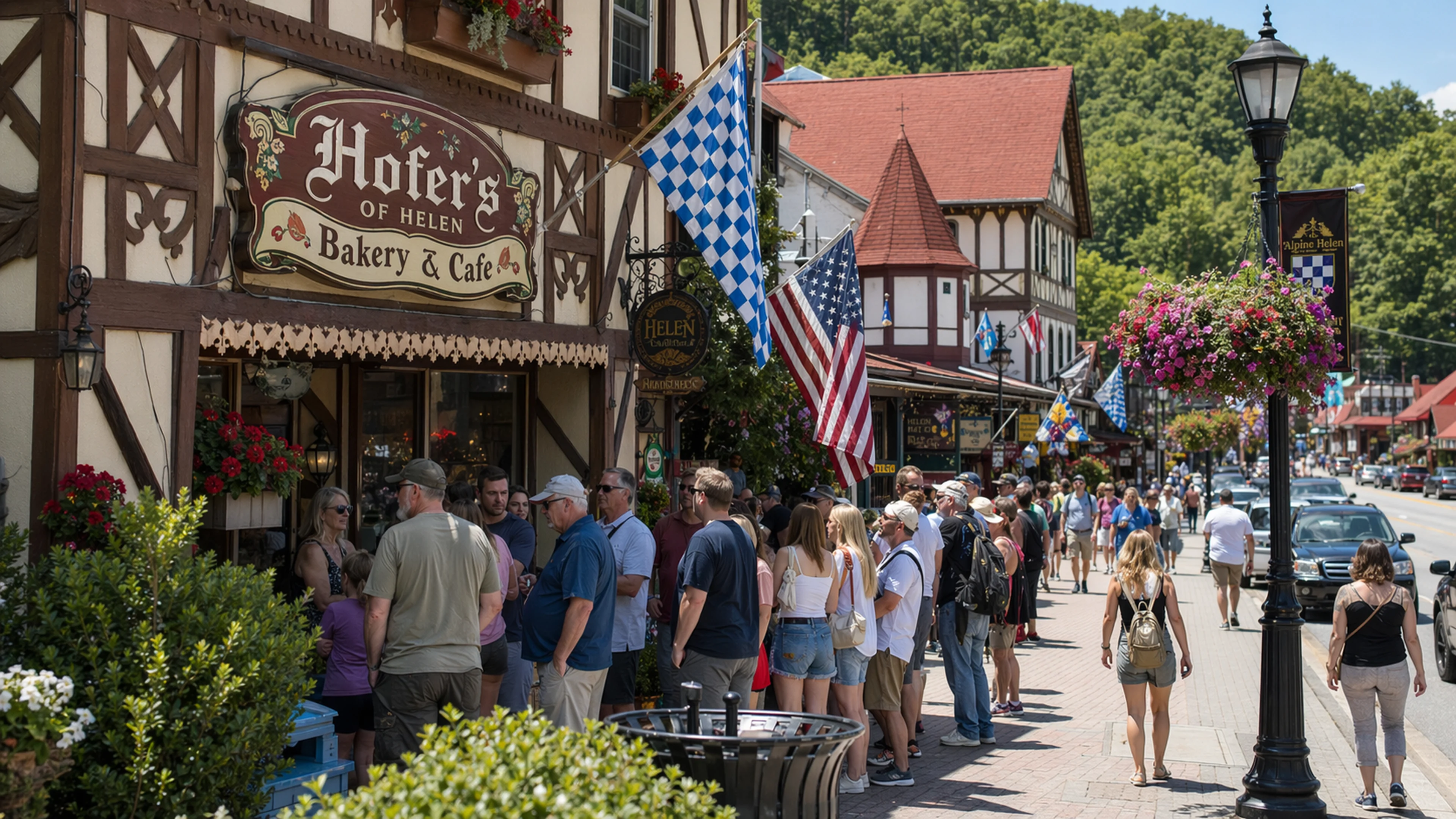
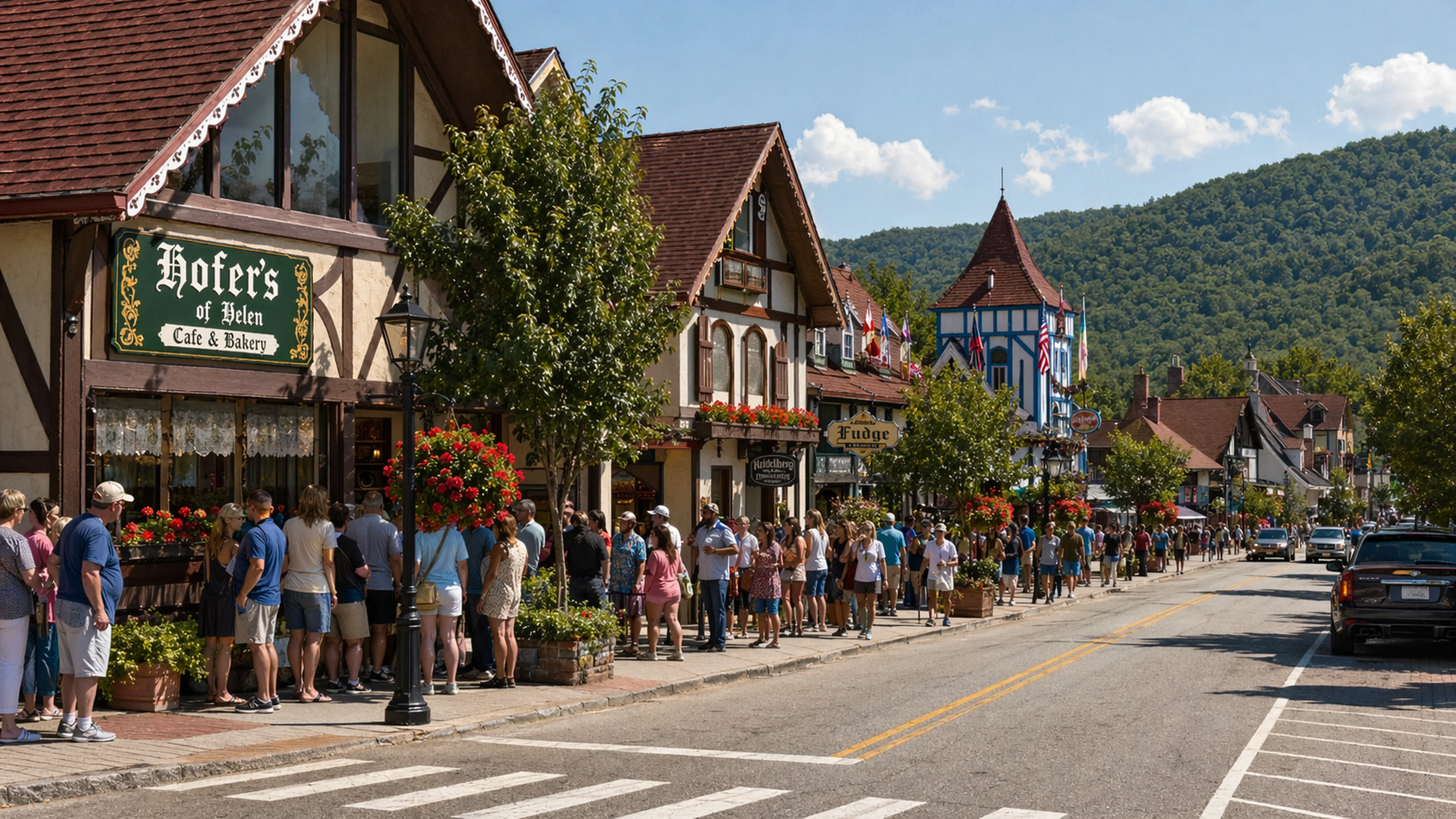
Restaurant operators along South Main Street have long absorbed the cost of non-patron restroom traffic without formal compensation. An employee at Hofer's of Helen who asked not to be named estimated that during Oktoberfest weekends, "Democrats, Republicans, people who don't vote at all" use the restaurant's facilities at a rate of roughly 30 to 40 non-patrons per hour. "We go through a case of toilet paper every two days during peak," the employee said. "In February it's a case every two weeks." The employee did not speculate on what price the Commission might set but noted that the restaurant's plumbing had been serviced three times between September 15 and October 12, 2025, at a combined cost the employee described as "more than my car payment."
The economics of per-use municipal restroom pricing have been studied in European contexts but remain largely unexamined in Georgia. Brüning cited the Sanifair system deployed at German Autobahn rest stops, which charges 70 euro cents per use and returns 50 cents as a voucher redeemable at adjacent retail. A similar voucher-offset model applied to Helen restaurants would require, at minimum, a point-of-sale integration, signage in compliance with the city's Alpine design ordinance, and a revenue-sharing agreement between the city and participating establishments. Building and Zoning Administrator Jonah Casper, who has spent recent months conducting a seat-counting operation at Helen restaurants to verify unpaid sewer impact fees, would be the logical enforcement authority for any restroom-pricing ordinance, though no assignment has been announced.
A formal ordinance of this type would need to specify a minimum charge, a maximum charge, applicable hours, exemptions for ADA-covered individuals, signage dimensions conforming to the Alpine aesthetic code that has governed Helen facades since 1969, and a remittance schedule to the city. It would require drafting by City Attorney Carl Free, review at a Planning, Development, and Regulatory Board hearing, and two readings before the full Commission — the same procedural path that produced Ordinance 25-11-02, which regulates left turns from Chattahoochee Street onto North Main Street and required approximately 14 weeks from introduction to adoption.
Gunter the Pretzel Vendor, who operates a cart on Bruckenstrasse and has maintained an informal restroom-referral arrangement with neighboring establishments since what he described as "before the glockenspiel tuning crisis," said the Commission's interest did not surprise him. "People come to Helen for the architecture, the river, the food, and the bathroom," Gunter said, salting a batch of Bavarian knots at 11:47 a.m. on a Tuesday. "Three of those things already cost money."
The April 21 meeting is scheduled for 2 p.m. at Helen City Hall. Finance Director Mona Wood is expected to present the monthly revenue report at the same session. Hotel/motel tax receipts through March 2026 stand at $2,201,494 for the fiscal year, a 7.62 percent increase over the prior nine-month period. Whether restroom-use fees would be classified under a new revenue line or folded into the existing miscellaneous category has not been discussed publicly. The agenda item, in its entirety, is 10 words long.
Reader Comments
Leave a comment ↓