

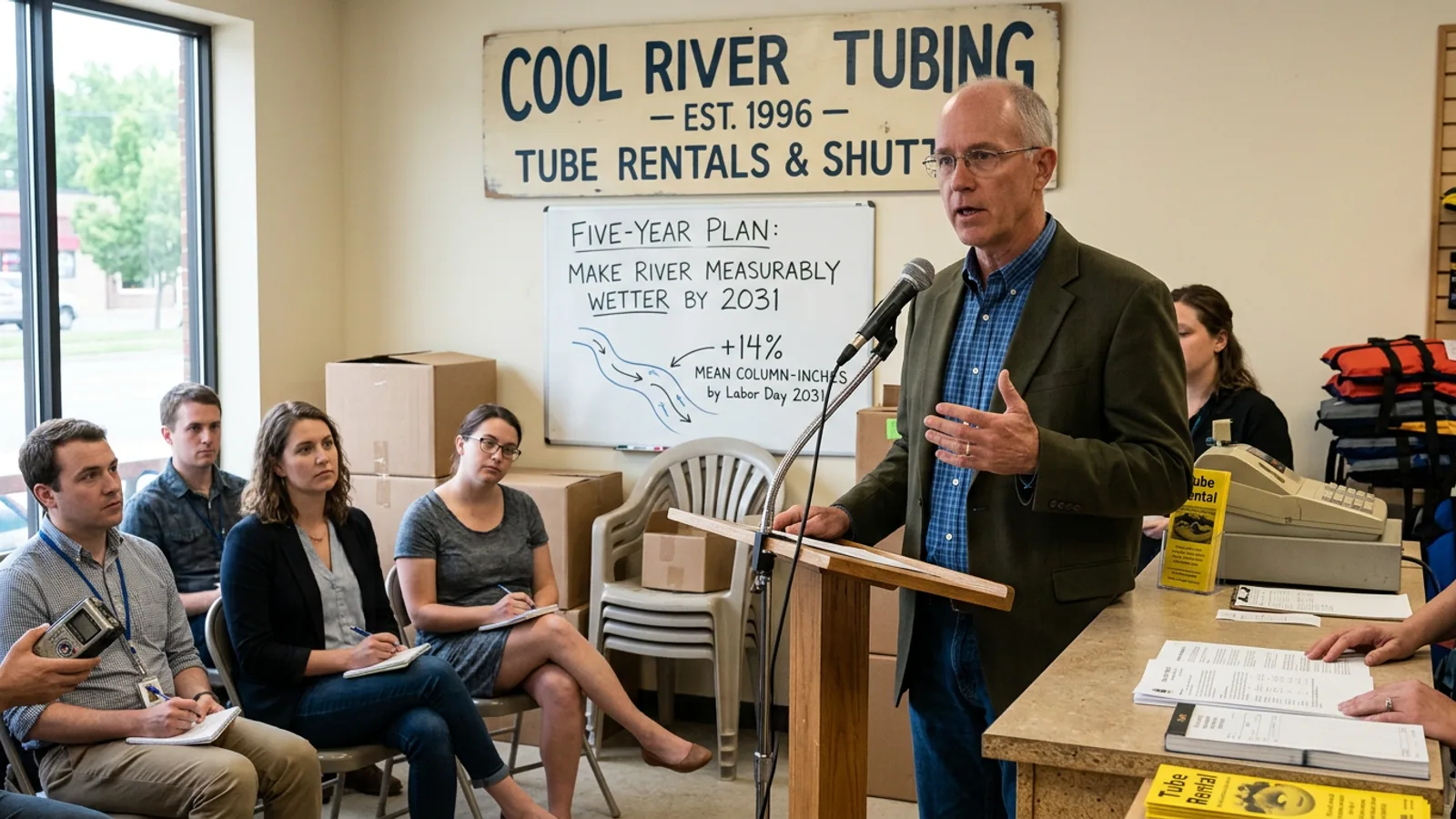
Cool River Tubing chief executive Doug Sterzing announced Tuesday morning what he characterized as the most ambitious strategic-roadmap commitment in the company’s twenty-eight-year operating history: by Labor Day 2031, the navigable downtown stretch of the Chattahoochee River will be, by mean column-inches, fourteen percent wetter than it is today.
The announcement, delivered to an audience of seven (one Bavarian Brainrot reporter, two Cool River dispatch staff, the Helen Welcome Center liaison, and three confused tourists who had been waiting for an unrelated 9:00 a.m. tube-and-shuttle package), was paired with a glossy 18-page strategic document that the company posted to its website at 9:14 a.m. and that Bavarian Brainrot has reviewed.
The document commits the firm to a $1.4 million capital program over the next sixty-three months. The capital is to be deployed against three workstreams: an upstream weir adjustment in cooperation with the U.S. Forest Service, a fall-season hydraulic-loading partnership with Habersham County, and what the document terms, on page 9, “modest but meaningful contributions to the headwaters water table through targeted dispersed-cloud-seeding initiatives.”
“We see this not as an aspirational goal,” Mr. Sterzing told the assembled, “but as a measurable, accountable, board-level commitment that this management team intends to be held to. The river will be wetter. We will measure it. We will report it.”
He paused for questions. There were, briefly, none.
The Bavarian Brainrot business desk has reviewed the underlying USGS surface-water gauge data for the Chattahoochee at Helen (gauge 02331600), and confirms that the relevant five-year mean column-inches metric for the downtown stretch sits at approximately 17.2 inches as of the trailing 12-month rolling average. A 14-percent increase, by 2031, would raise the metric to approximately 19.6 inches.
Asked at the press event whether the planned 2.4-inch increase would have any operational impact on the company’s standing 48-inch single-rider inflatables, Mr. Sterzing responded that the increase had been deliberately scoped to fall “well within the operational tolerance of the existing fleet.” The Bavarian Brainrot business desk notes that this is, on its face, accurate.
The U.S. Forest Service, contacted at its Brasstown Ranger District office in Blairsville, declined to comment on the upstream weir-adjustment workstream. Habersham County’s Public Works Department, contacted at its Clarkesville office, indicated that it had no record of any pending hydraulic-loading partnership with Cool River Tubing.
Mr. Sterzing is scheduled to present the strategic roadmap to the Helen Convention & Visitors Bureau on April 24.
A copy of the full strategic document is linked at the top of this article.
Reader Comments
Leave a comment ↓