Tuesday morning, January 27, 2026, at 9:00 a.m. Pacific Standard Time
(12:00 p.m. Eastern, 12:00 p.m. Helen local time), NASA's Jet
Propulsion Laboratory issued a press release announcing the
identification, from archival data collected by the Kepler Space
Telescope's K2 extended mission in late 2017, of a new transiting
exoplanet candidate: HD 137010 b. The planet, per the paper, is
approximately Earth-sized (1.06 ± 0.08 Earth radii), orbits its F7V
host star at a period of 89.14 days, and falls near the outer edge of
the host's habitable zone. The host star, HD 137010, is a
reasonably sun-like star 146 light-years away in the direction of the
constellation Boötes, with an apparent magnitude of 7.8 — bright
enough, under dark skies, to be observed through a modest amateur
telescope.
At 11:14 a.m. Eastern Standard Time, my cellular telephone rang. The
caller was Mr. Calloway Endicott, 78, a retired aerospace-
instrumentation engineer (Pratt & Whitney, 1972-2005) who has been,
since his 1996 retirement, a regular source for this reporter on
Helen-area amateur-astronomy matters. Mr. Endicott's opening sentence,
transcribed from the call: "Buck, I want to tell you about HD 137010."
The 2017 notebook
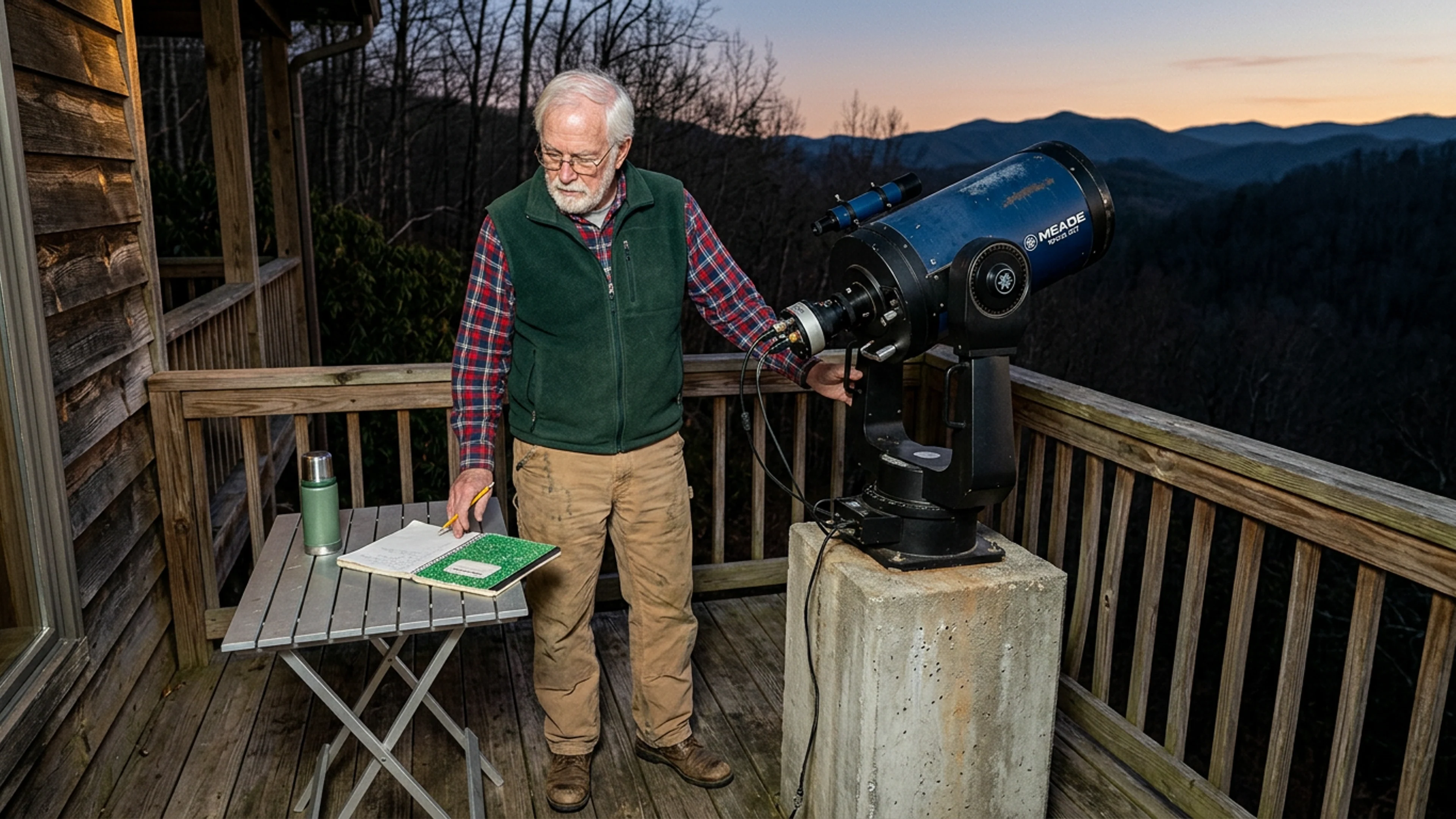
Mr. Endicott's principal observing instrument is a 1996 Meade LX200
10-inch Schmidt-Cassegrain reflector, mounted on a permanent concrete
pier on the elevated back deck of his 1976 timber-framed home at 414
Sunlight Hollow in Sautee. The scope is equipped with a 2002-model
SBIG ST-8XE CCD imager. Mr. Endicott observes, per his own practice,
on clear moonless evenings. He keeps, for each observing session, a
spiral-bound notebook in which he logs target, start time, exposure
parameters, atmospheric conditions, and any notable observations.
In the fall of 2017, Mr. Endicott's primary observing program was an
amateur survey of bright F-type and G-type stars, aimed at detecting
periodic brightness variations characteristic of transit events. He
conducted the survey, per his own log, "mostly for my own interest."
He showed me the relevant pages of his 2017 notebook Tuesday
afternoon. The notebook is a 1990s-era composition-style spiral-bound
5-by-8 book, with worn green hardboard covers. On six separate
dates — September 29, October 27, November 25, November 27, December
24, and December 25, 2017 — Mr. Endicott logged an observation of
HD 137010. On two of those dates (November 25 and December 25), his
notes include the handwritten sentence, preserved verbatim across
both entries: "Target brighter then dimmer — possible transit — about
0.02 mag — check again next period."
Mr. Endicott did not publish or otherwise submit these observations
at the time, "because I was not sure. A 0.02-magnitude dip is
consistent with an Earth-sized transit, but it's also consistent with
atmospheric noise on a back-deck scope, and I couldn't rule out my
own equipment. I was going to write it up when I had four more
consecutive observations. I never got the four."
He did, however, keep the notebook.
The claim
The Mukherjee et al. paper identifies HD 137010 b's transit ephemeris
as P = 89.14 ± 0.03 days, with a first observed transit (in the K2
data) at BJD 2458062.147. Working back from that reference epoch, the
paper's predicted transit times during the relevant window of late
2017 are: September 26 (partial, start of K2 observing), November 24,
December 24 (approximate). Mr. Endicott's November 25 and December 25
observations fall, respectively, one day after each of two of the
paper's predicted transits.
One day after a predicted mid-transit moment is, Mr. Endicott
acknowledged, "not exactly on top of the transit." He notes,
however, that his observing session on each of those nights began
after local midnight and that the preceding nights (November 24 and
December 24) had been, per the historical record in his notebook,
cloudy.
He is therefore asserting that he observed the tail end of each of
the two predicted transits, on the following early mornings, from
his back deck.
His ask
Mr. Endicott's stated hope is that the paper's authors, on reviewing
his notebook, would include, as a footnote to the paper, a brief
acknowledgement that his 2017 observations independently suggested
the transit signal. He is not seeking authorship. He is not seeking
funding. He is not seeking credit for the discovery, which he
credits entirely to the NASA team.
He wants a footnote.
I transmitted this request, with Mr. Endicott's permission, to Dr.
Mukherjee's communications office Tuesday evening. A response was
received Wednesday at 10:14 a.m. It reads, in its entirety:
"Thank you for sharing Mr. Endicott's observations. The paper has
been accepted and is in production; footnote additions at this
stage are, per journal policy, not possible. We would be pleased
to include Mr. Endicott in the Acknowledgements of any follow-up
paper on the HD 137010 system. We appreciate his careful work."
I relayed the response to Mr. Endicott Wednesday afternoon. Mr.
Endicott said he would accept it. He then asked whether I thought the
Acknowledgements section of a follow-up paper "counted."
I said I thought it did.




Reader Comments
Leave a comment ↓