

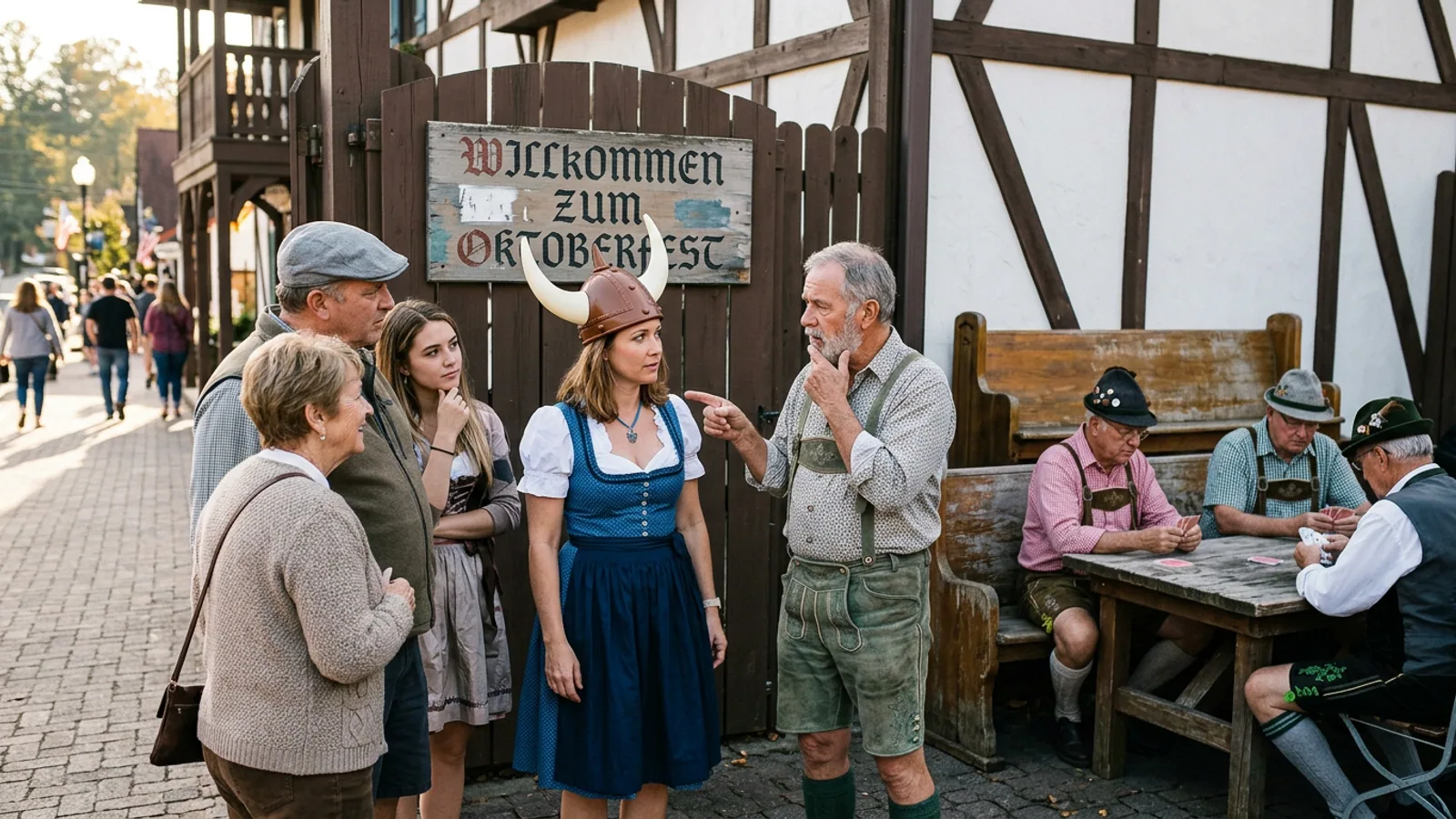
The problem is, at its foundation, a problem of category error made visible.
The horned helmet — universally recognized as Viking iconography, associated in the popular imagination with Norse culture, Scandinavian raiding, and a broad cluster of northern European warrior mythology — is not Bavarian. Bavaria is in southern Germany. The Vikings were, at their historical operating peak, Scandinavian. The two cultures inhabited different parts of Europe, spoke different languages, celebrated different festivals, and wore, on their heads, categorically different things. This is not a contested historical point. This is a basic geographic and cultural fact available in any encyclopedia that deals in either subject.
And yet, at Oktoberfest in Helen, Georgia — which is itself a themed replication of a Bavarian cultural festival held annually in Munich, the capital of Bavaria — a nontrivial percentage of attendees arrive wearing horned Viking helmets, purchased in the gift shops on Bruckenstrasse or, more commonly, brought from home. The Bavarian Brainrot newsroom, in a nonscientific count conducted on three consecutive Oktoberfest Saturdays in the fall of 2025, observed Viking helmets on 14% of adult male festivalgoers and 6% of adult female festivalgoers, for a combined rate of approximately one in nine adults. This is, as a matter of regional cultural geography, a figure that rewards examination.
The Bavarian Brainrot newsroom asked six Helen residents and visitors, photographed in person at the Festhalle gate on Edelweiss Strasse between 2:00 and 4:30 p.m. Saturday, to address the question.
Carl Brendan, age 42, general contractor, photographed at the Festhalle gate, Saturday at 2:11 p.m. Dr. Brüning notes that Mr. Brendan was, at the time of the interview, wearing a horned Viking helmet.

"I'm going to be honest with you — I bought this at the gift shop on Main Street in 2019 and I bring it back every year. I know it's not German. I know it's Viking. I also know that I'm at a festival in Georgia where the town looks like someone built Bavaria inside the Appalachian Mountains, and in that context the Viking helmet feels like it fits. Everything here is a little bit — I don't want to say fake, because that sounds mean — everything here is a theme. And Viking is a theme. I get that it's the wrong theme for the specific German theme. I just think that's fine. We're all having fun."
Dr. Brüning notes, for the record, that he did not find this argument persuasive. He notes, further, that "everything here is a theme" is an accurate description of Helen's general condition, and that this accuracy does not resolve the category-error problem. It compounds it.
Linda Fairchild, age 55, retired librarian, photographed at the second table from the Festhalle gate, Saturday at 2:38 p.m.

"I read your piece last fall about the historical inaccuracy of horned Viking helmets, and I want to say first that it was very good and I agreed with it entirely. Historical Vikings did not, as the archaeological record makes clear, wear horned helmets. The horned helmet is a 19th-century romantic invention, popularized by theatrical costume and later by popular culture. So we have a situation in which people are wearing an inaccurate representation of a culture that is not the culture the festival is representing. It is, in terms of historical accuracy, wrong on two levels simultaneously. I say this as someone who is, frankly, a little obsessed with this. I have explained this to my husband at length. He bought a Viking helmet on the way in."
Dr. Brüning notes that he was unable to reach Mrs. Fairchild's husband for a follow-up comment, as he had already moved to the beer-hall interior.
James Wu, age 29, software engineer, photographed near the Festhalle entrance, Saturday at 3:04 p.m.

"I'm here for the first time. I drove up from Atlanta this morning. I don't have a strong view on the Viking-helmet question, but I notice it as a thing that's happening. What I find more interesting, honestly, is the meta-question of why people reach for the Viking iconography specifically when they want to signal 'European medieval festival.' Because there are other European medieval options. There is not, at this festival, a significant contingent wearing jester's caps, or knight's helmets, or anything associated with southern German medieval culture, which is what this is supposed to be referencing. It's specifically the Viking helmet. I think that says something about how the popular culture has organized its European-festival signifiers. I don't know what it says, exactly. I'm just noting that it says something."
Georgia Hensley, age 61, co-owner, Alpine Gift Haus, Bruckenstrasse, photographed at the Festhalle gate, Saturday at 3:29 p.m.

"We sell them. I want to put that on the record. The Alpine Gift Haus has sold Viking helmets since 2003. We sell, on average, between 80 and 110 units per Oktoberfest season. They are our second-best-selling non-food festival item after the plastic beer steins. I understand, from your reporting in the fall, that this is historically incorrect. I knew it was historically incorrect before your reporting. The question I would ask in return is: what would you like me to replace them with? We tried traditional Bavarian felt hats with the Gamsbart brush in 2018. We sold eleven of them in three years. We had a run of custom-made Miesbacher Tracht embroidery kits in 2021. We sold four. The Viking helmets move. That is the complete explanation."
Dr. Brüning acknowledges that Mrs. Hensley's explanation is the complete explanation. He notes that the complete explanation does not, in his view, constitute an answer to the question.
Don Westfall, age 47, high school history teacher, photographed on the walkway between the Festhalle and the parking area, Saturday at 3:58 p.m.

"I use this as a teaching moment every single year. I bring my 10th-grade world history students to Oktoberfest in October and I let them walk around for twenty minutes and I say, write down everything you see that is historically inaccurate. They always find the Viking helmets first. Then they find the lederhosen variants that don't match any regional Bavarian style. Then they find — and this one usually takes longer — the Festhalle's decorative frieze, which includes a rune sequence that is Old Norse and not Old High German. So actually the Viking contamination goes deeper than the helmets. There is a genuine runic frieze on the Festhalle exterior that reads, in a loose translation, 'victory or feast.' It is beautiful workmanship. It is completely from the wrong civilization. My students love finding it. I have not, in fifteen years of pointing it out, managed to get anyone to change it."
Renate Sommer, age 66, pharmacist, Helen, photographed at the Festhalle interior exit, Saturday at 4:22 p.m.

"I grew up in Regensburg. I moved here in 1993. I have watched this festival grow from three hundred people to the thing it is now. I have, over the years, learned to make my peace with many aspects of the festival that a person from Bavaria would find peculiar. The Viking helmet is not, for me, the most peculiar aspect. The most peculiar aspect, in my view, is the yodeling competition, which at the Munich Oktoberfest does not exist as a formal competition because yodeling is associated with the Alps and the Bavarian plateau, not with the city of Munich or its particular urban festival character. The Viking helmet is, compared to the yodeling competition, a surface problem. I am not saying the Viking helmet is not a problem. I am saying there is a hierarchy."
Dr. Brüning notes that Mrs. Sommer's hierarchy is, structurally, correct, and that the yodeling competition deserves its own investigation. He expects to file a separate piece before the end of the quarter.
The question of the Viking helmet at Helen Oktoberfest, as this vox populi makes clear, is a question that admits of no resolution and, as such, will recur. The helmets will be sold. They will be worn. The 14% figure, or some figure near it, will obtain in October of 2026 as it obtained in October of 2025. Mrs. Sommer's hierarchy is correct, in this reporter's view, but the hierarchy does not relieve any individual element of the hierarchy from examination. The Viking helmet is the most visible element. It is, therefore, the first element addressed.
The runic frieze on the Festhalle exterior will be addressed in a separate piece.
— Dr. Wilhelm Brüning, Cultural Affairs Correspondent



Reader Comments
Leave a comment ↓