India's Prototype Fast Breeder Reactor (PFBR) is a 500-megawatt-electric
sodium-cooled pool-type nuclear reactor located at the Madras Atomic
Power Station complex at Kalpakkam, in the state of Tamil Nadu. It
achieved first criticality — the point at which a reactor first
sustains a neutron-chain reaction indefinitely without external
neutron input — on Monday, April 6, 2026, following approximately two
decades of construction, commissioning delays, and regulatory review.
The reactor, per its operator Bhavini, is expected to enter commercial
operation and begin delivering power to India's southern grid during
Q3 of 2026.
The City of Helen, Georgia, is not, per its municipal filings, a
nuclear power. The City of Helen does not operate a nuclear reactor,
a conventional fossil-fuel generating station, or any other electrical
power source. The City of Helen is, per its billing records with
Georgia Power, a commercial-class retail electricity customer.
Per the White County BOC's draft Resolution 2026-43, introduced
Wednesday, these two facts are linked.
The resolution
Resolution 2026-43 — sponsored by Commissioner Dale Henneman, the same
commissioner who authored Resolution 2026-41 pegging the Glockenspiel
to the FOMC calendar — is a 1,100-word resolution that, in its third
paragraph, states:
"Whereas the Republic of India, on the sixth day of April, Two
Thousand and Twenty-Six, successfully achieved first criticality on
its Prototype Fast Breeder Reactor at Kalpakkam, a facility of
design-capacity 500 megawatts-electric, therein demonstrating the
outcome of sustained long-duration infrastructure discipline over
approximately two decades of effort, the White County Board of
Commissioners hereby identifies the said reactor as a benchmark
case for energy discipline in our own municipal footprint."
The resolution goes on to order "a comprehensive audit of every
publicly owned electricity-consuming asset in the City of Helen," to
be conducted by a three-member ad-hoc committee, and to be delivered
to the Board within 45 days. The stated benchmark of the audit is
"the India PFBR's 20-year execution timeline."
Commissioner Henneman, reading the resolution from the dais Wednesday
evening, described the intended outcome as "a generational clarity
around the energy-consuming assets of our civic estate." He did not
further define "generational clarity."
Commissioner Reba Kinnison, who dissented on Resolution 2026-41 and
spoke at length Wednesday, asked from her seat at the dais: "Has
Commissioner Henneman reviewed the existing municipal utility
schedules?"
Commissioner Henneman said he had.
Commissioner Kinnison asked a follow-up: "Is he aware that the
municipal estate's entire electrical consumption is approximately
0.0008% of a single 500-megawatt reactor's output?"
Commissioner Henneman, after a pause, said: "I am aware of the scale.
The resolution is not about scale. The resolution is about discipline."
The largest consumer
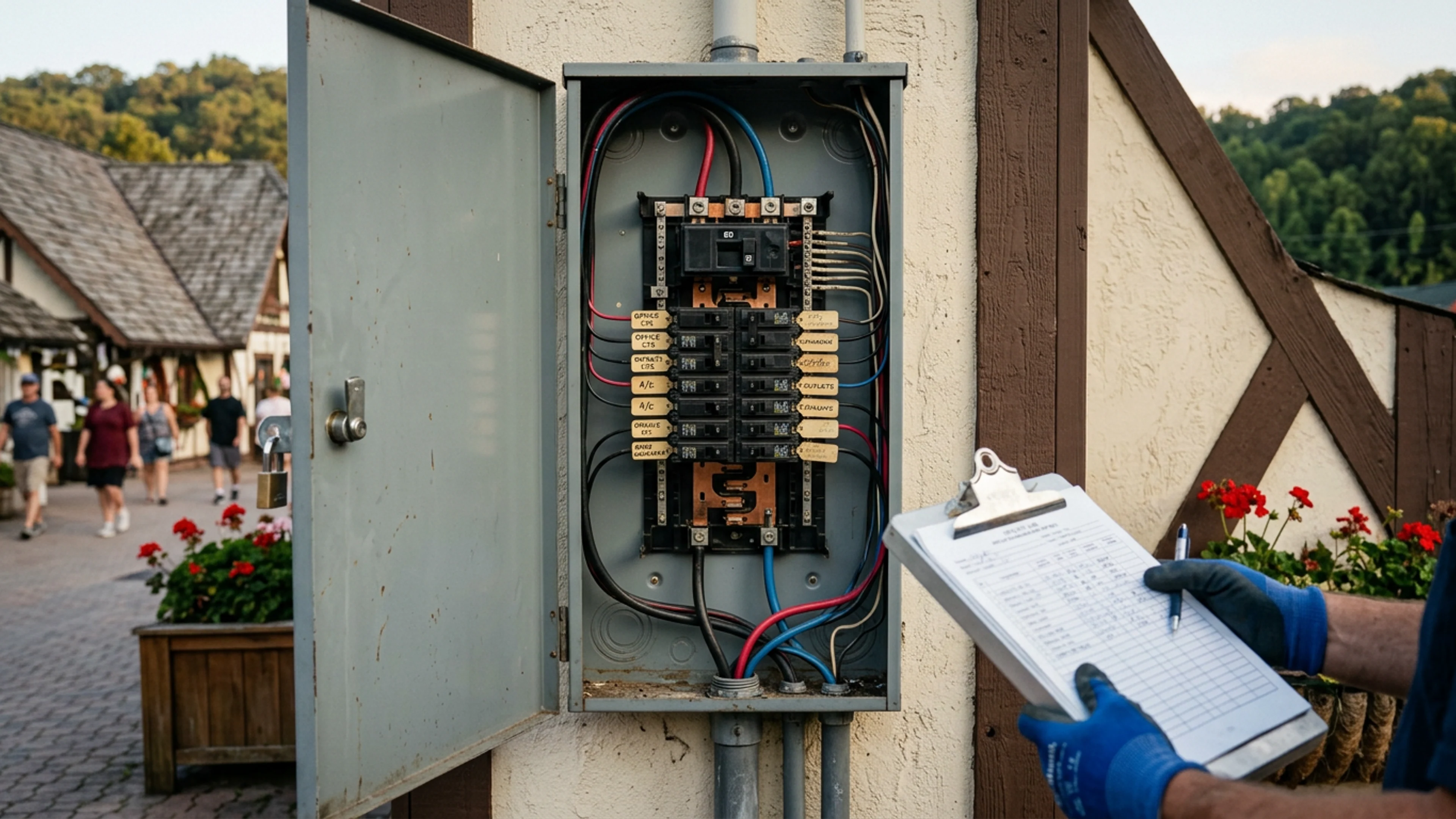
The audit, though not yet formally commenced, has been informally
anticipated by Helen city staff. City Manager Bjorn Olsen confirmed
Thursday morning that he had, on his own initiative, begun pulling
monthly consumption records for the City's 47 publicly owned
electricity-consuming assets.
Of those 47 assets — which include eleven streetlights (most of which
are LED-retrofit), eight traffic signals, six municipal-building HVAC
systems, four restroom facilities, three public-park lighting
systems, and other miscellaneous assets including the Municipal Pool
filtration — the single largest consumer, per Mr. Olsen's preliminary
review, is the Helen Downtown Glockenspiel.
The Glockenspiel draws, at peak chime-cycle consumption, approximately
14.2 amps at 240 volts, for a peak demand of approximately 3.41 kW.
Over a typical 2,900-chime operating year (per its 1977-through-2025
operating pattern), the Glockenspiel consumed an estimated 380 kWh
annually — a figure Mr. Olsen characterized to this reporter, Thursday
evening, as "roughly what a single refrigerator uses in an average
American household in a year."
The Glockenspiel's annual consumption, relative to India's PFBR's
design-year 4.38-billion-kWh output, is 0.0000087%.
The resolution does not specify a reduction target.
What the audit will conclude
Asked Thursday what outcome the audit was, in his professional
estimation, likely to produce, Mr. Olsen said: "The audit will
identify the Glockenspiel as the municipal estate's largest single
electrical asset. It will identify the municipal restroom facility
on Edelweiss Strasse as the second largest. It will identify no
meaningful path to a India-PFBR-style 500-megawatt scale of operation
from our current estate, as we have no interest in operating a nuclear
reactor."
He added: "The Glockenspiel is, in any case, currently silent, per
Resolution 2026-41. The resolution has already, without the audit,
reduced the Glockenspiel's annual consumption by 90.1%."
Commissioner Henneman, asked about this, said: "The work continues."






Reader Comments
Leave a comment ↓