

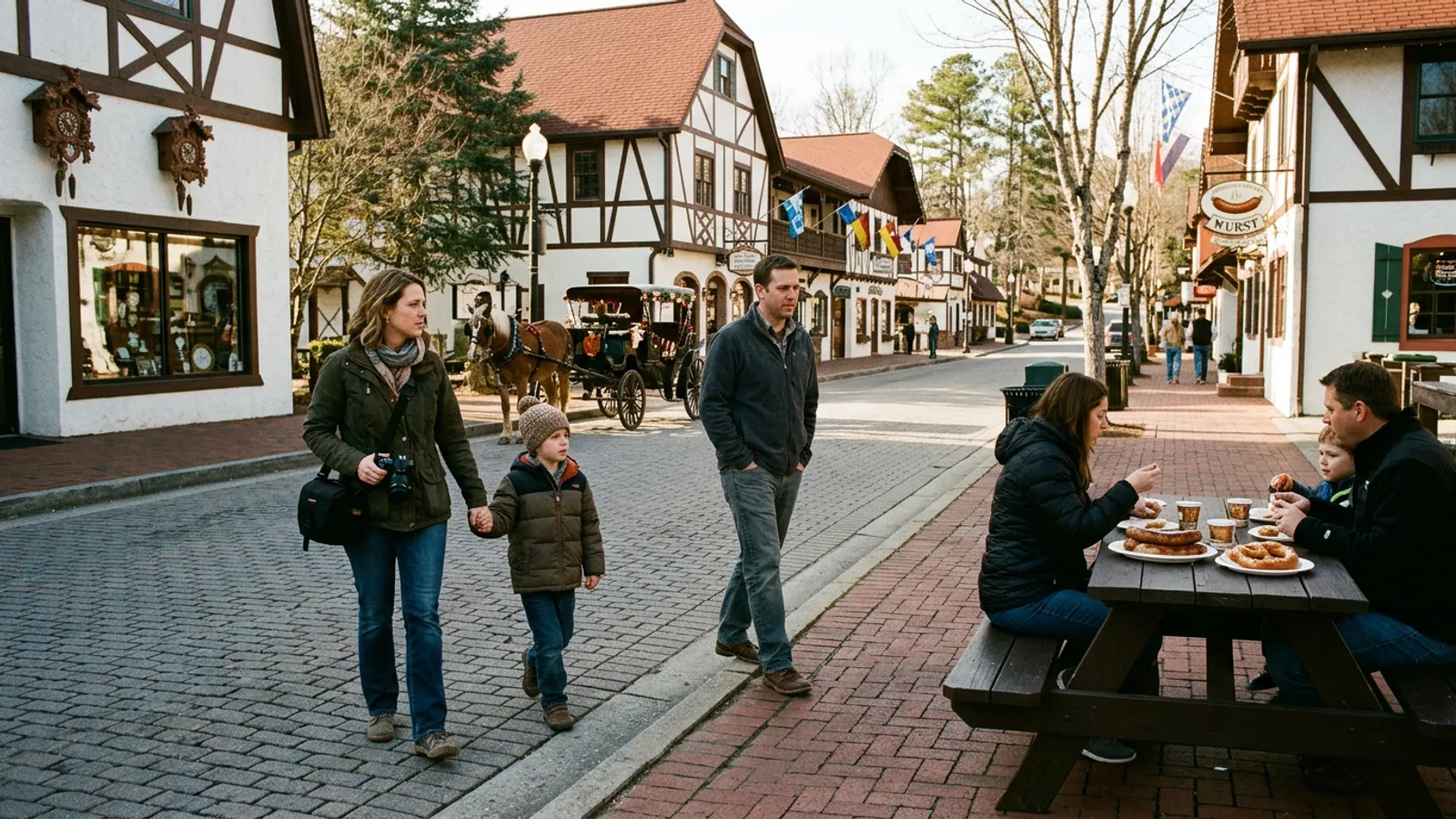
There is a moment, somewhere on Bruckenstrasse between the Helen Welcome Center parking lot and the third cuckoo-clock retailer, when the accumulated environmental signals cross a threshold and you understand, without checking a map, that you are here. The moment is sensory before it is intellectual. Below are 11 of the signals that produce it.
1. Accordion Music From Three Non-Adjacent Sources Simultaneously
The first source is typically the Festhalle. The second is a portable speaker system mounted outside one of the Bruckenstrasse souvenir shops, playing what appears to be a commercial recording of a 14-piece Bavarian ensemble. The third source varies. On a given morning it may be a live busker near the Edelweiss footbridge; on other mornings it is a second commercial recording from a different retailer's speaker, in a different key. The three sources are not synchronized. The net auditory effect is one of total Bavarian ambient saturation with no single coherent reference point.
2. The Consistency Of Pretzel-Cart Steam On A 60-Degree Morning
The Bruckenstrasse pretzel cart produces, at operating temperature, a specific grade of steam: dense, white, and carrying a mild salt-and-carbohydrate thermal signature. On a 60-degree morning, with low ambient wind, this steam column is visible from approximately 40 feet away and intersects the pedestrian path at shoulder height. The experience of walking through it is brief, approximately one second, and leaves no physical residue. But it is, on multiple repeat visits, consistently recognizable as a Helen arrival signal.
3. The Two-Second Delay Between The 9 A.M. Glockenspiel Chime And The First Goose
The corner glockenspiel at Edelweiss and Bruckenstrasse strikes on the hour. The first goose vocalization from the river corridor reliably follows within two seconds. The photographer has documented this interval on seven separate 9 a.m. observations and the range is 1.6 to 2.4 seconds. Whether this is coincidence or a conditioned goose response to the glockenspiel stimulus is outside this publication's area of coverage.
4. The Specific Chill Coming Off The Chattahoochee That Is Distinct From General Air Temperature
Standing on the Edelweiss Strasse footbridge, you can measure, by sensation, a three-to-five-degree temperature differential between the ambient air and the air directly above the river surface. This is most pronounced in the February-through-April shoulder season, when the river is running near its winter temperature and the surrounding air has begun warming. The chill is directional — it arrives from the north-northwest, which is upstream — and it is cooler and slightly wetter than the ambient air on either bank.
5. The Cobblestone-To-Asphalt Transition On Bruckenstrasse North Of The Welcome Center
The cobblestone section of Bruckenstrasse begins approximately 30 feet north of the Helen Welcome Center's main entrance. The transition from asphalt to cobblestone produces a specific tactile signal underfoot — a slight increase in vertical impact, a shift in surface regularity — that is, on the photographer's repeated experience, always the same. The photographer has, across multiple visits, identified this transition as the precise moment of arrival.
6. The Smell Of Fudge From The Christmas Shoppe That Extends Approximately 15 Feet Onto The Sidewalk
The Christmas Shoppe operates a fudge station visible through the front window. The fudge station's scent profile — butter, sugar, vanilla, and a secondary chocolate note — extends onto the Bruckenstrasse sidewalk to approximately 15 feet from the entrance in low-wind conditions. On a still morning, the boundary of the scent envelope is relatively sharp. The photographer has, on two separate occasions, stopped at what proved to be the exact outer edge of the envelope without intending to do so.
7. The Visual Compression Of The Streetscape That Occurs At The Bend Near The Bodensee
Bruckenstrasse curves slightly left at its midpoint, near the Bodensee. This curve produces a visual compression of the street ahead: the storefronts on both sides appear to close in as you approach the bend, and then open again as you pass it. The effect is mild — the street is not narrow enough for it to be dramatic — but it is, on repeated visits, consistently present. Helen is one of approximately three downtown environments in the Georgia mountains where this occurs.
8. The Sound Of The Heidi Motel Windmill, Which Is Different Depending On Wind Direction
The Heidi Motel windmill, mounted on the roofline above the lobby entrance, produces a low mechanical rotation sound that carries at varying volumes depending on wind direction. From the north, walking toward the motel, you hear it before you see it. From the south, passing it, the sound is louder on the way past and then fades. The photographer has, on one visit, not heard it at all. The photographer attributed this to wind conditions rather than a mechanical stoppage.
9. The Specific Weight Of Foot Traffic On A Saturday Morning Between 9:30 And 10:00 A.M.
In the 30 minutes before the primary weekend retail hour begins, the foot traffic on Bruckenstrasse is at its minimum daytime density but is still, by the standards of most small towns in this part of Georgia, notably present. The sidewalk is not crowded but it is not empty. There are people with coffee cups. There are people making decisions about souvenir shops. The weight of it is specific to Helen; the photographer has not encountered it at comparable scale in Dahlonega or Clarkesville.
10. The Particular Quality Of Morning Light On The North-Facing Bavarian Facades Between 8:45 And 9:15 A.M.
The north-facing building facades on the east side of Bruckenstrasse receive indirect morning light — reflected from the opposite facades, which are in direct sun — from roughly 8:45 to 9:15 a.m. in the winter and early spring months. This produces a warm, even, non-directional illumination on the painted architectural details: the flower boxes, the shutter hardware, the carved wooden balcony railings. It is, in the photographer's experience, the best light of the day. It is also, by 9:20, gone.
11. The Moment Of Total Simultaneity
There is a specific place on Bruckenstrasse — the photographer estimates it is near the intersection of Bruckenstrasse and Edelweiss, facing north — where, if you stop, you can hear accordion music from at least two sources, smell the pretzel cart, feel the river chill coming off the footbridge 40 feet east, see three Bavarian facade treatments in your forward visual field, and hear, from the Festhalle, what appears to be a soundcheck. The photographer has stopped here on four visits. On all four visits, the simultaneity was present. It is, in the photographer's read, what the town is trying to do. It is, also, what it does.
— Romi Fitzgerald

Reader Comments
Leave a comment ↓