On the afternoon of Wednesday, January 7, 2026, in a parking lot on
the south side of Bakersfield, California, a woman named Renée Good,
39, a mother of two daughters and the manager of a small payroll-
services business, was killed by a U.S. Immigration and Customs
Enforcement deportation officer. The circumstances of her killing
have been, in the days since, the subject of continuing federal
investigation, considerable national press coverage, and sustained
protest activity across more than sixty American cities.
The national story is not the subject of this editorial. The national
story is being covered by the national press. This paper is not the
national press. We are a satirical local publication in a town of
550 permanent residents in Northeast Georgia. We do not cover
federal investigations at the national scale. Our beats are the
White County Board of Commissioners, the Helen Chamber of Commerce,
and the brass escapement of the Helen Downtown Glockenspiel.
We are, however, obligated — as any publication that claims to be
of record is obligated — to note the things that happen in the town
we report on. We are obligated, even if the thing that happened is
small, un-organized, unattended by press, and unnoted by any other
publication.
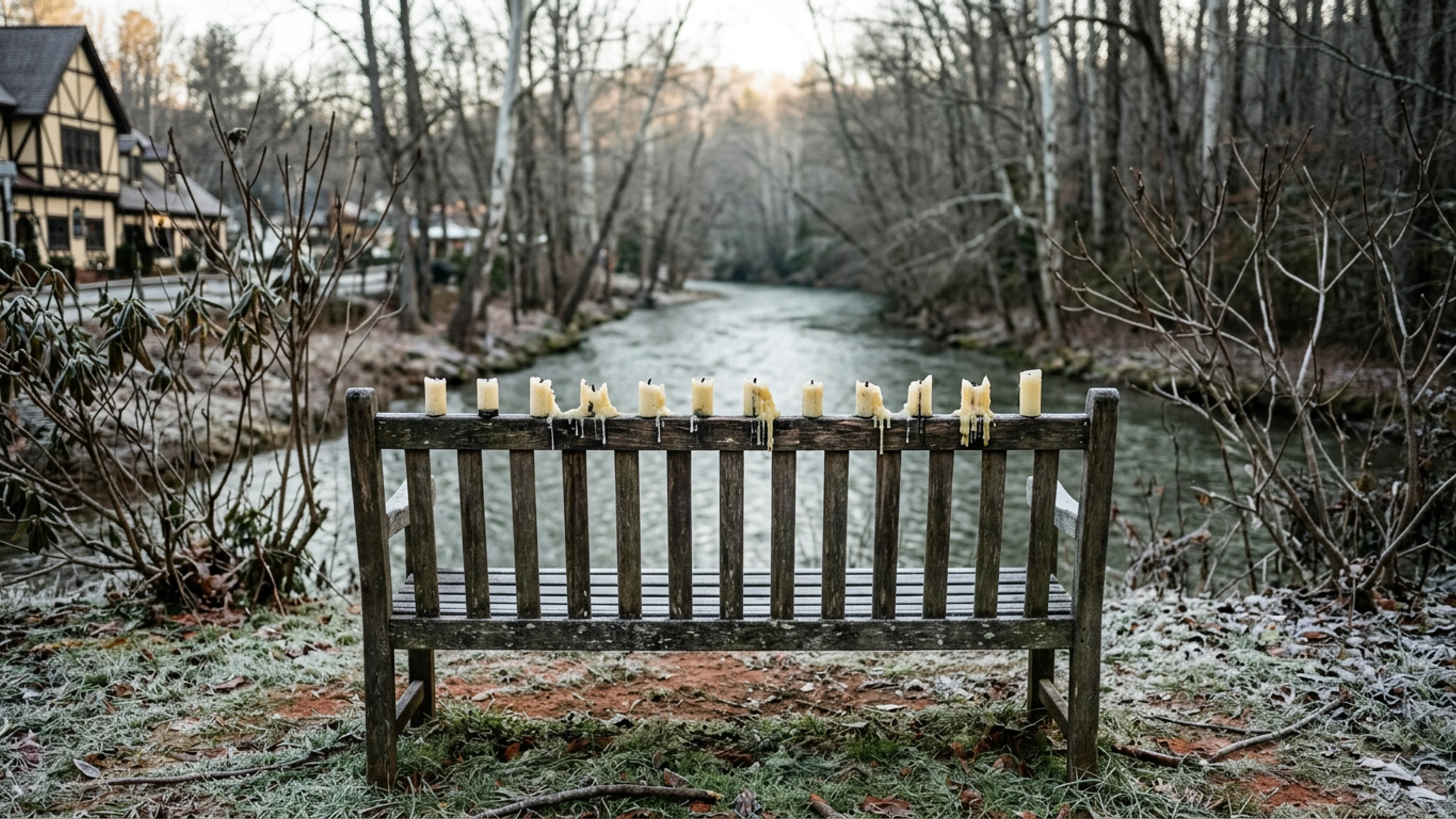
On the night of Thursday, January 22, 2026, twelve people gathered at
the small wooden park bench on Bruckenstrasse, between the Welcome
Center and the Chattahoochee pedestrian bridge, between
approximately 7:00 p.m. and 8:47 p.m. They brought twelve candles.
They lit them. They stood in a rough half-circle around the bench.
One person — I will not name her here — read Ms. Good's name aloud.
She then read nine additional names, each corresponding to a person
who had been killed, in 2025 or in the period so far of 2026, by a
federal or state law-enforcement officer acting in the course of
immigration or removal duties. I know most of the names that were
read. I will not list them in this paper; they are listed on
federal incident reports, in the public record of investigations,
in the reporting of national publications that have the resources
to document them properly. I do not.
The twelve people were, per the count I took at 8:12 p.m., seven
Helen residents, three Sautee residents, one from Cleveland, and one
from out of state (Pittsburgh). They were of ages between
approximately 24 and 81. They did not speak, after the names, other
than occasionally to each other. They did not chant. They did not
hold signs. They did not sing. They stood. They sat. The candles
burned.
At 8:47 p.m. the last of the candles went out. One of the twelve
picked up the spent candles, placed them in a small paper bag, and
put the bag in the municipal trash bin at the Welcome Center's
front parking lot. The twelve then dispersed. The bench was left
empty.
Why we print this
A newspaper's obligation — even a publication such as this one, which
most of the time files pieces on glockenspiel chime schedules, the
intrigues of the downtown cuckoo-clock inventory, and the
metaphysical properties of the 1978 Blodgett 1060 oven — is to
record what has actually occurred in its jurisdiction.
A vigil of twelve people, held in silence on a January Thursday, is
a small thing. It did not make the national news. It did not, so
far as I have been able to determine, make any news at all. It was
not filmed. It was not photographed (this publication was present;
we did not bring a camera). It did not produce a press release. The
bench, in the morning, was empty.
But it did occur. The people who attended it have a right to have
their attendance recorded. The person whose name was read first has
a right to have had her name read first. The eleven names after
hers have a right to have been read.
I have noted the event. That is, in this publication, all.
— Edmund Crowe, Editorial Page Editor

Reader Comments
Leave a comment ↓