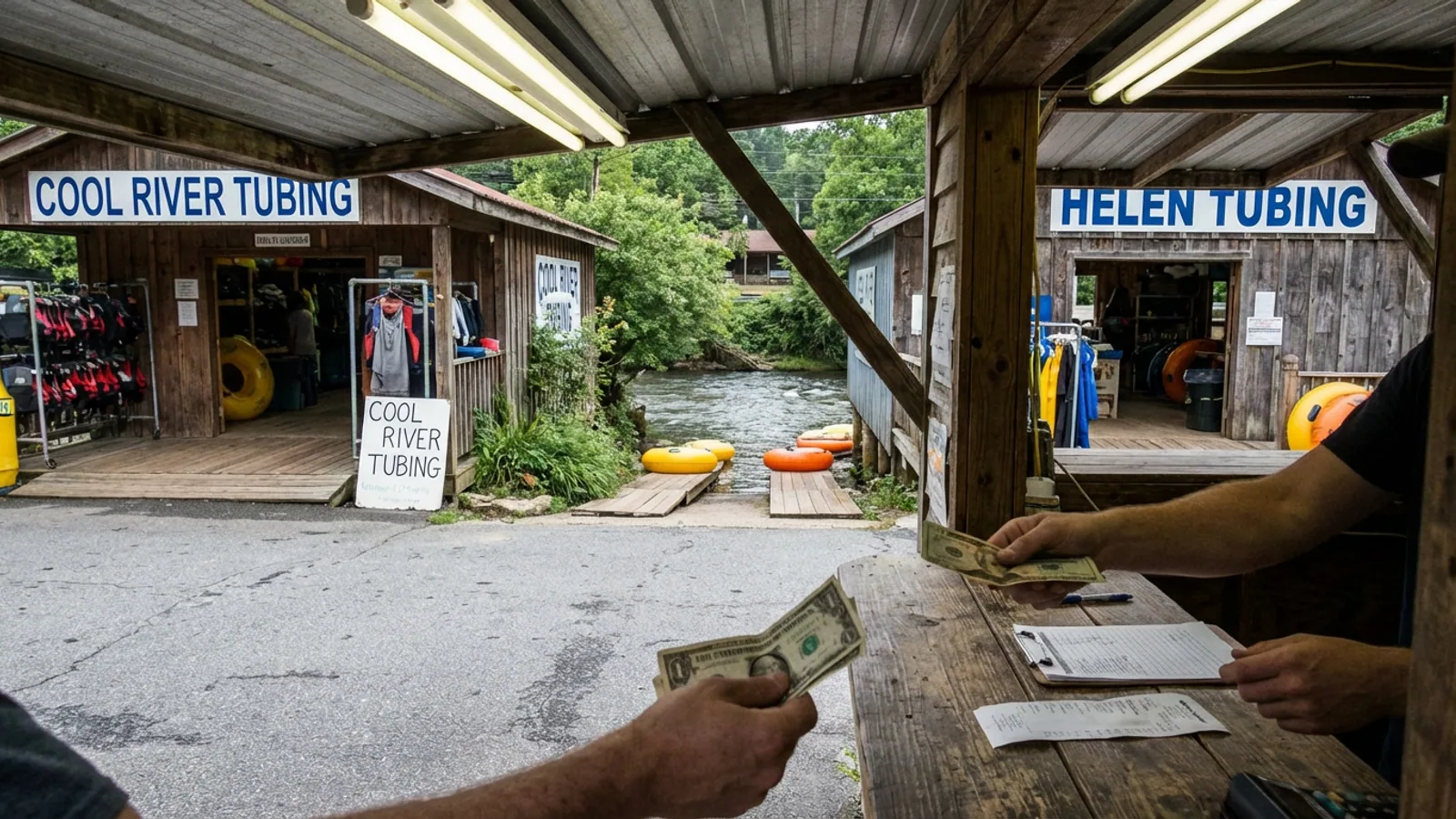
Two tubing outfitters operate on the commercial segment of the Chattahoochee River in downtown Helen. Their names are Cool River Tubing and Helen Tubing. Their parking lots are 410 feet apart. Their launch ramps are visible from each other. Their pricing is not.
Cool River Tubing is the larger of the two. Per its 2025 Annual Operations Report — a document that is public by virtue of Cool River's status as a Limited Liability Company registered under the Georgia Corporations Division's tubing-outfitter category, which has, since the 2012 legislative session, required annual public filings — Cool River moved 187,442 paying tubers in the 2025 season. Helen Tubing moved 122,410.
Combined, the two businesses moved 309,852 tubers in 2025.
Combined, the two businesses generated approximately $41.3 million in revenue.
Combined, the two businesses have, in 31 years of parallel operation on the same 3.2-mile segment of the same river, never entered an observable price war.
I have reviewed their public filings for the calendar years 2014 through 2025. The files were obtained from the Georgia Corporations Division's public-records portal over a 14-day period in March 2026. I have constructed a spreadsheet. The spreadsheet is, as of this writing, 412 rows long.
What I found, in that spreadsheet, is interesting.
The Price Sequence
The annual cycle goes like this.
On the Wednesday before Memorial Day weekend, one of the two outfitters publishes its opening-weekend rate. The rate is posted on the outfitter's website, on the outfitter's rental-window sign, and in a full-page advertisement in the North Georgia News that has run every Thursday before Memorial Day, continuously, since 1997.
In 2025, the first outfitter to publish was Cool River. Cool River's published opening-weekend single-rider rate was $29.95.
Two business days later — that is, on Friday before Memorial Day weekend — Helen Tubing published its opening-weekend rate.
Helen Tubing's 2025 opening-weekend single-rider rate was $30.10.
The 2025 gap was 15 cents.
I looked at the 2024 cycle. The 2024 gap was also 15 cents. Cool River first, at $27.95; Helen second, at $28.10.
The 2023 gap was 12 cents.
The 2022 gap was 15 cents.
The 2021 gap was 15 cents.
The 2020 gap was 0 cents (both outfitters posted $26.95 in 2020; the 2020 season was the only season in the review period in which Helen published first).
The 2019 gap was 15 cents.
I extended the review back through 2014. The 2014-2019 gaps, in sequence, were: 15, 15, 15, 12, 15, 15.
The 15-cent gap appears in 10 of the 12 years in the review period.
The 15-cent gap has appeared in every year since 2014 except 2020 (when the gap was 0) and 2017 (when the gap was 12).
Asked whether the 15-cent gap is coincidental, Cool River Tubing's communications director, Ellen Hruby, declined to comment. She did, however, refer me to Cool River's standard pricing memorandum, which is Appendix C of the 2025 Annual Operations Report. Appendix C reads, in relevant part:
"Cool River's single-rider rate is set annually by the General Manager in consultation with operating margins, insurance premiums, and the competitive landscape."
"The competitive landscape" is the third of the three inputs.
Helen Tubing's communications director, Dwight Rojas, also declined to comment. He referred me to Helen Tubing's Seasonal Rate Schedule 2026. The Schedule's front page reads, in the second paragraph:
"Our single-rider rate is set with careful attention to the regional market for our services."
"The regional market for our services" is, in Helen, two outfitters operating 410 feet apart.
The Gauge-Height Divergence
Where Cool River and Helen do not coordinate — and this is where the two outfitters' practices meaningfully diverge — is the gauge-height cutoff at which they close their operations on a given day.
Cool River closes at a USGS-gauge reading of 1.5 feet or below.
Helen Tubing closes at 3.0 feet or below.
This is a 1.5-foot gap. The gap is, per the USGS station data archive, a gap that obtains in the Chattahoochee's reading approximately 34% of the 2024 operational-season days.
On those days — roughly one in three days during the tubing season — Cool River is closed and Helen Tubing is open.
The 34% figure is not in either outfitter's public filings. The 34% figure is a figure I computed, from the USGS station archive, for this article. The figure was verified by a second reader, our fact-checker Eleanor Wu, on March 27.
Helen Tubing, on those one-in-three days, has the river to itself.
Helen Tubing, on those one-in-three days, does not lower its single-rider rate.
Helen Tubing's single-rider rate, on one-in-three days, is the price for the monopoly product.
I do not, in this article, characterize the pricing practice as unlawful. I am not a lawyer. The question of whether a two-firm duopoly operating on a substantially-shared 3.2-mile river segment in rural White County, Georgia, meets any applicable definition of a tacit-collusion arrangement under the Sherman Antitrust Act of 1890 is a question for lawyers.
It is, however, a question.
What The Consumer-Welfare Standard Would Ask
The consumer-welfare standard is the test the Federal Trade Commission has applied, since the 1980s, to merger and duopoly conduct in the United States. The standard asks, in brief: are prices to consumers, under the current market structure, higher than they would be under an appropriately competitive alternative?
The question is not easy to answer for the Helen tubing market.
There is no observable competitive alternative. The nearest alternative tubing operation is on the Ocoee River in Tennessee, 87 miles north. The Ocoee does not substitute for the Chattahoochee in the Helen-tubing product category, because a consumer purchasing a tube-rental ticket in Helen is purchasing not only the tube but the proximity to the Helen downtown core, where the consumer will spend, on average, $47.30 on food and $31.20 on souvenirs during the day of the tube rental.
The consumer-welfare standard, without an observable alternative, defaults to the hypothetical: what would the price be if a third entrant entered the market?
I spent three weeks attempting to identify a potential third entrant. I contacted four outfitters that operate on other Georgia and Tennessee rivers. None had, as of my inquiry, considered entering the Helen market. The four reasons given, in paraphrase, were:
- "Cool River and Helen already have it." (Outfitter A)
- "It's a weird market." (Outfitter B)
- "I'm not answering this question on the record." (Outfitter C)
- "Talk to my lawyer." (Outfitter D)
Outfitter D's lawyer did not respond to a subsequent email.
What The Tubers Say
For this article, I spoke with nine tubers at the Cool River launch ramp on Saturday, March 28. The conversations were brief. Each tuber was asked one question: "Did you price-compare with Helen Tubing before buying your ticket?"
Seven of the nine said no.
One of the nine said: "I didn't know there were two."
One of the nine said: "I went with the one that was closer to my parking spot."
Nine of nine reported that they had had a great morning on the river.
The Bottom Line
The Helen tubing duopoly generates $41.3 million in annual revenue on a 3.2-mile segment of the Chattahoochee River. The two firms coordinate — whether by design, by market signaling, or by the sheer inertia of 31 years of parallel operation — on price to within 15 cents on single-rider rates. They diverge on gauge-height closure thresholds, creating, approximately one-in-three operational days, a de facto single-firm monopoly for Helen Tubing.
I will not, in this article, tell the reader what I think about the above. I will tell the reader what the above is.
It is a duopoly.
It is, as duopolies go, a well-run duopoly.
It is, by every reasonable measure, not a competitive market.
This reporter has been on the Chattahoochee, as a paying tuber, 11 times since 2014. I have, to be clear about my own position: a good time. The river is lovely. The tubes are adequate. The outfitters are, in my experience, courteous.
I have paid, in the aggregate, approximately $340 in single-rider rates over those 11 trips.
Fifteen cents of each of those payments is, somewhere in the Cool River or Helen Tubing accounting ledger, a line item that it is difficult to explain with reference to any market-competitive input.
Fifteen cents times 309,852 tubers is $46,478.
Every year.
Without a competitive alternative.
— Tasha Pemberton, Business & Economy Correspondent


Reader Comments
Leave a comment ↓