

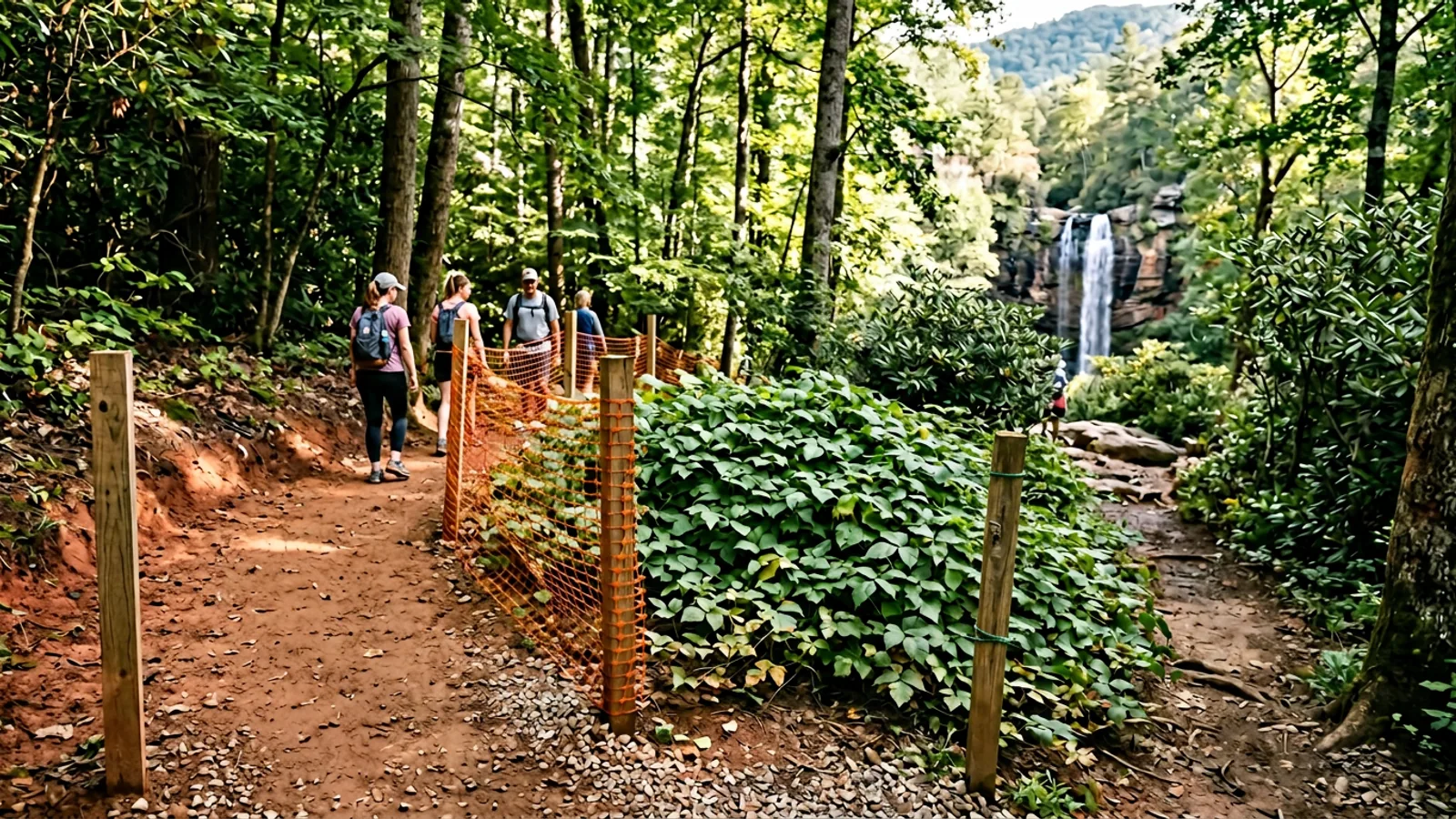
The approach trail to Toccoa Falls has been rerouted.
The new trail, which opened to the public on March 1, adds 140 yards to the walk from the Toccoa Falls College welcome area to the base of the 186-foot falls. The additional distance takes visitors southeast along a newly graded gravel path, around a section of the original trail corridor, and back to the main viewing area via a restored junction point near the creek.
The section of original trail that the new route bypasses is, per the college's January 2026 campus environmental review, approximately 27 feet long. For much of those 27 feet, the trail passed within arm's reach of a patch of Toxicodendron radicans — Eastern poison ivy — growing on the creek-bank slope to the trail's east side.
The patch is, per the Toccoa Falls College botany department's permanent vegetation survey, approximately 14 square feet in its current extent. It has been documented at its current location in every annual or biennial survey the department has conducted since 1974. It has not, in 52 years of documentation, meaningfully moved.
The college's botany department refers to it, in internal documentation, as Mrs. Winterbottom.
The Patch And The Dam
The historical record of the Toccoa Falls corridor is shaped by the events of November 6, 1977, when the Kelly Barnes Dam, a private earthen dam situated approximately 700 feet upstream of the falls, failed catastrophically following heavy rains, releasing approximately 176 million gallons of water and resulting in the deaths of 39 people, most of them students and staff of the then-Toccoa Falls Institute. The dam failure remains one of the deadliest dam disasters in Georgia history, and the falls and their immediate vicinity bear the marks of the event in ways that are visible to any attentive visitor.
The botany department's permanent vegetation survey, which dates from the mid-1960s, contains entries for the Zone 7 plot — the plot covering the falls-approach corridor — from 1966, 1968, 1970, 1972, and 1974. Each entry documents the T. radicans patch at its current creek-bank location. The 1974 entry is the last pre-disaster survey on record; the department's subsequent surveys resume in 1980. The 1980 survey, conducted three years after the dam failure, documents the patch at the same location.
The January 2026 campus environmental review cites this continuity of record directly. "The subject T. radicans specimen," the review states on page 9, "has been documented at its current location through multiple landscape-alteration events, including the 1977 dam failure. Its persistence and its current growth rate suggest it is not a candidate for removal or relocation. The appropriate management response is to route pedestrian traffic away from its growth zone."
The college's decision to reroute the trail rather than remove the ivy is, in the Bavarian Brainrot newsroom's assessment, the botanically sound one. Poison-ivy removal from a riparian slope is technically demanding, environmentally disruptive, and unlikely to produce permanent results in a stream-corridor location where the plant's root system is well established.
It is also, in the view of the college's botany department chair, not something they are going to do to Mrs. Winterbottom.
What The Environmental Review Required
The Toccoa Falls College campus environmental review — initiated in December 2025 after the falls-trail coordinator flagged three separate visitor contact reports from the 2025 season — ran to 22 pages and required the sign-off of the college's provost, the campus facilities director, the botany department, and the college's legal counsel.
The review examined four possible responses to the T. radicans encroachment: increased signage only, partial-removal attempt, trail rerouting, or trail closure pending a full corridor environmental plan. The review recommended rerouting. The college's leadership team approved the rerouting recommendation in January. Construction of the new trail segment, performed by the college's facilities crew with volunteer assistance from the college's environmental-science student chapter, was completed in late February.
The full review process, from the initial trail-coordinator flag to the new trail's public opening, took 14 weeks.
Per the college's facilities director, Martin Pruett, the rerouting cost approximately $4,200 in materials and $1,100 in contracted equipment rental for the grading work. The facilities crew's labor was absorbed into the department's regular operating schedule.
"We've talked about that patch for years," Mr. Pruett said, in a brief phone conversation Wednesday. "We should have done this sooner."
He was asked whether the botany department had been consulted at any point before the 2025 visitor-contact reports brought the matter to the formal review stage.
"They have been aware of it since before I worked here," he said.
Mrs. Winterbottom
The name appears in the Toccoa Falls College botany department's zone-survey files without explanation. It is used, consistently and without quotation marks or qualifiers, in survey notes from at least 2001 onward, though it does not appear in the department's pre-2001 records. The survey notes are internal documents not intended for public distribution; the Bavarian Brainrot newsroom obtained them as part of the college's environmental-review disclosure package.
The department chair, Dr. Leanne Whitaker, was asked in a Friday phone call whether she could explain the name's origin.
"I've been in this department since 2004," she said. "The name was already there when I arrived. I've asked. Nobody remembers who started it. It's in our files. We just kept using it."
Asked whether the department had any particular attachment to the patch given its longevity in the survey record, Dr. Whitaker paused before answering.
"It is a very old and very persistent plant," she said. "In its own way, it's remarkable."
She was asked whether the rerouting of the trail, which will reduce visitor contact with the plant without eliminating it, represented a satisfactory outcome from the botany department's perspective.
"From our perspective," she said, "the plant is fine. The plant has always been fine."
The trail opens daily at 9:00 a.m. Admission to the falls is $3 for adults.
— Margaret Holcomb
Reader Comments
Leave a comment ↓