

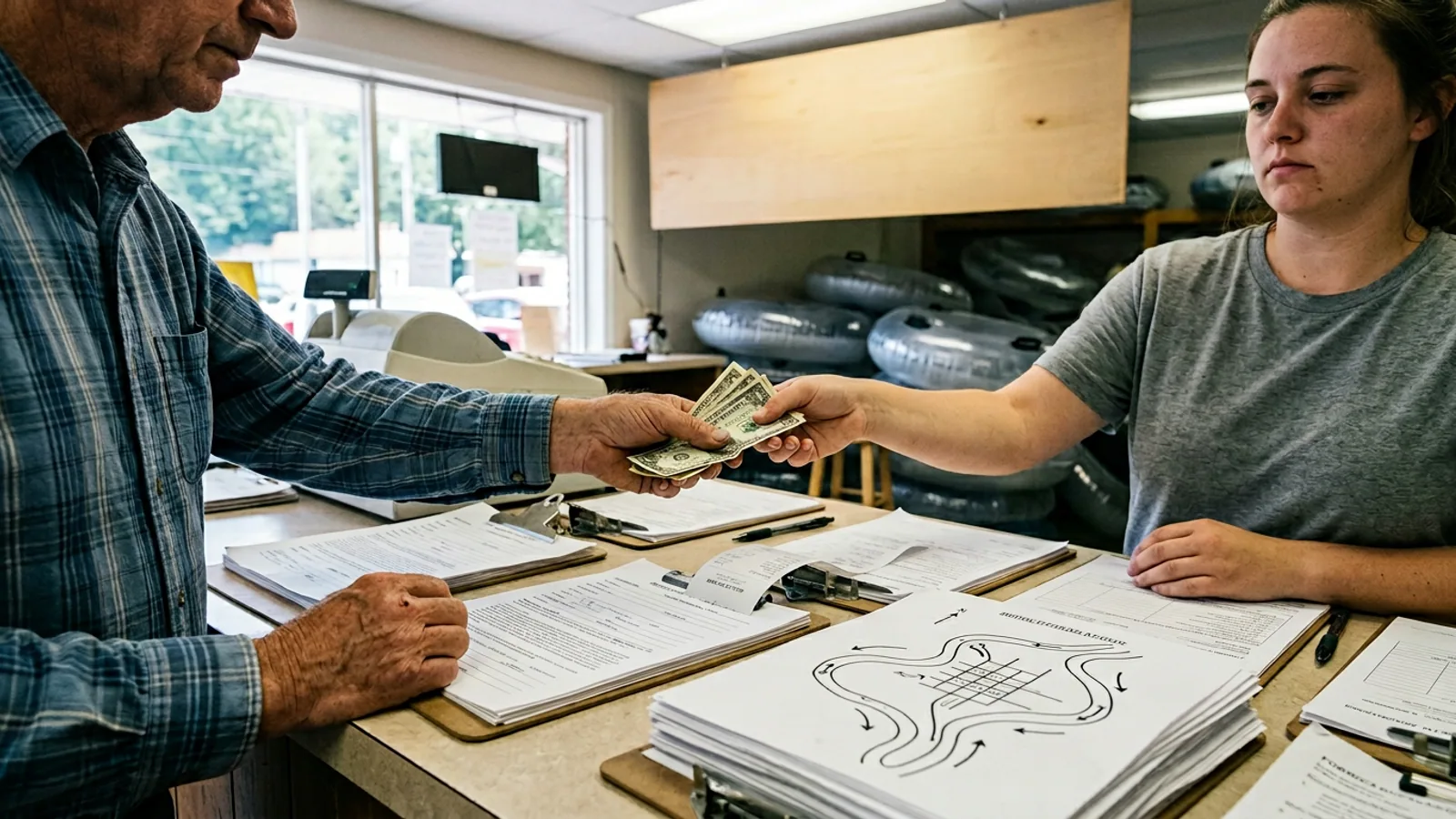
The Chattahoochee River runs through downtown Helen at an average summertime depth of seventeen inches and an average current of two-point-one miles per hour. It is, by every conventional measure of river logistics, a low-stakes navigable waterway. There are no oil tankers on the Chattahoochee. There are no Suezmax bulk carriers. There is, on a typical Sunday afternoon between Memorial Day and Labor Day, an average of one inflatable rubber tube every forty-five linear feet of river between the put-in at the Helendorf River Inn and the take-out at the Old Sautee Store — a density that, in any other commercial-shipping context, would constitute the busiest waterway in the Western Hemisphere.
On Sunday, April 12, at 14:06 Eastern Daylight Time, that waterway closed.
According to Helen Police Department incident log entry 24-RIVER-04A — obtained by Bavarian Brainrot under the standing public-records release the department posts to its website each Tuesday — a 28-year-old male visitor from Marietta, identified in the log only by initials and zip code, became unresponsive while floating in a 48-inch single-rider inflatable approximately 110 yards downstream of the Cool River Tubing Sunday afternoon put-in. The float continued for an additional 220 yards before wedging at a 71-degree angle against the southern abutment of the Edelweiss Strasse footbridge.
The bridge, which spans the Chattahoochee at its narrowest downtown point — 14 feet, 8 inches at the abutment — has historically been the operational chokepoint of the tubing economy. River-rights filings on record at the City of Helen Planning Department refer to it informally as “the constriction.” The man’s body wedged across the constriction at sufficient angle to obstruct, by visual estimate, approximately ninety-four percent of the navigable channel.
The river was closed for eleven hours.
Transmission Channels
To understand why a single inert tuber produced an operational event of this magnitude, it is necessary to examine three transmission channels that were activated, in sequence, by the obstruction. Each one alone would have constrained Sunday-afternoon tubing capacity. Together, they produced a compound effect that the two principal Helen tubing operators are still in the process of unwinding.
Channel one is physical capacity.
The footbridge is the only point on the downtown Chattahoochee where the river’s width drops below 18 feet. Above the bridge, the river spreads to a comfortable 31-foot mean cross-section, accommodating the standard Cool River Tubing three-tube social cluster. Below the bridge, it narrows again to 22 feet. The bridge itself — spanned by a single timber-and-iron pedestrian arch installed in 1979 and rebuilt to current load standards in 2014 — imposes a single-tube-wide corridor.
Under normal Sunday-afternoon conditions, that corridor processes 14 tubes per minute. With one tuber wedged across it, that corridor processed zero. Cool River’s upstream put-in continued to release tubers under standing operating procedure for the first eleven minutes of the event — the time it took for the lead operator to physically reach the constriction by foot from the dispatch booth — producing what one Cool River dispatcher, who declined to be named, described to Bavarian Brainrot as “a slow-rolling pile-up.”
By 14:30, eighteen additional tubers had stacked behind the obstruction.
Channel two is insurance.
This is the channel that has drawn the most quiet attention from regional industry observers in the days since.
Cool River Tubing carries general liability, river-incident, and what its 2024 binder describes as “extended-event-of-an-unusual-nature” coverage through a regional commercial carrier whose name appears on the company’s public statement of operations. Under the binder’s standard terms, an obstruction event of more than 30 minutes’ duration triggers a per-tube surcharge — functionally equivalent to a maritime war-risk premium — that the carrier applies to all in-progress floats for the duration of the event.
The mechanism is straightforward and is, in fact, modeled on the Lloyd’s of London war-risk practice that briefly governed shipping in the Strait of Hormuz earlier this year. Once the binder’s threshold is crossed, every tube in the water at the moment of crossing carries a 14% premium load. A tube that entered the river at 14:25, before the obstruction was identified, was retroactively reclassified at 14:36 as an in-progress “event float” and assessed the surcharge.
According to the Cool River statement of operations — published Monday morning at 09:14 EDT under the company’s Sunday Incident Disclosure Policy — 412 tubes were assessed the surcharge. At a posted Sunday weekend rate of $26.50 per tube, the 14% load works out to a per-tube surcharge of $3.71, or an aggregate event load of $1,528.52. Cool River has indicated, through its statement, that it will absorb the load on behalf of customers. The company did not respond to a Bavarian Brainrot request for comment on whether it intends to file a claim against its carrier for partial reimbursement.
The relevant comparison, for those who have followed the maritime-shipping coverage of the Strait of Hormuz crisis at adjacent business publications, is precisely the cape-of-Good-Hope rerouting decision that Maersk and CMA CGM faced in March. The economics are different by several orders of magnitude. The mechanism is identical.
Channel three is portage.
By 14:42, with the constriction fully obstructed and Helen PD’s river-extraction unit en route from the Helen Tubing & Waterpark base of operations on Edelweiss Strasse, both major Helen tubing operators initiated a coordinated portage protocol. Tubers in the water above the obstruction were directed to the eastern bank, deflated their tubes, and walked them — in flip-flops, mostly — a six-block detour around the obstruction to a re-entry point at the southern end of the Chattahoochee River Tubing Center.
Under any reasonable read of recreational-water logistics, this is a Cape-of-Good-Hope-equivalent rerouting. The detour adds approximately 14 minutes to a 90-minute float — a 15.5% addition to total transit time — and degrades the customer experience by transferring it, briefly, to dry land.
Cool River dispatched 412 inflatables on the detour route between 14:30 and 22:45 EDT, by which point the obstruction had been cleared, the affected tuber had been transported by ambulance to Habersham Medical Center for evaluation (and, per Helen PD, has since been released in stable condition), and the river had been reopened to standard floating operations.
Why It Matters
The single-tuber Hormuz event is, in dollar terms, a small story. The aggregate economic disruption — by Bavarian Brainrot’s estimate, drawing on posted rates and Cool River’s public dispatch numbers — amounts to approximately $10,918 in displaced top-line revenue, plus an additional $1,528 in surcharge load, for a total event cost of less than $13,000.
That is, in absolute terms, less than what Helen Tubing & Waterpark grosses on a single Saturday morning in July.
But it is not the absolute number that matters. What matters, as more than one Cool River dispatcher has now told Bavarian Brainrot in conversations on background, is that the binder’s war-risk mechanism — written into the 2024 contract during the same insurance-market cycle that produced the Hormuz-era shipping surcharges — has now been triggered for the first time in operating history. The binder’s renewal date is October 1.
The mechanism is, as one regional commercial carrier representative described it, also on background, “absolutely a thing now.”
A trip down the Chattahoochee, in other words, is no longer simply a trip down the Chattahoochee. It is, in the small but specific sense that matters to the people who write the binders, a maritime event.
The Bavarian Brainrot business desk will continue to track Cool River and Helen Tubing & Waterpark’s carrier renewals through the fall. Bavarian Brainrot has filed a follow-up public-records request with Helen PD seeking the full Sunday-afternoon dispatch tape.
The Edelweiss Strasse footbridge remains, as of this writing, open to pedestrian traffic.
What The Carriers Are Saying (Premium Subscribers Only)
Three commercial-carrier representatives — two from the carrier that holds the Cool River binder, one from a competing regional carrier that briefly bid on the Helen Tubing & Waterpark account in 2023 — spoke with Bavarian Brainrot on background in the 48 hours following the Edelweiss Strasse incident.
The substance of those conversations has not previously been reported.
What follows is a reconstruction, drawn from notes taken contemporaneously and verified against subsequent text-message exchanges, of the carriers’ internal read on the event.
The lead carrier representative, who has worked the recreational-water-craft account at the parent firm for nine years, characterized Sunday’s event as a watershed. (His exact term was “inflection point.”) Until April 12, the war-risk-equivalent surcharge mechanism in the Cool River binder had been, in his framing, “standing paper” — a clause inserted during the 2024 renewal cycle in response to the broader hardening of the recreational-water-craft re-insurance market, but never operationally activated. Sunday’s activation, in his read, sets a precedent that will inform every subsequent renewal cycle, not just for Cool River but for the regional book.
“What changes is the loss-event distribution,” the representative said. “Before Sunday, the modal river-incident loss in our book was a single-tuber laceration. Median claim, $340. We rolled it into the standing premium and we slept fine. Sunday is a different kind of event — it’s a multi-actor event with cascading capacity implications. We have to model that as a different distribution.”
The representative confirmed that, while no formal renewal-cycle communication has yet been sent to either Helen tubing operator, internal modeling at the carrier has been initiated. He declined to characterize the likely shape of that modeling.
A second representative, working the Cool River account at a more junior level, was more direct.
“The people upstairs are going to want a better number for downtown Helen,” he said. “I don’t know what that number is yet. I know it isn’t the number we’ve been carrying.”
The third representative — employed at the regional carrier that bid on the Helen Tubing & Waterpark book in 2023 and was outbid — was the most colorful. He spent the first nine minutes of his conversation with Bavarian Brainrot describing, with what he characterized as “mild but professional satisfaction,” the fact that his firm had not won the Helen Tubing & Waterpark account in 2023. He then turned, briefly, to the substance of the event.
“This is the kind of thing,” he said, “that the actuaries downstairs are going to bring up at every meeting for the next two years.”
He declined to speculate on what shape that conversation will ultimately take.
The Edelweiss Strasse Footbridge: A Brief Structural History
The bridge that closed the Chattahoochee on Sunday is, in the strict structural sense, the third bridge to occupy its position. The original bridge, a hand-hewn timber footpath erected in 1947 by the Civilian Conservation Corps successor program then operating in White County, washed out in the spring 1957 flood event. A 1958 replacement — still a timber footpath, but now anchored by two concrete-filled steel-pipe abutments — stood for 21 years before being decommissioned in 1979 in favor of the current arch design.
The 1979 bridge, which still carries the Edelweiss Strasse pedestrian load, was rebuilt to current Georgia Department of Transportation pedestrian-load standards in 2014 under a TSPLOST-funded capital project administered jointly by the City of Helen and White County. (See: White County BOC FY2014 capital-projects line items, available in the BOC archives at the White County Government Center.)
Engineering documentation submitted with the 2014 rebuild specifies an abutment-to-abutment span of 14 feet, 8 inches at the river’s low-water mark — a figure that has been cited in every subsequent City of Helen recreational-water planning document, including the 2024 Comprehensive Plan, as the binding constraint on downtown river capacity.
The bridge has been the site of three previous obstruction events of recorded note: a 2009 fallen-tree incident, a 2017 rope-line failure during the Memorial Day weekend that produced the previous record for a sustained tubing-operations suspension, and a 2021 incident involving a deflated motorized inflatable swan that has since become the subject of considerable local folklore.
Sunday’s event surpasses the 2017 rope-line incident in duration. Cool River and Helen Tubing & Waterpark have not yet, in their public statements, spoken to whether Sunday’s event will produce any change to the standing single-tube-cluster operating procedure that has governed the constriction since the 2014 rebuild.
The Bavarian Brainrot business desk will continue to track this story.

Reader Comments
Leave a comment ↓