

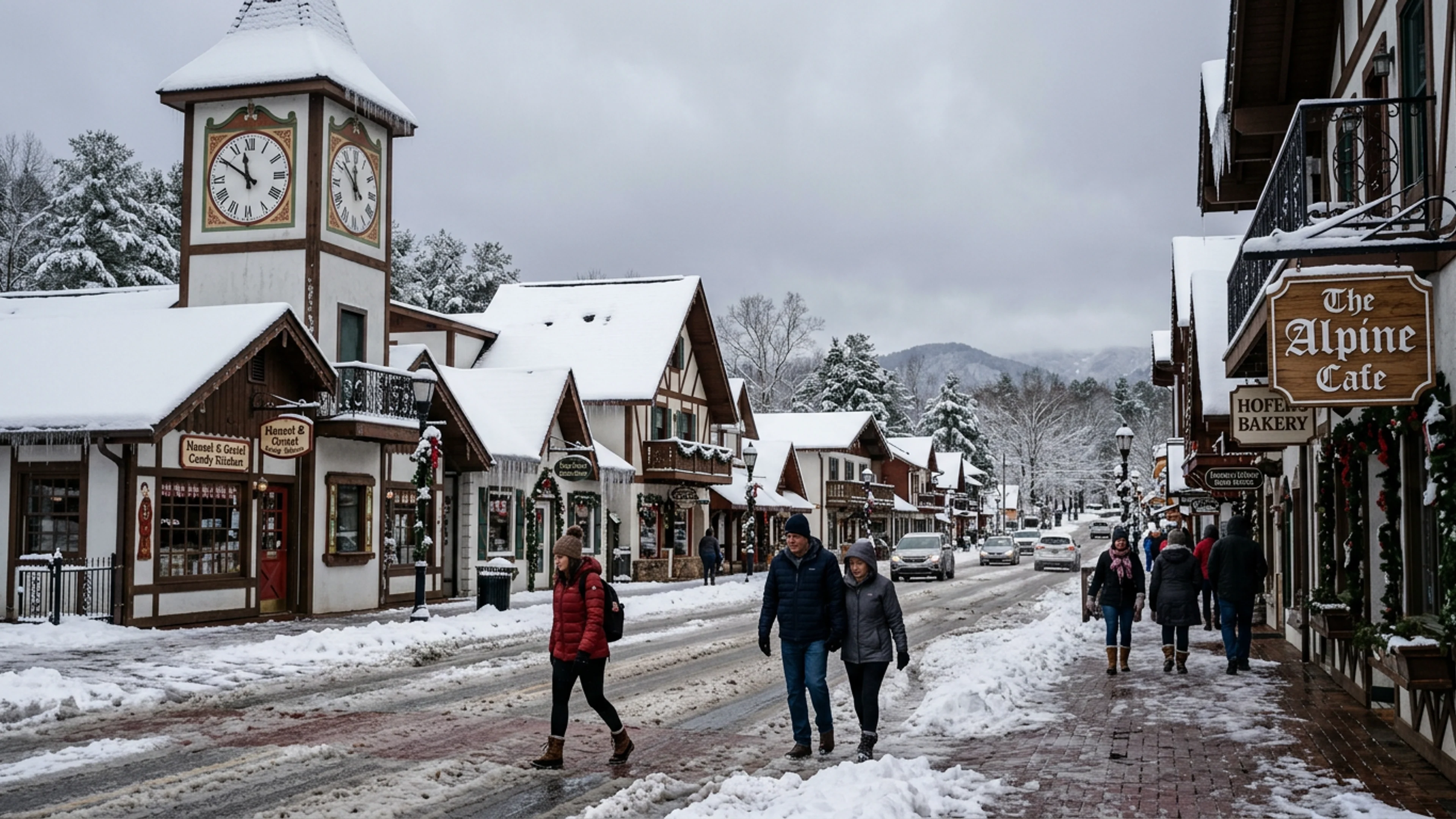
The winter storm-and-cold-wave system that swept from the central Rockies across the southern Mississippi Valley to the Atlantic coast between Friday, January 23 and Monday, January 26, 2026, produced, per the National Weather Service's post-event summary released Tuesday, at least 85 weather-related deaths, impacted more than 30 U.S. states, caused governors of at least 15 states to declare state of emergency, and generated, in some locations, as much as 24 inches of snowfall.
In Helen, Georgia, elevation 1,440 feet, the storm's effects were more modest. The storm arrived as a steady heavy snowfall at approximately 2:14 p.m. Friday, January 23, and concluded as a light flurry at approximately 7:30 a.m. Sunday, January 25. Over the course of the 65-hour event, the Helen Welcome Center's north-facing roof mounted weather station recorded a total of 4.1 inches of new snowfall accumulation. This was on top of the 4.3 inches that had fallen the preceding Wednesday, January 14, through Friday, January 16. The compound snow depth at the peak of the event (Sunday morning) was, in the sheltered downtown core, approximately 6.5 inches — in exposed north-slope locations (such as the Alpine Helen Park maintenance-shed roof), as much as 9 inches.
Temperatures at the Welcome Center's roof station reached a low of 9°F at 4:14 a.m. Saturday morning. This was, per Chamber Meteorological Consultant Dr. Rosario Mendes of Gainesville, the lowest low temperature Helen has recorded since a single-day reading of 8°F on February 19, 2014.
I offer the foregoing meteorological summary for the record. It is not, however, the most unusual piece of Helen-specific information I have to report from the weekend.
The most unusual piece of Helen-specific information is that the Glockenspiel, throughout the storm, chimed correctly.
The Glockenspiel
The Helen Downtown Glockenspiel's operating record, maintained by the Chamber of Commerce since its 1977 installation, documents the clock's notorious mechanical vulnerability to cold-and-damp conditions. Per the Chamber's historical log, the Glockenspiel has, in any snowfall event exceeding 2 inches of accumulated snow on the clock face, failed to complete its scheduled hourly chime at least once during or in the 48 hours following the event. This failure pattern has, per Chamber logs, held consistently since 2010 (the year of the most recent clock-mechanism servicing).
The most common failure mode, per the Chamber's chief maintenance volunteer Arnulf Steinberg (a retired Seth Thomas repair technician who has serviced the Glockenspiel on an unpaid volunteer basis since 2011), is the moisture-induced "stickiness" of the clock's brass escapement, which, at temperatures below approximately 25°F, tends to retard the clock's 60-second pulse by fractions of a second, cumulatively delaying the release of the hour-strike hammer by as much as 30 or 40 seconds over a 12-hour period.
This weekend's storm, however, produced — per the Chamber's minute- by-minute log, which was maintained manually by Mr. Steinberg through the duration of the event (he slept, he told me, on a cot in the Chamber's administrative storage room) — zero chime failures. At every scheduled hour between 10:00 a.m. Friday and 6:00 p.m. Sunday, the Glockenspiel executed its chime cycle within 1 second of the cesium-atomic-clock reference broadcast maintained by the University of North Georgia.
This is, per Mr. Steinberg, "unprecedented since 2010."
The explanation
Mr. Steinberg's working hypothesis, offered without strong conviction Monday morning at the Chamber's offices, is that the specific combination of this weekend's weather conditions — a sustained below-25°F temperature combined with a very low ambient humidity (average 28% over the storm period, unusually low for a snowfall event) — produced conditions in which the brass escapement's moisture-induced stickiness did not, in fact, occur. The escapement, he said, may have been "genuinely dry" for the first time in sixteen years of modern Helen winters.
He added: "I am not certain of this. I would not stake my pension on it."
He does not have a pension. He is volunteering.
Disposition
The snow is, as of Monday evening, melting. The Glockenspiel, throughout Monday, continued to chime correctly. Mr. Steinberg plans to return to his home on Tuesday morning, assuming no further weather develops.
He has, he said, "left it the cot, in case."

Reader Comments
Leave a comment ↓