

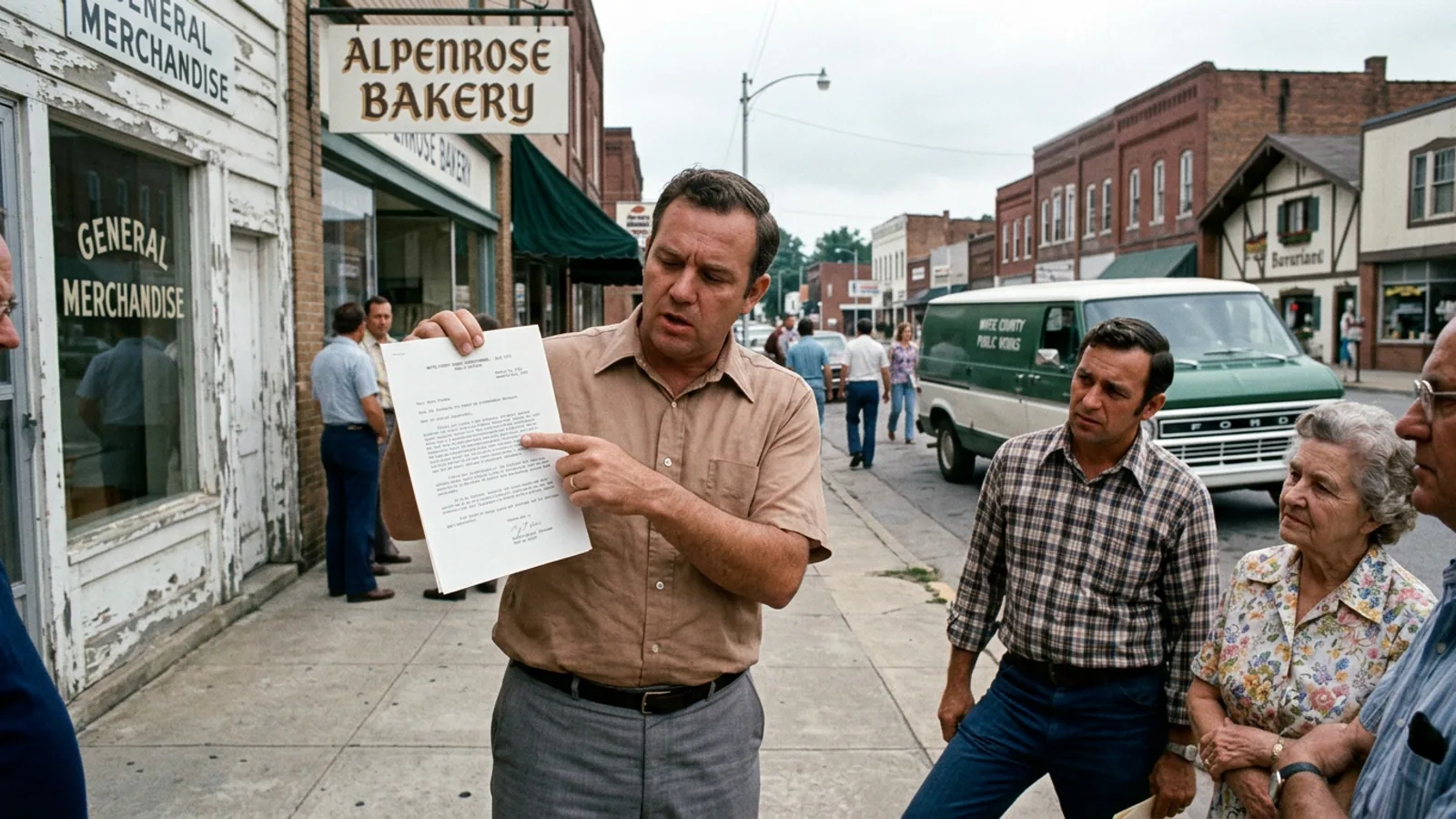
Everyone who knows the story of Helen, Georgia knows the 1969 story. A dying north Georgia mill town, its primary employer gone, its downtown buildings emptying. A group of local business owners, looking for a way to attract visitors to a place that had, at that point, no particular reason for visitors to come. A local artist named John Kollock, hired to sketch a vision: Bavarian alpine facades on the existing building stock, a fantasy transplanted from the Alps to the southern Appalachians, a theme town constructed not from scratch but from the dressed-up bones of what was already there.
That story is true. The 1969 sketches exist. The business association's vote is documented. The first facade conversions — the Hotel Helen, the Bodensee building, several storefronts on Bruckenstrasse — were completed between 1969 and 1972. The visitors came. The story of Helen is, in the version everyone tells, a 1969 story.
What the 1969 story leaves out is the paragraph.
The paragraph is 127 words long. It appears on page 6 of the White County Board of Commissioners' minutes from the regular session of July 19, 1973. It grants, on a vote of four to one, a zoning variance identified in the county's filing system as ZV-1973-014. It authorizes two property owners on Hauptstrasse to convert the roof-pitch profile of their existing commercial buildings from the standing Appalachian-residential design standard — which required a 4:12 pitch minimum and prohibited decorative gable ornamentation — to the Bavarian-alpine profile that the 1969 conversion had established as Helen's visual identity.
In its final 15 words, the paragraph does something the earlier conversions had never done. It says, in language that has been cited in four lawsuits and one Georgia Supreme Court opinion in the 51 years since, that the variance applies "and for similar applications henceforth, subject to the Planning Commission's reasonable review."
Those 15 words are why Helen looks the way it looks today.
The Paragraph
The full text of the operative paragraph of variance ZV-1973-014 is, in the July 19, 1973 BOC minutes, as follows:
"Variance ZV-1973-014 is hereby granted to the applicants as described herein, authorizing the conversion of roof-pitch profile and exterior facade treatment on Parcels 14-A and 14-B of the Hauptstrasse commercial district to the Bavarian-alpine profile described in the attached architectural specification, subject to inspection and sign-off by the White County Building Inspector prior to occupancy. Said conversion shall comply with all applicable fire and structural codes as currently in force. Applicants acknowledge that the variance is granted for the specific parcels described and does not create a general entitlement to variance for other properties, except that the White County Board of Commissioners finds the Bavarian-alpine profile described herein to be consistent with the adopted tourism-development direction of the City of Helen and therefore approves the profile as a permitted design standard for similar applications henceforth, subject to the Planning Commission's reasonable review."
The vote was four to one. The dissenting commissioner is not named in the minutes, per the standard minute-taking practice of the White County BOC in 1973. The time stamp of the vote is 9:47 p.m.
The meeting had begun at 6:00 p.m.
What Preceded It
The 1969 business-association design initiative had a fundamental legal problem from its inception: it was voluntary. Property owners who chose to convert their facades to the Bavarian-alpine profile did so because they thought it would attract customers, not because any zoning authority required or formally permitted the style. The Appalachian-residential design code that governed White County's commercial districts in 1969 had been written in 1961 and had not been amended to account for tourism-themed architecture. The early facade conversions — the Hotel Helen and several Bruckenstrasse storefronts — were built under construction permits that described, often vaguely, the structural work being done (new roof framing, exterior cladding replacement) without specifying the aesthetic outcome.
By 1972, the conversions that had been completed were legally anomalous. They existed. They were built. No one had challenged them. But they had no formal zoning basis. There was no ordinance that said Bavarian architecture was permitted; there was an ordinance that specified other requirements, which the conversions technically violated in some particulars, and which no one had enforced.
The two Hauptstrasse property owners who filed for variance ZV-1973-014 in June 1973 were, as best I can reconstruct from the 8-page variance file available in the White County Government Center archive, motivated by a practical concern: they wanted to obtain financing for their proposed conversions, and their lender required a formal zoning clearance before it would fund construction. The existing conversions, built without zoning clearance, could not serve as precedents in a financing context. The owners needed a variance.
The variance file contains: the owners' original petition (two pages, handwritten); an attached architectural specification prepared by a firm whose letterhead lists a Gainesville, Georgia address; a one-page staff recommendation from the White County Planning Commission recommending approval; and the BOC's July 19 minutes page containing the adopted text.
The Planning Commission's staff recommendation does not mention "similar applications henceforth." That language appears to have originated with the BOC itself — or, more precisely, with whichever commissioner drafted the variance text, which the minutes do not record.
It is 15 words. Their origin is undocumented.
The Four Lawsuits
Variance ZV-1973-014 produced four civil lawsuits in the years immediately following its adoption. Each one came at the legal status of the 1973 language from a different angle. Collectively, they constitute the case law that has governed Helen's architectural character ever since.
The first lawsuit, filed in August 1973, was a direct challenge to the variance itself by a property owner on Edelweiss Strasse who objected to what his petition described as "the creation of an ex post facto design standard in favor of commercial interests." The White County Superior Court dismissed the petition in December 1973, finding that the variance's "henceforth" clause was a permissible exercise of the BOC's zoning authority and that it did not constitute retroactive legislation.
The second lawsuit, filed in 1974, was the inverse of the first: a property owner who had been denied approval for a Bavarian-style conversion under the Planning Commission's "reasonable review" process argued that the ZV-1973-014 precedent entitled him to approval as a matter of right. The Superior Court found against him, holding that "reasonable review" preserved the Planning Commission's discretion.
The third lawsuit, filed in 1975, reached the Georgia Supreme Court. The plaintiff — identified in court records as one Wemberton, a property owner in the Robertstown community then being considered for annexation into the Helen planning area — challenged the Planning Commission's application of ZV-1973-014's design standard to a parcel outside the original Hauptstrasse commercial district. The Supreme Court, in Wemberton v. White County BOC (232 Ga. 441), held that the "similar applications" language was not geographically restricted to the Hauptstrasse district and affirmed its application to any parcel within the Helen planning area.
The fourth lawsuit, filed in 1977, challenged the Planning Commission's denial of a variance for a property whose owner wished to maintain a non-Bavarian facade. By 1977, the design standard had been inverted: the BOC had adopted a supplemental resolution in 1976 treating the ZV-1973-014 profile as the default standard for new construction and major renovation in the Helen commercial district, and requiring a variance from that standard for non-Bavarian designs.
The fourth lawsuit established that a property owner could not, as a matter of right, maintain a non-Bavarian design against the Planning Commission's reasonable objection. The court found for the county.
By the end of 1977, the 15 words had become the architectural law of Helen.
The Architects
The attached architectural specification that accompanied the ZV-1973-014 variance petition is four pages long. It specifies roof pitch (minimum 8:12, with gable ornamentation permitted but not required), facade treatment (half-timbering acceptable on all exterior walls, minimum exposed-timber spacing of 18 inches), window configuration (shuttered casement preferred, minimum window-to-wall ratio of 30%), and paint palette (earth tones with white trim preferred; high-chroma colors permitted on shutters and gable trim only).
The firm that prepared the specification is identified on its letterhead as "Alpine Design Associates, Gainesville, Georgia." The firm does not appear in any subsequent White County or Helen planning document. A search of Georgia Secretary of State business records shows no registration under that name after 1979.
A regional architectural history scholar who wrote about the Helen conversion for the Appalachian Regional Architectural History Quarterly in 1991, and who agreed to speak to Bavarian Brainrot on background, said the specification was likely prepared by a single architect or draftsman rather than a firm, and that the "Alpine Design Associates" name may have been a project-specific entity. He described the specification as "competent but not sophisticated — someone who had looked at photographs of Bavarian alpine architecture and translated what they saw into code language."
"The interesting thing," he said, "is that the specification they wrote in 1973 became the template. Every subsequent conversion in Helen was benchmarked against those four pages. The firm that wrote them had no idea, presumably, that they were writing the aesthetic law for an entire town."
Reader Comments
Leave a comment ↓