


Buried three-fourths of the way down the City of Helen Commission's April 21, 2026 agenda, under the Administrative section and below items concerning a parking-lot contract on Hoen Strasse and a price-setting measure for restaurant restroom use, appears a single line: "G. APPROVAL OF MATRIX SIGNS." There is no further description. There are no attached materials. There is no dollar amount, no vendor name, no installation location, no timeline, no rendering, and no indication of how many signs are under consideration. The item is preceded by "F. JEFF ASH — PARKING LOT CONTRACT ON HOEN STRASSE" and followed by nothing — it is the final administrative item on the agenda. City Clerk Marilyn M. Chastain, who signs every agenda with "Respectfully Prepared," did not attach a supplemental packet to Item G. The entire documentary record of Helen's apparent entry into the variable-message-sign era is seven words.
"Matrix signs," in transportation-engineering and municipal-wayfinding usage, refers to variable-message signs — electronic displays capable of changing their text, graphics, or directional content remotely, typically via cellular modem or hardwired network connection. The Federal Highway Administration's Manual on Uniform Traffic Control Devices classifies them under Chapter 2L, "Changeable Message Signs." They are a standard feature on interstate highways, where departments of transportation deploy them to display travel times, Amber Alerts, and, on occasion, the Georgia DOT's annual reminder not to drive drunk during football season. They are a considerably less standard feature in municipalities of fewer than 700 residents.
Helen does not, to Bavarian Brainrot's knowledge, currently deploy any matrix signs within city limits. The city's existing wayfinding infrastructure consists of fixed Alpine-style directional signs — wooden-faced panels with Fraktur-adjacent lettering — installed at intervals along Bruckenstrasse, Main Street, and Chattahoochee Street. These signs do not change. They have not changed since the signage consolidation of 1987, with the partial exception of one panel near the Festhalle that was replaced in 2011 after what Public Works Director Jack Morgan's predecessor reportedly described in a work order as "impact damage, vehicle, unwitnessed." The April 21 agenda item therefore represents a potential first-of-kind infrastructure decision for Helen — the introduction of electronically variable messaging into a downtown corridor that has, for 57 years, operated under an architectural mandate requiring all visible structures to conform to an Alpine Bavarian aesthetic.
The 1969 zoning ordinance that established Helen's Alpine theme does not contain the word "electronic." It does not contain the word "LED." It does not contain the phrase "changeable message." It does, on page 3 of the original filing, require that "all structures and appurtenances visible from the public right-of-way shall conform in exterior appearance to the Alpine Village theme as determined by the Planning and Design Review Board." Whether a matrix sign constitutes a "structure" or an "appurtenance" is a question the ordinance does not answer, because in 1969 the most advanced publicly deployed variable-message technology in the state of Georgia was a movie-theater marquee with removable plastic letters.
Dr. Wilhelm Brüning, formerly of the Bavarian State Institute for Regional Cultural Geography and a recurring consultant to this publication on matters of Alpine-code interpretation, called the agenda item "a forcing function on the architectural code, whether the Commission recognizes it as such or not."
"An LED wayfinding sign in downtown Helen is not a sign. It is a precedent," Dr. Brüning said by phone. "Either it is exempt from the 1969 mandate, or it is not. If it is exempt, the exemption must be codified, which means a public hearing, which means the Planning and Design Review Board must determine what an Alpine-compliant matrix sign looks like. If it is not exempt, the sign must look Alpine. I am not aware of any Bavarian municipality that has attempted to render a variable-message sign in half-timbered framing, but I would not rule it out."
The practical applications of matrix signs in Helen are not difficult to imagine. The city's tourism infrastructure processes an estimated 2.7 million visitors annually — a figure derived from the Alpine Helen/White County Convention and Visitors Bureau's cumulative traffic data and the Zartico benchmarking platform presented to the Commission by Adam Zappia on March 2, 2026. Peak-season traffic on Main Street routinely exceeds the corridor's design capacity. Oktoberfest alone, now in its 56th year as the longest-running Oktoberfest in the United States, generates multi-hour traffic delays on Georgia Route 75. A matrix sign could, in theory, display real-time parking availability, direct overflow traffic to satellite lots, or warn tubers on the Chattahoochee of upstream congestion — a function that would have been useful during the 2022 float-lane standoff, which this publication has previously documented.
The cost question is the one the agenda does not address. Industry pricing for a single full-color LED variable-message sign ranges from $18,000 to $140,000, depending on size, resolution, and connectivity package, according to a 2024 procurement summary published by the American Public Works Association. Installation, permitting, and network infrastructure can double the unit cost. If Helen is approving a single small-format amber-text sign for a parking lot, the expenditure could fall within City Manager Darrell Westmoreland's $25,000 contract-authority threshold established by Ordinance 25-11-01, adopted December 16, 2025 — which would explain the absence of a detailed packet. If Helen is approving a network of full-color signs across downtown, the expenditure would almost certainly exceed that threshold and require the competitive-bid procedures the same ordinance mandates for contracts above $25,000.
The agenda does not specify which scenario is under consideration. It specifies nothing.
Gunter the Pretzel Vendor, who operates a cart at the corner of Bruckenstrasse and Main Street within line of sight of the most probable installation point for a downtown matrix sign, said he was not aware of the agenda item until a Bavarian Brainrot reporter read it to him on April 18.
"I don't know what a matrix sign is," Gunter said. "Is it like the movie."
It is not like the movie. It is a sign whose content can be changed remotely by a municipal operator. When this was explained, Gunter asked whether the sign could display pretzel prices. He was told this was theoretically possible but unlikely to be the intended use case.
"Then I have no opinion," he said.
Building and Zoning Administrator Jonah Casper, who would presumably be responsible for reviewing any sign installation against the Alpine code, is not listed on the April 21 agenda as a presenter for Item G. Nor is City Attorney Carl Free, whose office would typically weigh in on ordinance-compliance questions involving new infrastructure categories. Nor is Fletcher Holliday of Engineering Management Inc., who presents engineering updates at most Commission meetings but whose firm's scope of work covers water and sewer infrastructure, not signage. The item appears to belong to no one.
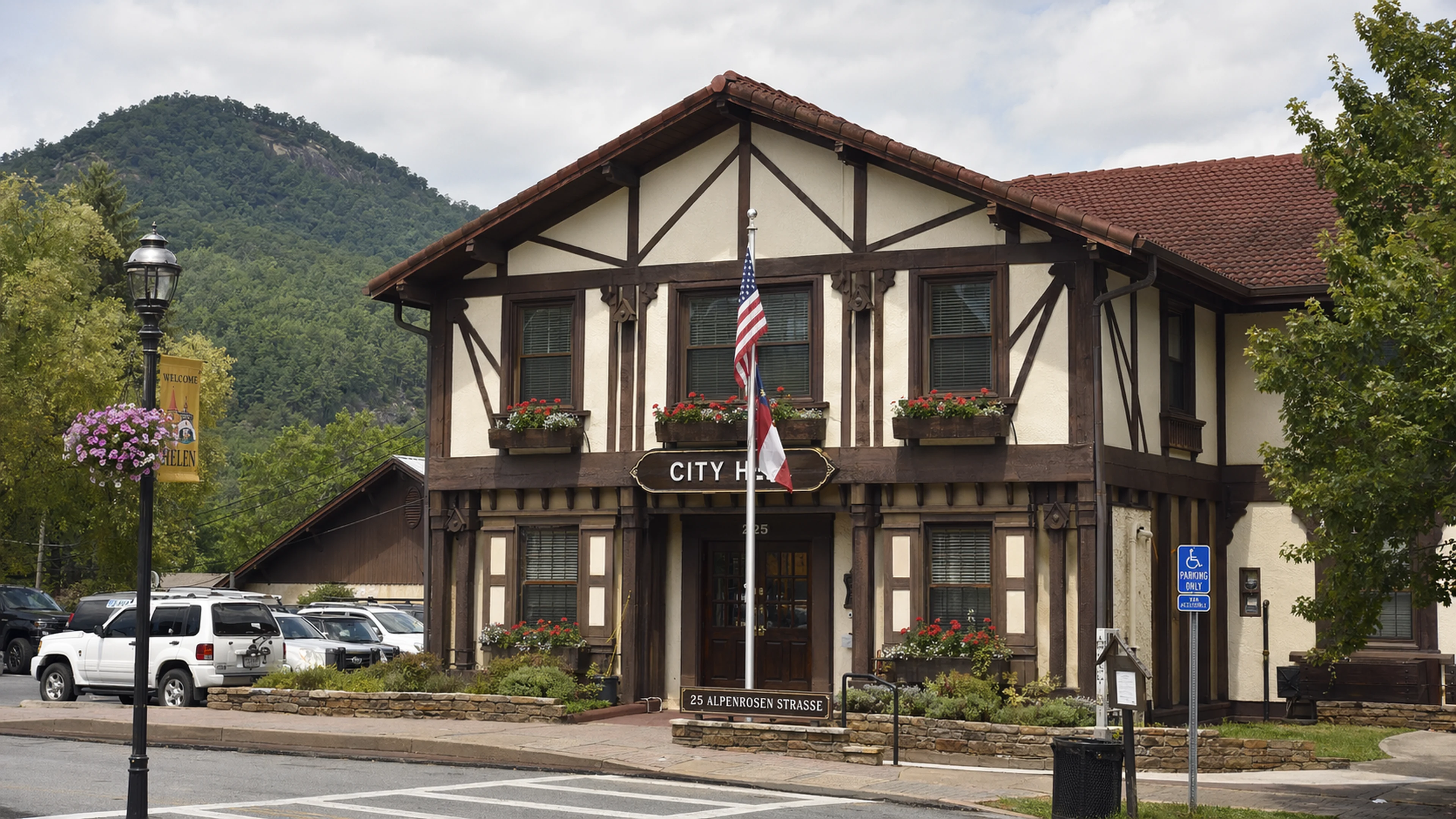
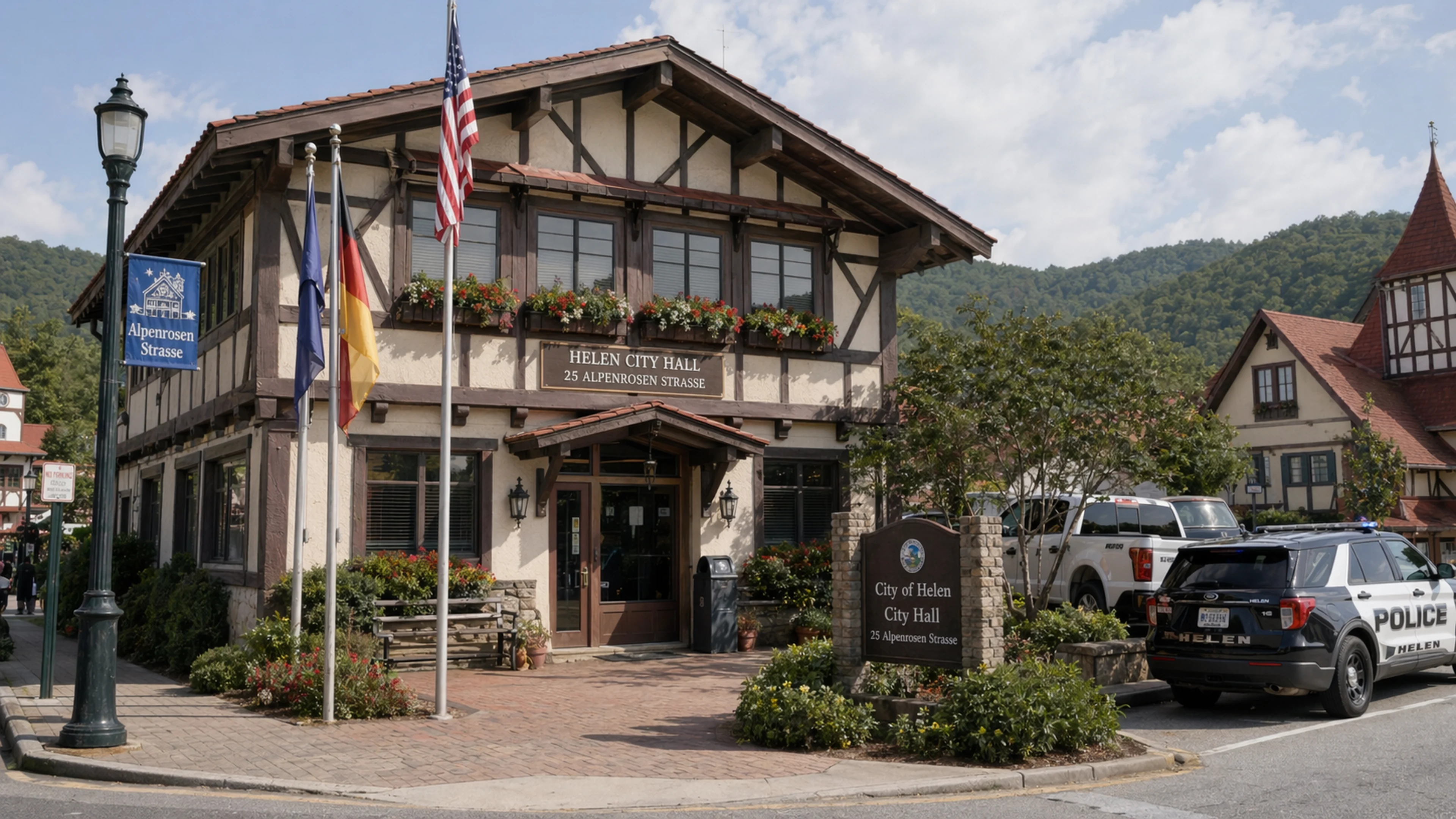
The April 21 meeting is scheduled for 2 p.m. at Helen City Hall, 25 Alpenrosen Strasse. The agenda's final line, as on every agenda prepared by Chastain, reads: "Adjournment." It does not estimate when adjournment will occur. Given the seven words allocated to Item G, it may not need to.

Reader Comments
Leave a comment ↓