


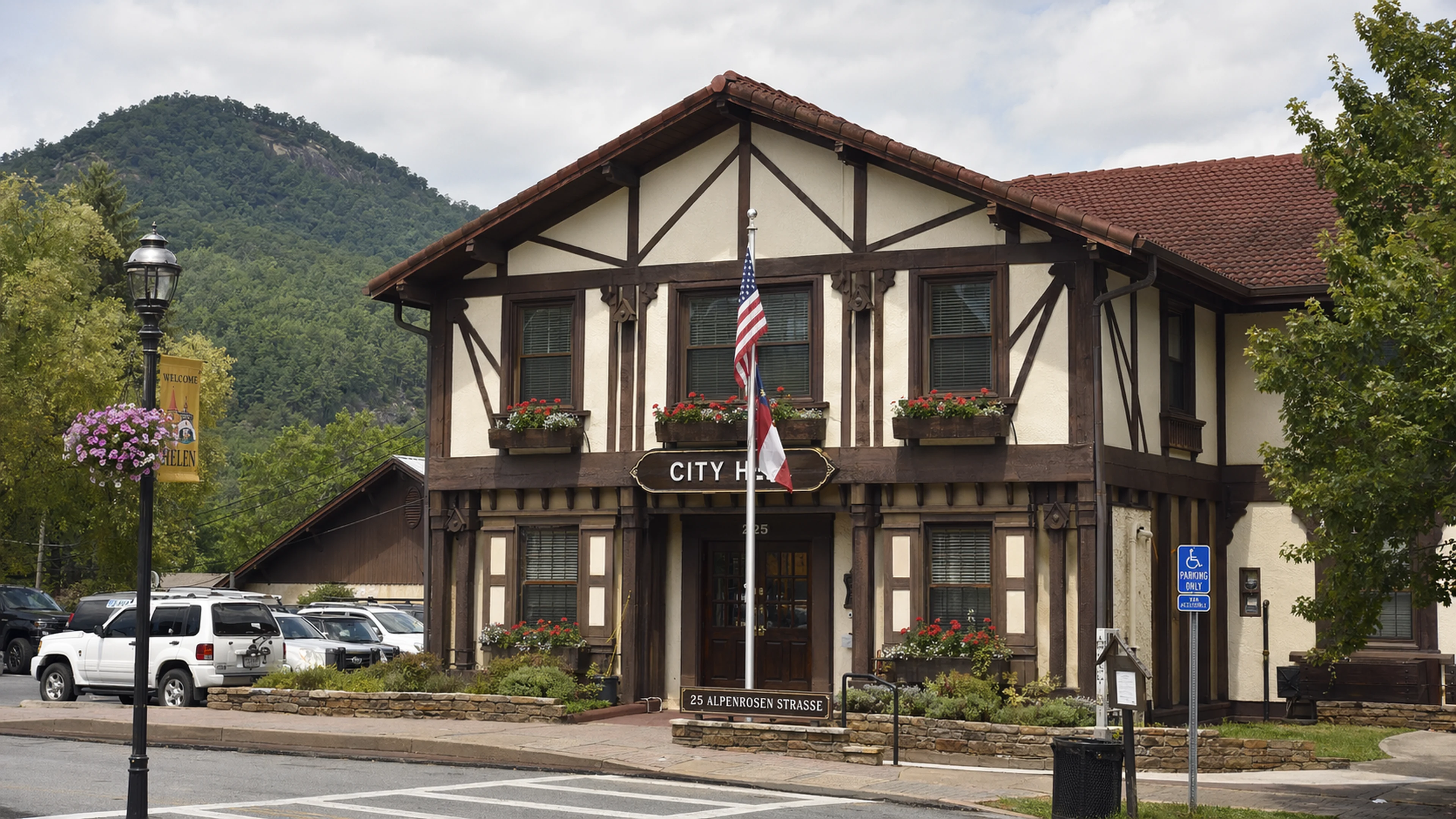
The City of Helen switched its employee health insurance from Cigna to Blue Cross Blue Shield Anthem effective January 1, 2026, securing a 34 percent reduction in annual premiums. The switch was not the product of a competitive procurement process, a benefits consultant's recommendation, or a commission subcommittee review. It was the product of Cigna leaving. City Manager Darrell Westmoreland confirmed the carrier change at the December 16, 2025 Commission meeting, held at Helen City Hall, 25 Alpenrosen Strasse, noting that Cigna "is no longer being offered to small businesses." The minutes were respectfully prepared by City Clerk Marilyn M. Chastain.
A 34 percent premium reduction for a municipality with fewer than 700 residents and an estimated 28 to 35 full-time employees represents, depending on prior per-employee contribution rates in the Cigna group plan, somewhere between $30,000 and $80,000 in annualized savings. The figure is large enough to fund, for example, 1.3 monitoring well replacement contracts at the Sailors Engineering Associates bid price of $6,611, or roughly four years of German band performances at the Bandshell at Don Ostosky's contracted rate of $800 per week. It is small enough that it received approximately 40 words in the December 16, 2025 minutes, wedged between discussion of a 3 percent cost-of-living adjustment for city employees and the second reading of Ordinance 25-11-01, which raised the City Manager's unilateral contracting authority to $25,000.
The minutes do not record any commissioner asking a follow-up question about the switch. No motion was required. No vote was taken. The city's insurer of record simply ceased to exist as an option, and its replacement arrived 34 percent cheaper, in the manner of a tenant who moves out in the night and is replaced by someone willing to pay less rent for the same apartment. Finance Director Mona Wood, who oversees the city's benefit expenditures, is listed on the December 16 agenda under routine financial reporting but is not quoted in the minutes on the insurance matter.
Cigna's retreat from the small-group market — generally defined as employers with two to 50 employees, the bracket into which Helen's municipal workforce falls — is not a Helen-specific event. The Cigna Group, following its $67 billion merger with Express Scripts in 2018 and subsequent corporate restructuring under the parent entity now branded as The Cigna Group, began shedding small-group health plans across multiple states in 2024 and 2025. Georgia was among the affected markets. The withdrawal left municipalities, volunteer fire departments, and small businesses across the state scrambling for replacement coverage during open enrollment windows that, in many cases, lasted fewer than 45 days. Helen's window is not specified in the minutes, but Westmoreland's December 16 announcement — 16 days before the January 1 effective date — suggests the timeline was not generous.
Dr. Wilhelm Brüning, a former senior fellow at the Bavarian State Institute for Regional Cultural Geography and a frequent commentator on Alpine-themed municipal governance, characterized the switch as "procurement by subtraction." Reached by telephone, Brüning noted that Helen's situation represents "possibly the only documented case in which a city's annual health insurance cost fell by a third because the vendor fired the client." He added that the 34 percent figure, if applied retroactively to prior fiscal years, "raises the question of what the city was paying before, and for how long, and whether anyone ran a comparison while Cigna was still willing to cash the checks."
The December 16 minutes do not include a line-item breakdown of the prior Cigna premium. They do not include the new Blue Cross Blue Shield Anthem per-employee rate. They do not specify whether the plan is an HMO, PPO, or high-deductible health plan, or whether dental and vision coverage transferred with the switch. The only quantified detail is the 34 percent figure itself, offered without a base number from which to calculate the absolute savings — a construction not unlike reporting that a building is 34 percent less on fire than it was previously without specifying the original scope of the blaze.
Blue Cross Blue Shield Anthem, marketed in Georgia under the Anthem Blue Cross and Blue Shield brand, is the state's dominant small-group carrier. Following Cigna's withdrawal and similar contractions by Aetna in rural Georgia markets, Anthem's small-group enrollment in northeast Georgia increased by what one industry observer who declined to be named described as "a lot, and not because they did anything." The observer, who claimed familiarity with the White County insurance market, noted that Helen's switch was "not a negotiation" but "a gravity event," adding that "when there are two carriers and one leaves, the other one doesn't have to be 34 percent cheaper. They just were."
The 3 percent COLA approved at the same December 16 meeting — chosen over a proposed 7 percent increase and benchmarked against Social Security's 2.8 percent COLA for 2026 — compounds with the insurance savings in ways the minutes do not explore. An employee receiving a 3 percent raise and a 34 percent reduction in insurance premium contribution, assuming the city passes any portion of the savings through to employee cost-sharing, would experience an effective compensation increase well above the headline COLA figure. Whether the city adjusted employee premium contributions is not addressed in the December 16, January 20, March 17, or April 21, 2026 minutes reviewed by this publication.
The last time Helen changed health insurance carriers prior to the 2026 switch is not specified in the minutes archive. Walker, Pierce & Tuck, CPAs, PC, the city's auditor of record, would reflect benefit expenditure changes in the annual financial statements, but the most recent completed audit on file covers fiscal year 2022, when Cigna was still operational in the small-group market and, presumably, still willing to insure the employees of Georgia's third-largest tourist destination. The FY2023, FY2024, and FY2025 audits, when filed, will contain the before-and-after. Until then, the 34 percent figure floats in the minutes unmoored from a numerator or a denominator — a savings expressed as a fraction of a number the public record does not contain, approved in a process that required no approval, resulting from a decision made not by the City of Helen but by a $190 billion health services conglomerate headquartered 574 miles away in Bloomfield, Connecticut.
Gunter the Pretzel Vendor, who operates near the Festhalle and carries his own individual-market health plan, said he was "not surprised" by the savings figure. "Thirty-four percent is what I save when I buy salt in bulk from the Costco in Dawsonville instead of the IGA," he said. "But I still had to drive to Dawsonville. Helen did not have to drive anywhere. The savings came to them." He paused. "That has never happened to me."



Reader Comments
Leave a comment ↓