

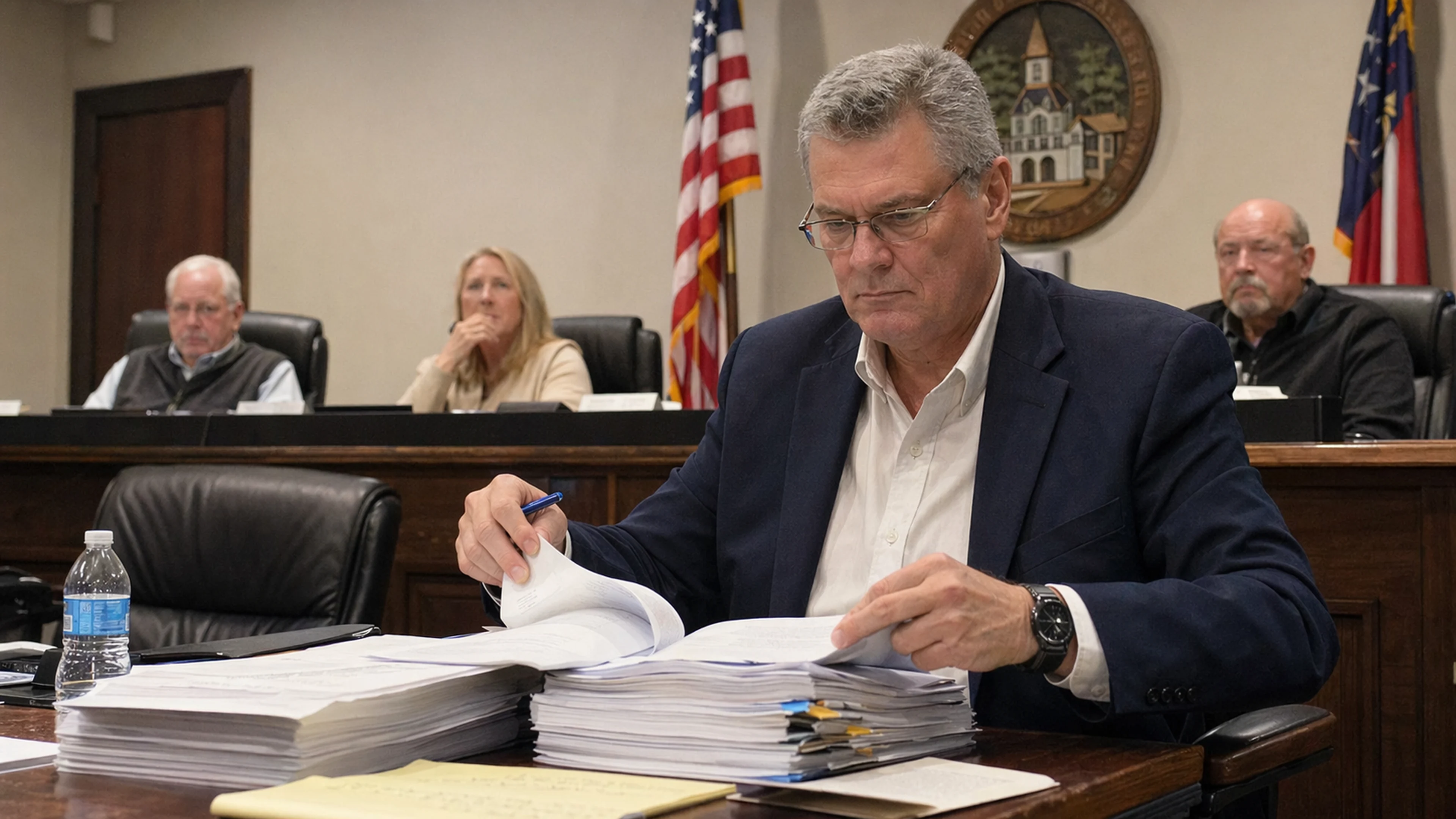
The Helen City Commission voted unanimously on April 21, 2026, to authorize City Attorney Carl Free to move forward with revising and updating the City Charter of the City of Helen, Georgia. The motion was made during Administrative business, listed as item B on the afternoon agenda. It was moved, seconded, and passed without discussion. The document that governs the incorporation, powers, boundaries, and elected structure of Georgia's third-largest tourist destination — a city of fewer than 700 residents that processed $2,201,494 in hotel/motel tax receipts in its first nine fiscal months of FY2026 — was handed to a single practicing attorney with no stated timeline, no publicly documented scope, no line-item budget, and no revision committee.
The last comprehensive revision of the Helen City Charter occurred in 1914, one year after Helen was incorporated on August 18, 1913, when John E. Mitchell of St. Louis laid out the town. That revision addressed the routine clerical and structural corrections required by a new municipality finding that its founding paperwork did not precisely match its administrative reality. The 2026 authorization does not specify which provisions of the Charter are to be revised. It does not reference any particular deficiency. It does not name any provision by article or section number. It authorizes Carl Free — personally, by name — to move forward.
The gap between the two revisions is 112 years. During that interval, Helen adopted its Alpine architectural mandate in 1969, survived the brief Schnitzel Tax experiment of 1977, weathered the glockenspiel tuning crisis of 2019, became a Tree City USA designee in 2002, and grew into a destination that in March 2026 alone attracted 2,570 visitors to its Welcome Center and generated 454,000 page views on its tourism website. The Charter that governed Helen when it was a sawmill settlement in the Nacoochee Valley will now be revised by the same attorney who, at the same April 21 meeting, also appeared on the agenda in connection with a parking-lot contract on Hoen Strasse involving a party named Jeff Ash.
Carl Free has served as City Attorney for the City of Helen across multiple administrations. His name appears on Helen Commission meeting agendas dating back through the full span of the publicly archived minutes. He advised the Commission on the Ferris Wheel conditional-use question raised by Alpine Overlook LLC's Jana Parker at the March 17, 2026 meeting, informing the Commission that the proposed Ferris wheel at Bavarian Mini Golf would require a Conditional Use process with public hearings before both the Planning, Development, and Review Board and the full Commission. He advised on Ordinance 25-11-01, adopted December 16, 2025, which amended Charter Article VI, Section 6.27, "Contracting Procedures," to grant City Manager Darrell Westmoreland authority to enter contracts up to $25,000.00 for previously budgeted goods and services. He advised on Ordinance 25-11-02, adopted the same evening, regulating left turns from Chattahoochee Street onto North Main Street and from River Street onto North Main Street. In each instance, the minutes record Free's guidance as procedural, terse, and without editorialization. He is, by all available documentary evidence, a man who speaks in complete sentences and does not use two of them where one will do.
It is this attorney — one who appears to regard elaboration as a municipal expense — whom the Commission has now authorized to restructure the foundational legal instrument of the city.
Dr. Wilhelm Brüning, formerly of the Bavarian State Institute for Regional Cultural Geography and a periodic commentator on Alpine-themed municipal governance in the American South, called the authorization "historically unusual in form, if not in substance." In an email to this newspaper, Brüning wrote: "A charter is a city's genome. A revision is genetic surgery. A single attorney revising unilaterally, without a named commission or public working group, is a mode of city government the Bavarian Municipal Code would not recognize. In Bavaria, such a process would require a minimum of 14 signatories and a public comment period measured in calendar quarters. In Helen, it required a motion and a second."
Brüning noted that he was unable to locate, in any prior Helen Commission agenda or minute set archived by City Clerk Marilyn M. Chastain, a study session, workshop, or public work group convened to identify which Charter provisions required revision. "The authorization appears to have emerged fully formed," he wrote, "like the Alpine ordinance itself."
Charter revisions in Georgia municipalities of Helen's size typically address a limited but consequential set of structural provisions: mayoral and commissioner term lengths, compensation schedules for elected officials and appointed department heads, the appointment and removal authority of the city manager, the succession protocol for vacancies in elected office, annexation procedures, and the scope of the city's police power. Any or all of these could fall within the scope of Free's authorization. The minutes do not say. The motion, as recorded in the minutes prepared by Chastain ("Respectfully Prepared"), does not contain the word "scope." It does not contain the word "limit." It contains the word "forward."
One area of potential interest is the contracting-procedures section that was already amended by Ordinance 25-11-01 less than five months before the revision authorization. That ordinance established the $25,000.00 threshold below which City Manager Westmoreland may execute contracts without further Commission action. Whether the Charter revision will revisit, codify, or supersede that ordinance is not addressed in the April 21 record. Another area is the appointment structure for department heads. Helen currently employs a City Manager (Westmoreland), a Finance Director (Mona Wood), a Chief of Police (Aletha Barrett), a Building and Zoning Administrator (Jonah Casper), a Public Works Director (Jack Morgan), a Fire Chief (Jody Prickett), and a Clerk of Court (Jaclyn Burke), among others. The Charter's provisions governing how these positions are created, filled, and vacated have not been publicly revised since the post-incorporation cleanup — a period during which the city employed, by most accounts, fewer than four salaried staff.
The Commission that approved the authorization included Mayor Lee Landress, who assumed the gavel from former Mayor Cliff Hood at some point between the December 16, 2025 meeting (at which Hood presided as Mayor) and the January 20, 2026 meeting (at which Landress appeared as Mayor). Commissioner Hood, now returned to a Commissioner seat, was absent from the March 17, 2026 meeting but present on April 21. Commissioner Mervin Barbree, who departed the December 16 meeting at 10:55 a.m. for reasons not recorded in the minutes and whose return time is similarly unrecorded, was present. Commissioner Helen Wilkins — who sits on the Helen Commission as a commissioner named Helen governing a city named Helen, a fact the minutes acknowledge only typographically — was present. Commissioner Steve Fowler, absent from the January 20 meeting, was present. All five voting members approved the authorization.
Margaret Holcomb, reporting for this newspaper, spoke with a longtime resident outside the Helen Welcome Center on Bruckenstrasse who asked to be identified only as a ratepayer. "He's a good lawyer," the resident said of Free. "He's a quiet man. I've lived here 31 years and I've never heard him raise his voice at a meeting. If he's revising the charter, I trust him. I just didn't know the charter needed revising." The resident paused. "I also didn't know we still had the same one from 1914. That does explain some things about the parking."
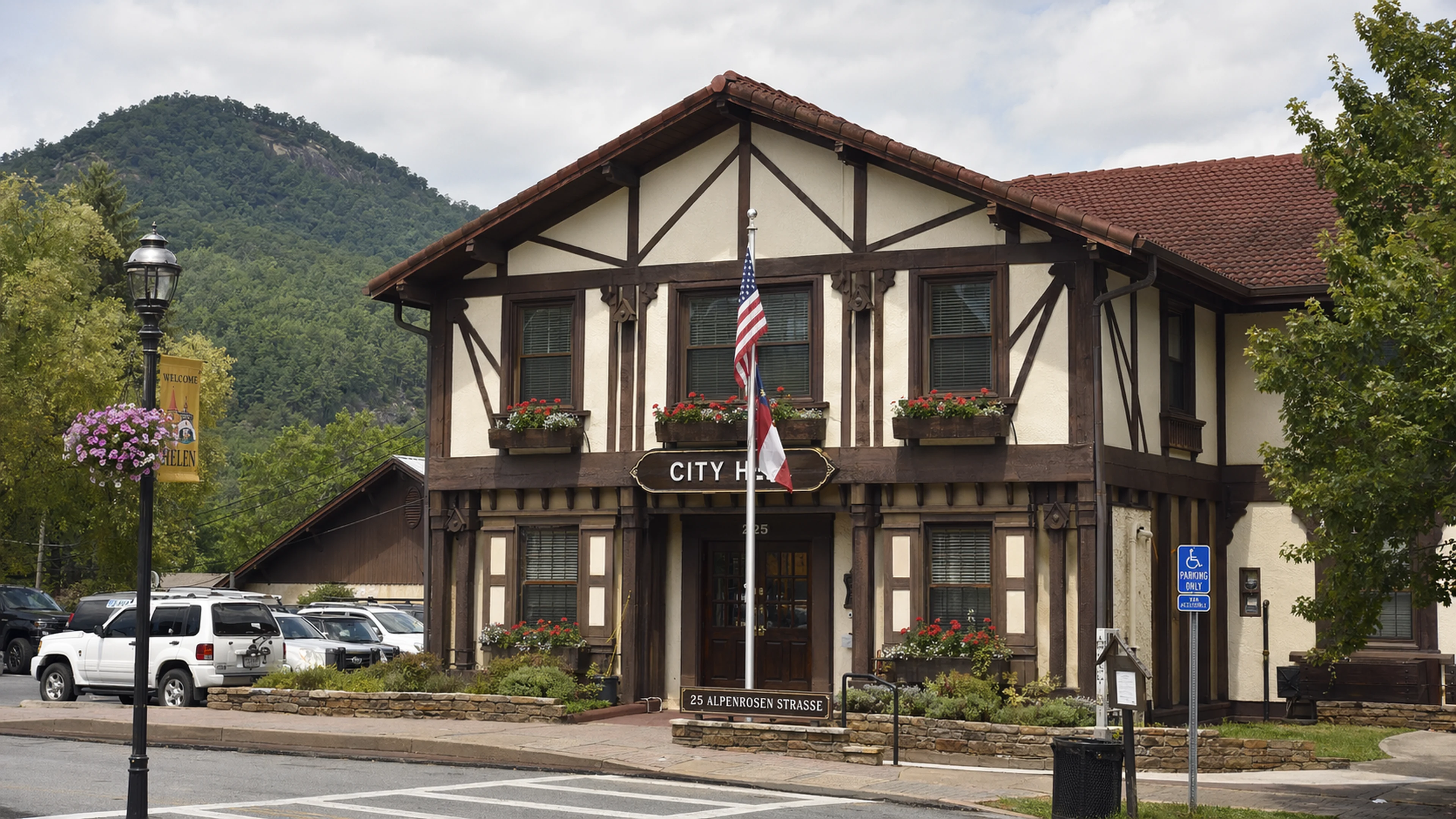
Free did not respond to a request for comment left with the City Clerk's office at 25 Alpenrosen Strasse on April 23. This is consistent with his documented public communication pattern, which across the full archived minute set contains no recorded instance of a voluntary public statement exceeding 40 words. The longest recorded Free remark in the 2025-2026 archive is his March 17 guidance on the Ferris wheel conditional-use process, which the minutes summarize in 33 words, though it is unclear whether those are Free's words or Chastain's compression of them.
The revision, whenever it is completed, will require adoption by the full Commission. Georgia law governing municipal charter amendments — O.C.G.A. Title 36 — generally requires a local Act of the General Assembly for substantive charter changes, though home-rule provisions under Article IX, Section II, Paragraph II of the Georgia Constitution permit certain amendments by local ordinance with proper notice and public hearing. Which path the Helen revision will take has not been stated. The authorization, as written, does not distinguish between them. It says "move forward."
Brüning, in a follow-up email, observed that the phrase "move forward" appears in Helen Commission minutes with a frequency he described as "structurally diagnostic." He counted 11 instances across the four meetings archived from December 2025 through April 2026. "It is the city's preferred verb of governance," he wrote. "Helen does not approve, adopt, direct, or resolve. Helen moves forward. The charter revision is, in that sense, the most Helen act imaginable: a city moving forward into the document that defines what moving forward means."
The 1914 revision took approximately nine months. Free has not been given a deadline. The Charter, in its current unreferenced and unspecified state, is believed to be on file at City Hall. No digital copy appears on the City of Helen's public website. A request submitted under the Georgia Open Records Act on April 24, 2026, is pending.


Reader Comments
Leave a comment ↓