

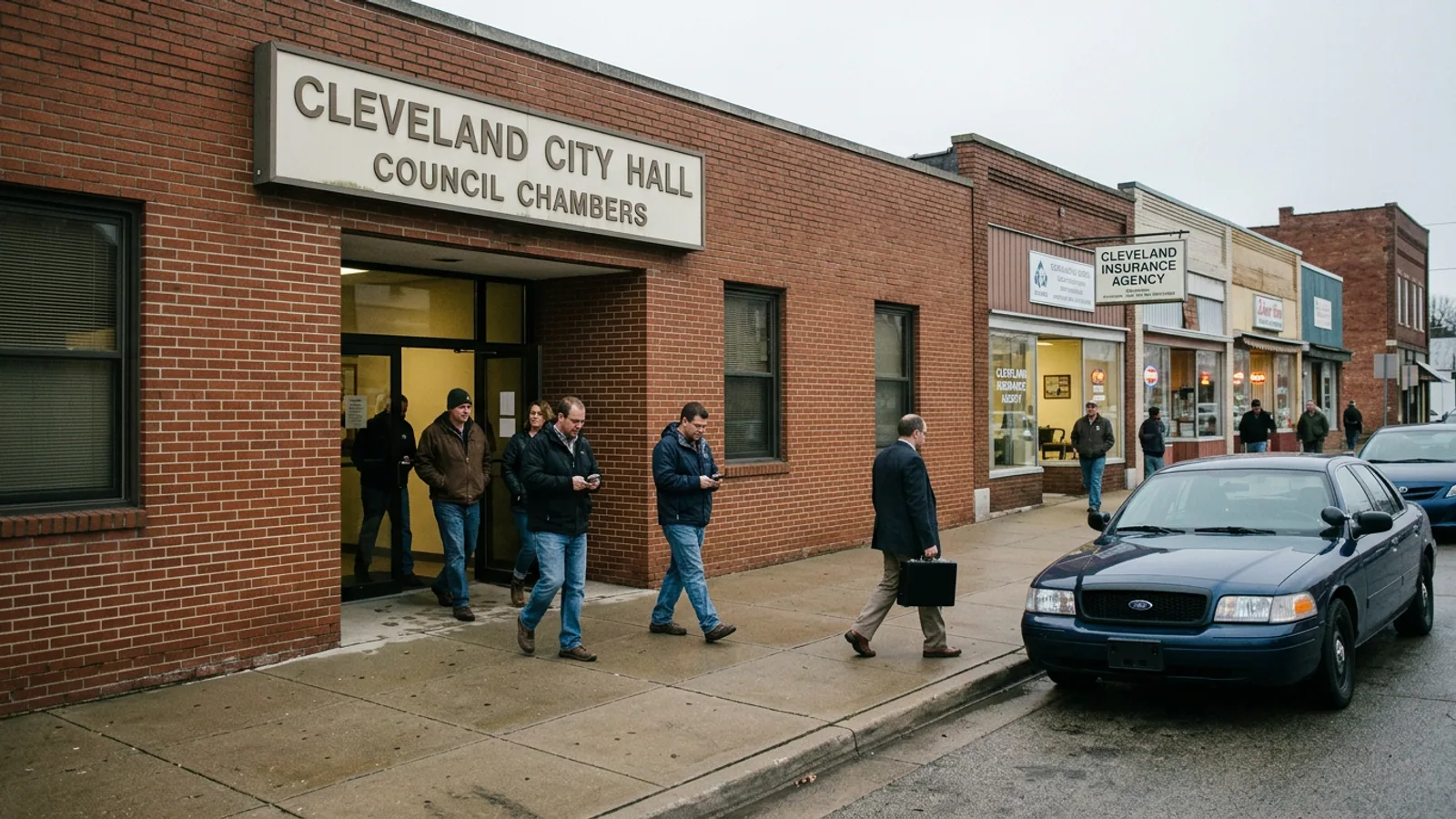
The vote took twenty-six seconds.
At 8:47 p.m. Tuesday, in the regular session of the Cleveland City Council — nine items deep into a thirty-one-item agenda, immediately following the unanimous reauthorization of the city’s standing contract with its sole approved street-sweeping vendor and immediately preceding a discussion of revisions to the dog-park signage policy — the Council voted six to one to adjust the city’s 2026 millage rate from the previously published rate of 8.4380 mils to a revised rate of 8.4522 mils. Mayor Pro Tem Davidson dissented. The vote was not, per the certified minutes, accompanied by any discussion.
The change works out to an increase of 0.0142 mils.
For a household occupying a property assessed at $250,000, the change works out to an additional $1.42 in annual property tax. For the city’s aggregate property-tax base, the change works out to an additional approximately $43,800 in annual general-fund receipts.
Nobody, in the period between the gavel and the close of the meeting at 11:14 p.m., noticed.
The Cleveland City Council’s standing public-notice policy required the millage adjustment to be advertised in the Cleveland Times-Courier, the city’s legal organ of record, three times in the thirty days preceding the vote. The Council, per the agenda packet, had complied with this requirement. The advertisements ran in the Times-Courier on March 11, March 18, and March 25.
Each advertisement was 1.4 column inches in size and was placed, in each of the three weeks, on page B-7 of the paper, immediately below a half-page advertisement for a Cornelia-based heating-and-air-conditioning contractor.
We are reporting on the millage adjustment for two reasons. The first is that, in the Bavarian Brainrot newsroom’s view, the routine adjustment of a municipal millage rate is, in the most literal possible sense, the operating mechanism of self-government in this country. It is, in the strictest civic-architecture sense, what city councils are for. The second is that nobody else, as best we can tell, is going to.
The Mechanics Of A Millage Adjustment
A millage rate, for readers who have not previously had occasion to think about one, is the rate at which a Georgia local government taxes the assessed value of real property within its jurisdiction. The rate is expressed in mils — one mil being one one-thousandth of one dollar of tax per one dollar of assessed value. The 8.4380-mil rate previously in effect for the City of Cleveland’s 2026 fiscal year worked out to approximately $8.44 in city tax per $1,000 of assessed value, or $844 in annual city tax for a property assessed at $100,000.
The 8.4522-mil rate that took effect at 8:47 p.m. Tuesday works out to approximately $8.45 per $1,000.
The 0.0142-mil increase is, by the historical record of Cleveland-area millage adjustments, the smallest single-vote millage adjustment in the city’s adopted-budget cycle since at least 1998 — the year in which the Georgia Department of Revenue began publishing its now-canonical White County millage-rate history. The previous record-low single adjustment, recorded in 2014, was 0.0186 mils. The 1998-to-present median single adjustment has been 0.31 mils.
What this means, in practice, is that Tuesday’s vote was not a dramatic one. In the most literal possible quantitative sense, it was the least dramatic single millage adjustment in the city’s recorded history.
It is precisely for this reason that we are interested in it.
What Item 9(d) Of The Agenda Said
Item 9(d) of the April 8 agenda packet (page 17 of 47) read in full as follows:
9(d). Adjustment, City of Cleveland 2026 millage rate, from previously published 8.4380 mils to revised 8.4522 mils, per FY2026 Adopted Budget Resolution line item 4.7 (final reconciliation of pre-roll-back state-equalization adjustment).
Action requested: Approve.
The 0.0142-mil increase is, per the agenda packet’s page 18 staff memorandum, the consequence of a state-level reconciliation adjustment that the Georgia Department of Revenue applied, in late February, to the city’s previously certified property-tax digest. The reconciliation — which the Department applies, in the routine course of its administration of the property-tax-equalization formula, to all 159 Georgia counties’ incorporated municipalities each spring — is, per the staff memorandum, “a technical compliance matter not properly subject to local discretion.”
The Council, the staff memorandum continued, “must adopt the reconciled rate by formal resolution prior to the publication of the city’s 2026 tax bills.” The 2026 tax bills are scheduled, per the City Treasurer’s office, to be mailed to property owners on or about May 18.
The Council, per the certified minutes, complied with the staff recommendation.
What Mayor Pro Tem Davidson Said
Mayor Pro Tem Donna Davidson — the Council’s Ward 3 representative since 2018 — was the sole dissenting vote on item 9(d). She did not, per the certified minutes, offer any explanation of her dissent at the time of the vote. She did not, per the agenda packet, request that any explanation be added to the post-vote record.
The Bavarian Brainrot newsroom contacted Mayor Pro Tem Davidson by telephone Wednesday morning at the office of the small-animal veterinary practice she operates on Main Street in downtown Cleveland. She was, at the time of our call, between appointments. She gave us four minutes.
Asked the reason for her dissent, the Mayor Pro Tem responded as follows:
“I vote no on every millage-rate adjustment. I have voted no on every millage-rate adjustment for seven and a half years. I voted no in 2018, in 2019, in 2020 — we did three of them in 2020 because of the federal-relief reconciliations — in 2021, in 2022, in 2023, in 2024, in 2025, and now twice in 2026 because we have to do the spring one and the fall one. I will vote no on the fall one too.”
Asked whether her dissent reflected a substantive objection to the underlying state-equalization-formula reconciliation that produced the 0.0142-mil change, the Mayor Pro Tem responded:
“I do not know what that is.”
Asked whether her dissent reflected a more general objection to the operation of the property-tax system as such, she responded:
“I think the property-tax system is fine.”
She declined further comment, citing the arrival of her 11:00 a.m. appointment, a Persian cat named “Marvin.”
What The Other Six Council Members Said
Bavarian Brainrot contacted, by telephone, each of the other six members of the Cleveland City Council in the twenty-four hours following the vote. Five of the six did not return our calls by press time. The sixth, Council Member Pendergrass (Ward 1, no relation to our outdoors correspondent), returned our call Wednesday evening at 6:14 p.m. and gave us approximately ninety seconds.
Asked his rationale for the affirmative vote, Council Member Pendergrass responded:
“The staff memo said we had to.”
We thanked him for his time.
What The 0.0142 Mils Will, In Aggregate, Pay For
The $43,800 in incremental annual general-fund revenue produced by the millage adjustment is, per the FY2026 Adopted Budget Resolution’s line-item allocation, allocated as follows:
- $14,200 to the city’s standing public-works pothole-repair line, raising the line’s total annual appropriation to $158,400.
- $11,800 to the city’s standing parks-and-recreation operating budget, primarily covering the contracted maintenance of the Cleveland Town Square fountain.
- $9,400 to the city’s standing animal-control budget, primarily covering staffing of the city’s contracted small-mammal-relocation service.
- $8,400 to the city’s standing general-administration overhead pool, distributed at the City Manager’s discretion across approximately fourteen line items.
The $14,200 marginal increase in the pothole-repair line is sufficient, per the public-works director’s March 12 memorandum to the Council (agenda packet page 23), to fund the patching of approximately 71 additional linear feet of road surface during the FY2026 cycle.
The City of Cleveland has, per the public-works director’s standing inventory, approximately 41,000 linear feet of road surface presently rated as “moderate-or-worse” on the city’s pavement-condition index.
A Note On Why We Are Filing This
The Bavarian Brainrot newsroom is reporting on Tuesday night’s 0.0142-mil adjustment of the Cleveland city millage rate not because the adjustment is, in any conventional news sense, important. It is, on every quantitative measure available, the smallest possible event the City Council could have voted on Tuesday night.
We are reporting on it because the most consequential set of decisions any local government makes — the decisions that determine, with mathematical precision, how much each individual property owner will pay each year for the operation of their city — are routinely made in twenty-six-second votes nine items deep into thirty-one-item agendas after public comment has ended.
We have read the agenda. We have read the staff memorandum. We have read the certified minutes. We have called the Council. We have called the Mayor Pro Tem. We have linked, at the top of this article, every primary-source document we consulted in the preparation of this story.
The next regular meeting of the Cleveland City Council is scheduled for May 13, 2026 at 7:00 p.m. in the City Hall meeting chamber. The agenda will be posted seventy-two hours in advance, at the City of Cleveland website link above.
The Bavarian Brainrot newsroom will be there.
— Margaret Holcomb

Reader Comments
Leave a comment ↓