
The Habersham County Board of Commissioners on Monday night unanimously reaffirmed the county’s standing $4.50-per-quarter residential stormwater-management fee — a routine procedural action that, per the county’s standing fee-reauthorization rule, the Board has taken without dissent in each of the seventeen years the fee has been in effect.
What was not routine was the public-comment period that preceded the vote.
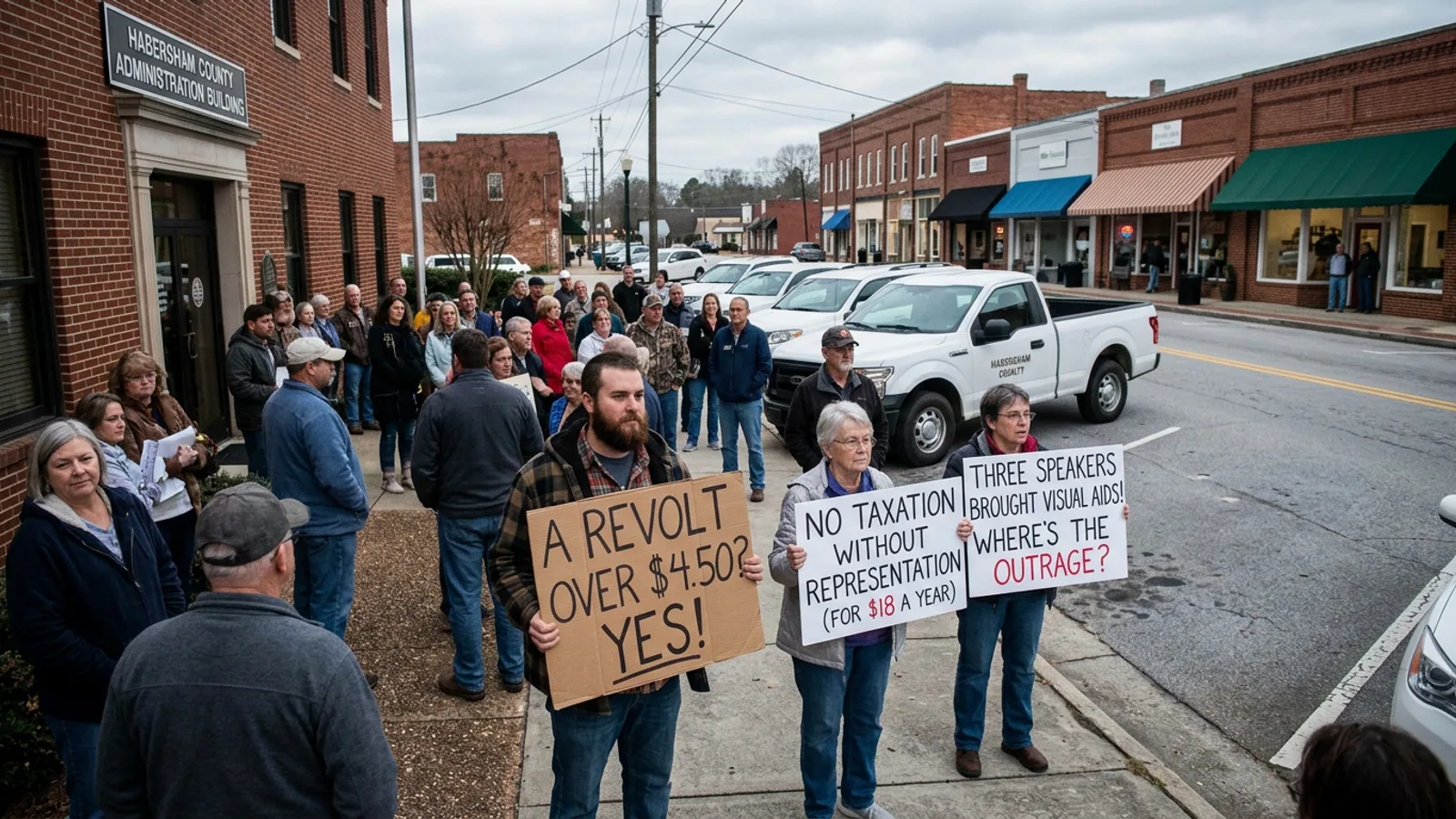
Seven Habersham County residents — four from Cornelia, two from Demorest, and one who declined to identify her town of residence beyond the phrase “a little ways out toward the lake” — addressed the Commissioners during the agenda’s standing public-comment slot. Three of the seven brought visual aids. Two of the seven characterized their appearance, in the opening sentence of their remarks, as a “revolt.”
By the standing length-limit rules, each speaker was permitted three minutes. Each speaker exhausted the entirety of the three minutes. The county chair, at the conclusion of the seventh speaker’s remarks, called the question. The vote was unanimous in the affirmative. The fee was reaffirmed.
It is, per the county’s certified minutes, the most contested public-comment period the Board has presided over since the 2017 leash-law debate.
The Bavarian Brainrot newsroom attended the Monday-night meeting in person. What follows is our reconstruction of the public-comment period, drawn from the certified minutes (linked above), from the county’s archived audio (also linked), and from the contemporaneous notes of the reporter.
What The Fee Is
The Habersham County stormwater-management fee, established by the Board’s 2009 stormwater-management ordinance and continuously in effect since the second quarter of the county’s 2009 fiscal year, applies to every Habersham County residential utility customer at the rate of $4.50 per quarter. The fee appears, on the standard Habersham County Utility Department quarterly bill, as a separate line item directly below the standing solid-waste-collection charge.
The fee’s annualized burden, per residential customer, is $18.00.
The fee’s aggregate annual revenue, per the FY2025 Stormwater Management Utility Annual Report (linked above), is $337,920.
The annual revenue funds the operation of the county’s standing stormwater-infrastructure-maintenance program, which is responsible for the periodic inspection, cleaning, and — where required — replacement of the county’s approximately 2,140 catch basins, 41 stormwater-detention ponds, and 18 miles of stormwater conveyance piping.
It is, per any reasonable cost-of-civic-infrastructure benchmark, an inexpensive fee.
What The Speakers Said
Speaker 1 (Cornelia, retired insurance underwriter, age approximately 71) opened her remarks by holding up a single Cornelia Utility Department quarterly bill and reading the stormwater-fee line item aloud. She then read the line item aloud a second time, more slowly. She characterized the fee, in the third minute of her remarks, as “taxation by inserted line item.” She declined to elaborate on the precise inserted-line-item theory beyond noting that, in her view, “most of us pay this without noticing it, and the county knows that.”
Speaker 2 (Demorest, currently employed in residential roofing, age approximately 44) brought as a visual aid a poster-board print of the Habersham County FY2025 Stormwater Management Utility Annual Report’s page 12 expenditure-summary table. He pointed at the line item labeled “Contracted Catch-Basin Cleaning, Q3 2025” ($41,200 in expenditures) and asked the Commissioners whether they were satisfied that the cleaning had, in fact, been performed. The county chair indicated that the cleaning had been performed. Speaker 2 indicated that he was, on the basis of his own observations of the catch basins on his street, not so satisfied. He provided no further detail.
Speaker 3 (Cornelia, currently retired, age approximately 68) was the first of the two speakers to characterize the appearance as a “revolt.” He used the word four times in his three-minute address. He did not specify what action the proposed revolt would entail beyond the speaking of the assembled at public comment, which he characterized as “a first step.”
Speaker 4 (Demorest, currently a substitute teacher, age approximately 52) brought as a visual aid a hand-drawn diagram, on a single sheet of typing paper, depicting what she described as the path of stormwater runoff from her residence on Wahsega Drive to the nearest catch basin. The diagram was, by Bavarian Brainrot’s observation from the press table, an artistically competent rendering. She used the diagram to argue that her own residence’s stormwater contribution to the county system was “negligible” and that her assessment of the $4.50 quarterly fee was therefore, in her view, “disproportionate.” She conceded, on examination by Commissioner Holdsworth, that she had not previously raised this concern in writing with the county Stormwater Management office.
Speaker 5 (Cornelia, currently employed in regional logistics, age approximately 39) was the second speaker to characterize the appearance as a “revolt.” He used the word twice. He further characterized the assembled Commissioners as, in his view, “unaccountable to the customer base” — a characterization the chair noted, in his subsequent remarks, was technically inaccurate insofar as the Board is, in fact, popularly elected on the standard Habersham County election cycle.
Speaker 6 (Cornelia, currently a small-business owner of a downtown framing-and-art-supply store, age approximately 47) brought as a visual aid an enlarged 8½-by-11 print of the City of Cornelia’s January 2026 standard quarterly utility bill insert (linked above), specifically the bottom-right corner where the stormwater-fee line item appears. He held the print up for the duration of his three-minute address. He did not, in the address, refer to the print or speak about it directly. He did not explain its purpose.
Speaker 7 (no town of residence given, currently described as “retired,” age not specified but visually estimated at approximately 60) gave the meeting’s most measured remarks. She acknowledged that the fee was, in dollar terms, modest. She acknowledged that the county’s stormwater system required maintenance. She characterized her objection to the fee as “not really about the fee, but about the principle.” She did not specify the principle. She thanked the Commissioners for their service and yielded the remainder of her time.
How The Commissioners Responded
The county chair, at the close of the seventh speaker’s remarks, thanked all seven speakers for their attendance and their input. He noted that the staff recommendation to reaffirm the standing $4.50 quarterly fee was, per the FY2025 Stormwater Management Utility Annual Report’s page 31 fee-adequacy analysis, supported by the county’s standing stormwater-infrastructure-maintenance cost projections through FY2030. He moved the question.
The reaffirmation passed unanimously, five to zero.
The Habersham County stormwater-management fee will, accordingly, remain at $4.50 per quarter through at least the second quarter of the county’s 2027 fiscal year, when the standing fee-reauthorization rule will require the Board to take the matter up again.
Now Habersham’s Coverage
The Cornelia-based local-news outlet Now Habersham, which has covered the Habersham County BOC since the outlet’s 2014 founding and which represents, in our view, the gold standard of regional coverage in this part of the state, ran a 740-word advance piece on the proposed reaffirmation on March 14 (linked above). That piece, by reporter Margie Williamson, identified the Monday-night reaffirmation as a “routine procedural action”.
Now Habersham’s subsequent coverage of the Monday-night meeting, posted to the outlet’s website at 11:47 p.m. Monday, ran to 410 words and characterized the public-comment period as having been “unusually well-attended.”
The Bavarian Brainrot newsroom commends our colleagues at Now Habersham for their continuous coverage of the Habersham County BOC, and refers any reader interested in additional context on the meeting to that coverage.
— Margaret Holcomb


Reader Comments
Leave a comment ↓