

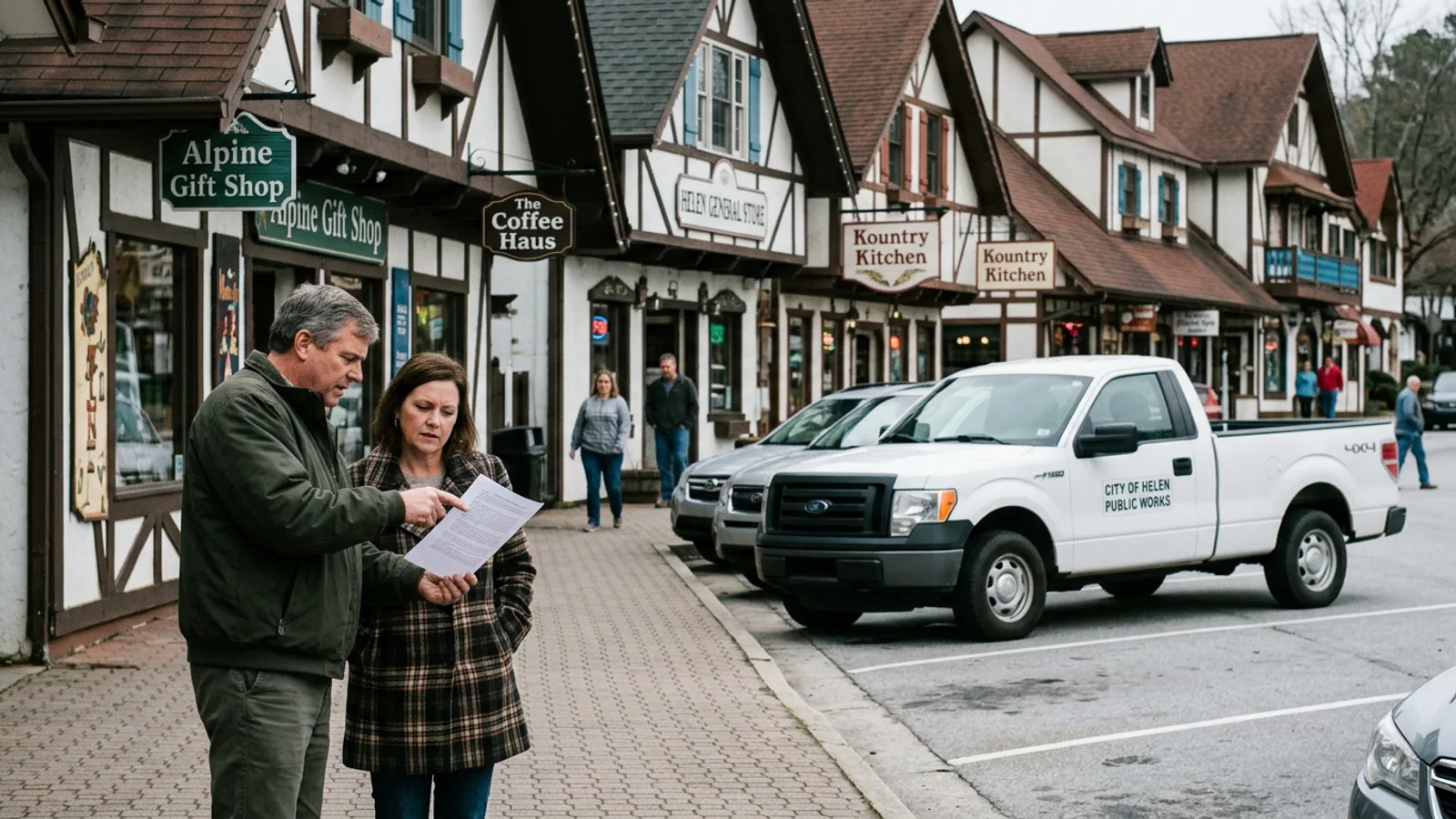
The Helen Downtown Aesthetic Consistency Subcommittee submitted a draft ordinance amendment to the Helen Planning Commission last Tuesday that would, if adopted, prohibit the use of the letter "K" in new commercial business names within the downtown Helen four-block core, unless the "K" is immediately followed by a qualifying German umlaut diacritic — specifically, "ü," "ö," or "ä" — as the next letter in the business name.
The amendment defines a non-compliant "K" as any uppercase or lowercase "K" in a registered business name that does not meet the diacritic-adjacency requirement. Existing businesses in violation of the standard would have 18 months from the amendment's effective date to either rebrand or apply for a variance.
There are, per a staff analysis included with the draft, 17 such businesses currently operating in the downtown core.
One of them is Kramer's Kitchen Krafts at 8904 N Main Street. It is owned by Dale Osgood. Dale Osgood is the brother-in-law of Subcommittee Chair Patricia Wendt.
The Amendment's Stated Rationale
The draft amendment's preamble describes its purpose as "the preservation and enhancement of the downtown Helen commercial district's Bavarian cultural-heritage aesthetic identity, specifically as expressed through the visual language of commercial signage."
The preamble notes that the German language employs the letter "K" extensively but that English-language adaptations of German-sounding business names frequently render phonetic "K" sounds through letter combinations — "KC," "CK," "KR," "KL" — that, in the Subcommittee's assessment, "create visual inconsistency between the intended Bavarian aesthetic of the business name and the graphic treatment of its signage."
The amendment's Section 2(b) states: "The standalone letter 'K,' absent a modifying umlaut diacritic in immediate adjacency, presents a visually ambiguous heritage signal that neither reads clearly as German nor reads clearly as English, producing an aesthetic dissonance inconsistent with the downtown Helen commercial district's established visual standards."
Subcommittee Chair Wendt, reached Thursday afternoon, elaborated on the rationale. She said the Subcommittee had spent approximately eight months studying the signage aesthetics of comparable Bavarian-themed American municipalities, including Leavenworth, Washington, and Frankenmuth, Michigan.
"Both of those communities have much stricter signage standards than we do," Chair Wendt said. "We are simply trying to close a gap."
Asked whether the amendment was specifically targeting the letter "K" because it appears in the name of her brother-in-law's business, she said it was not.
"The letter 'K' came up because it came up in the analysis," she said. "The analysis is in the draft."
The 17 Affected Businesses
The 17 businesses identified in the staff analysis as non-compliant under the proposed standard include three categories of K-usage.
The first category — businesses whose names begin with "K" — includes Kramer's Kitchen Krafts, the Kuckuck Souvenir Shop at 8812 N Main Street, and Kessler's Fine Chocolates on Edelweiss Strasse. These three businesses would each need to either rename, adopt a German diacritic rendering of their "K" usage (e.g., "Kückuck" or "Kessler's"), or seek a variance.
The second category — businesses whose names contain a mid-word "K" — includes 11 establishments, among them the Alpine Fudge Haus (whose registered trade name includes the word "Knödel" in its window signage), three souvenir shops, four clothing-and-accessories retailers, and two food-service operations.
The third category — businesses whose names end in "K" — includes three establishments: a woodworking gallery, a candle shop, and a Christmas-ornament retailer whose registered name ends in the word "Shack," spelled with a "K" in the proprietor's stylized script.
The 17 businesses were not individually notified of the draft amendment prior to its submission to the Planning Commission. The Bavarian Brainrot newsroom contacted seven of the 17 this week. Four said they had not heard of the amendment. Two said they had heard about it through the downtown merchant community. One, the manager of the Kuckuck Souvenir Shop, said she had read it.
"I'm not going to rename my store," she said.
The Kramer's Kitchen Krafts Question
Dale Osgood, owner of Kramer's Kitchen Krafts, confirmed to the Bavarian Brainrot newsroom on Wednesday that Patricia Wendt is his sister-in-law. He confirmed that Kramer's Kitchen Krafts would be a non-compliant business under the proposed amendment. He said he had been unaware that his business name would be affected until a neighbor mentioned the draft amendment to him two days ago.
"I have not spoken to Patricia about this," Mr. Osgood said. "I don't know what the Subcommittee was thinking."
He said he would be attending the Planning Commission meeting at which the amendment is scheduled for public hearing, a date that has not yet been set.
Chair Wendt, asked whether she had disclosed the family relationship to the rest of the Subcommittee during its deliberations, said she had. She said the Subcommittee had determined that the relationship did not present a conflict of interest because the amendment applied generally, not specifically to any individual business.
The Subcommittee has five members. Two could not be reached by deadline. The two who were reached — members Harold Garst and Donna Pfenig — declined to comment on the conflict-interest question. Neither disputed Chair Wendt's characterization of the Subcommittee's determination.
The Umlaut Question
The draft amendment includes, in Section 3, a grace provision permitting any existing non-compliant business to achieve compliance by modifying its business name to add a German umlaut diacritic in qualifying adjacency to any standalone "K."
The Section 3 provision specifies that the umlaut modification must be reflected in the business's White County business license registration, its City of Helen trade-name filing, and its exterior signage within the 18-month compliance window.
The amendment does not address the question of whether a business's existing customers, suppliers, or digital presences — websites, online directories, delivery platforms — would also need to reflect the modified name.
The City Attorney's office, per a footnote in the staff analysis, has been asked to provide a memorandum on whether the amendment's diacritic requirement implicates any First Amendment commercial-speech concerns under Georgia or federal law. The memorandum has not yet been submitted.
The Planning Commission's public hearing date has not been set. Chair Wendt said she anticipated the amendment would be on the April or May agenda.
Kramer's Kitchen Krafts is open Tuesday through Sunday, 10 a.m. to 6 p.m.
— Margaret Holcomb



Reader Comments
Leave a comment ↓