


The White County Tourism Authority's facilities committee received, at its February 18 regular meeting, a 31-page annual facility maintenance audit of the Helen Welcome Center that contained, on page 11, the following notation:
"Glockenspiel assembly (installed 1987; last major service 2021): Parts supply chain identified as single-source. All documented replacement parts orders since December 1989 have been fulfilled by a single vendor, Meindl Musikmechanik, Oberammergau, Bavaria (Federal Republic of Germany), operated by proprietor Otto Meindl (b. 1952). Vendor has fulfilled 14 parts requests totaling 23 individual components over the 37-year supply relationship. No secondary source has been identified. Succession risk: elevated."
The glockenspiel is, at this writing, operational.
What The Glockenspiel Is
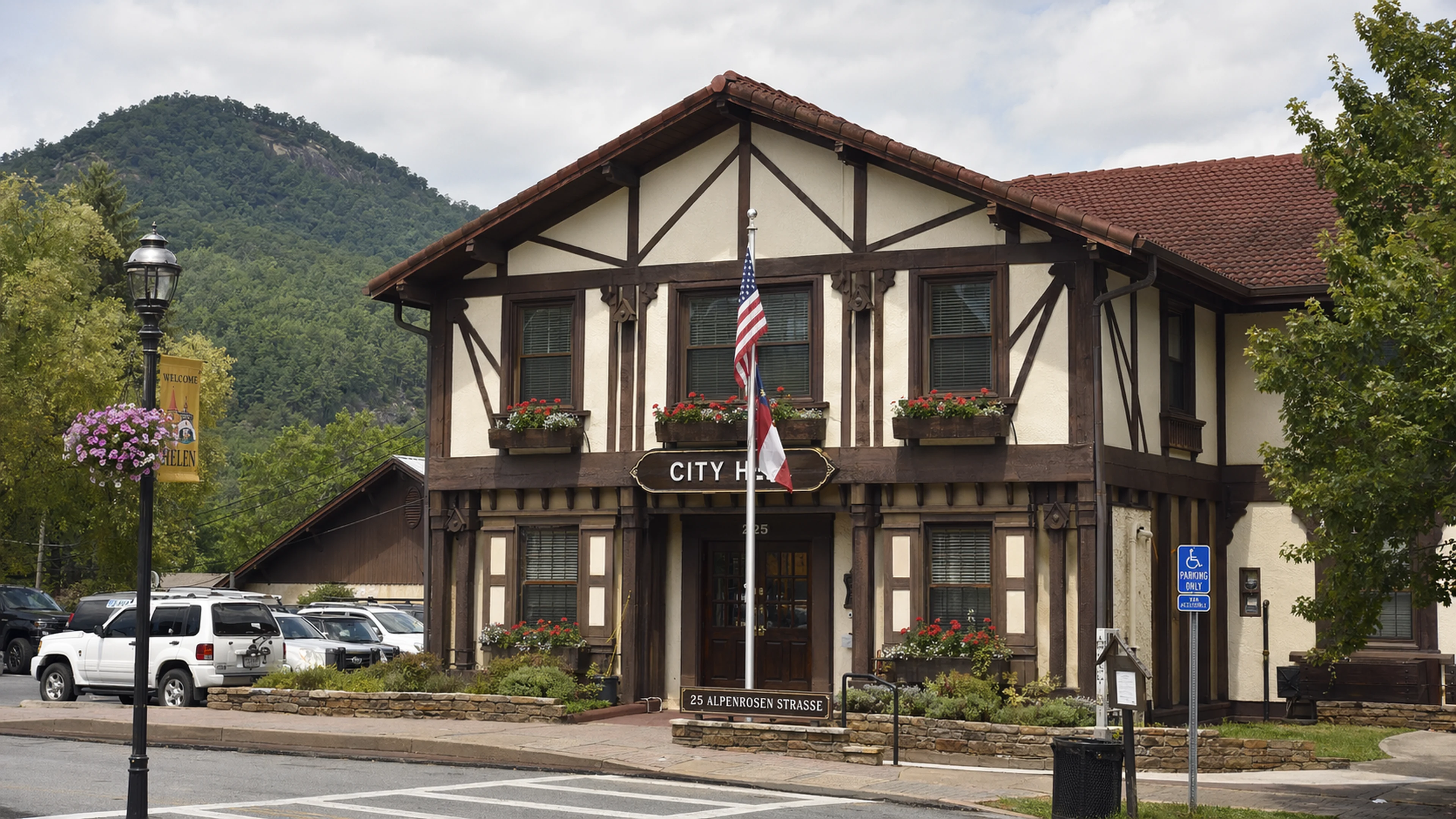
The Helen Welcome Center glockenspiel — a 14-foot decorative tower-clock mechanism installed in 1987 as part of the city's standing program of Bavarian-themed architectural and ornamental improvements — is one of five functioning glockenspiel mechanisms documented within the City of Helen's incorporated limits. It is the only one that is operated and maintained by a municipal entity. The other four are operated by private businesses and are, per the Tourism Authority's 2026 audit, outside the scope of the municipal maintenance schedule.
The Welcome Center glockenspiel plays, on the hour between 9:00 a.m. and 9:00 p.m., a rotating program of four compositions. The compositions — "Edelweiss," a passage from Johann Strauss II's "An der schönen blauen Donau," a mid-tempo arrangement of the traditional Bavarian folk piece "Bayerischer Defiliermarsch," and a melody that several Welcome Center staff members, in separate conversations with the Bavarian Brainrot newsroom, described only as "the other one" — are encoded on a brass program disc manufactured by Meindl Musikmechanik in 1991.
The mechanism has required 14 separate parts requests over its 37-year service history. The requests have involved, in aggregate, 23 individual components: nine striker-hammer mounts, four bell-pin assemblies, three timing-cam follower springs, two program-disc locating pins, two drive-shaft collar bushings, and three components the audit describes only as "miscellaneous precision fasteners, Meindl proprietary specification."
All 23 have been supplied by Herr Meindl.
What The Audit Found
The February audit — conducted by the Welcome Center's contracted facilities-management firm, whose name appears on the audit cover page as Gilstrap & Associates, Gainesville — characterizes the Meindl supply relationship in terms that, in the Bavarian Brainrot newsroom's reading, suggest both institutional gratitude and institutional concern.
The audit notes, on page 9, that Herr Meindl has, in each of the 14 requests since 1989, responded to the Welcome Center's written inquiry within 21 days and has shipped the requested components within 45 days. The audit notes, on page 10, that Herr Meindl's pricing, adjusted for the trailing-37-year producer price index for precision machined components, has been "consistent with market rates for specialty heritage-mechanism parts, though full market comparison is not possible given the absence of an identifiable secondary supplier."
On page 11 — the page containing the succession-risk notation — the audit observes that the Welcome Center's facilities staff attempted to identify an alternative parts source in 2019, during a routine supply-chain review. The 2019 review identified three potential alternative vendors: two in Germany and one in Austria. All three, per the 2019 review's findings, indicated they were not equipped to manufacture components to Meindl's specifications without access to the original mechanism's engineering drawings. The original engineering drawings are, per the audit, held by Meindl Musikmechanik.
The audit also notes that on three occasions — in 2012, in 2018, and in 2023 — Welcome Center staff or Tourism Authority representatives raised with Herr Meindl the question of succession planning for his enterprise. The audit characterizes his responses, on each of the three occasions, as follows: "Vendor declined to identify a successor or to discuss the subject further."
What Herr Meindl's Parts Look Like
The Bavarian Brainrot newsroom, in the course of reporting this story, requested access to the Welcome Center's physical parts log — a three-ring binder, maintained by the facilities staff, that documents each of the 14 parts requests and contains, in several cases, photographs of the received components alongside their Meindl Musikmechanik packing slips.
The log was made available by the Welcome Center's facilities coordinator, Darlene Hutchins, who has occupied the position since 2007.
The packing slips, which are printed on a cream-colored form with the Meindl Musikmechanik letterhead — a treble clef flanked by two stylized edelweiss — bear Herr Meindl's typed name, a PO box in Oberammergau, and, in the spaces provided for sender address and phone number, the same information that has appeared on every packing slip since the first order in 1989. The most recent packing slip, dated August 14, 2024, is for two striker-hammer mounts received in connection with a bell-strike misalignment reported during the 2024 summer operating season.
The components are, per Ms. Hutchins's description, small, precisely machined, and packaged in tissue paper inside a cardboard box slightly larger than a shoebox.
"He wraps them himself," Ms. Hutchins said. "You can tell."
What The Facilities Committee Did
The White County Tourism Authority's facilities committee received the February audit and, per the meeting minutes, referred the succession-risk notation on page 11 to the full Tourism Authority board for discussion at its next quarterly meeting, scheduled for April 8.
The committee did not, per the minutes, take any formal action on the glockenspiel supply chain at the February 18 meeting. The committee chair, per the minutes, noted that the mechanism was "presently functional" and that "no immediate parts requirement is currently anticipated." The committee's vice chair asked whether the city had considered digitizing the mechanism's engineering drawings. The facilities coordinator indicated that the drawings would need to come from Herr Meindl. The committee's vice chair did not pursue the question further.
The Tourism Authority board's April 8 quarterly meeting agenda, posted to the Authority's website Friday, does not list the glockenspiel supply chain as a stand-alone agenda item. It appears, per the agenda, as a sub-item under the board's standing facilities committee report.
The glockenspiel, per the Welcome Center's online operating schedule, will play its hourly program through at least the end of the 2026 tourist season.
Herr Meindl, reached by the Bavarian Brainrot newsroom via a written inquiry sent to the Oberammergau PO box, had not responded by press time.
— Margaret Holcomb


Reader Comments
Leave a comment ↓