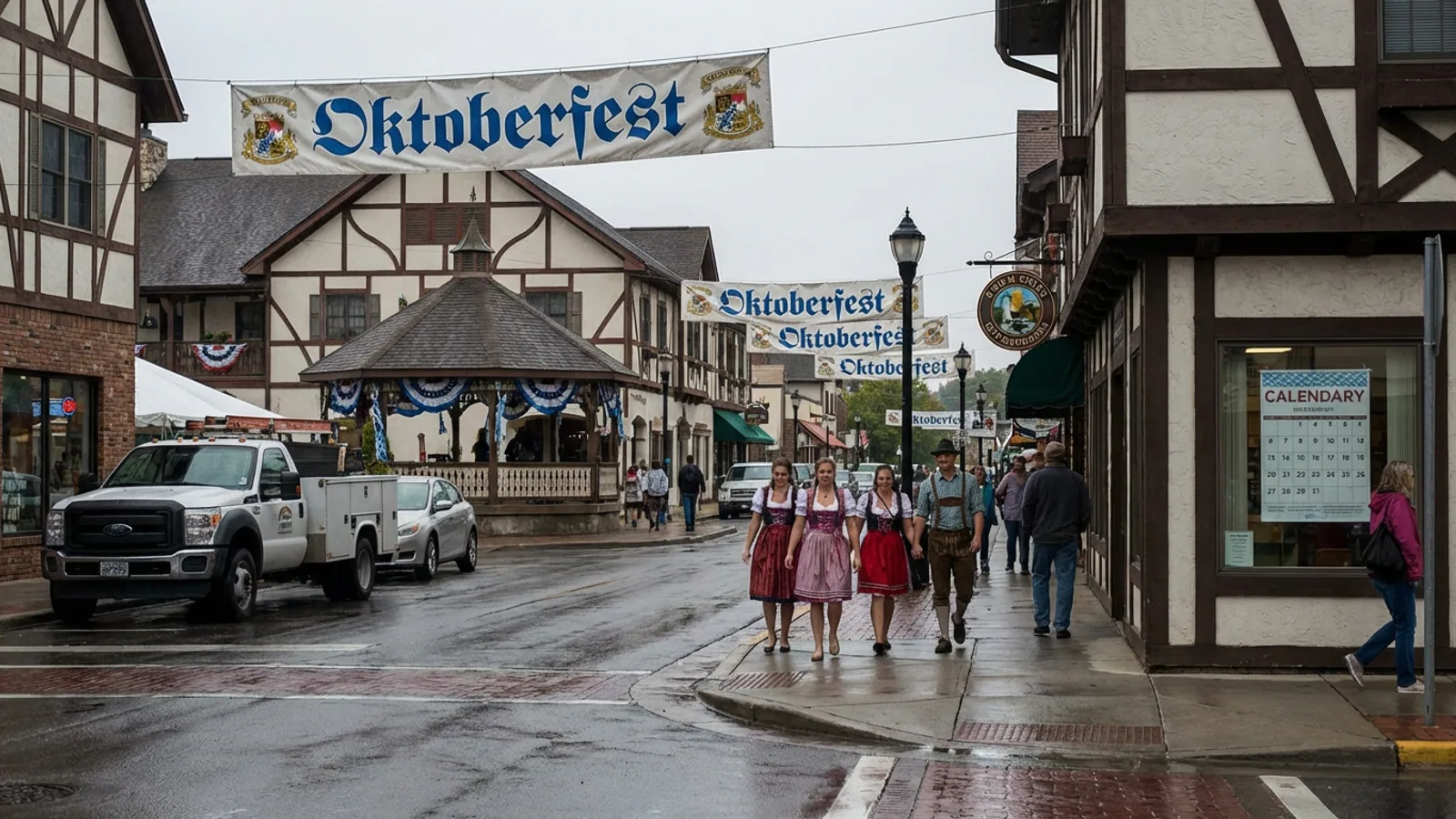
The 56th Annual Helen Oktoberfest will run for 53 consecutive days.
It will begin on Wednesday, September 10, 2026. It will end on Sunday, November 1.
This is a fact, confirmed by the Helen Chamber of Commerce's March 14 announcement, linked at the top of this article.
The Munich Oktoberfest, held annually in Theresienwiese since 1810, runs for 16 to 18 days, depending on whether the starting Saturday falls before or after German Unity Day. It has never, in 214 continuous years, run for 53 days.
This newsroom has spent the last eight weeks attempting to answer a question that, when we first raised it with the Chamber on March 14, the Chamber declined to answer. The question is: at 53 days, is it still a fest?
The question sounds glib. It is not glib. The word has legal and linguistic weight in the country from which the festival was imported. The weight is load-bearing. And the extension of the festival by a factor of three and a quarter appears to have been made without consulting the architecture that the word is supposed to carry.
What The Etymologists Say
Bavarian Brainrot consulted, in the preparation of this piece, three etymologists: Dr. Alina Messer of the Universität Passau (Bavarian dialectology), Dr. Klaus Vogt of the Deutsches Seminar at the Ruprecht-Karls-Universität Heidelberg (historical Germanic vocabulary), and Professor Emeritus David Hahn of the University of Texas at Austin (Germanic-English loanword drift).
All three, independently, returned the same answer: a fest, in the strict semantic sense preserved across modern High German, Old High German, and the West Germanic family more broadly, denotes a bounded festive event. The root, fest, is cognate with the English feast. The semantic boundary is central to the word. A fest that does not end is not, semantically, a fest. It is, as Dr. Messer put it in an email response Tuesday, "a condition."
Professor Hahn, reached by phone at his office in Austin, was willing to go further. "Fifty-three days is not a festival," he said. "Fifty-three days is a season. If you wanted to call what Helen is doing by an appropriate Germanic word, the appropriate word would be Zeit — time — rather than Fest. So: Oktoberzeit. Oktober-time. That is what they have constructed. They have not constructed an Oktober-fest."
Dr. Vogt, in a written response Wednesday, declined to offer an alternative German word. He wrote: "I decline to offer an alternative. The word the City of Helen is using is not the word I would use, and I would like to remain there."
What The Munich Tourism Official Says
Katharina Brenner, Senior Program Director at the München Tourismus office, responded to a Bavarian Brainrot inquiry within four hours of receiving it. She was extraordinarily gracious. She asked this reporter twice to confirm that the duration in question was, in fact, 53 days.
Bavarian Brainrot confirmed twice.
Ms. Brenner's full on-the-record statement, in English, follows:
"The Munich Oktoberfest is held on the Theresienwiese for the third and fourth weeks of the Bavarian meteorological autumn. It runs for 16 days, or 18 days in a year that includes October 3, the Day of German Unity. It has never run for longer than 18 days. It will never run for longer than 18 days. The notion that an Oktoberfest could run for 53 days is, to be polite, not a notion that we in Munich have previously considered. I am very interested in how it is going. Please write back after. I would like to hear whether the people are still dancing on day 44."
What The Zoning Clerk Said
Lurleen Carpenter, Senior Zoning Clerk for White County, has been in her position for 22 years. She was reached at the White County Annex on Brooks Avenue on Tuesday afternoon. She had a copy of the Chamber announcement already on her desk, highlighted in yellow.
"We had to issue the special-event permit as 'continuous festival use,'" Ms. Carpenter said. "The permit form has three boxes. One for under 72 hours. One for three to ten days. One for 'continuous festival use.' We checked the third box. It's the box we also use for the Christmas Market, which runs from the day after Thanksgiving through December 23. So the form has the category. I will say — and you can quote me on this — the form's category is not the same thing as whether the word 'festival' means what a festival is. Those are two different things. The form is a form. The word is a word. I can't speak to the word."
What The 1810 Charter Says
The Bavarian Brainrot newsroom obtained, through the Bavarian State Archives' online research portal, a scanned reproduction of the original handwritten charter for the first Munich Oktoberfest. It is dated October 12, 1810. It is signed by Crown Prince Ludwig of Bavaria.
The charter, translated from Early Modern German by Dr. Messer for this article, specifies the festival's duration. The relevant clause reads:
"The celebration is to continue for a period of five days, at the close of which the meadow shall be returned to its ordinary condition, and the citizens shall resume the business of ordinary life."
Five days.
The 1811 Oktoberfest, per the subsequent royal proclamation, was extended to seven days. The 1817 extension added two more days. The 20th-century extensions brought the festival to its current 16-to-18-day range. In every extension, the question of duration was formally submitted for review. The question was not taken lightly.
There is no record, in 214 years, of any Oktoberfest organizer proposing a 53-day duration.
What The Chamber Says
The Helen Chamber of Commerce, through Executive Director Bill Osgood, declined to make Mr. Osgood available for an on-the-record interview for this article. The Chamber's communications director, Mary Beth Teague, provided the following written statement:
"The 2026 extension is a direct response to significant and sustained feedback from member businesses indicating that the traditional three-week format does not adequately capture the visitor demand profile now obtaining in downtown Helen. The extension allows our member businesses to meet that demand. We are proud of the 2026 lineup. We look forward to welcoming visitors from around the region to the longest Oktoberfest in the United States."
Asked whether the Chamber had consulted any Bavarian cultural organization — the German-American Chamber of Commerce of the Southern United States, the Deutsches Generalkonsulat Atlanta, or any successor organization to Helen's original 1969 Bavarian theme consultants — before announcing the extension, Ms. Teague did not respond.
Dr. Brüning's Preferred Framing
Dr. Wilhelm Brüning, Bavarian Brainrot's Cultural Affairs Correspondent, has been writing about the Helen Oktoberfest for 31 consecutive years. He had been expecting the extension announcement since 2021. He had, at the time of the March 14 press release, already drafted his response.
"We are no longer operating within the category of Fest," Dr. Brüning wrote in a memorandum attached to this article as an internal source document. "We are operating within a category I will call, in the absence of any better word, Touristenandauer — a tourist-duration. It is a mode of civic economic activity in which the externally recognizable signifiers of a specific, bounded cultural celebration are maintained, extended, and gradually decoupled from the celebration itself. The glockenspiel plays. The lederhosen are worn. The pretzel is salted. These are present. The Fest is not."
He added, in a telephone follow-up Wednesday afternoon:
"The Fest is a concept. The concept is not continuous. The concept has a start, a middle, a climax, and an end. A 53-day duration does not have a climax. A 53-day duration is a condition."
What The Neighbors Do
For comparison, Bavarian Brainrot surveyed the two other American towns whose Oktoberfest events exceed two weeks. Leavenworth, Washington, runs a three-weekend festival across a total of 9 festival days spread over 21 calendar days. Frankenmuth, Michigan, runs a four-day core event supplemented by a "Bavarian Season" of ambient themed programming from late September through the weekend before Thanksgiving.
Neither Leavenworth nor Frankenmuth markets their extended programming as "Oktoberfest." Leavenworth, when asked, described its extended programming as "Oktoberfest Weekend plus." Frankenmuth described its extended programming as "the fall programming calendar."
Helen will, at 53 consecutive days under a single "Oktoberfest" banner, become the only American town to market a nearly two-month event as, per the Chamber's own language, "Oktoberfest."
The Reader's Question
This article was reported over eight weeks. In that time, the Chamber's banner has been rehung, the Festhalle's interior seating has been reconfigured to increase capacity, and the Alpine Gift Haus on Bruckenstrasse has already received its first container shipment of the new 2026 stein design.
The stein has a date range on it.
The date range says September 10 – November 1.
The stein does not use the word "fest."
The stein uses the word "season."
The word "season" appears, in what we understand to be the Alpine Gift Haus's internal proofing file, in embossed gold script, 8 millimeters tall, below the crossed-pretzel crest.
Bavarian Brainrot has not confirmed whether the Chamber of Commerce was consulted on the stein.
— Margaret Holcomb

Reader Comments
Leave a comment ↓