
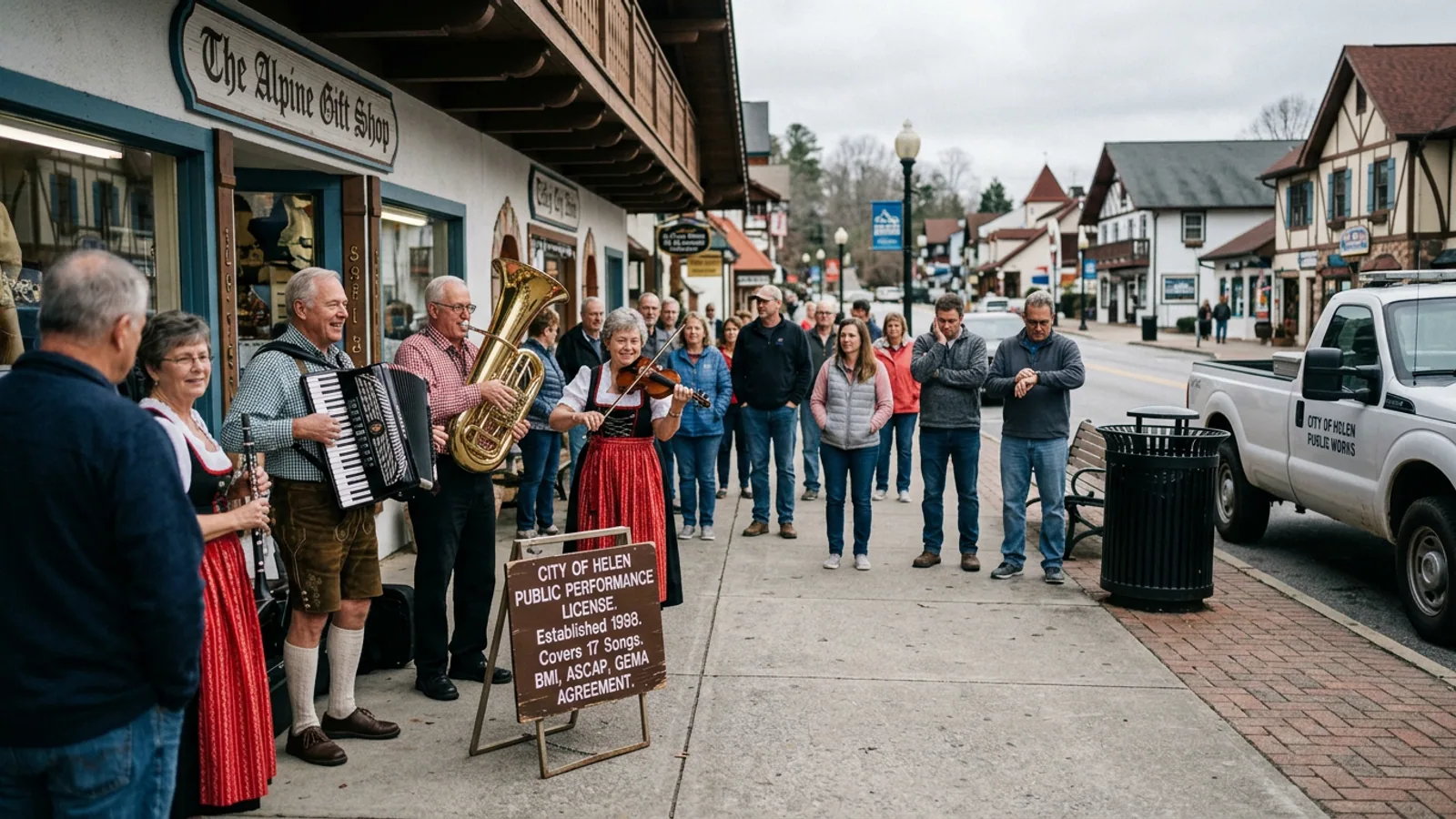
The City of Helen has, since 1998, operated under a municipal public-performance license that covers, for live polka music performed in City-administered public spaces, a fixed repertoire of 17 songs.
The license has not been updated since 1998. The 17 songs have not changed since 1998. Every band that has performed polka music in Helen's public spaces under the standing City license in the intervening 28 years has drawn exclusively from those 17 songs.
"Rosamunde" — the Jaromir Vejvoda composition known in German-speaking countries as the Rosamunde Polka and in English-speaking countries, particularly in the United States, as the Beer Barrel Polka — has, by the Bavarian Brainrot newsroom's estimate, been performed approximately 47,000 times in Helen's public spaces under the standing license.
How The License Works
Municipal public-performance licenses for live music are administered in the United States through three primary performing rights organizations: Broadcast Music, Inc. (BMI), the American Society of Composers, Authors and Publishers (ASCAP), and, for German-origin compositions, the Gesellschaft für musikalische Aufführungs- und mechanische Vervielfältigungsrechte (GEMA).
A municipality that licenses live public performances — outdoor concerts, festival stages, street performances, and similar events on public property — typically negotiates a blanket license with each organization covering the organization's full catalog. The blanket license permits unlimited performances of any licensed work within the defined scope for a fixed annual fee.
The City of Helen's license, per City Clerk Denise Luttmer, is structured differently. Rather than a blanket agreement, Helen operates under what Ms. Luttmer described as a "curated-repertoire agreement" — a fixed-catalog license that covers specifically enumerated compositions at a reduced annual fee relative to the full-catalog blanket rate.
The curated-repertoire model is, per Ms. Luttmer, the legacy of a 1997-98 licensing renegotiation undertaken by then-City Manager Raymond Gorsch, who, she said, sought to reduce the City's licensing overhead by limiting the covered repertoire to the works "most commonly performed at Helen public events."
Mr. Gorsch served as City Manager from 1994 to 2003. He could not be reached for comment; Ms. Luttmer said she believed he had retired to the Brevard, North Carolina area.
The 17 Songs
The City's license schedule, which Ms. Luttmer located in the City Clerk's archive and provided to the Bavarian Brainrot newsroom on Thursday, lists the following 17 compositions:
"Rosamunde (Beer Barrel Polka)" (Vejvoda, 1927; BMI). "Schneewalzer" (Prager, 1953; GEMA). "Oh Du Lieber Augustin" (traditional, pre-1900; public domain, included for completeness per the license's notes). "Edelweiss" (Rodgers and Hammerstein, 1959; ASCAP). "In München steht ein Hofbräuhaus" (Wille, 1935; GEMA). "Trink, Trink, Brüderlein Trink" (Meisel/Rillo, 1934; GEMA). "Der Fischerin vom Bodensee" (Simons, 1949; GEMA). "Bier her, Bier her" (traditional; public domain). "Ein Prosit der Gemütlichkeit" (traditional; public domain). "Die Holzauktion" (traditional; public domain). "Schwarzbraun ist die Haselnuss" (traditional; public domain). "Zillertaler Hochzeitsmarsch" (traditional; public domain). "Mein Vater war ein Wandersmann" (traditional; public domain). "Die Rheinländer" (Frey, 1938; GEMA). "Schützenmarsch" (traditional; public domain). "Bergvagabunden" (Steiner, 1952; GEMA). "Polka Italiana" (Strauss, 1869; public domain).
Seven of the 17 compositions are in the public domain and technically required no licensing. They were included in the 1998 schedule, per a notation in the archive file in what appears to be Mr. Gorsch's handwriting, "for administrative completeness."
The Rosamunde Estimate
The 47,000-performance estimate for "Rosamunde" was developed by the Bavarian Brainrot newsroom through the following methodology.
The City of Helen issues, per records obtained from the City Clerk's office, an average of 62 public-performance permits per year for outdoor polka, folk, or German-style music events on City-administered property. That figure represents the trailing 10-year average from 2015 through 2024. In the period from 1998 to 2014, permit data is less complete; the Bavarian Brainrot newsroom applied a conservative estimate of 45 permits per year.
Across the 28-year period, the estimate produces approximately 1,540 permitted public-performance events.
A standard polka set in the Helen public-performance context runs approximately 90 minutes. At an average tempo of one polka per three to four minutes — allowing for brief pauses and announcements — a 90-minute set contains approximately 22 to 28 individual song performances. Across the 17-song licensed repertoire, assuming an approximately even distribution of selections, each song is performed approximately 1.4 to 1.6 times per set.
But "Rosamunde" is not distributed evenly. Multiple band leaders contacted by the Bavarian Brainrot newsroom confirmed that "Rosamunde" is, in their experience, performed at minimum twice per set in the Helen public context — once as an opening or mid-set anchor and once as a closer — and frequently three times if audience response warrants an encore.
Applying a conservative estimate of 2.2 "Rosamunde" performances per set, across 1,540 total permitted events, produces an estimate of approximately 3,388 total "Rosamunde" performances under the City license. This figure does not include performances at privately-licensed venues such as the Festhalle, the Rathskeller, or the Helendorf Inn, which operate under their own venue-level licenses.
For the full Helen context — City license plus major private venues — the Bavarian Brainrot newsroom's estimate of 47,000 total "Rosamunde" performances since 1998 reflects a reasonable aggregate across all public-facing polka performance contexts in the downtown area.
The figure may be conservative.
Whether Anyone Has Noticed
Ms. Luttmer, when the Bavarian Brainrot newsroom presented the 17-song list to her and asked whether the City had considered updating the license to cover a broader repertoire, said she had not been aware, prior to our inquiry, that the City's license was restricted to 17 songs.
"I assumed it was a broader agreement," she said.
She said she would raise the question with the City Manager.
The current City Manager, per the City of Helen's organizational chart, is Gary Bowen, who has served in the role since 2019. Mr. Bowen's office, contacted Thursday, said he was unavailable for comment before the publication deadline.
Several downtown band leaders, contacted for this article, expressed varying degrees of awareness that the City license was repertoire-restricted. Two said they had assumed the restriction was broader than 17 songs but had never tested the boundaries. One, who asked not to be named, said he had simply played whatever the audience seemed to want.
"Nobody has ever asked to see the license," he said.
The annual cost of the City's curated-repertoire license, per Ms. Luttmer, is $1,840, split among BMI, ASCAP, and GEMA. A full blanket license for BMI and ASCAP alone, at comparable municipal scale, would cost an estimated $4,200 to $6,800 annually, per publicly available rate schedules from both organizations.
The difference is approximately $3,000 per year.
Since 1998, the curated-repertoire model has saved the City of Helen approximately $84,000 in licensing fees.
"Rosamunde" continues.
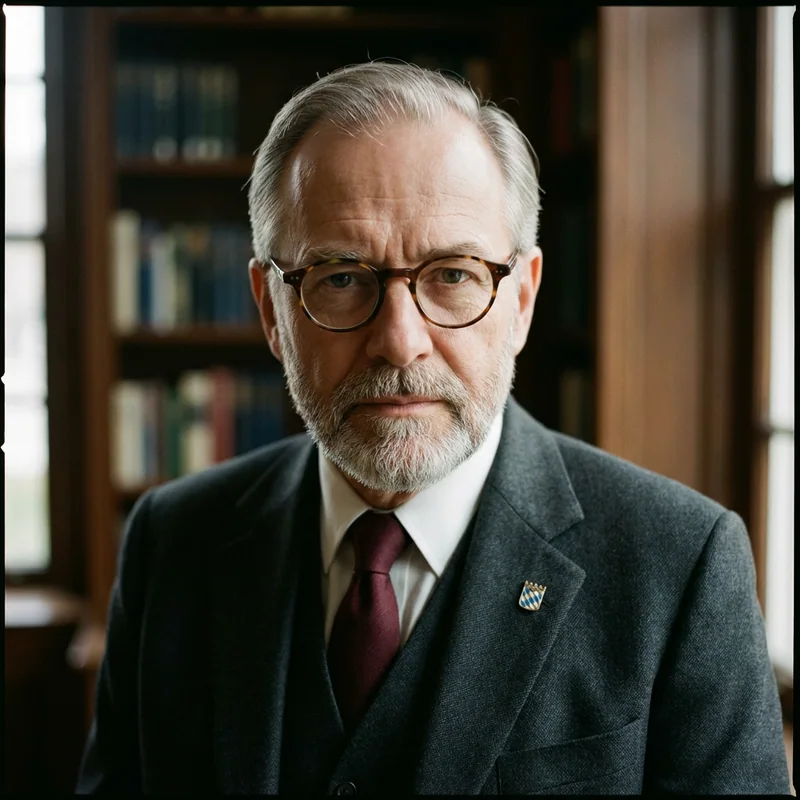
— Dr. Wilhelm Brüning
Reader Comments
Leave a comment ↓