
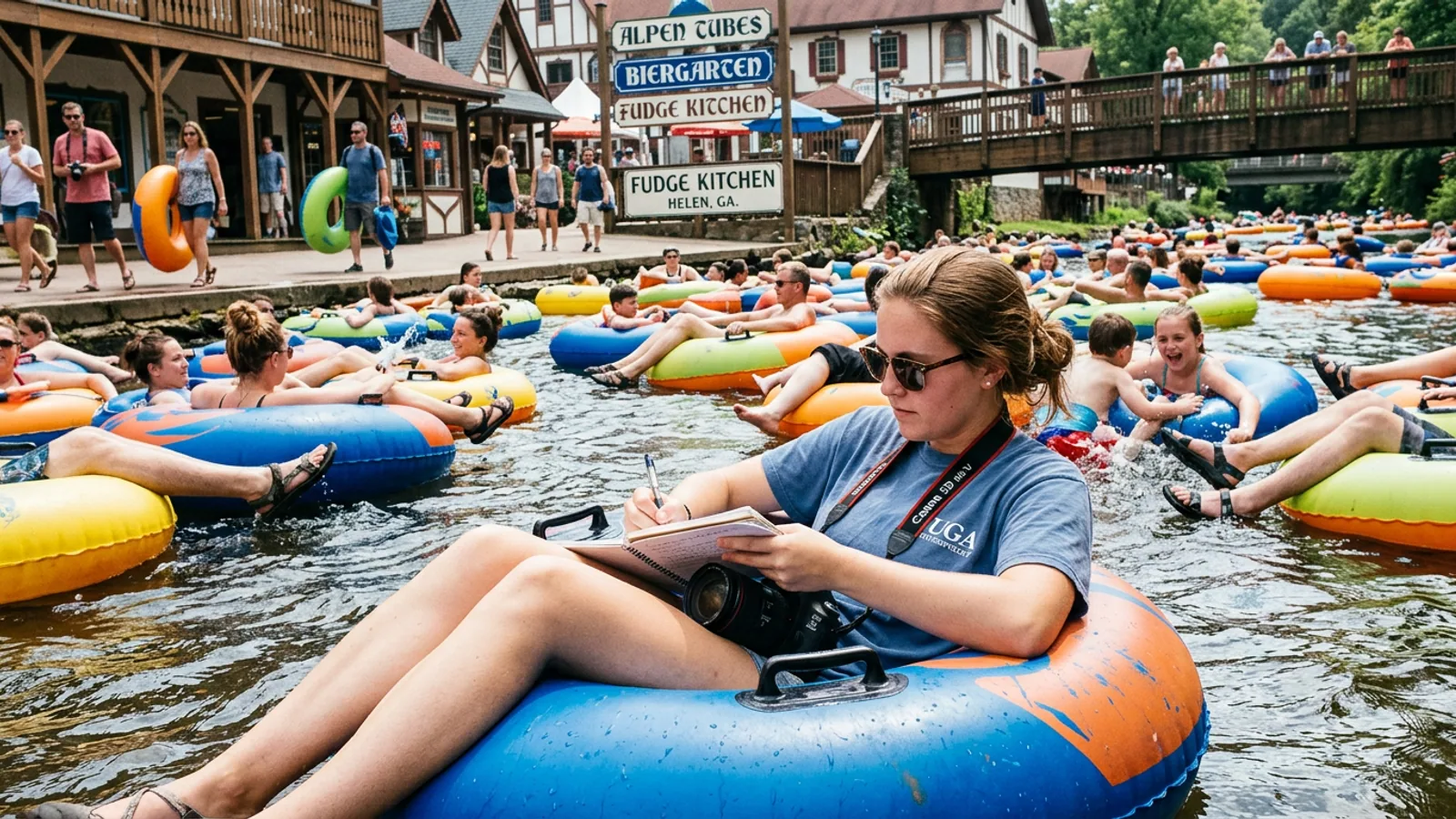
There is a moment, approximately forty-seven minutes into the first float, when the Chattahoochee River ceases to be a river in the conventional sense and becomes something more accurately described as a social medium. The traveler is reclined in a 48-inch single-rider tube, moving at somewhere between one and two miles per hour, unable to steer in any meaningful direction, and surrounded on all sides by other humans in an identical condition. The sun is present. The water is cold. The choice to be here was made last Tuesday, months before the concept of a weekend had any texture at all, from a desk in some other city, in some other register of the self.
What happens after that moment is the reason I spent 72 hours on the Chattahoochee.
I want to be clear about the methodology. I checked into the Helendorf River Inn on a Thursday evening in early February — not peak season, which was intentional; I wanted to observe the river's quieter social grammar before the May crowds arrived to override it — and I did not leave Helen, in any meaningful sense, until Sunday at noon. I purchased a two-day credit package at Cool River Tubing, a single-float credit at Helen Tubing & Waterpark, and I made five floats in total: two on Friday, two on Saturday, one on Sunday morning. I kept notes. I spoke with operators, with repeat visitors, with first-timers from Suwanee who had never previously been on a river. What follows is both itinerary and account.
Thursday Evening: Arrival and Reconnaissance
The Helendorf River Inn sits on a finger of land between Bruckenstrasse and the Chattahoochee, which means that from the room — a second-floor corner suite with a view of both the river and the parking lot behind the Bodensee — the traveler can hear the water at all times. At night in February, with no tubes on the river, the sound is simple and immediate. It is the sound of water moving over rounded stones at a volume that suggests neither urgency nor leisure but something more usefully described as continuity.
I had a late dinner at the Bodensee. The schnitzel was correct — which is to say, it was exactly the schnitzel one expects from a restaurant whose menu has, by design, not been revised in a direction that could be called surprising. This is not a criticism. The Bodensee's schnitzel operates, to borrow from Roland Barthes's analysis of the photograph as cultural signifier, as a punctum: the thing that fastens the rest of the image in place. Without it, the Bavarian-themed mountain-town experience lacks its anchor.
After dinner I walked the length of the operational tubing corridor — from the Cool River Tubing dispatch building to the take-out at the Chattahoochee River Tubing Center — in the dark, to understand the geography. The Edelweiss Strasse footbridge was the natural midpoint. I stood on it for twelve minutes. The river ran below me without comment.
I went back to the hotel and wrote four pages of notes about the footbridge.
Friday, 8:30 a.m.: The First Float (Cool River Tubing)
The Cool River Tubing dispatch process is worth documenting in full because it is, in the phenomenological sense, the entire setup for everything that follows. One arrives. One joins a queue that is, even in February, longer than expected. One presents a credit or a card. One selects a tube — single-rider or tandem — from a rack of tubes that are, to the eye, identical but feel, to the hand, subtly differentiated (some firmer, some softer, some carrying a faint residual lean from their previous occupant). One is given a route description that functions less as information than as ritual: the operator will tell you the float takes between 75 and 90 minutes, that you should keep your feet forward, that the take-out is on the left.
The traveler knows the take-out is on the left. The traveler has read about the take-out. But the recitation must happen, and the traveler must receive it, before the float can begin. This is, I want to argue, not inefficiency. It is liturgy.
The river at 8:45 on a February Friday is cold in a way that announces itself through the tube wall. The depth varies between 14 and 22 inches on this stretch; when the current catches a shallow bed and the tube drags, one can feel the river's bottom without reaching for it. The trees on both banks are bare. The light, coming from the east at a low February angle, produces a specific quality of illumination that I have not seen replicated anywhere else: silver, diffuse, unhurried.
There were, on this first float, four other people on the river. I observed them at intervals. Two were a couple from somewhere south of Atlanta (overheard conversation: they had been here "six or seven times," the exact number in gentle dispute). One was a man floating alone with the posture of a person who had done this specifically to not talk to anyone. One was a teenager in a hoodie who appeared to be treating the float as a personal time trial, paddling intermittently against the current to slow her progress, which is a thing a person does when they want the experience to last but cannot permit themselves to stop paddling.
I made the take-out at 10:11. I walked back to the dispatch building. I stood in the queue for a second float.
Friday, 11:15 a.m.: The Second Float, and the Discovery of the Group Dynamic
Peak-season tubing on the Chattahoochee operates, by all accounts, as a collective experience: groups of four, six, eight people tethered together by nylon clips, drinking from cans that the river periodically intercepts and redirects. But in February, the group dynamic is different. The clusters are smaller and more self-aware. One has chosen to be here off-season, and one knows that the other people on the river have also chosen to be here off-season, which creates a mild camaraderie among people who have not yet spoken.
I spent the second float documenting this camaraderie in real time. At the footbridge — which I had studied the previous night and which I now observed to be more architecturally interesting in daylight than in dark — a woman in a yellow tube caught my gaze and said, simply: "It's good, right?" I agreed that it was. We floated together for the next 220 yards without further exchange.
This is the core social grammar of the river. The tube is the common currency. The river is the shared condition. The float is both solitary and communal, depending on which way one turns one's head.
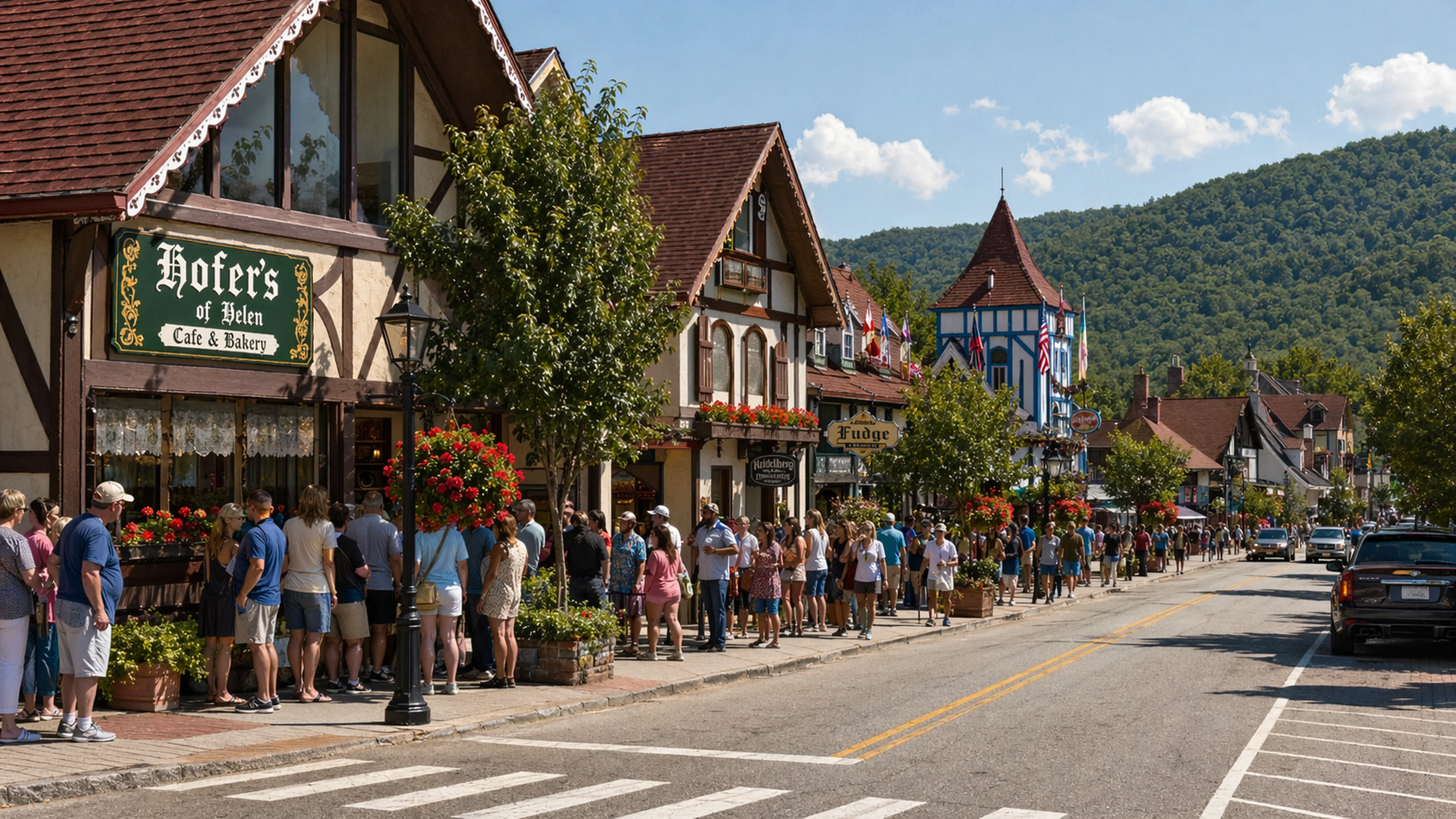
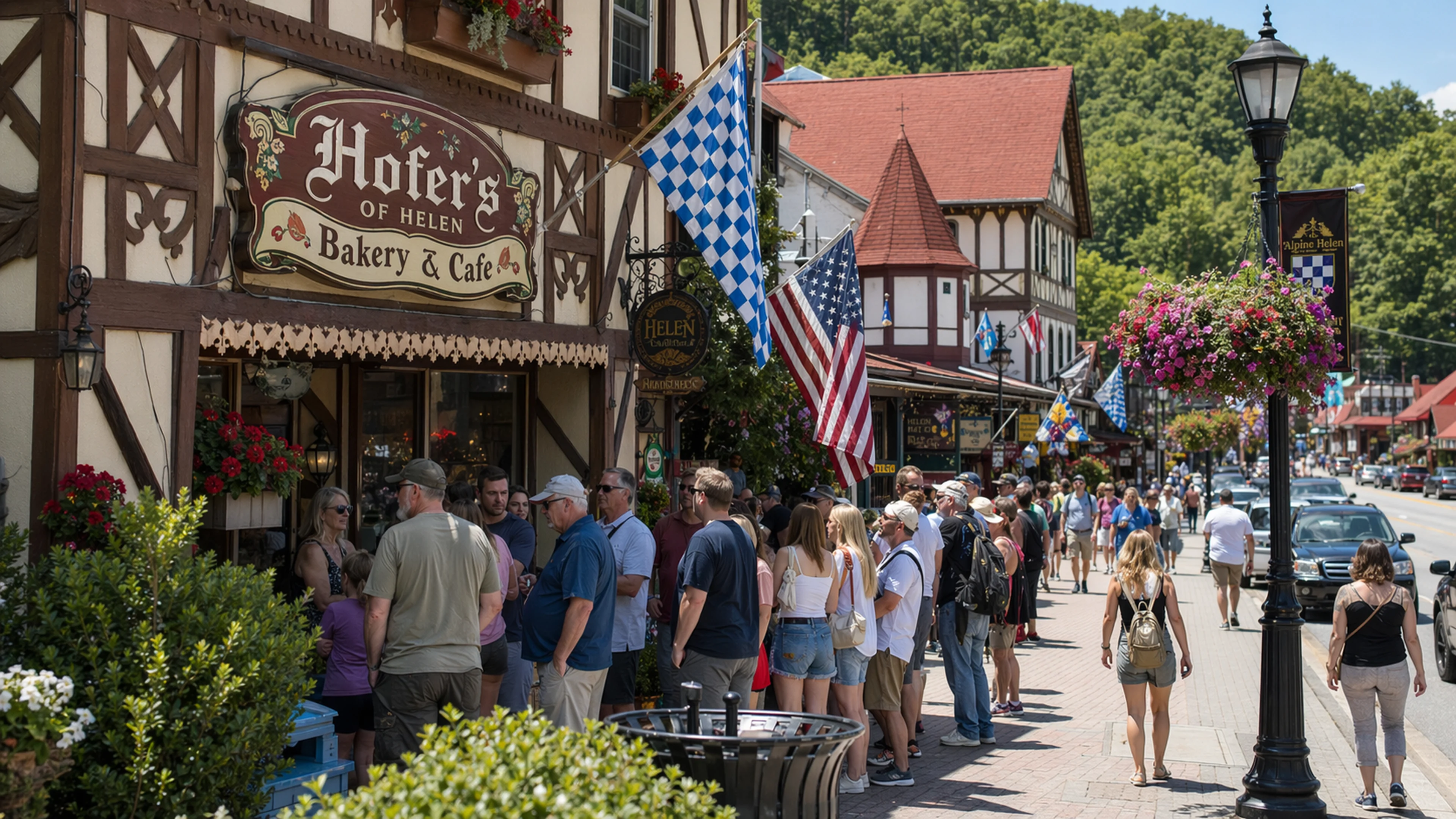
I had lunch at Hofer's Bakery at 12:45. The strudel was, as always, definitive.
Friday, 3:00 p.m.: Helen Tubing & Waterpark, and the Question of Institutional Register
My single-float credit at Helen Tubing & Waterpark was, in terms of the float itself, essentially identical to the Cool River experience: same river, same current, same interval of cold. What differed was the institutional register. Where Cool River operates with the quiet efficiency of a business that has spent decades calibrating its process to the point of near-invisibility, Helen Tubing & Waterpark announces itself more openly. The dispatch area is larger. The signage is more expressive. The staff — two young men of approximately college age on a Thursday afternoon in February — projected a cheerfulness that felt, not ungenerously, rehearsed.
None of this is a criticism. The two operations serve, I think, slightly different psychological needs, and the experienced Helen visitor ought to try both. Cool River is for the traveler who wants the float itself to be the entire experience. Helen Tubing & Waterpark is for the traveler who wants to feel, briefly, that tubing is a managed entertainment product, which it also is.
Both observations are true simultaneously. The river holds them without difficulty.
Saturday: The Long Day
Saturday was the study's density period. I made two floats, both on Cool River, at 9:00 a.m. and 1:30 p.m. Between them, I sat at a picnic table near the put-in and watched the operation for two hours and forty minutes, during which time I counted 63 tubes launched, observed four instances of the nylon-clip cluster forming in real time, and was offered a pretzel by a man named Bill from Gainesville, Georgia, who had been coming to Helen with his family every Memorial Day weekend for nineteen years and wanted me to know that the float "changes a little bit every year in a way you can't really put your finger on."
I asked Bill what had changed.
He thought about this for a moment. "The tubes are different," he said. "The old ones were harder. These ones you kind of... settle into more." He considered his pretzel. "Maybe that's it."
I believe it is not only that.
The Saturday morning float is, at any season, the qualitatively richest of the available float windows. The light is full but not yet flat. The river is at its Friday-overnight-recovery flow. The other floaters are awake enough to be social but not yet at the afternoon energy register that produces, in peak season, the loose choreography of the large cluster group. In February, on a Saturday morning, the river has something approaching a meditative quality — which is a term I use not loosely but in the specific sense of a deliberate attention to a thing that is not, by ordinary standards, deserving of such attention.
The river, in other words, rewards the act of paying attention to it.
The 1:30 float was the study's wildcard. A group of eight from Atlanta — a birthday party, to judge from the balloon attached to the birthday person's tube, which made steering unpredictable and attracted two crows for approximately 40 of the 85 float minutes — arrived at the dispatch window simultaneously with me and entered the river as a self-contained social system. I floated behind them at a consistent interval of approximately 30 yards for the first half of the float, observing their group coherence, before the balloon caught a branch near the footbridge and created a brief navigational situation that the group resolved with collective good humor and which, I thought, represented one of the most compressed examples of real-time community formation I had observed in recent months.
I am aware that this is a thing that other people would not find interesting about a birthday-party tubing group. I find it very interesting.
Saturday Evening: What The River Produces In Its Absence
By Saturday evening the traveler who has spent a day on the river will notice something that I have not seen described in any conventional service-journalism piece about Helen, possibly because it does not resolve into a recommendation: the Chattahoochee, once you have been on it enough times in a single day, persists in the body after you have left it.
This is not metaphorical. The specific vestibular adjustment produced by 90 minutes of slow-current drift — the mild inner-ear recalibration that the body makes in response to the tube's constant small movements — does not entirely resolve when one steps out of the water. One sits at dinner at the Bodensee and the room retains, faintly, the memory of the river's movement.
I had the sauerbraten on Saturday evening. I recommend it.
Sunday, 9:00 a.m.: The Final Float
The fifth and final float was made on a Sunday morning when the temperature was 41 degrees and the river was, to all appearances, entirely mine. There were, by my count, three other people on the Chattahoochee between the Cool River put-in and the take-out at the tubing center. The light was the same silver, diffuse, unhurried light as the first morning. The water was the same temperature. The footbridge was the same footbridge.
And yet it was different — which is, I suppose, the only conclusion a 72-hour study of this kind can honestly reach. The river changes not by changing but by changing the person who floats it. By the fifth float, the traveler's relationship to the current is not novice and not expert but something more usefully called habitual, which in Barthesian terms is the moment when the sign ceases to announce itself and begins to function. The tube is no longer an interesting object. The river is no longer a destination. One is simply on the river, in the way that one is sometimes simply in the room where one has lived for a long time.
This is, I want to argue, the 72-hour threshold effect. It requires 72 hours because it requires the sleep between the days — the overnight in the Helendorf, with the water audible through the window — to complete.
The Itinerary
For those who intend to replicate the study, the following logistics apply:
Lodging: The Helendorf River Inn is the only reasonable choice for a 72-hour tubing itinerary, because it is the only Helen lodging property from which the river is audible. Book a room with a river view. The corner suites on the second floor are the clearest.
Friday: Arrive Thursday evening for reconnaissance. First Cool River float at 8:45 a.m. (the queue is manageable before 9:00). Second Cool River float at 11:15 a.m. Helen Tubing & Waterpark single float at 3:00 p.m. Dinner at the Bodensee (schnitzel).
Saturday: Cool River at 9:00 a.m. Two hours of put-in observation between 10:30 a.m. and 12:30 p.m. Cool River at 1:30 p.m. Dinner at the Bodensee (sauerbraten).
Sunday: Cool River at 9:00 a.m. Depart by noon.
Total tubing expenditure: At current posted rates, a two-day Cool River credit package plus a single-float Helen Tubing credit amounts to $133.50 before gratuity for the dispatch staff, which the traveler should leave. The river is worth it. The river is, of all the things I have spent money on in the interest of understanding a place, among the most worthwhile.
The Chattahoochee is a small river by any objective measure. It is, by the measure of what it produces in the person who spends 72 hours on it, something considerably larger.
— Kaitlyn Reese-Brockman
Reader Comments
Leave a comment ↓